GEMA launches PLAI, a licensed AI training dataset, as Klangio signs on first
My stack My fav 6 tools for AI music after testing 70+
-
 ElevenMusic · Music generation
 -
 Moises · Stem separation
 -
 Controlla · Voice swap & cloning
 -
 Cryo Mix · Mixing + mastering
 -
 Neural Frames · Music videos
 -
 ONCE · Distribution
Some links are affiliate links — I earn a commission at no cost to you. Every tool here is one I run myself and truly believe in. This stack is proven.

GEMA has launched its first licensed dataset for training AI music tools. Called PLAI by GEMA, it sells cleared music to AI companies so they can train on licensed content instead of scraped catalogues. The German collecting society named Klangio, a transcription firm from Karlsruhe, as its first customer.
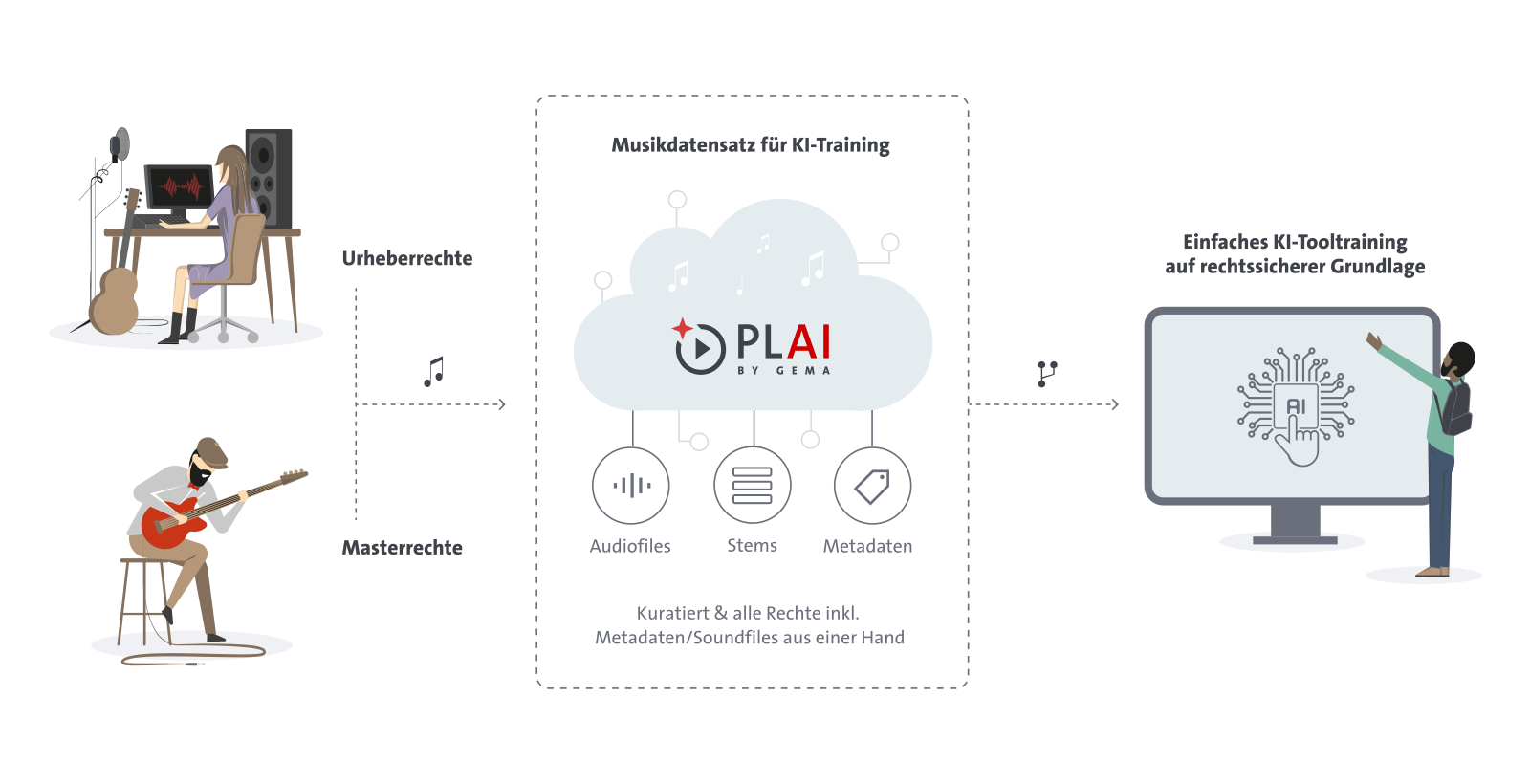
The pitch is one-stop rights. PLAI bundles the authors’ rights to the works, the master rights to the recordings, the sound files, and the metadata from a single source. For an AI developer, that means one license instead of chasing publishers and labels separately.
Five production-music partners supply the catalogue: Bailer Music Publishing, Earmotion Audio Creation, Intervox Production Music, Music Sculptor, and Sonoton Music. GEMA says the offering can grow as more publishers and collecting societies join, which is how it plans to scale the dataset for different customers and use cases.
What PLAI by GEMA gives AI developers
The dataset ships with heavy metadata, not audio alone. Each track carries genre, tempo, key, instruments, and chords, plus segment timestamps, ISWC and ISRC codes, structure data, and mood and context tags for sync use. Training packages can be tailored to a specific model and use case.
On payment, GEMA says every contributing rights holder is compensated proportionally. It frames PLAI as a fair, licensed alternative for AI providers who want to train on cleared content. What it has not published is the actual split: how a license fee gets divided among the publishers and authors, or how the value of any one track is measured.
Why some in the industry call it too small
Not everyone reads the launch as a breakthrough. Matthias Strobel Hohmann, president of MusicTech Germany, applauded the move in principle but questioned both the timing and the scale.
An AI model trained solely on stock and library music does not learn songwriting, emotions, or the stylistic diversity of popular music. 178,000 audio files is a joke.
His point is about scale. A generative model that writes full songs trains on millions of tracks with real vocals and arrangements, so a curated slice of production music will not teach it to write. He also called the revenue model a black box, since license fees appear to flow to a handful of publishers with no public formula for the split.
Klangio’s answer: PLAI is not built for song generators
Sebastian Murgul, co-founder and CEO of Klangio, answered the critique head on. His company is the first PLAI customer, and he agreed that 178,000 tracks would not move the needle for a song generator. That, he said, is the point.
There's a whole world of music AI beyond generation, transcription, analysis, education, MIR, where you simply don't need millions of tracks. Training on professional, fully licensed music is a real benefit for us.
Klangio’s tools turn audio into sheet music and MIDI. A model learning to read notes and chords needs clean, well-labeled, licensed music more than it needs raw scale, so a curated set of production music fits it. Murgul called PLAI a first step in the right direction.
The timing, one week before the Suno verdict
PLAI arrives one week before the Munich Regional Court rules in GEMA’s case against Suno on July 31, 2026. GEMA is suing over exactly this problem, AI trained on protected songs without a license. Launching a licensed product days before the verdict lets GEMA show the court a working alternative.
For independent artists, the launch matters less as a product and more as a marker. It is the first time a major collecting society has put a cleared, paid dataset in front of AI developers, following the licensing model GEMA proposed in 2024.
Frequently asked questions
Why did GEMA launch PLAI one week before the Suno verdict?
PLAI by GEMA launched in July 2026, about a week before the Munich Regional Court was set to rule in GEMA's copyright case against Suno on July 31, 2026. Launching a licensed training-data product days before the verdict lets GEMA show the court a working, paid alternative to scraping protected songs.
Why do critics say PLAI by GEMA is too small for generative AI?
Matthias Strobel Hohmann, president of MusicTech Germany, argued that a model trained only on stock and library music cannot learn songwriting, emotion, or the diversity of popular music. He noted that generative models need millions of tracks, so 178,000 production-music files suit a narrow tool but not a song generator.
Why does PLAI by GEMA fit Klangio's transcription tools?
Klangio builds tools that turn audio into sheet music and MIDI, which is a transcription task, not a generative one. A model learning to read notes, chords, and structure trains well on production music, so the dataset and Klangio's use case match.
Has GEMA disclosed how PLAI license fees are split?
No. GEMA says every contributing rights holder is compensated proportionally, but it has not published the formula. How a license fee is divided among the five publishers and their authors, or how the value of any single track is measured, is not public.
About the author

Covering AI music tools, industry shifts, and news for music creators and professionals. Twice-weekly newsletter at aimusicpreneur.com.