Spotify's spam filter may be hiding real user playlists from search, says the 11A founder tracking 50 of them

My stack My fav 6 tools for AI music after testing 70+
-
 ElevenMusic · Music generation
-
 Moises · Stem separation
-
 Controlla · Voice swap & cloning
-
 Cryo Mix · Mixing + mastering
-
 Neural Frames · Music videos
-
 ONCE · Distribution
Some links are affiliate links — I earn a commission at no cost to you. Every tool here is one I run myself and truly believe in. This stack is proven.
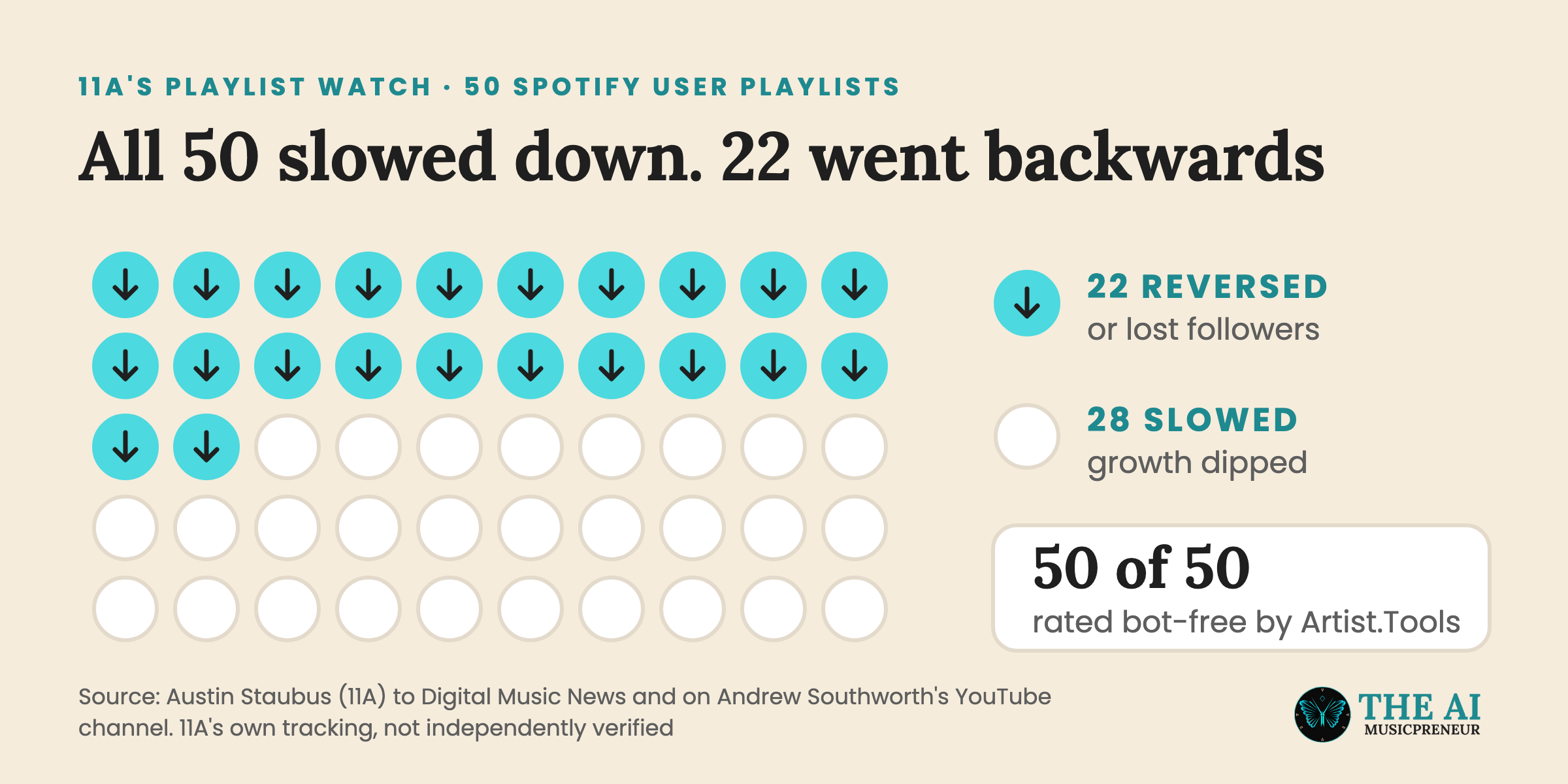
Follower growth slowed on all 50 Spotify user playlists that 11A tracks, and 22 of them went backwards or lost followers outright. That’s what 11A founder Austin Staubus told Digital Music News by email, in a story published November 3, 2026. He blames Spotify’s music spam filter.
The part that makes it odd: all 50 playlists were rated “Likely Bot-Free” by Artist.Tools, a service that checks playlists for fake streams. By that measure, these are real playlists with real listeners.
Staubus says the filter now judges whole playlists by the songs inside them, and pushes them down in Spotify search. Spotify hasn’t commented, and slower follower growth on its own doesn’t prove the filter is the cause.
What Austin Staubus says Spotify’s spam filter is doing to user playlists
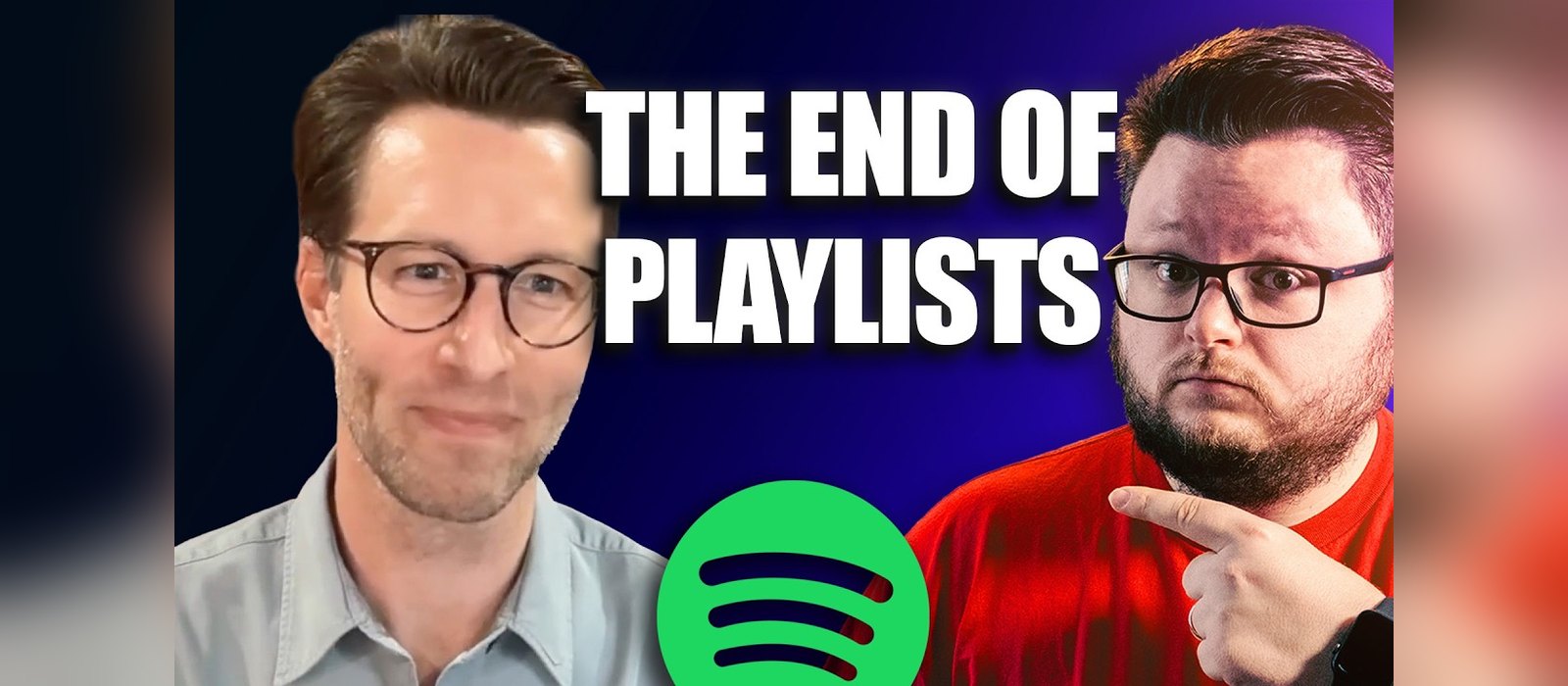
Staubus first laid out the case in a 56-minute interview on Andrew Southworth’s YouTube channel, published October 7, 2026. There he describes his company as an independent cover-song label, distributed by Warner Music’s ADA, that owns a number of large user playlists and grows them through Spotify search. He says the label has passed 500 million streams.
That’s why search rank matters so much to him. Citing a 2019 study from Spotify’s research team, he says 80% to 85% of people click the first search result, and most type 6 characters or fewer before they pick one.
Southworth’s video description says Spotify changed how playlists rank in search “since September 1st”, and that some labels lost 50% of their streams overnight.
The key line comes 37 minutes in. Staubus says he has seen “an unnamed executive that confirmed in writing that this spam filter system is making inferences on user playlists” and the songs inside them, and that the system then ranks or recommends those playlists more or less based on what it infers.
I haven’t seen that document, and Spotify hasn’t confirmed it. But Staubus is putting his own label behind the claim.
His bigger worry is what this does to the people who build playlists for a living. User playlists are one of the things that set Spotify apart from Apple Music and Amazon Music, he argues, because those two are “primarily just pitch only.”
Where's the opportunity there for the independent music space? Why would anyone try to build a user playlist?
To see why a playlist could get caught at all, you have to look at what Spotify said the filter was for.
What Spotify’s music spam filter was built to catch in 2025
Spotify announced the filter on September 25, 2025. It named the tactics: mass uploads, duplicates, SEO hacks, artificially short track abuse “and other forms of slop.” The system would “identify uploaders and tracks engaging in these tactics, tag them, and stop recommending them.”
Spotify also flagged the risk up front: “We want to be careful to ensure we’re not penalizing the wrong uploaders, so we’ll be rolling the system out conservatively over the coming months.”
A year later, on October 20, 2026, Spotify said it had taken more than 50 million tracks out of recommendations under that system. The 2025 announcement talks about uploaders and tracks. It doesn’t mention user playlists or search ranking once.
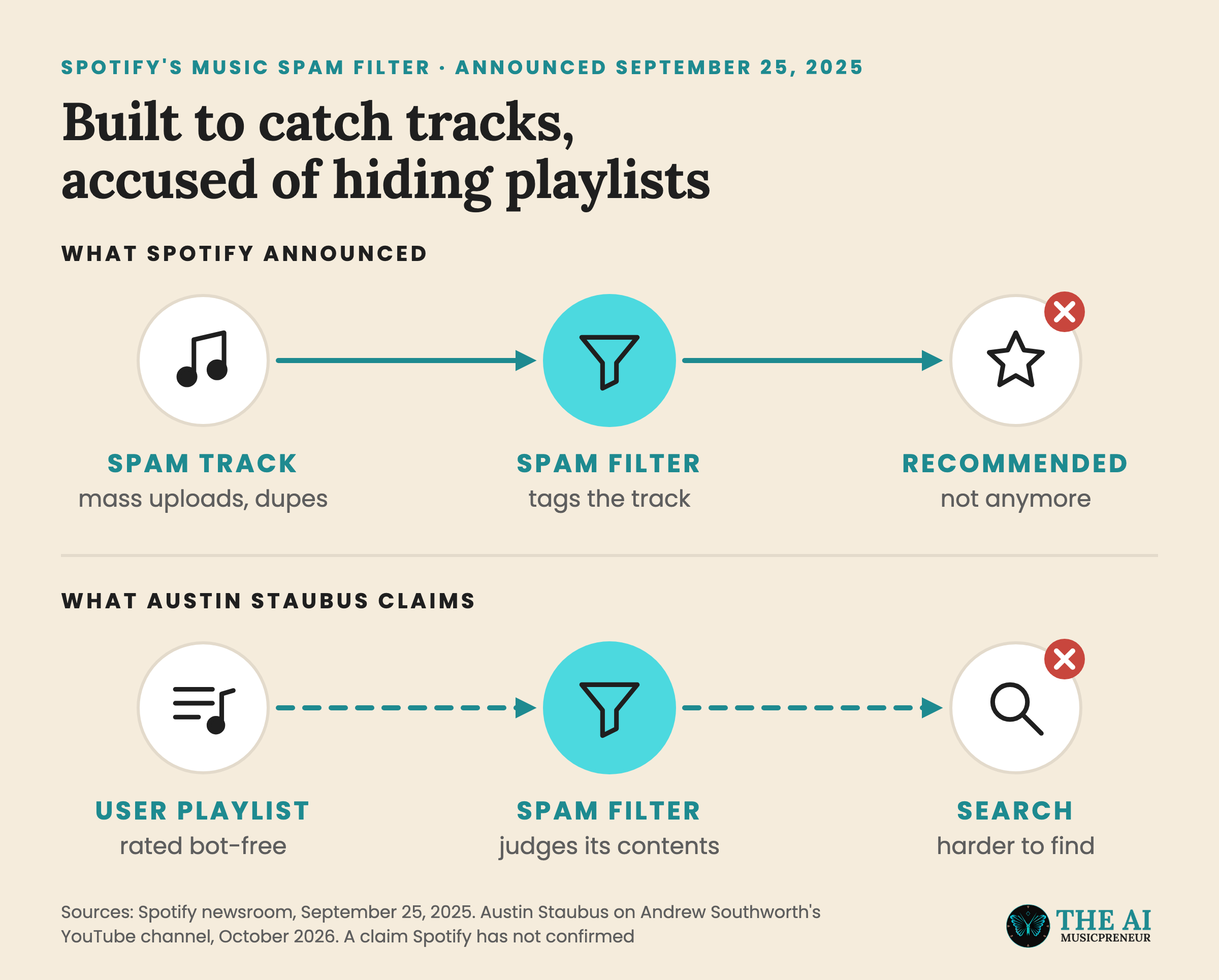
So the gap is one step. Spotify says the filter tags tracks. Staubus says it then reads a playlist’s contents and ranks the whole playlist on that. Digital Music News points out that the track-level filter and the playlist-level changes Staubus describes “are not necessarily borne from the same issue.”
Why 11A’s 50-playlist numbers don’t prove Spotify’s filter is the cause
Digital Music News says it plainly: slower follower growth and outright losses “do not necessarily prove” that Spotify is keeping legitimate playlists from being recommended. Playlists lose followers for plenty of reasons, and 11A’s 50 aren’t a random sample of Spotify.
It also matters whose playlists these are. 11A’s playlists are label-run and carry its own catalog, the same search-led model Staubus compares to functional music companies like Calmly and Strange Fruits.
That’s a legitimate business. It’s also the kind of search-optimised playlist a filter watching for “SEO hacks” is most likely to look at, which is one more reason the follower data can’t settle this on its own.
Staubus does bring a second test. In the interview, he says he ran paid ads to one of his sleep playlists, got about 1,300 link clicks in a day, and saw 128 new followers. Southworth said he’d normally expect 40% to 55% of conversions to follow a playlist.
That gap is what worries Staubus most. If followers aren’t being counted, he asks, are the streams on those playlists being counted, and are “royalties even being calculated correctly here”?
Nobody outside Spotify has the playlist-level data to answer that. Staubus says Luminate, which he subscribes to, only shows track and album data.
The interview also floats a theory about why. When the keyword “dinner time” was searched live on the call, Spotify’s own algorithmic mixes came up high in the results, and the two discussed how those mixes tie into Discovery Mode, where artists accept a 30% royalty cut for more exposure. That’s their theory, and Spotify hasn’t said anything to back it.
To be fair to him, Staubus isn’t pitching this as a war on Spotify. “I believe actually that Spotify perhaps saved the music business,” he says, and adds that “everyone supports cleaning up fraud and spam.” His point is that the system is “painting with too wide of a brush.”
He has hired the Nashville firm Adams and Reese, where music litigator Richard Busch works, to ask Spotify how the classification works and whether 11A’s songs and playlists were flagged, and to request a review of its accounts. Busch has sued Spotify before, on behalf of Eminem’s publisher Eight Mile Style.
Spotify public playlist not showing in search? What to check first
Spotify hasn’t published any playlist-level spam rules, so nobody can give you a fix. What you can do is rule out the boring causes and keep records. Here’s what I’d check:
- Search the playlist’s exact title from a second Spotify account, so your own listening history doesn’t push it up.
- Open the playlist menu and confirm it’s set to public and added to your profile.
- Read your title and description against Spotify’s own list. Keyword-stuffed titles are the closest thing on that list to “SEO hacks.”
- Check what’s inside. Duplicates and very short tracks are both on Spotify’s list, and Staubus’s whole claim is that the filter reads a playlist’s contents.
- Log your follower count daily and keep screenshots, the way Staubus did. A dated curve is what you’ll need if you ever raise it with Spotify or your distributor.
And if your release plan depends on one platform’s search box, that’s the risk this story is about. Spotify has been tightening its systems all year, from the AI Persona badge to the artificial streaming crackdown. The fans who sit on your own email list don’t move when Spotify changes a ranking, which is why owning that audience matters.
If Spotify answers Adams and Reese, or says anything public about what the filter does to playlists, I’ll update this piece.
Frequently asked questions
What tactics does Spotify's music spam filter target?
Spotify's September 25, 2025 announcement named mass uploads, duplicates, SEO hacks, artificially short track abuse and other forms of slop. The filter identifies the uploaders and tracks behind those tactics, tags them and stops recommending them. Spotify said it would roll the system out conservatively to avoid penalizing the wrong uploaders.
What does a 'Likely Bot-Free' rating from Artist.Tools mean for a Spotify playlist?
Artist.Tools is a playlist analytics and bot-detection service that rates Spotify playlists by the risk that they deliver artificial streams. A 'Likely Bot-Free' rating means its checks found no strong signs of botted listening. It's Artist.Tools' own assessment, not a Spotify label.
Has Spotify responded to Austin Staubus's claims about user playlists?
Not publicly, as of November 3, 2026. Staubus says he has hired Nashville law firm Adams and Reese, with music litigator Richard Busch, to ask Spotify how its spam classification works and whether his songs and playlists were flagged.
About the author
Covering AI music tools, industry shifts, and news for music creators and professionals. Twice-weekly newsletter at aimusicpreneur.com.