Spotify's fraud crackdown and its AI remix deal guard the same pot of money
My stack My fav 6 tools for AI music after testing 70+
-
 ElevenMusic · Music generation
 -
 Moises · Stem separation
 -
 Controlla · Voice swap & cloning
 -
 Cryo Mix · Mixing + mastering
 -
 Neural Frames · Music videos
 -
 ONCE · Distribution
Some links are affiliate links — I earn a commission at no cost to you. Every tool here is one I run myself and truly believe in. This stack is proven.
Spotify’s fight against artificial streaming gets framed as artist protection, and its UMG-backed AI remix feature gets framed as artist opportunity. I read both moves as the same move. On July 10, 2026, Hypebot’s Rich Kołodziej asked the question directly: is Spotify guarding against one type of AI market distortion while monetizing another?
It seems as though Spotify is guarding against one kind of AI market distortion while monetizing another.
The two stories he connects are worth restating. Spotify has spent years fighting fake listeners, and its fraud crackdown is genuinely aggressive. At the same time, Spotify and Universal Music Group announced a paid feature on May 21, 2026 letting Premium subscribers generate AI covers and remixes of licensed tracks. Co-CEO Alex Norström defended it as the “controlled” alternative to open-web slop.
Fake listeners and licensed AI covers pull from the same royalty pool
Follow the money in both stories and you land in the same place. Artificial streams drain the pro-rata pool Spotify pays artists from, so policing them protects the credibility of every payout and the margin underneath it. The remix feature adds paid consumption of machine-made derivatives, and Spotify captures the new Premium revenue. Both decisions defend Spotify’s economics. Neither came with a published artist number.
The crackdown also has blind spots exactly where independent artists live. This weekend’s Makeshift Hammer case showed a fake artist collecting 94% of a real band’s royalties with a sped-up copy of their album, undetected until a fan noticed. Deezer says it catches 60,000 fully AI tracks a day. The enforcement Spotify celebrates is calibrated to protect the pool, not the individual catalog inside it.
The number missing from both stories is the artist’s cut
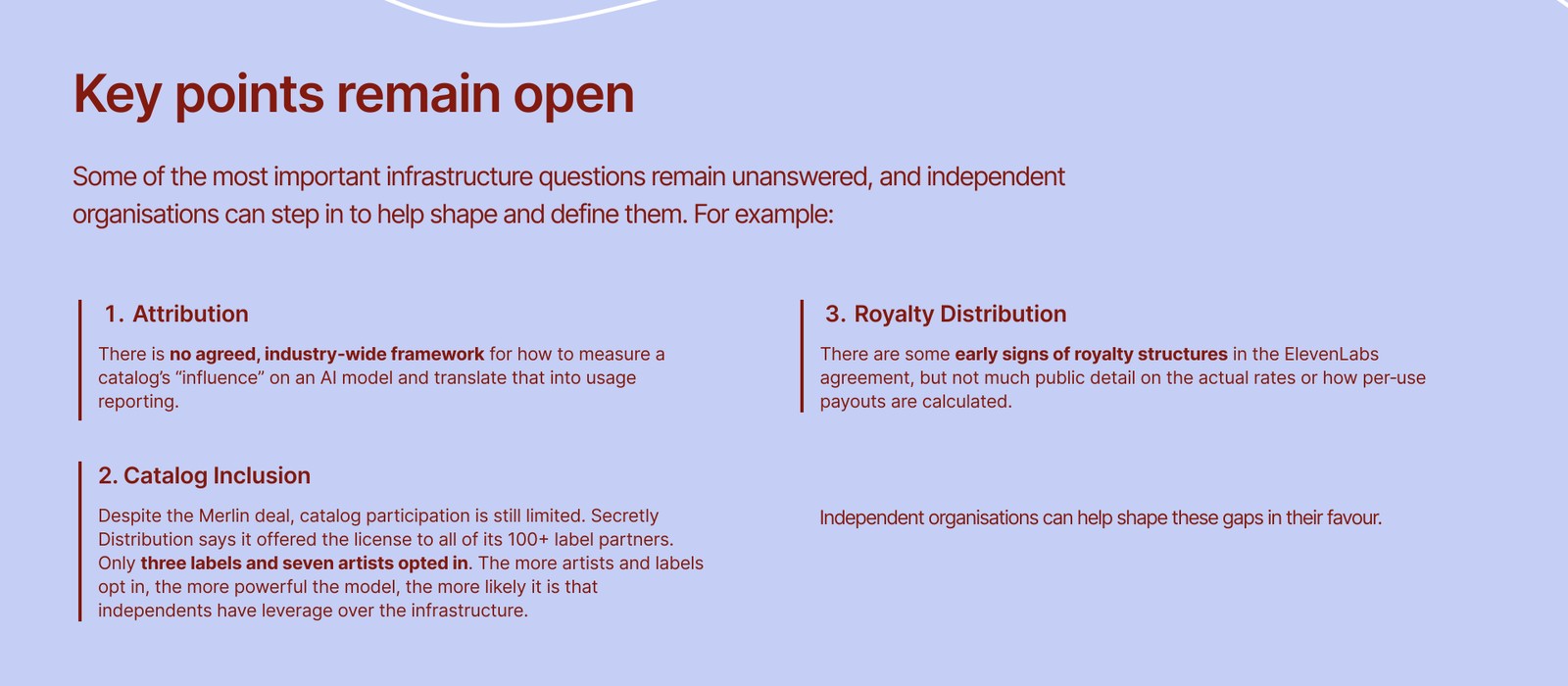
I keep applying the same test to the remix deal, and it still has no answer: does a participating artist earn meaningfully more from one remix request than from a thousand streams? No launch date, no price, no participating-artist roster, no per-generation payout. UMG has called it a superfan opportunity, and Wall Street moved 16% on the pitch. The songwriter’s share moved nowhere visible.
Kołodziej lands his sharpest line on the fan side of the same gap. “A superfan is not someone paying extra to have the artist removed from the artist’s own decisions,” he writes. A cover used to be a musician answering a song with their own choices. A prompt box produces a variation with nobody behind it, and the person being removed from the transaction is the one whose name sells it.
Where the licensed remix model still beats the alternative
The strongest case for Spotify’s product deserves stating plainly. Artists opt in, get credited, and get paid something, which beats the Carey Dupont model of theft by speed knob, and it beats scraped training data. I’ve held this position through every licensing story this year: a rights perimeter with consent inside it is the structure I want to win. Norström told the Irish Times the goal is one song becoming 10,000, legally.
The structure earns my support in principle. The deal in front of us hasn’t earned a verdict yet, because “controlled” stays a marketing word until the controls are public. Support for the model and a withheld verdict on this deal fit together fine.
What to watch when Spotify publishes the remix rates
The moment the per-generation payout is public, this stops being a framing debate. If a remix request pays an artist more than a thousand streams, I’ll call it a creator-economics win and say so loudly. If it pays less, the remix feature is margin expansion wearing a licensing wrapper, and the fraud crackdown next to it reads as pool defense rather than artist defense.
Watch one more disclosure: whether Spotify starts reporting clone takedowns and recovered royalties with the same energy it reports removed fake streams. Protection you can’t audit is a press release. My line in the sand is the rate card, and I expect we see it before the feature ships.
About the author

Covering AI music tools, industry shifts, and news for music creators and professionals. Twice-weekly newsletter at aimusicpreneur.com.