
Tencent Music says AI music streams are negligible and declining, even as AI floods the uploads

My stack My fav 6 tools for AI music after testing 70+
-
 ElevenMusic · Music generation
-
 Moises · Stem separation
-
 Controlla · Voice swap & cloning
-
 Cryo Mix · Mixing + mastering
-
 Neural Frames · Music videos
-
 ONCE · Distribution
Some links are affiliate links — I earn a commission at no cost to you. Every tool here is one I run myself and truly believe in. This stack is proven.
Tencent Music Entertainment, the company behind QQ Music, Kugou Music, Kuwo Music, WeSing and Ximalaya, told investors on November 17, 2026 that almost nobody on its apps is listening to AI music. Executive Chairman Cussion Pang said on the Q3 2026 earnings call that AI content stream volume “remains negligible with a declining share of listening.”
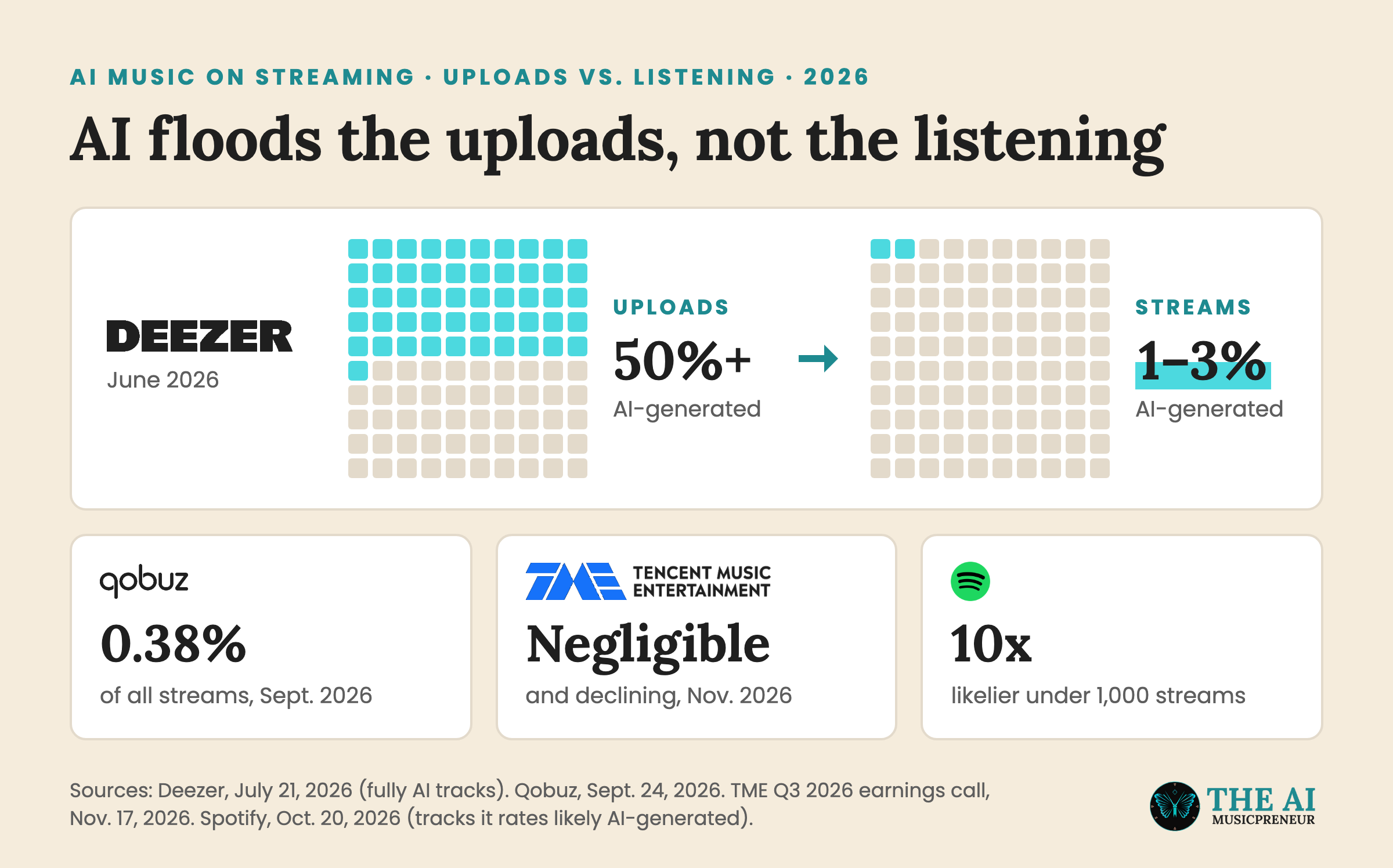
That lands in the same year AI tracks passed half of all new uploads at Deezer, where they still make up only 1% to 3% of streams. So the flood is real on the upload side, and on China’s biggest music platform it isn’t turning into listening.
Digital Music News first picked up the comment. I read the call transcript to see exactly what Pang said, and what he left out.
What Tencent Music said about AI music on its Q3 2026 earnings call
Pang made the point twice. In his prepared remarks, he tied it to listeners getting pickier:
While technology advancement makes content supply more abundant, users are becoming more selective about what they choose to engage with. As a result, AI content stream volume remains negligible with a declining share of listening, while high-quality differentiated content continues to gain traction.
Then a Bank of America analyst asked about 2027, and Pang named copyright protection as the first priority. Speaking through the call’s interpreter, he said “the proliferation of low-quality and unauthorized AI-generated content still weigh on subscription monetization.”
Tencent Music’s answer is “legal action and proactive content management, with encouraging early results,” done together with “the leading global rights holders.” His summary of where that leaves AI on the apps: “Streams from AI-generated songs remain very low and with a declining trend.”
Two things are missing, though. Tencent Music gave no percentage, so “negligible” is its word, not a number you can check. And the Q3 results release doesn’t mention AI listening at all. The comments only exist on the call.
Tencent Music isn’t against AI, either. Since September, Tencent Music has been running MusicBuddy as a closed beta, an AI agent that takes a song from first idea to release. The question is whether its rivals see the same thing on the listening side.
Do people actually listen to AI music? What Deezer, Qobuz and Spotify report
They do, a little. Every platform that has published numbers shows the same gap between what gets uploaded and what gets played:
- Deezer said on July 21, 2026 that fully AI-generated tracks passed 50% of its daily uploads in June, close to 90,000 a day, yet account for only 1% to 3% of streams. Up to 85% of those streams were fraudulent in 2025.
- Qobuz said on September 24 that tracks it identifies as AI-generated make up 0.38% of all its streams, about 1 in every 263, and 60% of those streams are flagged as fraud.
- Spotify said on October 20 that it has taken more than 50 million slop and spam tracks out of its recommendations this year. Tracks it rates as likely AI-generated are 10 times more likely to fall below its 1,000-stream royalty threshold.
One caveat matters here. These platforms push AI tracks down on purpose. Deezer’s AI music detector keeps fully AI tracks out of algorithmic and editorial recommendations, and Tencent Music credits its own content management for its low numbers.
So part of the gap comes from platform policy. The 1% to 3% shows what people play when no algorithm hands AI music to them.
Why Tencent Music says low AI listening still hurts its subscription business
Pang himself said the AI flood still costs Tencent Music money. Copyright protection was the first thing he named for 2027, and the reason he gave was the drag low-quality and unauthorized AI content puts on subscription monetization.
Most of that money leaks out through fraud. A bot farm doesn’t need a real listener to stream an AI track 10,000 times, and on pro-rata services like Deezer and Spotify every fake stream comes out of the same royalty pool your real plays get paid from. That’s why Deezer now deletes AI tracks used for fake streams, plus AI tracks nobody has played in 6 months.
If you release songs made with Suno or Udio, this changes how your tracks get found. On Deezer, a fully AI track never reaches recommendations, whatever its quality, so it gets heard when you send people to it. On Spotify, the 1,000-stream line is where payouts start, and an audience you built yourself is what gets a track over it.
The next test is whether Tencent Music puts an actual number on “negligible” at its next earnings call.
Frequently asked questions
Which apps does Tencent Music Entertainment run?
Tencent Music Entertainment runs QQ Music, Kugou Music, Kuwo Music, WeSing and the audio platform Ximalaya. The company is listed in New York under TME and in Hong Kong under 1698.
Did Tencent Music Entertainment give a percentage for AI music streams in Q3 2026?
No. On its November 17, 2026 earnings call, Tencent Music Entertainment described AI streams as negligible and declining but published no share or stream count, and its Q3 2026 results release does not mention AI listening.
How is Tencent Music Entertainment fighting unauthorized AI-generated music?
Executive Chairman Cussion Pang said Tencent Music Entertainment is working with leading global rights holders on legal action against infringement, plus what he called proactive content management. He said both have shown encouraging early results.
Does Tencent Music Entertainment make its own AI music tools?
Yes. Tencent Music Entertainment has run MusicBuddy, an AI agent that takes a song from first idea to release and promotion, as a closed beta since September 2026. It hasn't published pricing or named the models behind it.
About the author
Covering AI music tools, industry shifts, and news for music creators and professionals. Twice-weekly newsletter at aimusicpreneur.com.