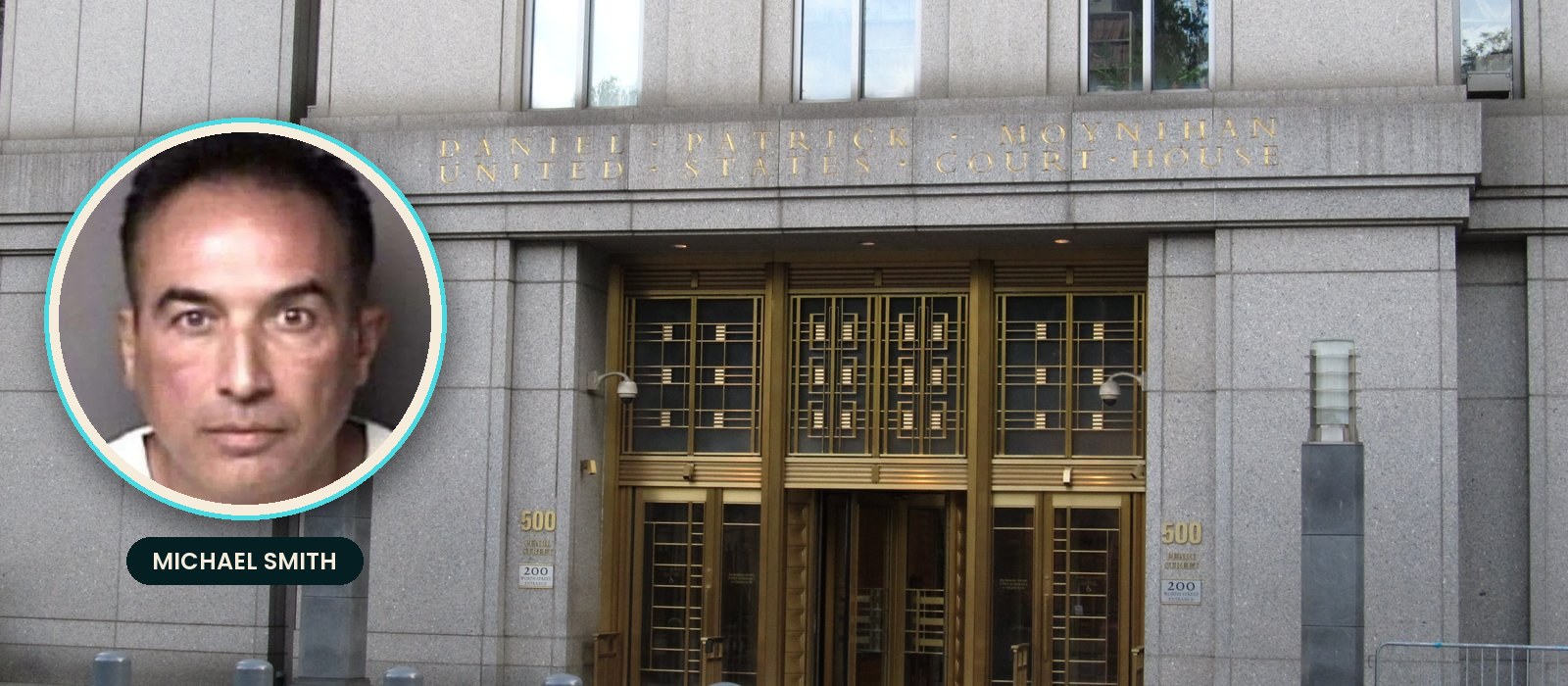
Prosecutors want Michael Smith in prison for at least 46 months over his $8M AI streaming fraud
My stack My fav 6 tools for AI music after testing 70+
-
 ElevenMusic · Music generation
 -
 Moises · Stem separation
 -
 Controlla · Voice swap & cloning
 -
 Cryo Mix · Mixing + mastering
 -
 Neural Frames · Music videos
 -
 ONCE · Distribution
Some links are affiliate links — I earn a commission at no cost to you. Every tool here is one I run myself and truly believe in. This stack is proven.
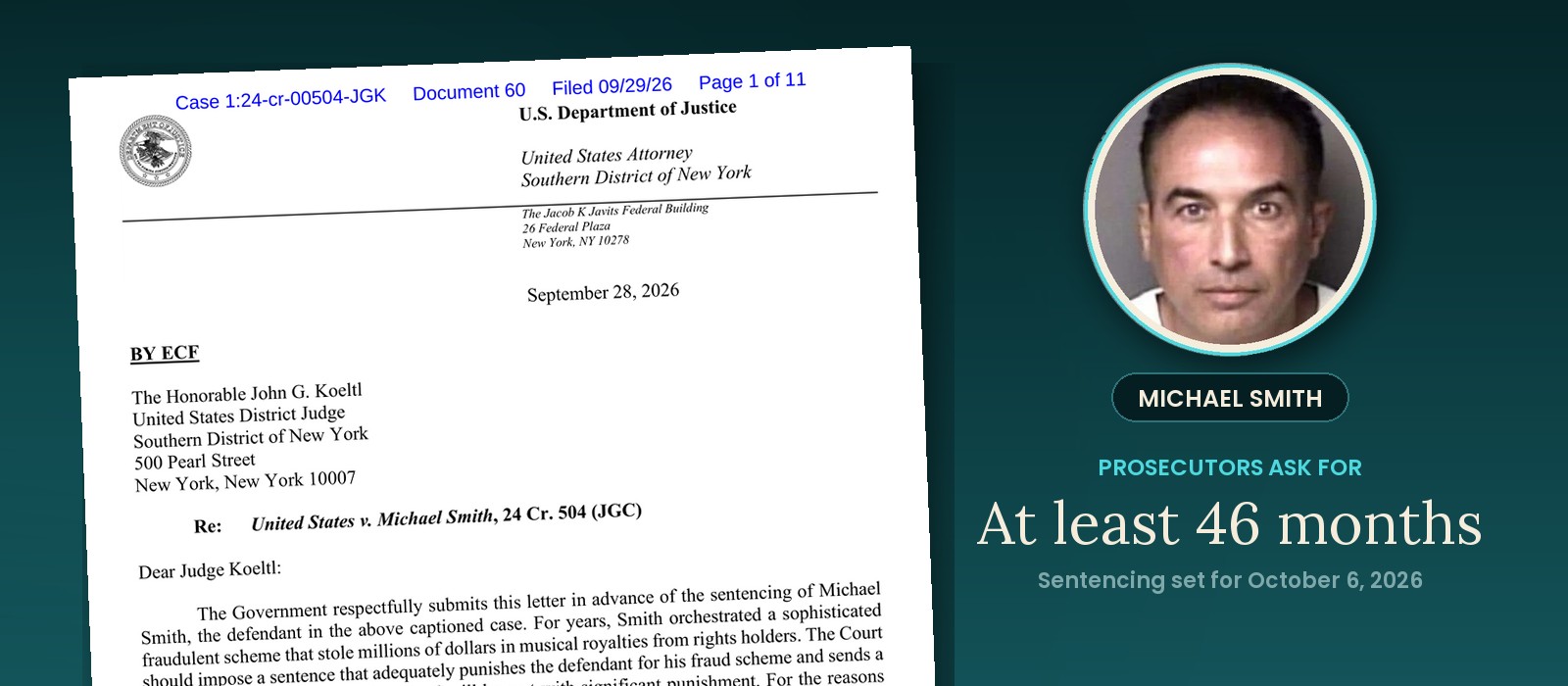
Federal prosecutors want Michael Smith in prison for at least 46 months. That’s almost 4 years for the man who used AI-generated songs and bot accounts to take more than $8 million in streaming royalties.
The US Attorney’s Office for the Southern District of New York made the ask in an 11-page letter to US District Judge John G. Koeltl, dated September 28, 2026 and filed on September 29. Rolling Stone obtained the letter that day, and Music Business Worldwide published it in full on September 30.
Prosecutors also want Smith to forfeit $8,091,843.64, the loss both sides agreed on. And the letter compares his streams with Taylor Swift’s: in April 2023, Smith’s catalog drew 80.9 million YouTube Music family-plan streams, while Swift’s entire catalog drew 9.3 million.
This is the government’s answer to Smith’s request for probation, which I covered on September 25. Judge Koeltl sentences him on Tuesday, October 6.
What sentence are prosecutors asking for in the Michael Smith AI streaming fraud case?
The letter asks for “a substantial term of imprisonment of at least 46 months.” That number is the bottom of the federal guidelines range for Smith’s case, which both sides agree runs from 46 to 57 months.
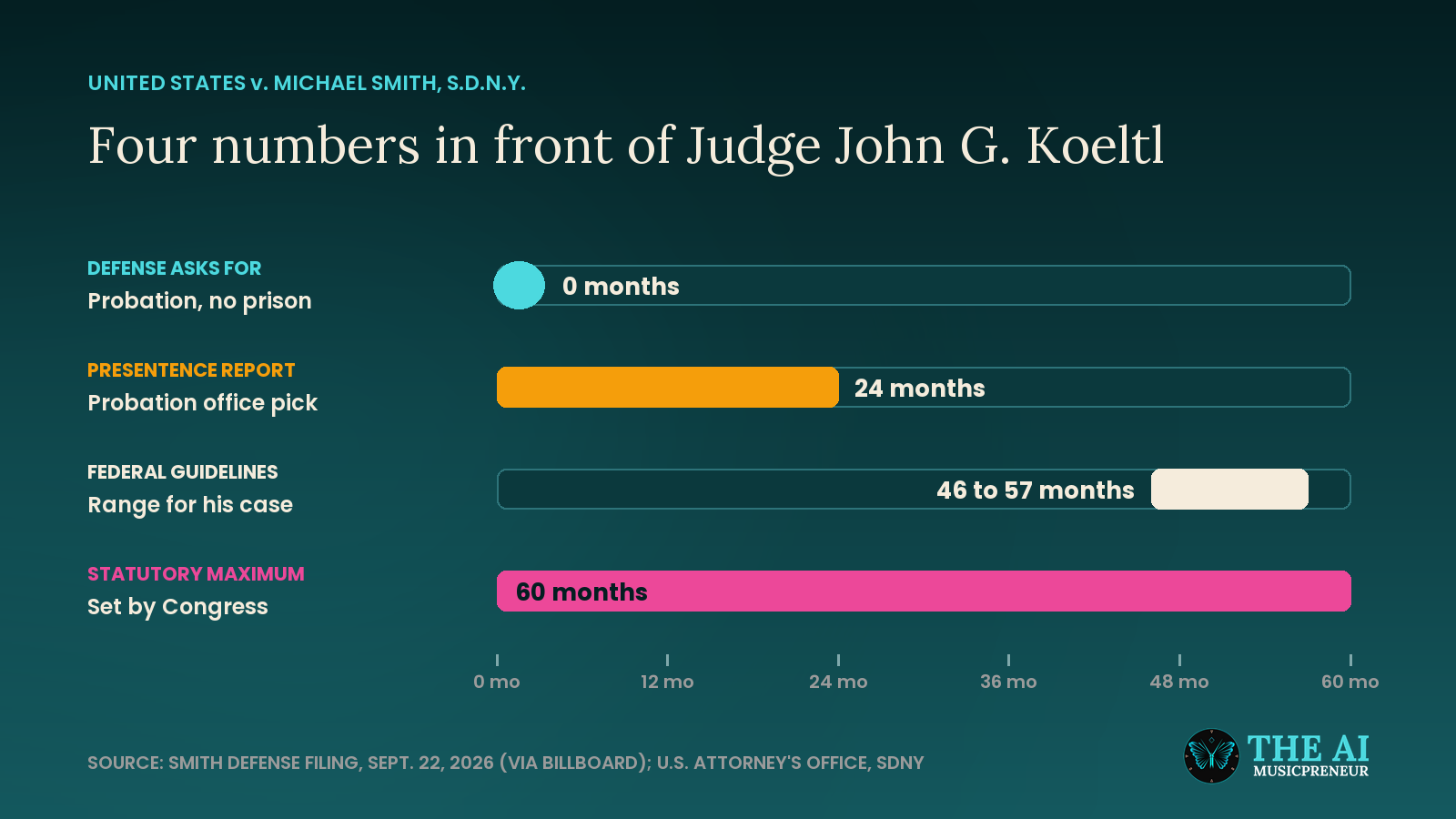
So here’s where every number in front of Judge Koeltl now sits:
- Smith’s lawyers ask for probation, with no prison time.
- The court’s probation office recommends 24 months.
- Prosecutors ask for at least 46 months.
- The guidelines range is 46 to 57 months, and the legal maximum for his charge is 60 months.
Prosecutors build the ask around how long the fraud ran. “For more than six years, Smith labored almost daily to perpetrate massive fraud,” the letter says.
Smith was the architect of, and led, a sophisticated and multi-faceted fraud scheme over the course of many years to divert musical royalties from legitimate and hard-working song writers and other rightsholders to himself.
To see why prosecutors call it sophisticated, you have to look at how the bot accounts were set up.
How did Michael Smith’s streaming fraud work with bot accounts on family plans?
Streaming fraud means getting paid royalties for plays no real person made. Smith’s version ran in 3 stages, according to the letter: create bot accounts, make them stream his songs nonstop, and collect the royalties.
Here’s how prosecutors say he set up the bot accounts:
- He bought email accounts in bulk, often in fictitious names, and used them to register the bot accounts.
- He paid for family plans, the cheapest way to run many accounts, with corporate debit cards issued in fake employee names.
- He ran the accounts on many cloud computers at once and used VPNs to hide that they were operating from his house.
- He spread the streams across hundreds of thousands of AI-generated songs, so no single song looked suspicious.
At certain points, Smith had as many as 10,000 active bot accounts. In a May 11, 2017 email, he told a co-conspirator to “Make up names and addresses” and to make sure “they all are the same for family member.”
That family-plan setup is where the Taylor Swift comparison comes from.
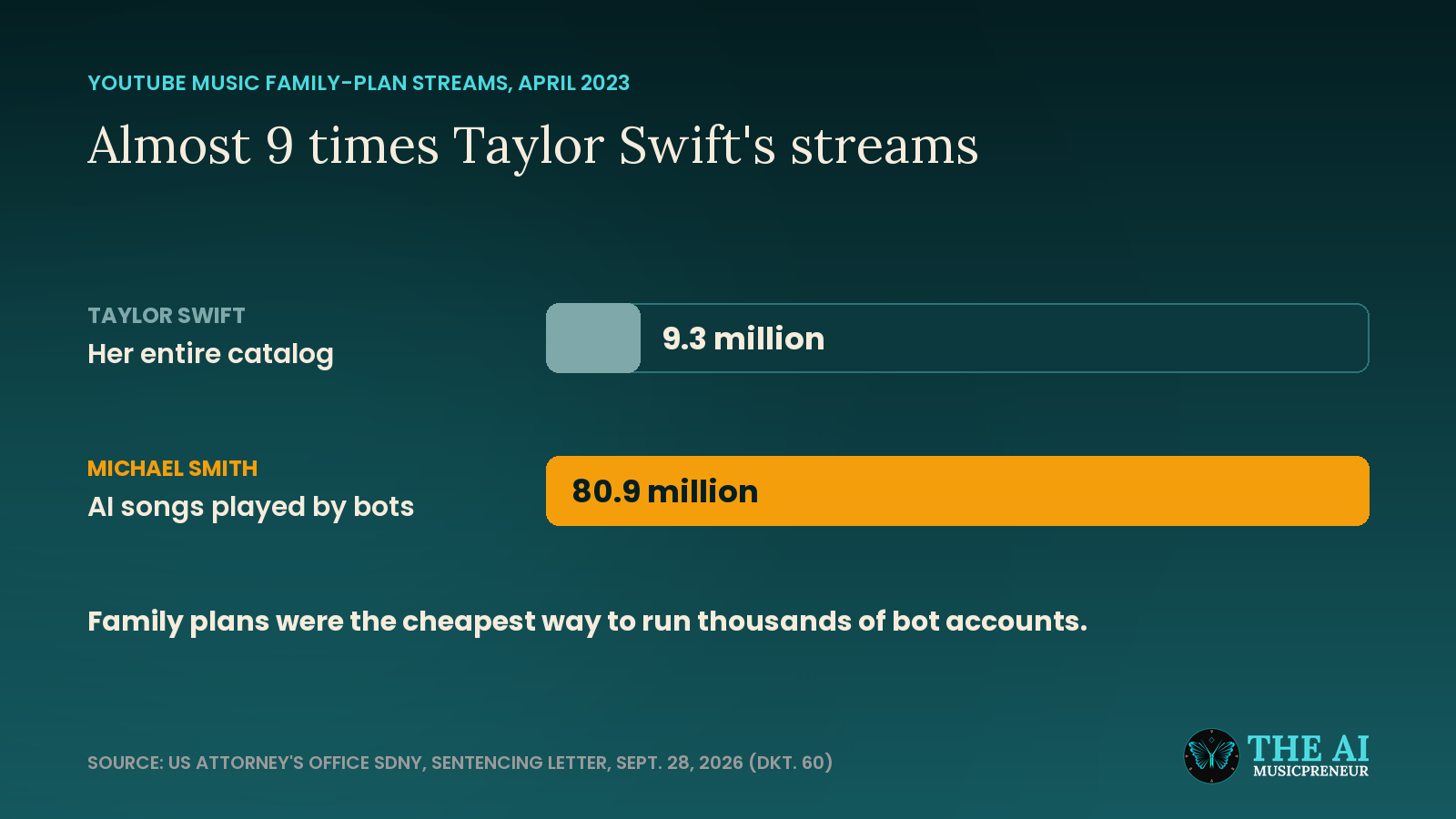
The pattern got noticed. An employee of The MLC flagged that Smithhouse Music Publishing’s Amazon streams in October 2021 and October 2022 came almost entirely from family-plan accounts, according to an attorney’s email the letter quotes. Smith’s side answered that “Mike categorically denies any play manipulation.”
Prosecutors say his own emails show he knew better.
What do Michael Smith’s emails show, according to prosecutors?
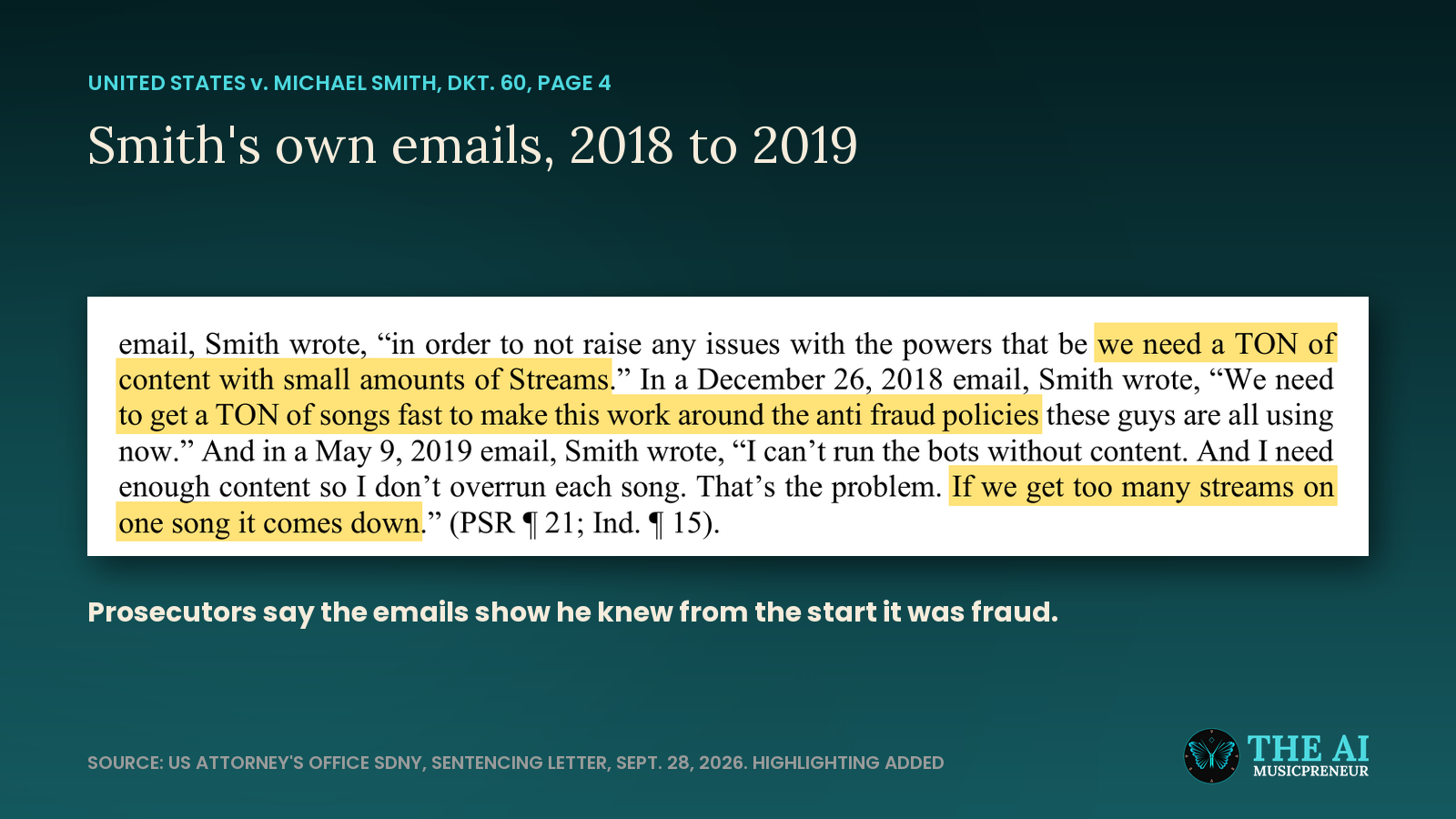
Smith’s lawyers argue he “did not set out to commit a federal crime,” partly because most streaming services didn’t expressly ban streaming manipulation when he started in 2017. Prosecutors answer with his own emails from the early years:
- October 4, 2018: “in order to not raise any issues with the powers that be we need a TON of content with small amounts of Streams.”
- December 26, 2018: “We need to get a TON of songs fast to make this work around the anti fraud policies these guys are all using now.”
- May 9, 2019: “If we get too many streams on one song it comes down.”
The letter also says he told co-conspirators to make the bot accounts and macros “Unde[te]ctable: At least put every safety measure in to avoid detection.” And it points out that Spotify already banned boosting play counts with scripts or automated processes in 2017.
Then come the denials. In October 2018, when a distributor planned to pull his releases over streaming abuse reports, Smith wrote back: “This is absolutely wrong and crazy! … There is absolutely no fraud going on whatsoever! How can I appeal this?”
The defense also says a well-known music lawyer told Smith he faced civil penalties at worst. Prosecutors believe that same lawyer emailed The MLC in March 2023 that “Mike is the ‘human’ author!” So either Smith hid the facts from the lawyer, the letter says, or “the attorney affirmatively lied to the MLC.”
That leaves the defense’s main argument: that nobody felt the loss.
Why do prosecutors reject Michael Smith’s “no artist was harmed” argument?
Smith’s lawyers argue the loss was spread so thin across millions of artists and songwriters that this is one of the “diffuse-loss cases” where courts go far below the guidelines.
Prosecutors say none of the cases the defense cites even discuss diffuse loss. Then they turn the argument around. “Every penny of loss was diverted to the defendant,” the letter says. The loss may have been spread out, but “the fraudulent proceeds were not,” because “they all went into the defendant’s pocket.”
The letter contrasts that with United States v. Adelson, a securities fraud case the defense cited, where shareholders lost $260 million and the executive got $1.2 million. Smith, by comparison, tracked every dollar: he “even created profit and loss statements showing how much profit he could obtain from each bot he operated.”
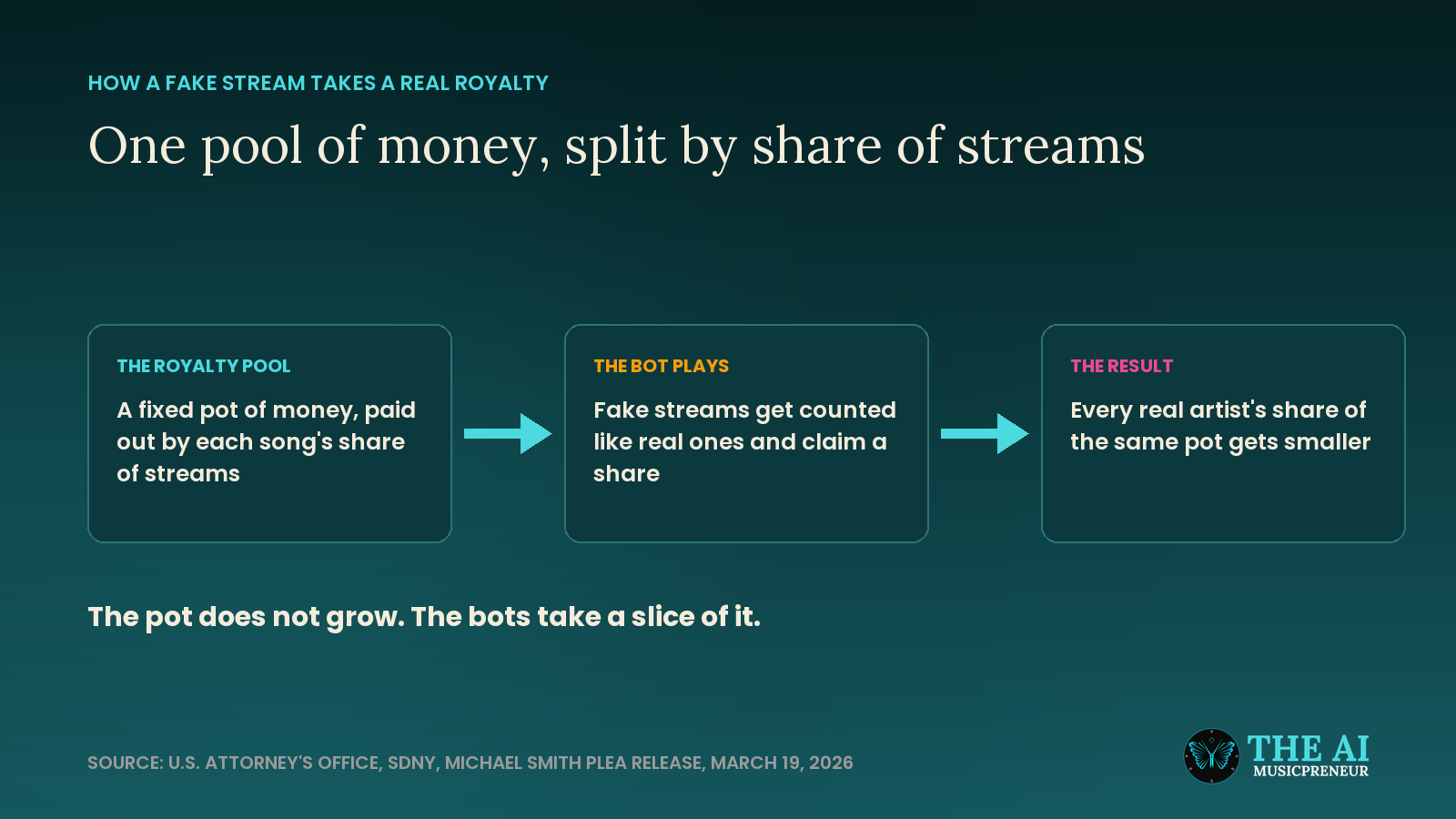
Two industry groups wrote to Judge Koeltl as well. The MLC said streaming fraud “redirects a portion of the existing royalty pool from every single legitimate rightsholder to fraudsters.” The Music Fights Fraud Alliance said that, since this is the first US criminal prosecution for streaming fraud, the sentence “will serve as the first real signal to the public regarding the actual legal consequences of streaming fraud.”
September brought other moves against streaming fraud too. 27 music companies signed IFPI’s anti-fraud pledge on September 14, LANDR says Spotify-flagged fake streams on its music fell 95%, and the indie think tank ORCA wants a per-track upload fee paid into the royalty pool.
If the public is watching this case, prosecutors argue, a lenient sentence sends “precisely the wrong message.”
What happens at Michael Smith’s October 6, 2026 sentencing hearing?
Judge Koeltl sentences Smith on Tuesday, October 6, 2026, at 3:00 PM at the Daniel Patrick Moynihan US Courthouse in Manhattan, according to the court docket.
None of the recommendations bind him. He can pick anything from probation up to the 60-month maximum. Smith already agreed to forfeit $8,091,843.64 in his March guilty plea, and prosecutors ask the court to order it.
On October 6, Judge Koeltl puts the first number on what streaming fraud costs in a US criminal court.
Frequently asked questions
Why is the agreed loss in Michael Smith's AI streaming fraud case $8.09 million when he collected more than $14 million?
The sentencing letter says Michael Smith obtained more than $14 million from royalty-paying entities in total. Prosecutors and Smith agreed on a loss of $8,091,843.64 after subtracting estimated royalties from real, organic streams of his music and the money he paid back into royalty pools by buying streaming subscriptions. That same $8,091,843.64 is the amount prosecutors want him to forfeit.
How do the federal sentencing guidelines reach 46 to 57 months for Michael Smith?
Both sides agree on an offense level of 23. It starts at a base of 6, adds 18 levels for a loss between $3.5 million and $9.5 million, 2 for more than 10 victims and 2 for sophisticated means, then subtracts 2 because Smith has no criminal history points and 3 for accepting responsibility. Level 23 with no criminal history gives a range of 46 to 57 months.
How much were Michael Smith's bot streams earning by June 2019?
By June 2019, Michael Smith reported “we are at 88 million TOTAL STREAMS so far!!!” and said his fraudulent streams were earning about $110,000 a month, according to the prosecutors' sentencing letter. Prosecutors say he tracked the money from the start, including profit and loss statements for each bot.
Besides AI-generated songs, what music did Michael Smith use for his bot streaming scheme?
According to the sentencing letter, Michael Smith first used the catalog of a music publicist to generate fraudulent royalties, then tried to sell fake streaming as a service to other musicians. Neither gave him enough songs to avoid detection at scale, so from about 2018 he obtained hundreds of thousands of AI-generated songs instead.
What earlier settlement do prosecutors cite in Michael Smith's sentencing letter?
Prosecutors point to a $900,000 False Claims Act settlement that Michael Smith, a former manager of the North Carolina practice Carolina Comprehensive Health Network, reached with its owner and another manager over billing Medicare and Medicaid for medically unnecessary tests. The Justice Department announced it on September 9, 2020, and the claims were resolved as allegations, with no finding of liability. The letter says it should have warned Smith to be scrupulous when taking other people's money.
About the author

Covering AI music tools, industry shifts, and news for music creators and professionals. Twice-weekly newsletter at aimusicpreneur.com.