IMPF and IMPEL publish 7 AI licensing principles, and the song must be valued at least equally with the recording
My stack My fav 6 tools for AI music after testing 70+
-
 ElevenMusic · Music generation
 -
 Moises · Stem separation
 -
 Controlla · Voice swap & cloning
 -
 Cryo Mix · Mixing + mastering
 -
 Neural Frames · Music videos
 -
 ONCE · Distribution
Some links are affiliate links — I earn a commission at no cost to you. Every tool here is one I run myself and truly believe in. This stack is proven.
Independent music publishers just told the AI industry what a song is worth: at least as much as the recording. On September 30, 2026, IMPF and IMPEL published a joint framework of 7 principles for generative AI licensing, and they call that one “non-negotiable.”
That’s a break from how streaming pays. In 2021, recording rights took 53% of UK streaming revenue and publishing rights took 15%, according to the UK Competition and Markets Authority (CMA). IMPF and IMPEL don’t want generative AI to inherit that gap.
IMPF, the Independent Music Publishers International Forum, is the Brussels-based global trade body for independent publishers. IMPEL, short for Independent Music Publishers’ E-Licensing, is the London-based collective that licenses indie publishers’ digital rights, and its members own it.
What are IMPF and IMPEL’s 7 principles for generative AI licensing?
The framework is a 2-page joint statement, released from London and Brussels. It opens with the argument and ends with the list.
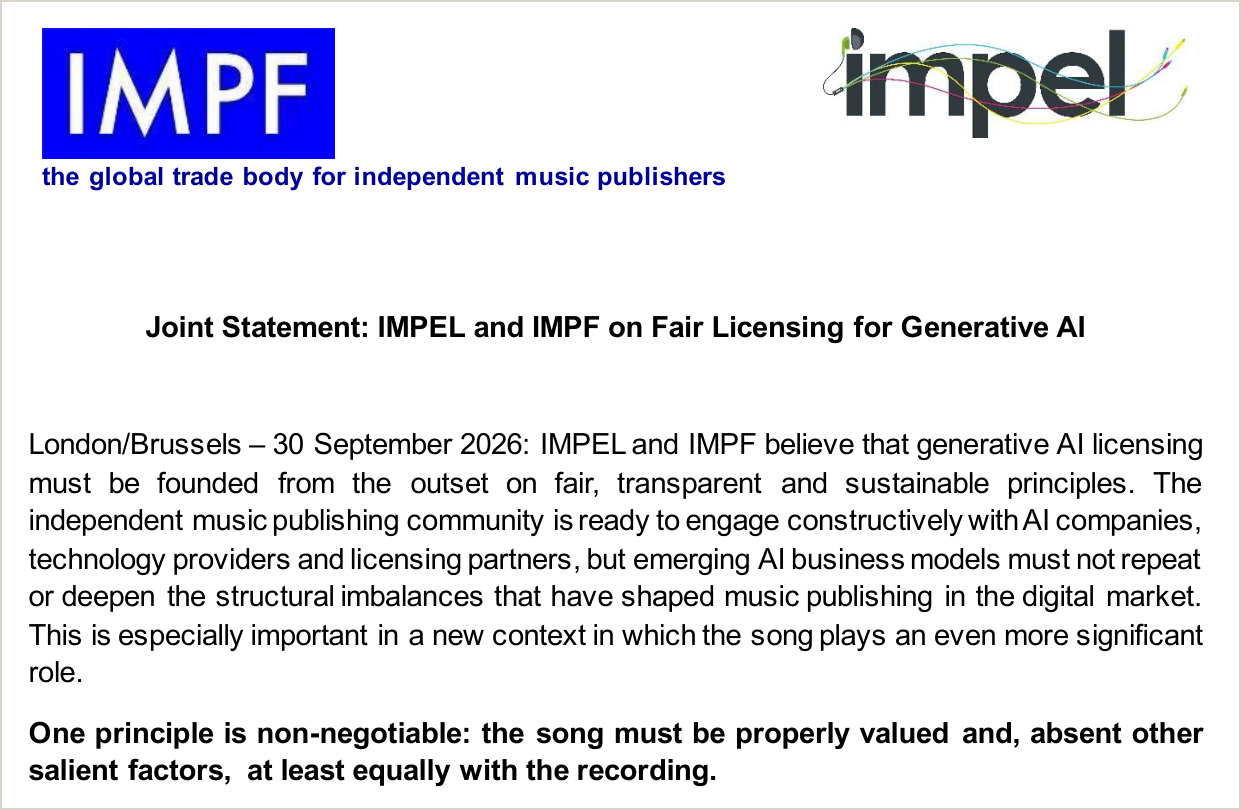
Here are the 7 principles, word for word:
- The song must be properly valued in all generative AI licensing models.
- Revenue allocations between master and publishing rights must be fair and balanced but in the absence of any other salient factors, generative AI training and exploitation should value the song at least equally with the recording.
- Payments for past use, training, outputs and future exploitation must be clearly distinguished and fairly treated.
- Any deductions, costs or revenue calculations must be transparent, justified and applied fairly.
- Licence scope must be specific and must not create unintended pathways for broader future uses.
- Mechanisms to establish trust and transparency in the attribution and valuation of original works used in AI training and output must be agreed with rightsholders.
- Downstream uses of AI-generated music must yield appropriate royalties for the songs on which AI models are trained.
Principle 3 splits AI money into 4 buckets: past use (music a model already used before any deal), training, outputs and future exploitation. IMPF and IMPEL want each one kept separate and paid fairly.
Principle 2 is the one that carries the money, so here’s how that split works.
Master rights vs publishing rights: how AI licensing money gets split
Every track carries 2 copyrights. The recording, also called the master, usually belongs to the label or the artist who paid for the session. The song, meaning the lyrics and melody (also called the composition), belongs to the songwriters and their publishers.
Streaming pays those 2 very differently. The CMA found that in 2008, recording rights took 51% of streaming revenue, publishing rights took 8% and the services kept 41%. By 2021, publishing had climbed to 15%, but recording still took 53%. The CMA concluded that the pre-streaming gap “ended up being broadly carried over to music streaming.”
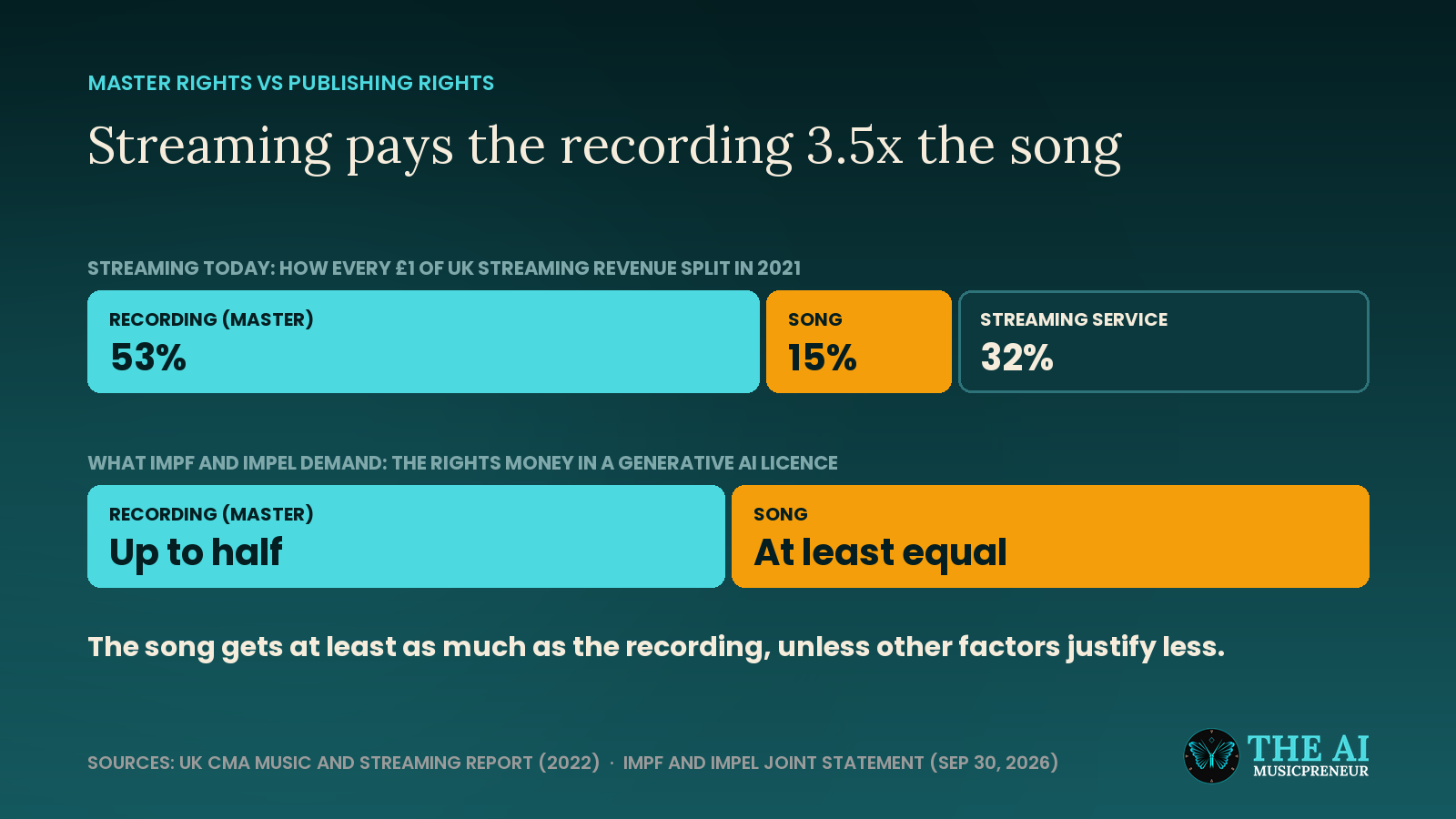
IMPF and IMPEL argue that in generative AI, the song plays “an even more significant role.” Their statement says “songs, lyrics, melodies and compositions are central to the training, prompting, generation, output and commercialisation of AI music products,” and calls generative AI a chance to build a fairer framework, “not another market in which outdated assumptions about the value of masters and compositions are carried forward.”
Any licensing model that, ab initio, treats publishing as a minor share of value while allocating the overwhelming majority of revenues to master rights is unacceptable.
“Ab initio” is Latin for “from the outset.” So the target is any deal that starts by treating the song as the small share. The core principle also carries a condition, “absent other salient factors,” which the statement doesn’t define.
How the IMPF and IMPEL principles compare with the NMPA’s 50/50 deals with Udio and Klay
The equal split is already in a real contract. In June 2026, the US National Music Publishers’ Association announced template AI licensing deals with Udio and Klay that divide AI income 50/50 between songs and recordings. NMPA president and CEO David Israelite said the Udio agreement was the first to “value songs and sound recordings equally” for AI training.
IMPF had put a number on it even earlier. On December 4, 2025, it urged independent publishers not to accept AI licensing agreements that “do not allocate 50% of proceeds to songwriters and publishers.” September’s framework is the first one IMPF and IMPEL have published together, Music Business Worldwide reports.
Most deals still don’t publish their split. Universal’s multi-year deal with ElevenLabs was announced on September 10, 2026 without a revenue split, and Kobalt’s AI covers deal with Spotify came with no published rate. A BPI report already counted nearly 300 AI licensing deals across creative sectors by June.
Licence scope, deductions and attribution pilots in the IMPF and IMPEL framework
The rest of the framework is about knowing what you signed. The statement says “limited pilots, closed environments or specific product models must not be used to create broad precedents for future exploitation.” Put simply, a small test licence today shouldn’t quietly become the template for everything an AI company does later.
Rightsholders, it adds, must understand “how attribution will operate, what deductions are being applied, and how revenues will be calculated and distributed.”
Attribution is the tech that works out which songs shaped a given AI output. IMPF and IMPEL say they are running 3 pilots with different companies to test it, without naming them. One partner is public: in July 2026, the two bodies announced a sandbox project with Sureel AI, the attribution startup Warner Music agreed to buy in June.
The ask now goes to collective management organisations (CMOs), the collecting societies that license songs on writers’ behalf, and to other licensors. Some CMOs already license AI on their own terms, like GEMA with its PLAI training dataset.
IMPEL CEO Sarah Williams said the principles “have been designed to protect songs and songwriters, and ensure they are properly valued,” per Music Week. IMPF president Annette Barrett called the song “the keystone of it all.”
The joint statement closes on the timing: “The rules being set now will have long-term consequences.”
Frequently asked questions
Which music publishers are members of IMPEL, the independent digital licensing collective?
IMPEL is 100% owned and controlled by its members, which include Bucks Music Group, Beggars Music, Reservoir Music, Kassner Music, CTM, ABKCO, Faber Music, Mute Song, Red Brick Songs and Warp Music. Its members' catalogs include songs recorded by Ed Sheeran, Dua Lipa, David Bowie, Rihanna and Miles Davis. Sarah Williams is IMPEL's CEO.
How much of the global music publishing market do IMPF's members account for?
IMPF says its members account for 26% of global market share. The Brussels-based trade body advocates for more than 300 independent publishing companies worldwide, and its president is Annette Barrett of Reservoir.
What did IMPF say about AI licensing before its September 2026 framework with IMPEL?
In 2023, IMPF proposed 4 ethical principles for AI developers, covering copyright compliance, record-keeping on works used in training, separating human-made from AI-generated works, and the line between assistive and fully generative AI. On December 4, 2025, it urged publishers to reject AI licensing deals that don't give 50% of proceeds to songwriters and publishers, and on December 9, 2025, it published its own key principles for AI licensing.
Is the IMPF and IMPEL generative AI licensing framework binding on AI companies?
No. It is a joint statement of principles, not a contract or a regulation. IMPF and IMPEL are asking collective management organisations and other licensors to support it, and they urge all parties to work with independent publishers and songwriters on a licensing framework built on it.
What does 'absent other salient factors' mean in the IMPF and IMPEL AI licensing framework?
It is the condition attached to the equal-value principle: the song should get at least as much as the recording unless other relevant factors justify a different split. The joint statement does not list those factors. It only says AI generation 'can take place in various forms that must be treated on their merits.'
About the author

Covering AI music tools, industry shifts, and news for music creators and professionals. Twice-weekly newsletter at aimusicpreneur.com.