Thomson Reuters v. ROSS: the first US appeals ruling on AI training rejects fair use, with the RIAA and NMPA on the winning side
My stack My fav 6 tools for AI music after testing 70+
-
 ElevenMusic · Music generation
 -
 Moises · Stem separation
 -
 Controlla · Voice swap & cloning
 -
 Cryo Mix · Mixing + mastering
 -
 Neural Frames · Music videos
 -
 ONCE · Distribution
Some links are affiliate links — I earn a commission at no cost to you. Every tool here is one I run myself and truly believe in. This stack is proven.
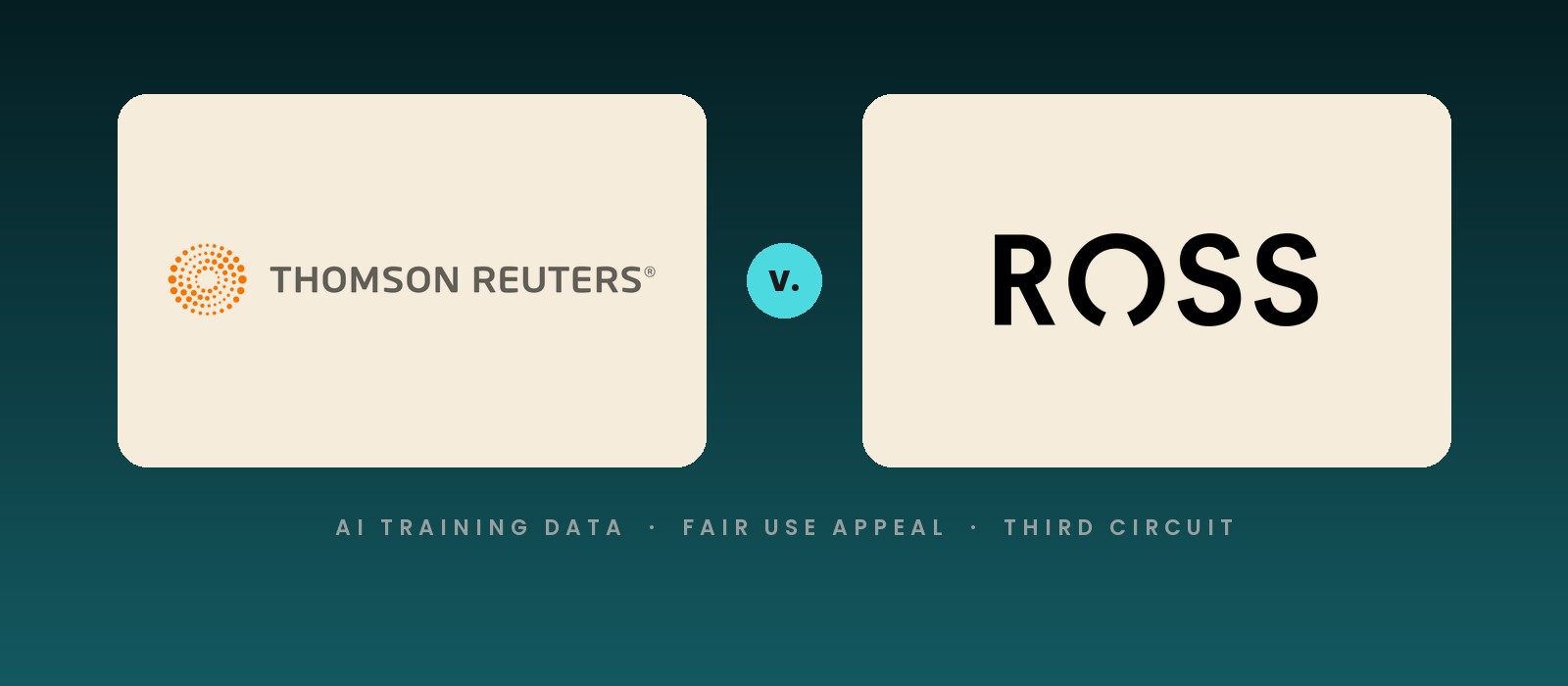
For the first time, a US federal appeals court has ruled on whether training AI on copyrighted work is fair use, and the answer is no. On September 29, 2026 the Third Circuit upheld Thomson Reuters’ win against ROSS Intelligence, a legal research startup that shut down in 2021 after training its AI search engine on Westlaw headnotes.
The RIAA and NMPA filed a joint brief backing Thomson Reuters. Their members are asking the same fair use question in their lawsuits against Suno, Udio and Anthropic.
I read the full 32-page opinion, which the court published a day after the ruling.
What the Third Circuit decided in Thomson Reuters v. ROSS Intelligence
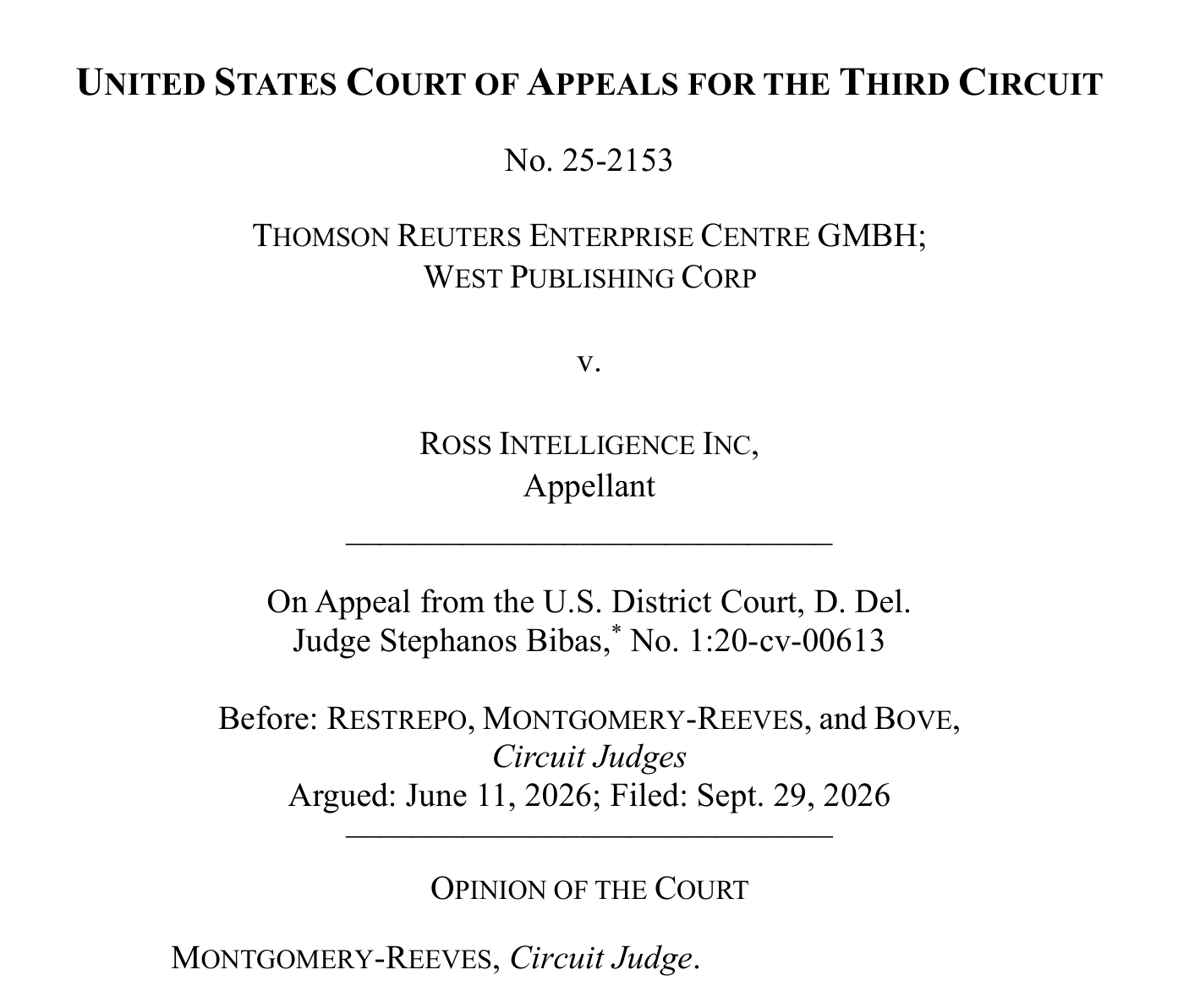
A 3-judge panel answered 2 questions, and Thomson Reuters won both. Westlaw’s headnotes are original enough to be copyrighted, and ROSS’s use of them to train its AI was not fair use.
Judge Tamika Montgomery-Reeves wrote the opinion, joined by Judges Luis Felipe Restrepo and Emil Bove. It affirms Judge Stephanos Bibas, who ruled against ROSS in Delaware federal court on February 11, 2025, and the judgment orders ROSS to pay Thomson Reuters’ costs on appeal.
ROSS framed the appeal as a case about the future of AI legal technology. The court answered that “appearances can be deceiving. In truth, this is no more than an ordinary copyright case.”
The opinion is precedential, so federal courts across the Third Circuit now have to follow it. It was filed under seal on September 29 while the parties could propose redactions, and the full text went public the following afternoon, as Digital Music News reported.
How ROSS Intelligence turned Westlaw headnotes into AI training data
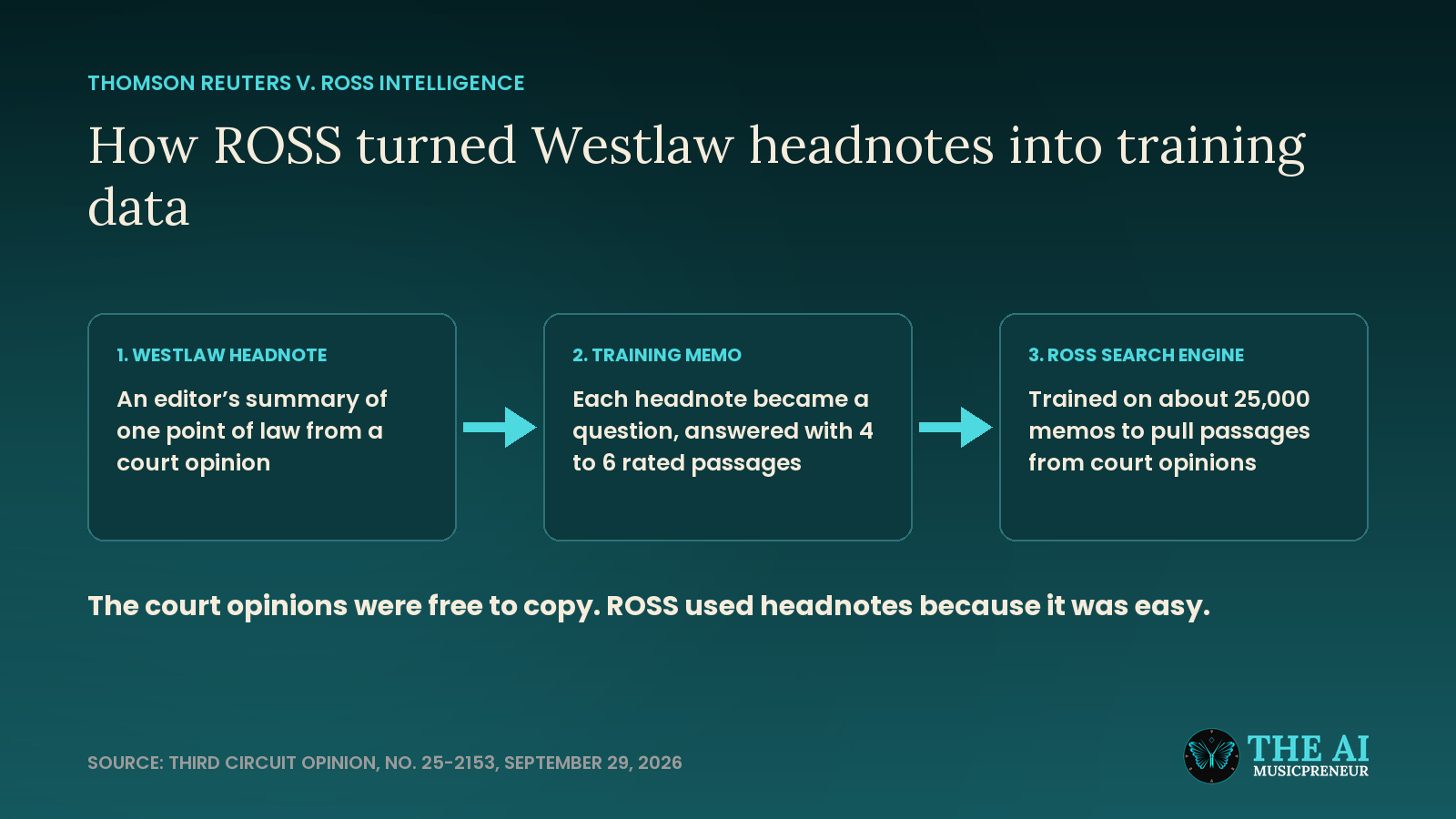
A headnote is the short summary a Westlaw editor writes above a court opinion, one point of law per note. Thomson Reuters owns Westlaw, and its editors are told to keep each one under 800 characters where they can.
ROSS wanted an AI that answers a plain-English legal question with the right passage from a court opinion. To teach it, ROSS hired a company called LegalEase Solutions, which wrote about 25,000 training memos. Each memo posed a legal question framed from a Westlaw headnote, then listed 4 to 6 opinion passages rated great, good, topical or irrelevant.
ROSS’s AI was not generative, so it wrote nothing new. It only returned passages from a bank of about 10 million court opinions that nobody holds a copyright in.
ROSS ran ads comparing itself to Westlaw at prices “in line with” Westlaw’s, and some law firms switched. Thomson Reuters sued in 2020, and ROSS shut its platform down in 2021, citing the cost of the lawsuit.
Remember the free court opinions in that chain, because they come back in the fair use ruling.
Why the Third Circuit rejected ROSS’s fair use defense, factor by factor
Fair use is the part of US copyright law that lets you copy without permission in some cases, like quoting a line in a review. Courts decide it with 4 factors, and the Third Circuit scored all 4:
- Purpose: ROSS charged prices close to Westlaw’s and used the headnotes for the same job Westlaw does, helping people find case law. The court called the use “highly commercial and minimally transformative.”
- Nature of the work: Headnotes are more factual than creative, so this factor went ROSS’s way, slightly.
- Amount: ROSS argued it took only 0.08% of Westlaw’s 28 million headnotes. The court answered that every headnote is a complete work, and ROSS copied each one whole.
- Market effect: ROSS built a rival to Westlaw, and the court found a “rapidly developing” market for licensing headnotes as AI training data.
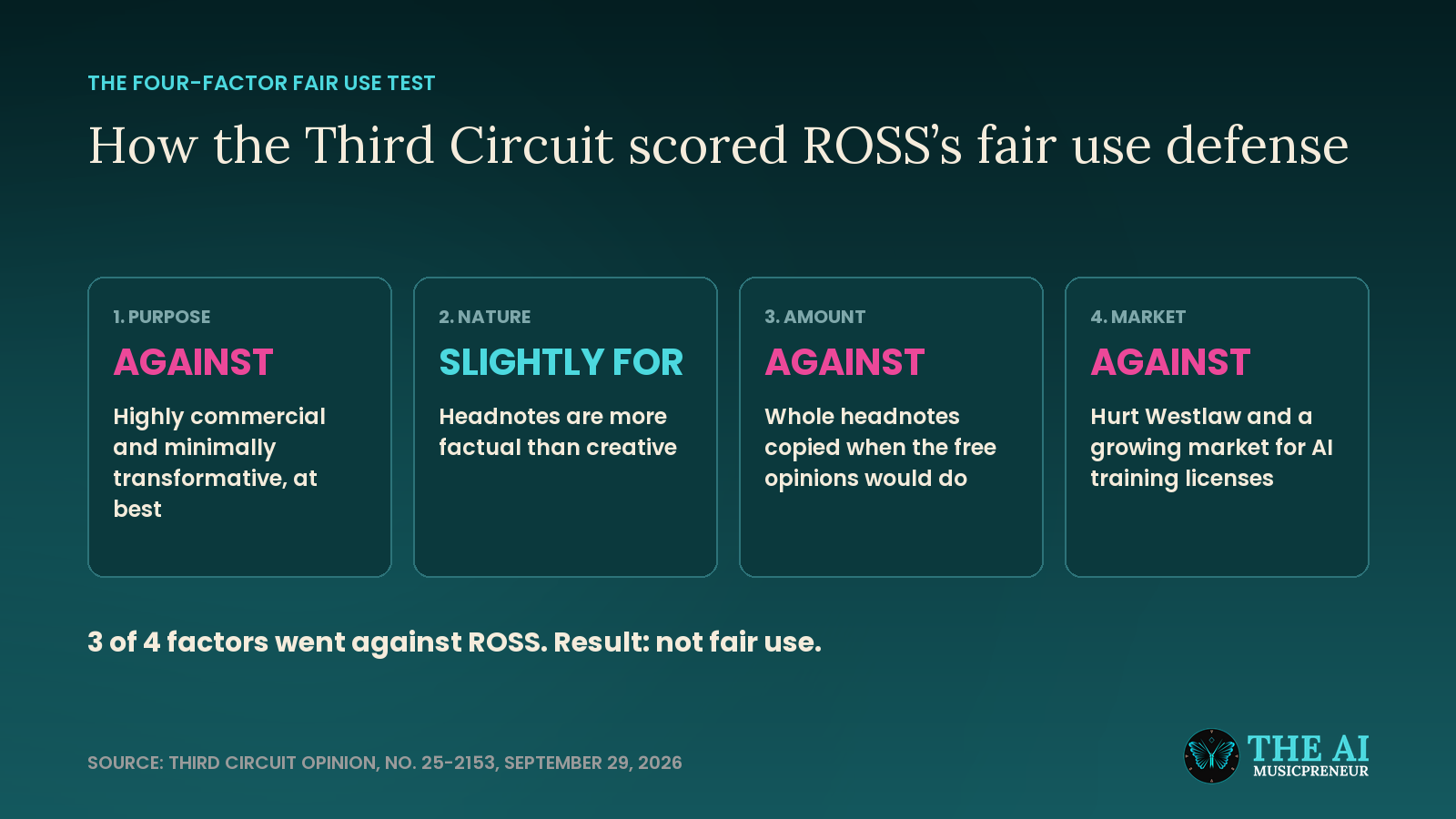
One line is about convenience. ROSS could have built its memos from the free opinions, and the court said it chose headnotes because they were the easy route: “Unlike necessity, ease is not a justification for copying.”
On the market factor, Thomson Reuters had never licensed its headnotes to anyone, and the court still counted the licensing market as real.
By copying the headnotes for use as training data without Thomson Reuters's authorization, ROSS usurped Thomson Reuters's opportunity to enter that derivative market and license its headnotes for that purpose.
Is AI training fair use after Thomson Reuters v. ROSS Intelligence?
For an AI built to replace the product it learned from, the first appeals answer is no. For generative AI, the court set ROSS apart in a footnote.
That footnote names Bartz v. Anthropic, where Judge William Alsup found in June 2025 that training on books was fair use, and Kadrey v. Meta. It also names the Justice Department’s September 1 filing in the OpenAI case, which argues that training a large language model is transformative.
Then the court separated them: “Unlike the AI models in Bartz and In re: OpenAI, ROSS’s AI platform cannot generate original expression.” It added that ROSS trained its AI to build a commercial substitute for Westlaw, while the DOJ had argued the OpenAI training caused no “substitutive competition.” And it pointed out that the DOJ, which filed in the OpenAI case, filed nothing in this one.
LawSites flagged the same limit while the opinion was still sealed, noting that ROSS’s copying happened before generative AI took off, and was for a non-generative system.
Why the RIAA and NMPA backed Thomson Reuters in a legal research case
Westlaw headnotes have nothing to do with music, so why did the music trade groups show up? Their members are suing AI companies over the same fair use question, and this was the first appeal to reach it.
The RIAA and NMPA filed their joint brief on November 25, 2025. A footnote names 3 of their members’ cases: Concord v. Anthropic, UMG v. Uncharted Labs (the company behind Udio) and UMG v. Suno. In April 2026 the same 2 groups joined 6 other music bodies on a brief in the Anthropic case.
The brief acknowledged the facts differ and argued the precedent holds anyway: “while the factual contexts of AI legal research tools and AI-generated music may differ,” the lower court’s ruling sets “key precedent that training an AI model on copyrighted works to compete with and substitute for those copyrighted works can never be fair use.”
Thomson Reuters, which also owns Reuters, told the news agency it was pleased with the ruling and “firmly believes that respecting copyright is essential for fostering innovation.” ROSS’s spokespeople and lawyer did not respond to Reuters’ request for comment.
Does the Thomson Reuters v. ROSS ruling bind the Suno, Udio and Anthropic cases?
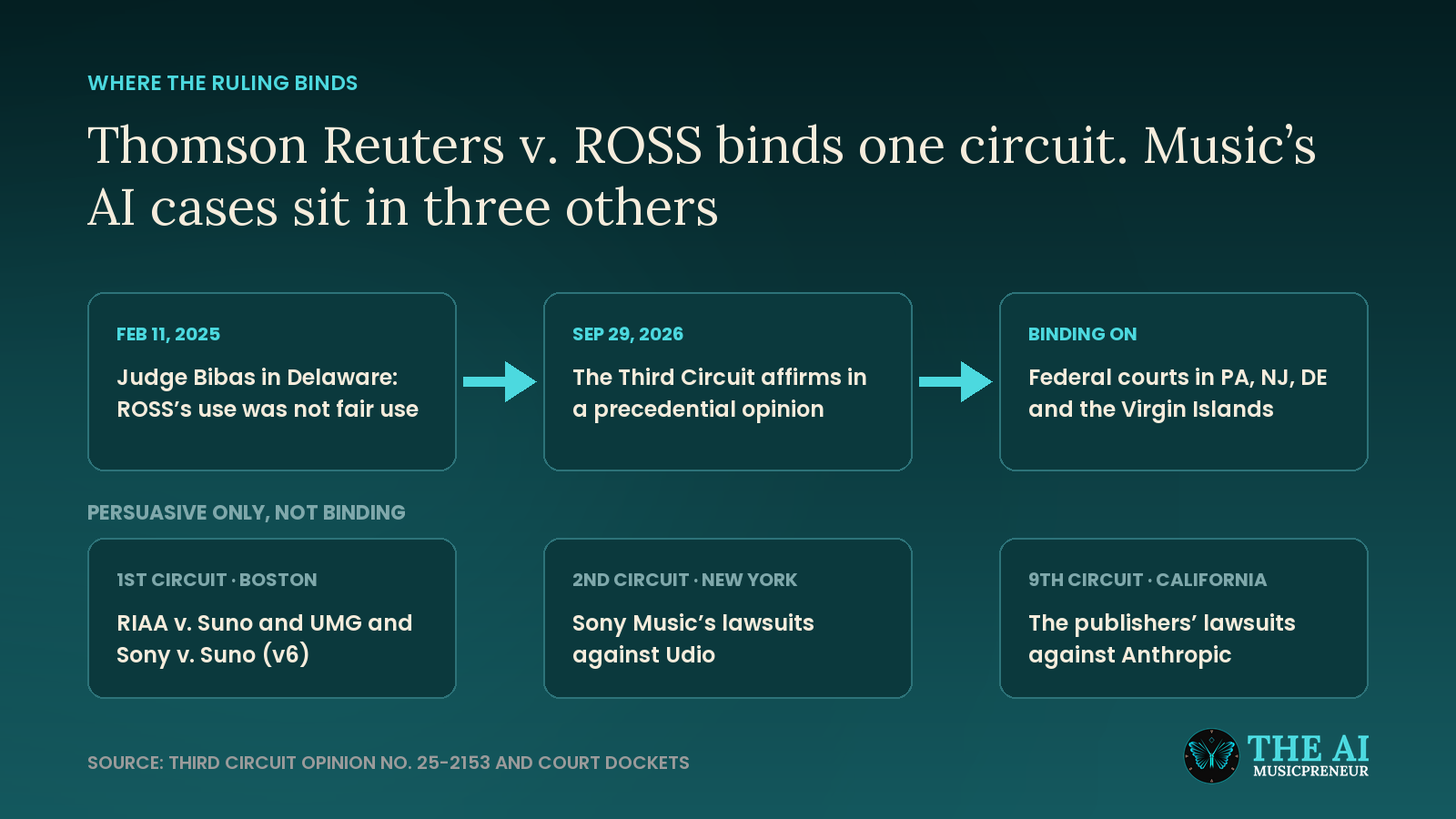
No. An appeals court’s ruling binds only the courts inside its circuit, and the Third Circuit covers Pennsylvania, New Jersey, Delaware and the US Virgin Islands. None of the Suno, Udio or Anthropic music cases is there:
- Suno faces RIAA v. Suno and the new v6 lawsuit in Boston federal court, which sits in the First Circuit.
- Udio is fighting Sony Music in Manhattan, in the Second Circuit, after Universal and Warner settled their Udio claims in late 2025.
- The publishers’ cases against Anthropic, including Concord v. Anthropic, are in Northern California, in the Ninth Circuit.
Judges in those courts can still read the opinion and borrow its reasoning, which lawyers call persuasive authority. They just don’t have to follow it.
The generative question stays with those courts too. Suno and Udio make new audio from a prompt, the kind of generative model the Third Circuit set apart from ROSS in its footnote. Udio is already arguing fair use against Sony in New York.
Until an appeals court rules on a generative model, Thomson Reuters v. ROSS is the only appellate answer on AI training. Rights holders can cite its market factor, and the AI companies can cite its footnote.
Frequently asked questions
Which judges decided Thomson Reuters v. ROSS Intelligence at the Third Circuit?
Judge Tamika Montgomery-Reeves wrote the opinion for a panel with Judges Luis Felipe Restrepo and Emil Bove. The appeal was argued on June 11, 2026 and decided on September 29, 2026. Judge Stephanos Bibas, whose February 2025 ruling the panel affirmed, is himself a Third Circuit judge who heard the case as a trial judge in Delaware.
How many Westlaw headnotes did ROSS Intelligence copy, according to the Third Circuit?
The ruling covers 2,243 headnotes that the district court found ROSS's training memos had so clearly copied that no reasonable juror could conclude otherwise. ROSS argued it used only 0.08% of Westlaw's 28 million headnotes, and the court rejected that because each headnote counts as a complete copyrighted work.
When did the RIAA and NMPA file their amicus brief in Thomson Reuters v. ROSS?
On November 25, 2025, in support of Thomson Reuters and of affirming the district court. Jonathan Z. King of Cowan, Liebowitz & Latman filed it for both trade groups, and the Third Circuit lists him among counsel for the amici supporting Thomson Reuters.
Did the Third Circuit decide whether Westlaw's Key Number System is copyrighted?
No. Judge Bibas certified that question for appeal, but ROSS never challenged the Key Number System's originality in its briefs, so the Third Circuit treated the issue as forfeited. The ruling covers the headnotes only.
Can ROSS Intelligence still challenge the Third Circuit's fair use ruling?
On paper, yes. Federal appellate rules give ROSS 14 days from the September 29 judgment to ask the full Third Circuit to rehear the case, and the Supreme Court allows 90 days to file a petition. ROSS shut down its platform in 2021, and its spokespeople and lawyer did not respond to Reuters' requests for comment on the ruling.
About the author

Covering AI music tools, industry shifts, and news for music creators and professionals. Twice-weekly newsletter at aimusicpreneur.com.