
Sony Music has now asked platforms to remove more than 260,000 tracks as AI deepfakes spread
My stack My fav 6 tools for AI music after testing 70+
-
 ElevenMusic · Music generation
 -
 Moises · Stem separation
 -
 Controlla · Voice swap & cloning
 -
 Cryo Mix · Mixing + mastering
 -
 Neural Frames · Music videos
 -
 ONCE · Distribution
Some links are affiliate links — I earn a commission at no cost to you. Every tool here is one I run myself and truly believe in. This stack is proven.
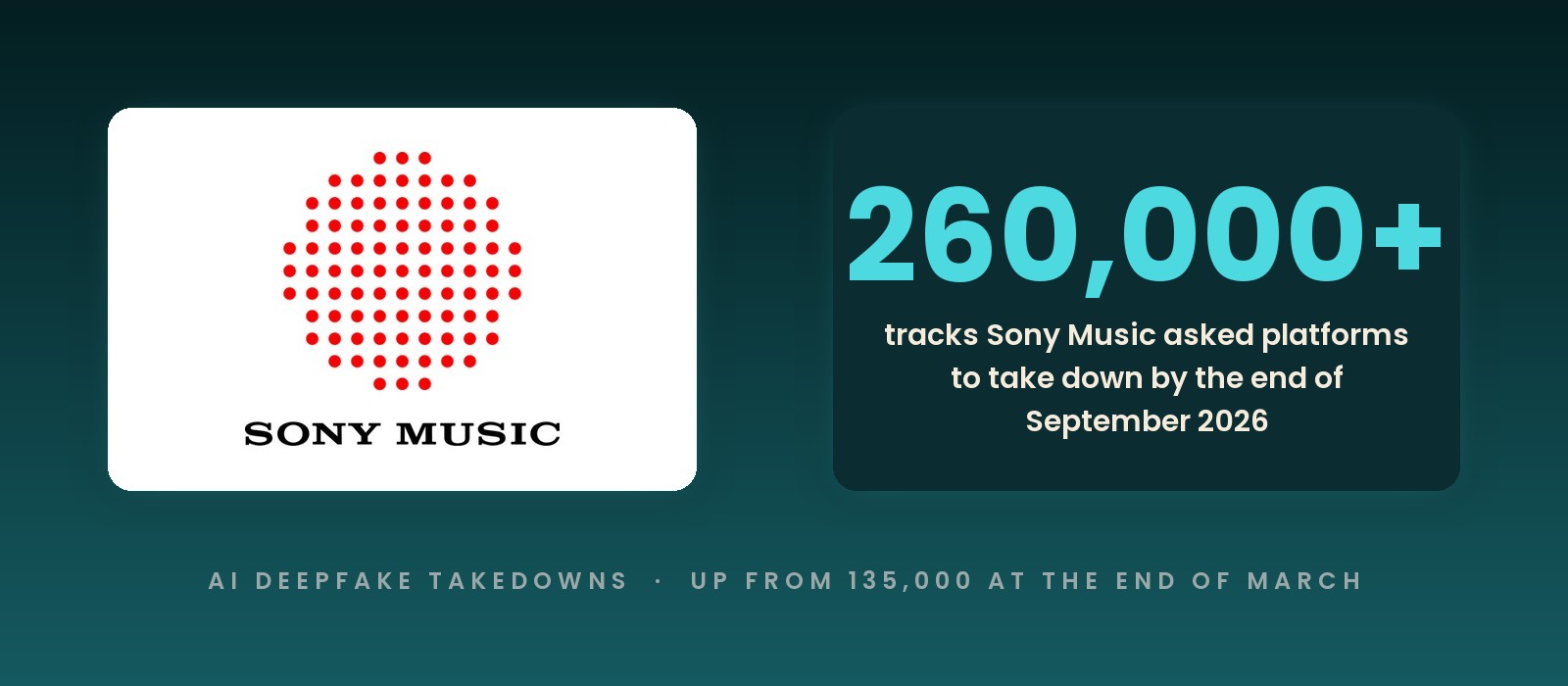
Sony Music has asked streaming platforms to take down more than 260,000 tracks. That’s the count at the end of September 2026, up from 135,000 at the end of March, according to the Financial Times on October 5.
So the number nearly doubled in 6 months. The fakes it’s chasing copy artists like Adele, Harry Styles and Michael Jackson, and the rest are bot-driven bulk uploads built to farm royalties.
Sony’s digital chief told the FT that fraudulent streams could account for as much as 10% of tracks on streaming services. Industry estimates put the annual cost of streaming fraud at $2.2 billion.
How Sony Music’s AI deepfake takedowns grew from 75,000 to 260,000
This is the third time Sony has put a number on it. Back in March 2025 the count was 75,000, which I covered as Sony’s fight against 75,000 AI deepfakes, with fakes of Harry Styles and Beyoncé at the top.
The FT puts the jump next to Deezer’s numbers. Deezer said 90,000 AI-generated songs were uploaded every day this summer, which is more than half of all new music it receives. And up to 85% of the streams on fully AI-made tracks last year were fraudulent.
Campaigners quoted in the same report say tools like Suno and distributors like DistroKid are being used by organised fraudsters to mass-produce fake music and get it paid. Universal already took that fight to court when it sued DistroKid over AI slop, and Sony and Universal are both suing Suno over training data. Suno rejects those claims.
Why AI deepfakes and fake streams take money from real artists
A fake song with your voice on it does two kinds of damage. It confuses your fans, and it takes money out of the same pot your royalties come from.
Spotify, Apple Music and most other services pay from one pool, split by each track’s share of total streams. So every stream a bot farm pushes onto a fake track makes everyone else’s share smaller.
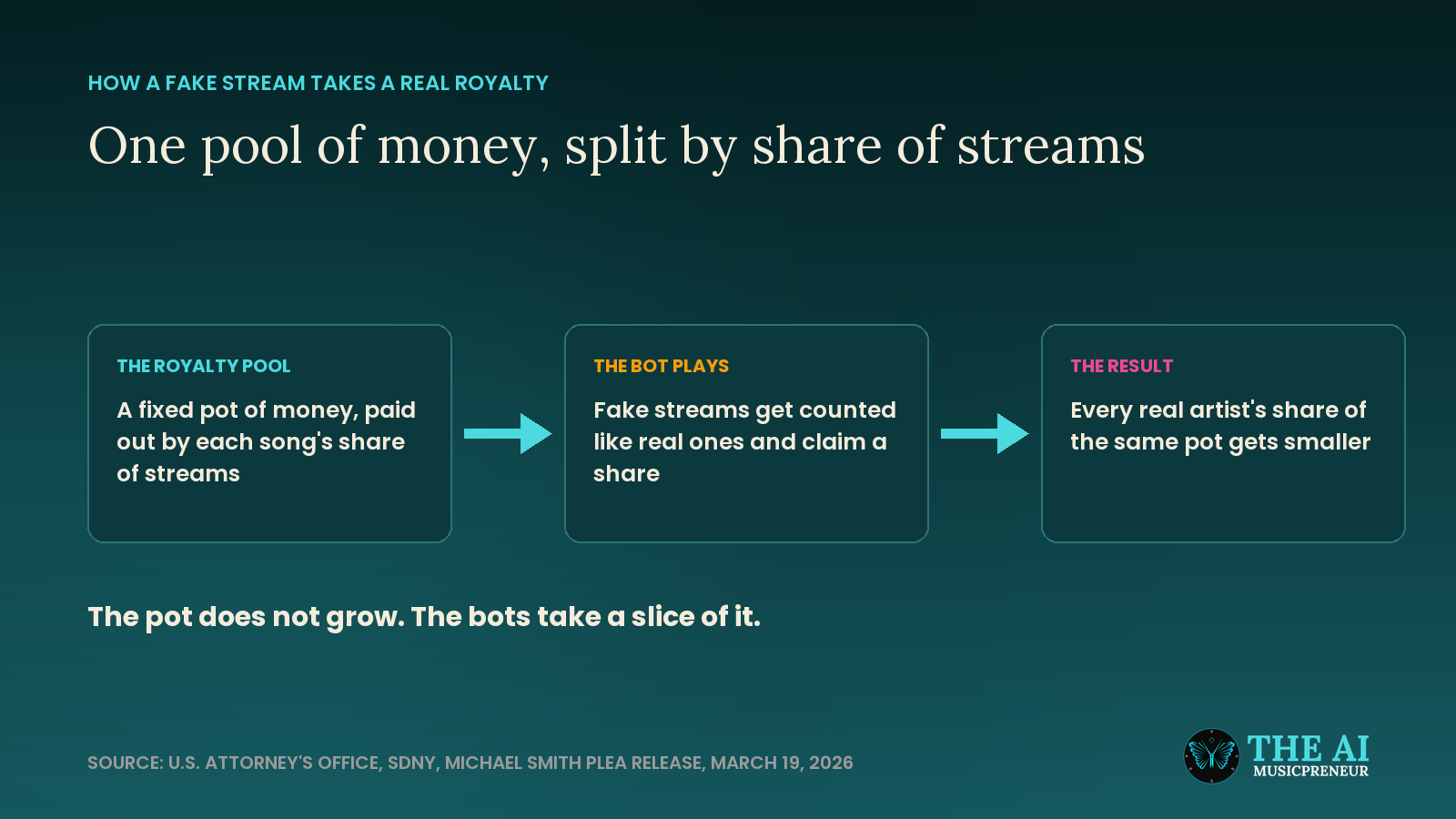
That’s the scheme Michael Smith ran for 7 years, with AI songs and 1,040 bot accounts. Prosecutors now want at least 46 months in prison for his $8 million fraud.
Sony has a team filing 260,000 requests. Most independent artists have nobody doing that for them, so here’s how you do it yourself.
How to report an AI deepfake of your song on Spotify, YouTube and through your distributor
Most fakes get found by fans before the artist sees them. So the first job is looking, and the second is knowing which form to use.
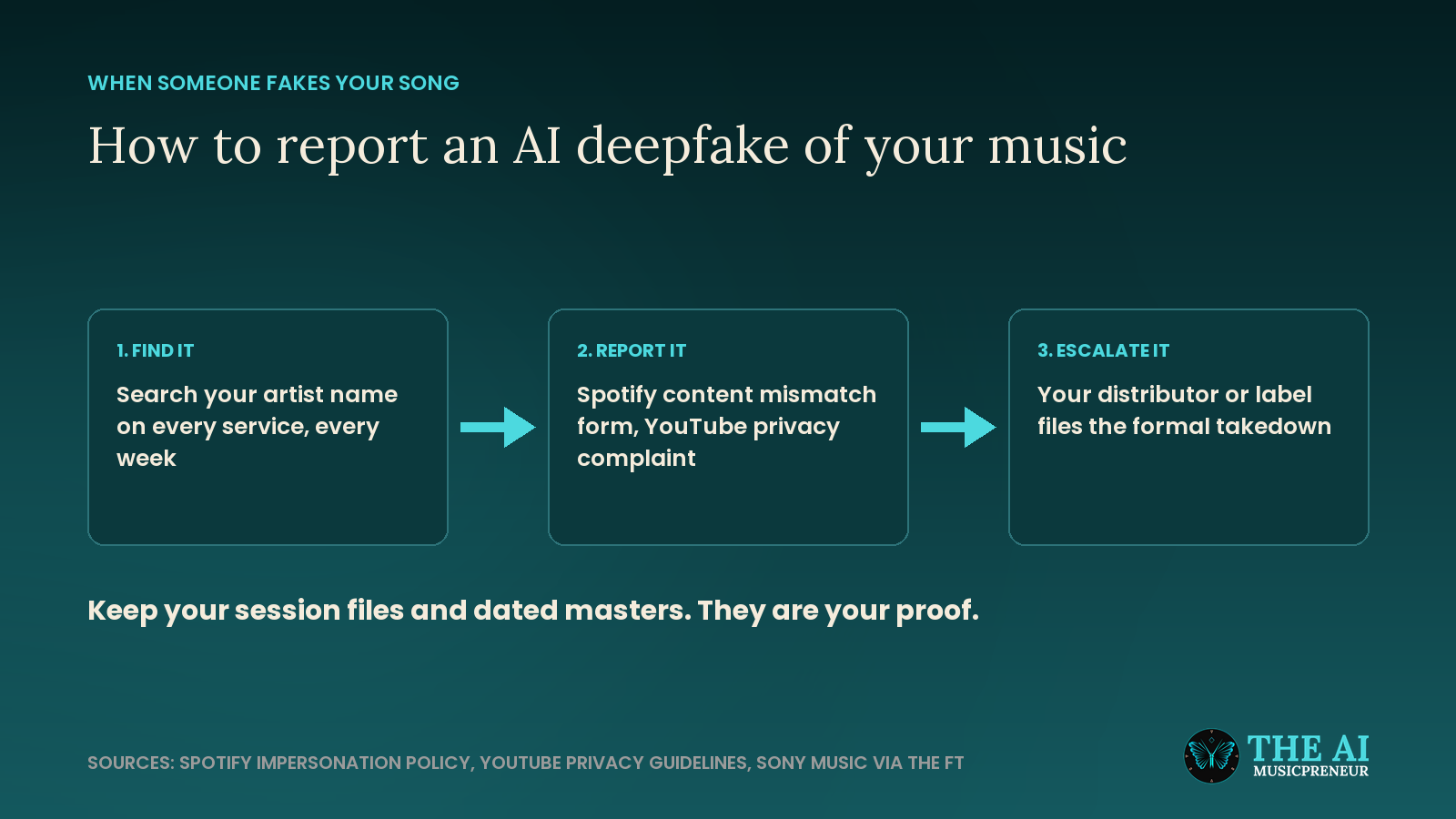
Here’s the order I’d work through:
- Search your artist name every week on Spotify, Apple Music, YouTube and Deezer. Look for releases you didn’t make, on your profile or on a lookalike profile.
- On Spotify, use content mismatch. Spotify’s impersonation policy bans AI voice clones you didn’t authorise, and artists can report music delivered to the wrong profile, even before it’s released.
- On YouTube, use likeness detection or a privacy complaint. Creators in the YouTube Partner Program can enrol in likeness detection, which matches faces today. For a cloned voice, the route is a privacy complaint.
- Bring in your distributor or label. They can file formal takedowns on your behalf and push back on the account that uploaded the fake.
- Keep your proof. Session files, stems and dated masters show what you actually made, which helps when you file the request.
None of this is quick, and that’s the part Sony’s number shows. A major label had to scale its own takedown work to 260,000 requests to keep up with fakes of its own roster.
If you release music, check your profiles this week. The fakes are going up faster than anyone is taking them down.
Frequently asked questions
How many tracks has Sony Music asked streaming platforms to take down in 2026?
More than 260,000 by the end of September 2026, according to the Financial Times. Sony had flagged 135,000 by the end of March 2026, so the number nearly doubled in 6 months.
Which artists do the AI deepfakes in Sony Music's takedown requests imitate?
The Financial Times names Adele, Harry Styles and Michael Jackson among the artists the fake tracks mimic. Sony's earlier count of 75,000 in March 2025 also covered fakes of Harry Styles and Beyoncé.
How much money does streaming fraud cost the music industry each year?
Industry estimates cited by the Financial Times put annual losses from streaming fraud at $2.2 billion. Because streaming pays from a shared pool, money taken by fake streams comes out of real artists' payouts.
Can an independent artist report an AI voice clone of their song on Spotify?
Yes. Spotify's impersonation policy bans unauthorised AI voice clones, and artists can report music delivered to the wrong profile through Spotify's content mismatch process, even before release. A distributor or label can also file the takedown on the artist's behalf.
About the author

Covering AI music tools, industry shifts, and news for music creators and professionals. Twice-weekly newsletter at aimusicpreneur.com.