US Copyright Office opens a music streaming fraud inquiry, and anyone can comment until November 23, 2026
My stack My fav 6 tools for AI music after testing 70+
-
 ElevenMusic · Music generation
 -
 Moises · Stem separation
 -
 Controlla · Voice swap & cloning
 -
 Cryo Mix · Mixing + mastering
 -
 Neural Frames · Music videos
 -
 ONCE · Distribution
Some links are affiliate links — I earn a commission at no cost to you. Every tool here is one I run myself and truly believe in. This stack is proven.
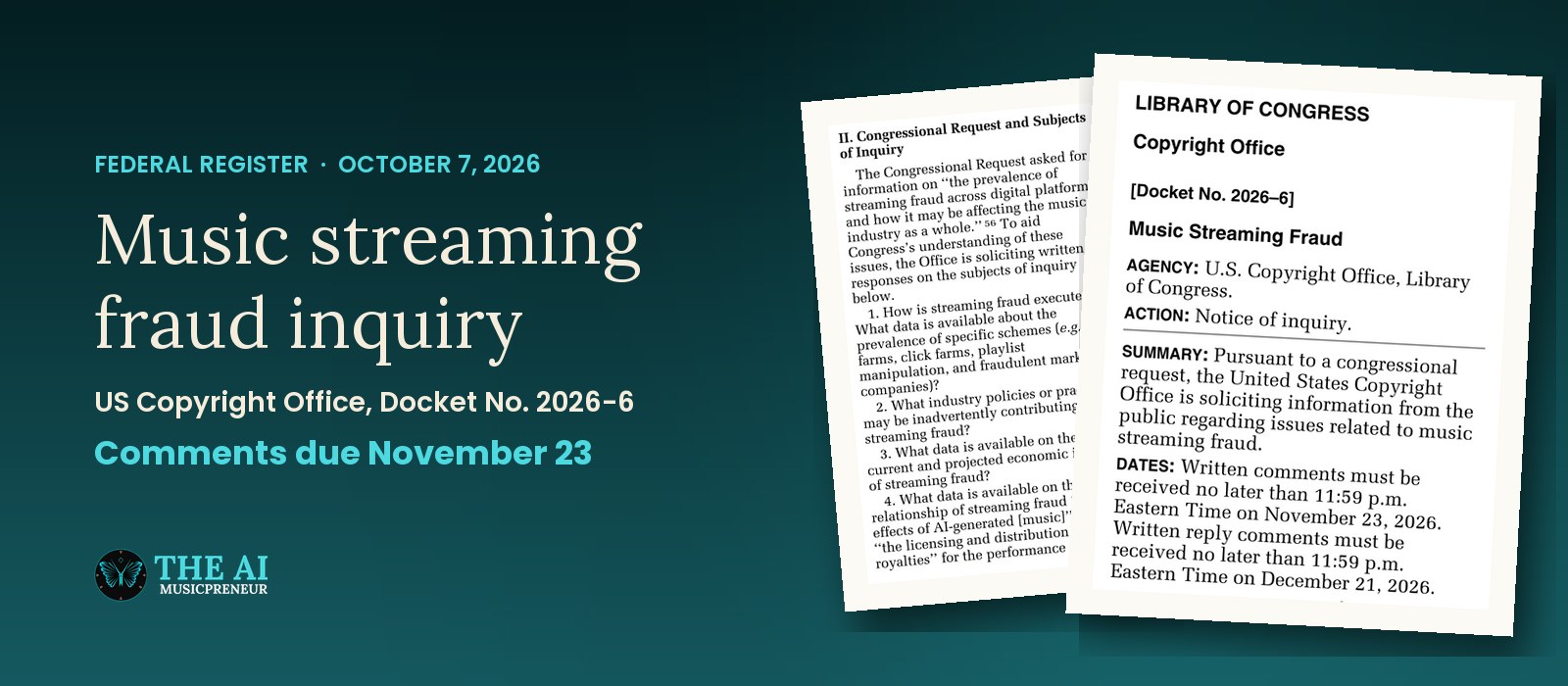
The US Copyright Office opened a public inquiry into music streaming fraud on Wednesday, October 7, 2026, and anyone can send it comments until November 23, 2026.
The notice of inquiry, Docket No. 2026-6, asks 10 sets of questions: how fraud schemes work, what they cost, how AI-generated music feeds them, and what Congress could do about it. Reply comments are due December 21, 2026.
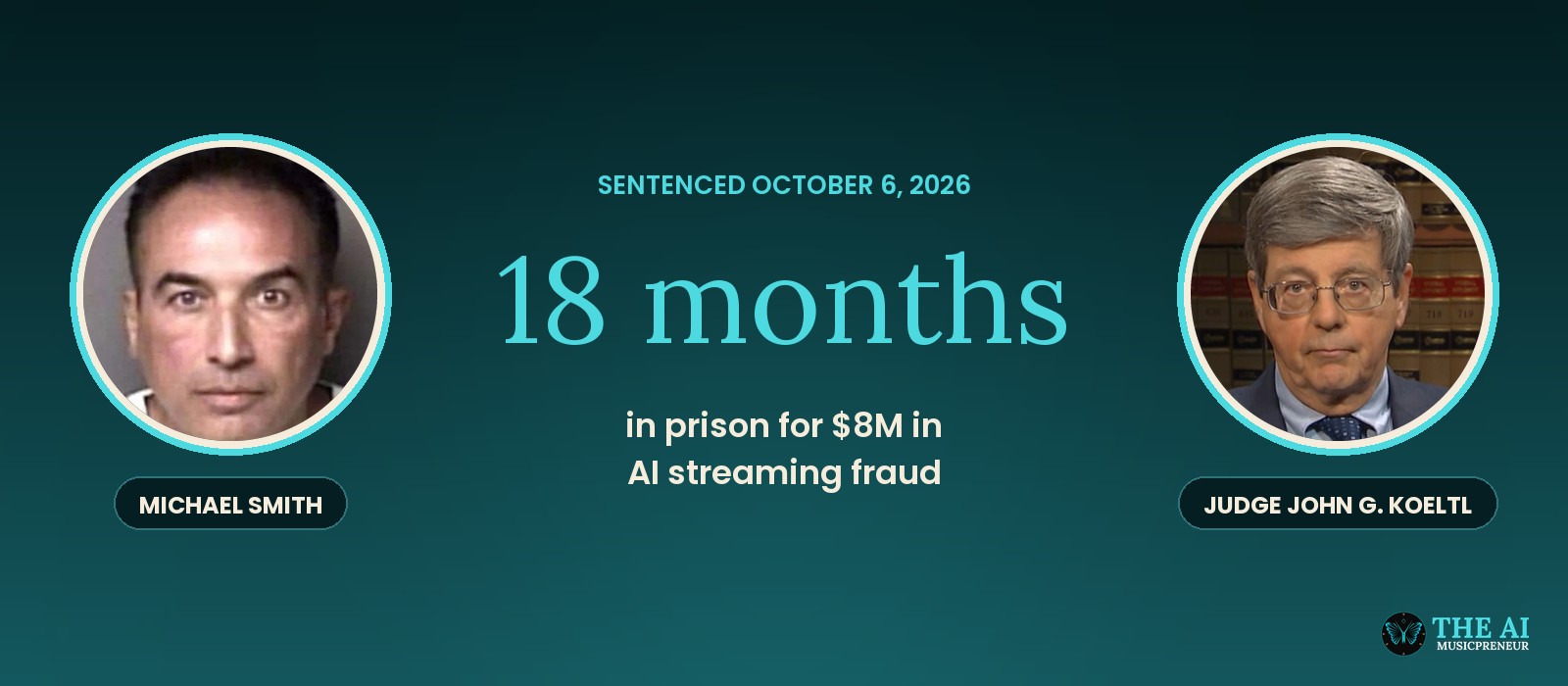
It landed one day after Michael Smith got 18 months in prison for his AI song and bot scheme, and the notice names his case as its high-profile example. The headline number comes from Deezer.
Why Rep. Scott Fitzgerald asked the US Copyright Office to examine AI streaming fraud
The inquiry exists because a congressman asked for it. Rep. Scott Fitzgerald (R-Wis.), who sits on the House Judiciary Committee, wrote to the Office on May 21, 2026.
His 4-page letter asks the Office to examine “the contributory effects of artificial intelligence (AI) in music streaming fraud.” He’s careful not to blame AI music itself. There is “nothing inherently wrong with using AI as a creative tool in music development,” he writes, but “generative AI can serve as a catalyst for criminals to perpetrate streaming fraud.”
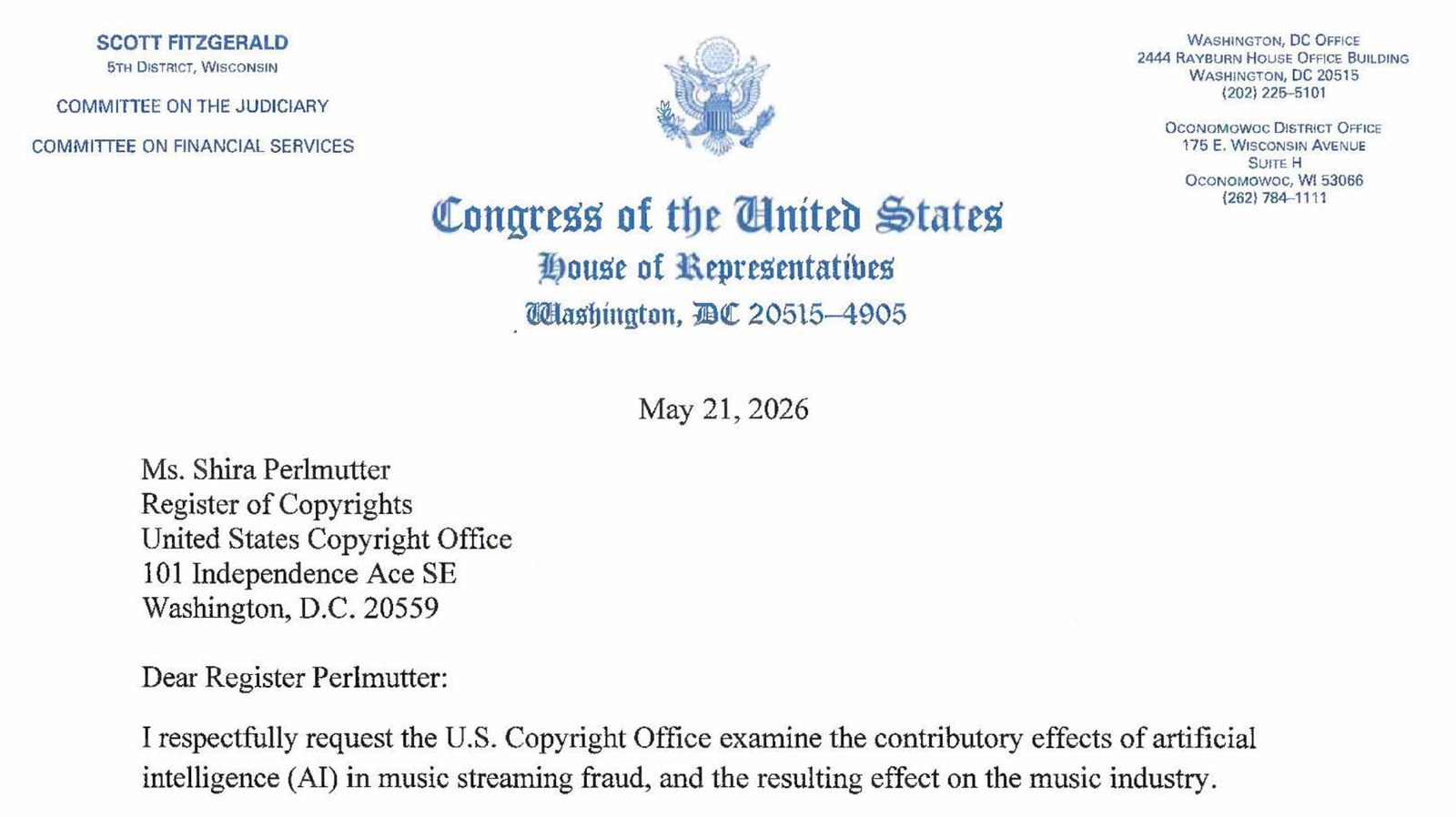
His evidence is mostly Deezer’s. Deezer’s January report found up to 85% of streams on AI-generated tracks were fraudulent in 2025, and by April nearly 44% of its daily uploads were AI-generated. He adds that Apple Music reportedly demonetized 2 billion fraudulent streams in 2025 alone.
A Fitzgerald letter has put the Office to work before. His September 2024 letter with Jim Jordan and Darrell Issa led to a 2025 inquiry into performance rights organizations, which drew more than 5,000 comments.
So what does a fake stream actually take from a real artist?
How streaming fraud takes money from independent artists in the pro-rata pool
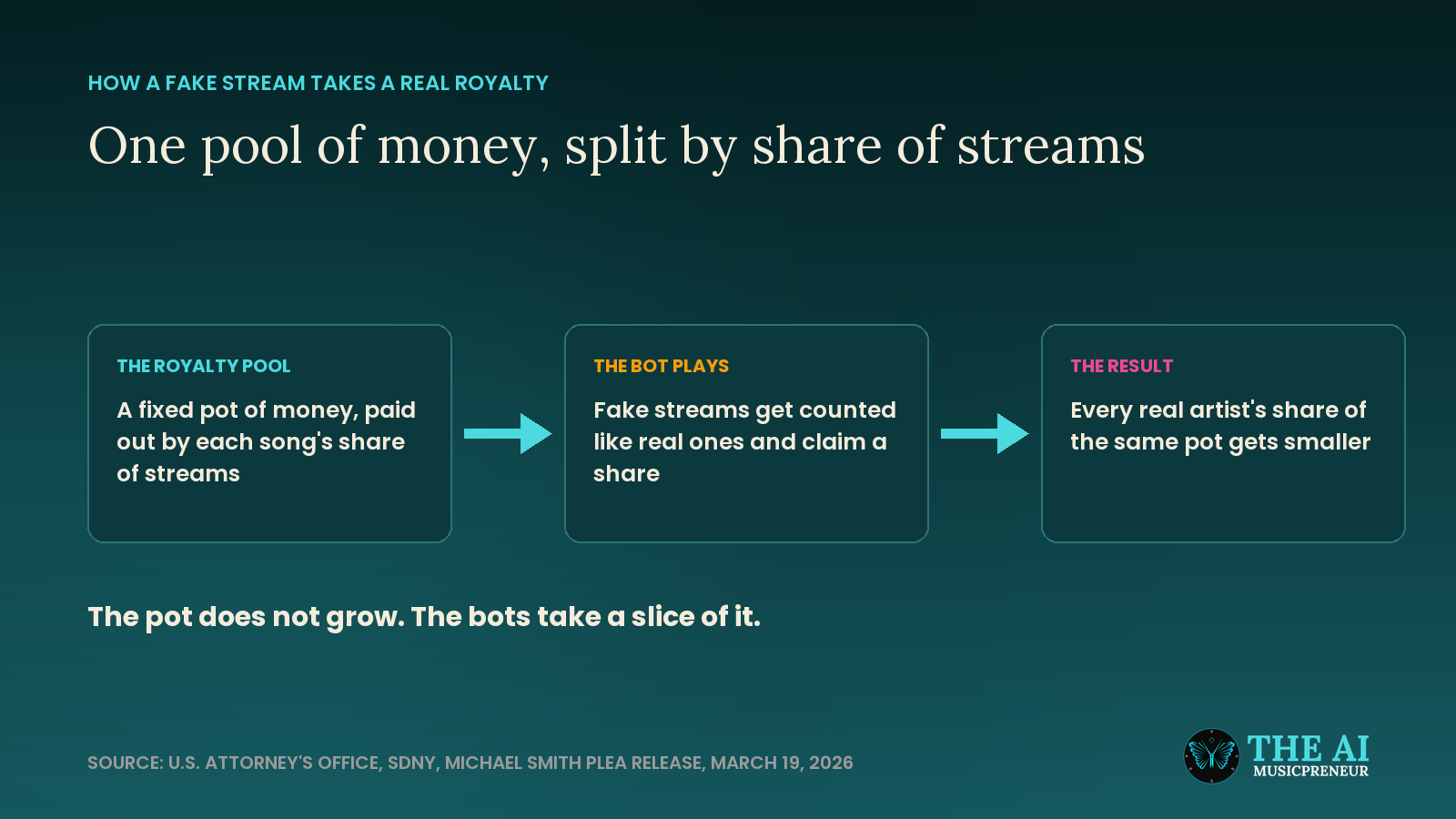
The notice spells out how the money moves. Streaming services set aside a percentage of their revenue as royalty pools, and under this “pro-rata” system, the more a song is played, the more its rightsholders get.
So every bot play takes a slice of the same pot, and every real artist’s share gets smaller. The Office calls this “the dilution of the royalty revenue pool” and lists it as the primary harm.
Across its whole catalog, Deezer says fraud made up 8% of all streams in 2025.
When AI-generated outputs compete against human-made works, they divert money from a finite royalty pool that would otherwise be distributed to actual rights holders.
If you release independently, there’s a second hit. The notice lists secondary harms too: fake plays push real songs down playlists and algorithm queues, and they distort the streaming data artists and venues use to decide “when and where to tour.”
The 10 questions in the US Copyright Office streaming fraud notice
Most of the Office’s 10 subjects of inquiry ask what data exists. Here they are, shortened:
- How fraud is executed, and how common bot farms, click farms, playlist manipulation and fraudulent marketing companies are.
- Which industry policies or practices may be “inadvertently contributing” to it.
- The current and projected economic impact.
- How fraud relates to AI-generated music and to royalties for songs and recordings.
- How it affects live music: venue choice, ticket sales, and food, merch and parking sales.
- Which anti-fraud methods work, from trusted distributors and customer checks to royalty clawbacks, fines, takedowns and outside vendors like Beatdapp.
- How shared data could help, including “a shared database to track instances of known streaming fraud.”
- Voluntary, statutory or regulatory fixes, including no-fault injunctive relief.
- Criminal enforcement, from state and local prosecutions to organized crime.
- Anything else Congress should do.
Question 2 is the one I’d watch. It invites the industry to say where its own rules feed the problem, and the notice already footnotes Universal’s lawsuit against DistroKid as the counterexample to labels and distributors working together.
Some private fixes already exist. IFPI launched its Streaming Integrity Initiative in September, indie label think tank ORCA wants a per-track upload fee, and LANDR says Spotify-flagged fake streams on its releases fell 95%.
How to file a comment in the Copyright Office streaming fraud inquiry before November 23, 2026
You don’t need a lawyer or a trade body to file. Here’s the process from the Office’s comment instructions:
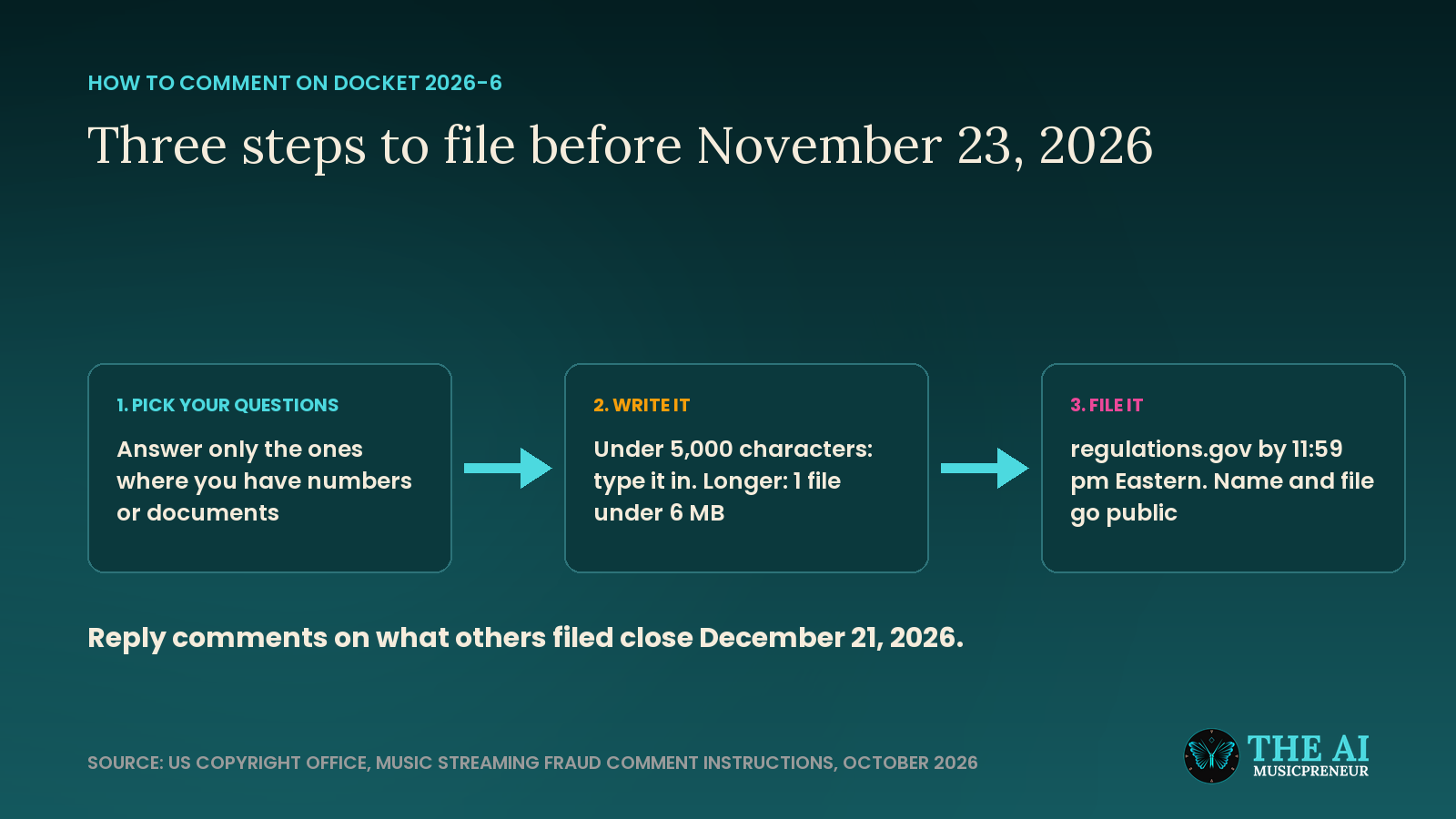
- Open the regulations.gov comment form for the streaming fraud docket.
- For a short comment, type it into the Comment field, up to 5,000 characters.
- For anything longer, upload 1 file under 6 MB (searchable PDF, Word, RTF or plain text) with your name, and your label’s name if you have one, at the top. Leave the Comment field empty.
- Filing as yourself, enter your first and last name and leave “I am submitting on behalf of a third party” unchecked. Filing for a label, tick that box and add the label in “Organization Name.”
- Submit before 11:59 pm Eastern on November 23, 2026.
One caveat: everything you submit goes public, your name and your file included.
So what’s worth sending? Numbers. Question 6 asks how well royalty clawbacks, fines and takedowns work. If your distributor ever pulled a track or clawed back royalties over bot streams you didn’t buy, that’s the evidence the Office is asking for, with dates and amounts.
Same if someone uploaded a sped-up copy of your song. The notice covers that kind of “carbon copying” too, and here’s how to report a fake of your own song.
I’d bet labels, streaming services and distributors all file. If independent artists don’t, Congress only hears from the companies that run the pool. You have until November 23.
Frequently asked questions
When are reply comments due in the US Copyright Office music streaming fraud inquiry?
Reply comments are due by 11:59 pm Eastern Time on December 21, 2026. They are the second round, where commenters respond to what others filed by the November 23, 2026 deadline. Both rounds go through regulations.gov.
Which bills does the US Copyright Office's streaming fraud notice point to?
Question 8 of the notice asks whether a remedy like no-fault injunctive relief could address streaming fraud. Its footnote points to the Block Bad Electronic Art and Recording Distributors Act discussion draft from 2025, the American Copyright Protection Act of 2026 (H.R. 10364) and the DEFEND IP Act (H.R. 10575) as examples.
What streaming fraud fines does the US Copyright Office notice cite for Apple Music and Spotify?
The notice cites a February 2026 report that Apple Music doubled its fraud fees to a sliding scale of 10% to 50%. It also cites a report that Spotify charges distributors $10 per track with detected fraudulent streams. Both are listed as examples of fines services already use.
Has a letter from Rep. Scott Fitzgerald started a US Copyright Office inquiry before?
Yes. A September 2024 letter from Scott Fitzgerald, Jim Jordan and Darrell Issa led the Office to open an inquiry into performance rights organizations in February 2025. That inquiry drew more than 5,000 public comments, and the Office sent Congress a summary in November 2025.
About the author

Covering AI music tools, industry shifts, and news for music creators and professionals. Twice-weekly newsletter at aimusicpreneur.com.