The MLC says Udio's streaming-data subpoena would take 2 to 3 weeks of staff time at $150 to $315 an hour

My stack My fav 6 tools for AI music after testing 70+
-
 ElevenMusic · Music generation
-
 Moises · Stem separation
-
 Controlla · Voice swap & cloning
-
 Cryo Mix · Mixing + mastering
-
 Neural Frames · Music videos
-
 ONCE · Distribution
Some links are affiliate links — I earn a commission at no cost to you. Every tool here is one I run myself and truly believe in. This stack is proven.
The Mechanical Licensing Collective (MLC) says handing Udio its streaming data would take “approximately two to three weeks of staff time,” from staff paid $150 to $315 an hour. That’s from the MLC’s formal opposition to Udio’s motion in Nashville federal court, as Digital Music News reported on November 3, 2026.
In July, the MLC’s own lawyer had passed on a vendor estimate of about $5,000.
Udio, through its parent company Uncharted Labs, wants documents “sufficient to show Performance Data for all Labels in Your Database on a monthly basis for the period 2021 to present.” Suno wants the same thing, and I covered its side in October: Suno’s motion to force the MLC to hand over 8 platforms’ data.
Why the MLC says Udio asked the wrong organization for label data
The MLC’s main argument is that Udio’s “request rests on its fundamental misunderstanding of The MLC’s role.”
Every song you stream carries 2 copyrights. The musical work is the song itself, the melody and the lyrics, and it belongs to songwriters and publishers. The sound recording is the specific recorded track, and that’s usually the label’s.
The MLC is the nonprofit the US Copyright Office designated under the Music Modernization Act to collect and pay mechanical royalties on the first one. So when Udio asks it for label data, the MLC says Udio is asking about the wrong copyright.
The MLC administers royalties for musical works, not sound recordings.
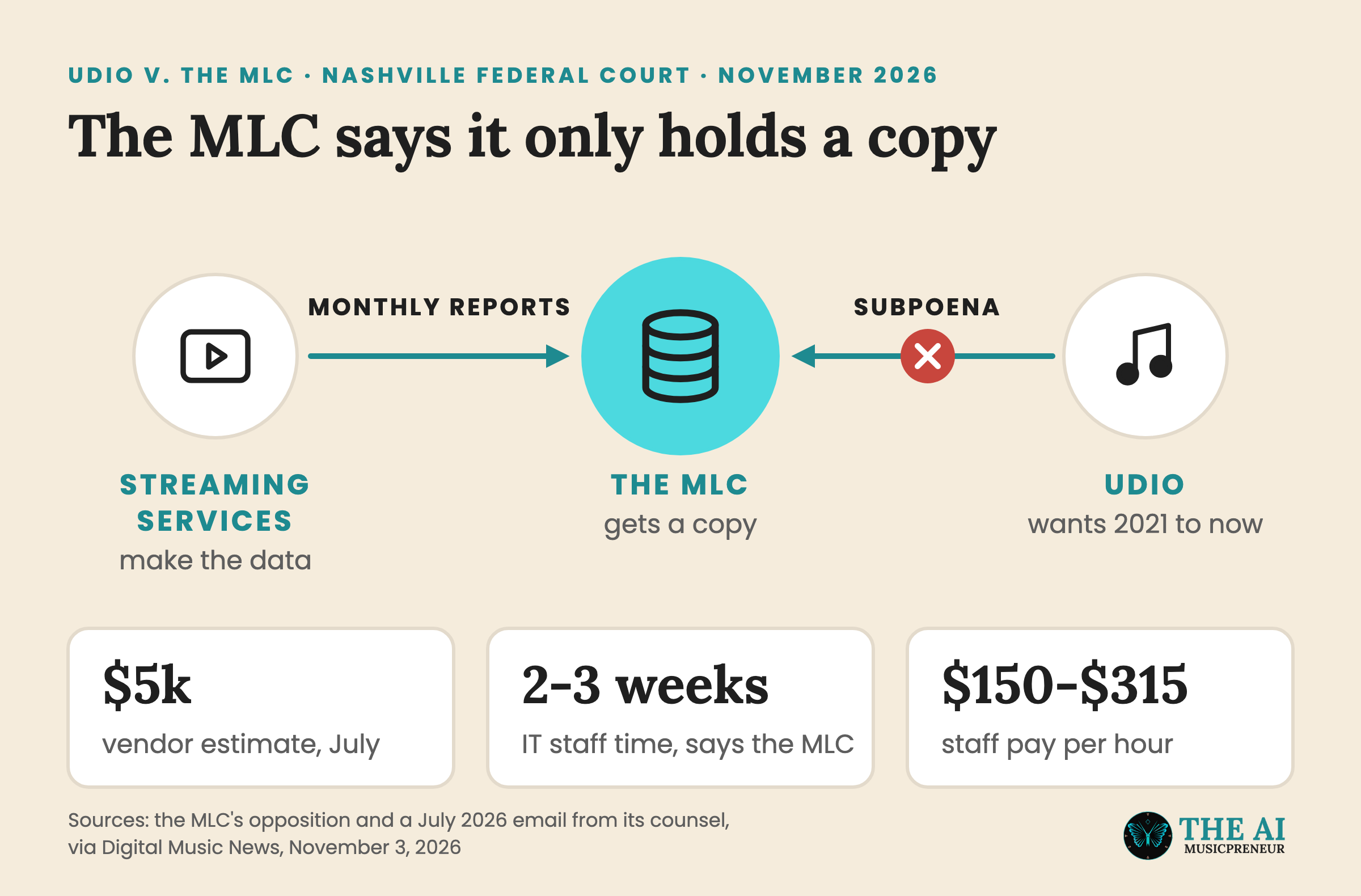
It also says it doesn’t create the numbers. The MLC “receives copies of monthly usage reports submitted by digital service providers,” and those reports hold “duplicated information already possessed by the DSPs themselves, including any reported label information.” DSPs are the streaming services: Spotify, Apple Music, Amazon, YouTube and the rest.
That leaves the price, which has moved a long way since the summer.
How the MLC’s cost estimate for Udio’s subpoena grew from $5,000
In July, Pryor Cashman’s Benjamin Semel, writing for the MLC, sent an early number to Chris Campbell of The Campbell Firm, who represents both Udio and Suno: “We got one heavily caveated estimate from a vendor of approx $5k in services and $100+/TB/mo AWS hosting.” He added that this “is not a standard ediscovery service” (ediscovery is collecting electronic files for a lawsuit) and that it “has never been done before.”
Then the streaming services pushed back. Pandora’s counsel told MLC assistant general counsel Dustin Kovacic in July that “Pandora does not consent to any production that includes Pandora data,” according to earlier DMN reporting. Apple Music objected too, and Apple is separately fighting a Suno subpoena of its own.
Now the MLC puts the job at 2 to 3 weeks, citing an estimate from its “information technology employees.” “The hourly pay rate of the staff who would be tasked to work on such a project ranges from $150 to $315 per hour,” it told the court, and that staff “would be diverted from their regular duties at The MLC.”
If that means one person working full-time, 2 to 3 weeks is 80 to 120 hours. At those rates it comes to $12,000 to $37,800, by my math. The filing, as Digital Music News quotes it, doesn’t say how many people would work on it.
Money alone may not settle it. In a September 23 letter cited in Suno’s motion, Campbell wrote that his clients had agreed to pay the MLC’s costs, and the MLC still calls the burden “substantial.”
Why Udio wants the MLC’s streaming data in its fight with Sony Music
Sony Music is the last major label suing Udio. Universal and Warner settled in late 2025, and Sony now has 2 lawsuits against Udio in New York.
Udio’s answer to Sony’s second lawsuit leans on fair use and adds a copyright misuse defense, accusing Sony of using its copyrights to extend a monopoly over music production. Digital Music News says both AI companies see the MLC’s numbers as relevant to exactly those 2 defenses.
Market harm is one of the 4 fair use factors a US court weighs. Suno has described the same data as showing “what actually occurred before and after AI-generated music arrived.”
Udio’s own motion wasn’t public on CourtListener when I checked the Nashville docket in October, so the record doesn’t show which of Sony’s 2 cases the subpoena was issued in.
What happens next in Udio’s subpoena fight with the MLC
Chief Judge William L. Campbell Jr. of the Middle District of Tennessee has both fights. Udio filed first, on October 1, in case 3:26-mc-00020. The court ordered a hearing there on October 21, and Suno’s matching case was reassigned to the same judge on October 22.
In Suno’s case, the MLC agreed to respond by November 2, though the judge hadn’t approved that schedule when DMN reported it on October 30.
Next, Udio can answer the MLC’s cost numbers in a reply, and then Judge Campbell decides whether the MLC has to produce anything. The labels are chasing data of their own at the same time, from DistroKid and Suno’s investors. I log every step on the Udio lawsuit tracker.
If Judge Campbell agrees with the MLC, the place left to get those play counts is the streaming services themselves, and Pandora has already said no.
Frequently asked questions
Who represents Udio and Suno in their subpoena fights with the Mechanical Licensing Collective?
Both AI companies use the same lawyer, Chris Campbell of The Campbell Firm. The MLC is represented by the law firm Pryor Cashman, whose attorney Benjamin Semel sent the July 2026 email with the $5,000 vendor estimate.
Did Pandora agree to share its data in Udio's subpoena fight with the Mechanical Licensing Collective?
No. In July 2026, Pandora's counsel told MLC assistant general counsel Dustin Kovacic that Pandora did not consent to any production that included Pandora data, according to Digital Music News. Apple Music also pushed back on the request.
Does the Mechanical Licensing Collective pay royalties to record labels?
No. The MLC licenses streaming services and pays mechanical royalties for musical works, the songs themselves, to songwriters and publishers. Royalties for sound recordings, the recorded tracks labels own, go from the streaming services to labels and distributors, or through SoundExchange for radio-style streams.
Which judge will rule on Udio's subpoena motion against the Mechanical Licensing Collective?
Chief Judge William L. Campbell Jr. of the US District Court for the Middle District of Tennessee. Udio's case, Uncharted Labs v. Mechanical Licensing Collective, is No. 3:26-mc-00020, and Suno's related case was reassigned to him on October 22, 2026.
About the author
Covering AI music tools, industry shifts, and news for music creators and professionals. Twice-weekly newsletter at aimusicpreneur.com.