Elvis Presley Enterprises sues Suno over voice cloning under the ELVIS Act, as Eminem's publisher seeks $41 million

SIQA Summit, LA, 12th November 2026 Ozzy Osbourne's former bassist is sharing a stage with Suno. I'm moderating:

Blasko
Bassist (Ozzy Osbourne, Rob Zombie)

Sam Berger
Artist Partnerships at Suno

RoccStar
Grammy Award-winning producer and songwriter

Drake Murphy
A&R at PlayPulse / Create Music Group

Janie Jennings
Founder, Creative's Flow Ecosystem

Chris Wieduwilt
Moderator
Limited capacity only
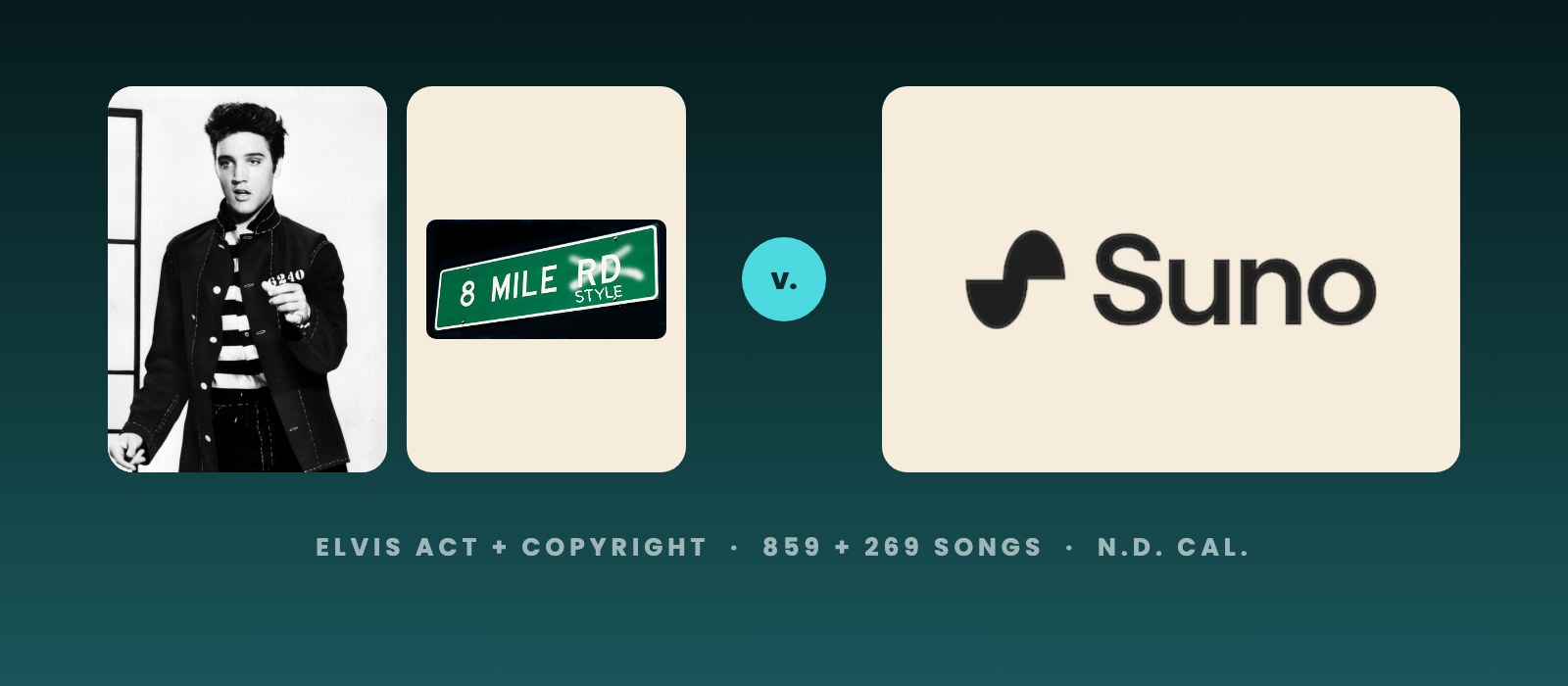
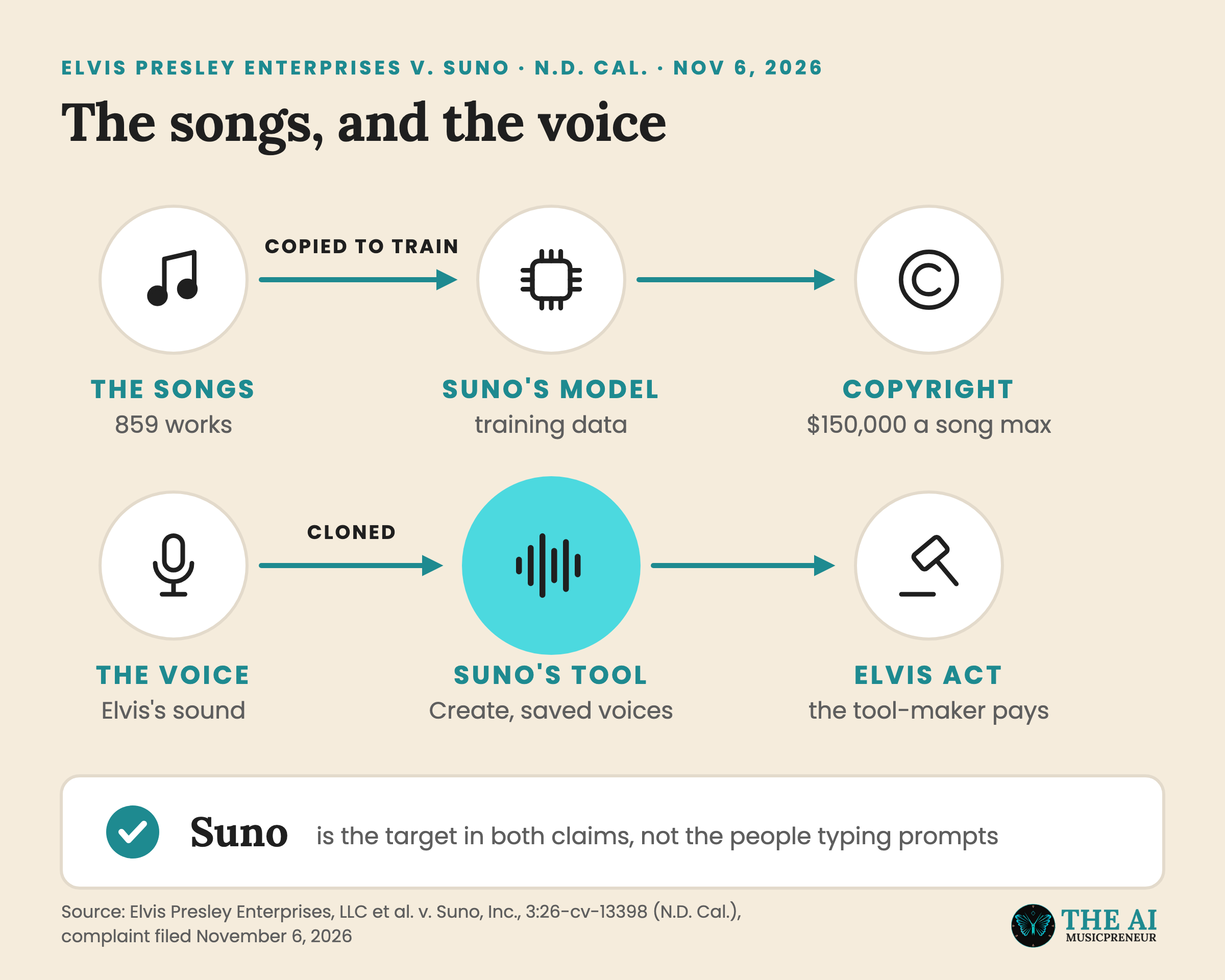
Elvis Presley’s owners sued Suno on Friday, November 6, 2026, and their complaint goes further than copyright. Elvis Presley Enterprises says Suno lets people make new songs in Elvis’s voice, and it’s suing under Tennessee’s ELVIS Act, a 2024 law that can make the company behind a voice-cloning tool pay, not only the person typing the prompt.
The same lawyers filed a second case that night for Eight Mile Style, the Detroit publisher that controls 269 Eminem songs. That one asks for more than $41 million. Both cases sit in the US District Court for the Northern District of California, and Billboard broke the Elvis story on November 7.
The Elvis complaint runs 51 pages, and Memphis station WREG posted the full filing. Everything below is what the plaintiffs allege. Suno hasn’t answered in court yet, and no judge has ruled on any of it.
What the Elvis Presley Enterprises complaint says Suno does with Elvis’s voice
Suno has told courts more than once that it blocks artist names. 3 days before this filing, in its motion to dismiss Jason Isbell’s identity lawsuit, Suno wrote that its outputs “do not replicate the auditory characteristics of any real artist’s voice to the point that someone would confuse a Suno creation with one actually sung by a particular famous musician”.
The Elvis complaint quotes that line and calls it “unequivocally false”. Then it attaches 47 recordings across 4 exhibits:
- 5 that copy both his voice and his songs, including “Elvis Presley - Blue Suede Sin Medley”, which the complaint says borrows from “Can’t Help Falling in Love”, “All Shook Up” and “Don’t Be Cruel”.
- 33 that use his voice, including “Elvis in The Jailhouse Rock”, which the complaint says was still live on Suno with more than 125,000 plays.
- 9 that copy his songs, including several versions of “If I Can Dream”.
The example I’d point any Suno user to is paragraph 25. On October 7, 2026, the plaintiffs gave Suno nothing but a lyric that spelled out “E L V I S P R E S L E Y” and ended “But he is still the King”. They say it returned 2 songs called “He Is Still The King”, both sung in what the complaint calls “Elvis’ unmistakable and iconic voice”.
Those … are NOT examples of Elvis Presley singing. They are synthetic and unlicensed uses of Elvis' voice and likeness. There are hundreds to thousands more like it.
So if the voice is the evidence, the law has to be one that covers voices.
Why the ELVIS Act can make Suno pay for voice cloning, not its users
The right of publicity is the law that stops a company from using your name, face or voice to sell something without your permission. Older versions mostly covered ads. The ELVIS Act (Ensuring Likeness, Voice, and Image Security) names the voice outright, and it adds a clause for anyone who makes available a tool whose “primary purpose” is producing an identifiable person’s voice without permission.
That clause is the heart of this case. The complaint says plainly that its claims are about “Suno’s own conduct, not any act by a user”.
A Tennessee law can apply in a California court because Presley died a Tennessee resident, so Tennessee decides who controls his likeness. The complaint also says the state asked Elvis’s rights holders for permission before naming the law after him.
On money, Elvis Presley Enterprises puts its ELVIS Act damages at more than $50 million, and then asks for that amount tripled. The reason is the most unusual paragraph in the filing: Elvis served in the US Army from about March 1958 to March 1960, and the complaint argues that makes him a “member of the armed forces” under the law’s enhanced-damages provision.
The copyright side works like every other Busch case. Up to $150,000 per song for willful infringement, $2,500 for getting around YouTube’s download protection and $25,000 for stripping songwriter credits, across 859 songs. Some of those 859 belong to co-plaintiff Raleigh Music Publishing rather than to Elvis’s catalog.
What Eight Mile Style says Suno did with 269 Eminem songs
Eight Mile Style is a Ferndale, Michigan publisher that controls about 270 Eminem compositions, including “Lose Yourself”, “Without Me”, “‘Till I Collapse”, “The Real Slim Shady” and “Stan”. Its 32-page complaint landed late on November 6, according to the Detroit Free Press. Eminem himself isn’t a party, Variety reports.
This complaint is about the name filter. You can’t type “Eminem” into Suno, but Eight Mile Style says a string like “aggressive rap, rapid-fire flow, dark humor, male rapper, horrorcore, intense beat, bass-heavy, menacing, controversial” gets you a Slim Shady-style track anyway.
Its examples include a Suno song called “Slim shady x Rosefalls” with AI-generated Eminem cover art and vocals “clearly derived from Eminem’s actual voice”, plus outputs with verbatim or near-verbatim lyrics from “Lose Yourself”, “The Real Slim Shady” and “Houdini”.
On training, it quotes Suno’s own court disclosure that its model learned from “essentially all music files of reasonable quality that are accessible on the open Internet”. CBS Detroit adds that it cites a 404 Media report on Suno using a service to scrape “millions of songs and lyrics” from YouTube Music, Deezer and Genius.
How Suno answered, and Richard Busch’s 5 lawsuits against Suno since August
Suno sent the same statement to CBS News and Variety:
“Suno exists to help people create new, original music, not to trade on anyone’s name or likeness, and we prohibit any unauthorized use of an artist’s work. To protect against this, we do not allow prompts for specific artists’ names and songs and work with third-party providers to screen uploaded audio files and lyrics for potential misuse.”
The filter does exist, and I tested it myself on November 5. I typed “Metallica like song” and Suno told me “We don’t reference artists directly”, then swapped in heavy metal, thrash metal, hard rock and speed metal. Both complaints are built on the cases where a name, a spelled-out name or a pile of style words got through anyway.
Richard Busch, the lawyer behind both suits, has now filed 5 cases against Suno in 12 weeks:
The same Elvis owners sued Anthropic over 274 songs in October, which I covered when that complaint landed. Like Reservoir’s Suno complaint, the Elvis filing asks the court to impound copies of the songs held in Suno’s model weights, not only in its training files.
Nobody in either case is suing Suno users, and no hearing date is set. I’m tracking both on the new Elvis Presley Enterprises v. Suno tracker and the Eight Mile Style v. Suno tracker.
Frequently asked questions
What is the case number of Elvis Presley Enterprises v. Suno, and which court is hearing it?
The case is Elvis Presley Enterprises, LLC et al. v. Suno, Inc., number 3:26-cv-13398, in the US District Court for the Northern District of California. It was filed on November 6, 2026 with a 51-page complaint and a demand for a jury trial. The co-plaintiffs include ABG EPE IP LLC, Raleigh Music Publishing and several songwriter trusts.
Why does the Elvis Presley complaint against Suno mention his time in the US Army?
Elvis Presley Enterprises asks for treble damages under the ELVIS Act's enhanced-damages provision. The complaint argues Presley qualifies as a member of the armed forces under Tennessee law because he served on active duty from about March 1958 to March 1960. No court has ruled on that argument.
Is Eminem a plaintiff in Eight Mile Style's lawsuit against Suno?
No. Eight Mile Style, the Ferndale, Michigan publisher that controls about 270 of his compositions, is the plaintiff. Variety reported that Eminem is not individually participating in the suit and that his representative did not respond to a request for comment.
Does the Elvis Presley Enterprises lawsuit ask the court to destroy Suno's AI model?
It asks for impoundment or destruction of every unauthorized copy of the songs, including copies held in training datasets, internal repositories, model weights and server infrastructure. It also asks for an injunction against further use of Elvis Presley's name, image, voice and likeness. Round Hill and Reservoir made similar requests in their own Suno cases.
About the author
Covering AI music tools, industry shifts, and news for music creators and professionals. Twice-weekly newsletter at aimusicpreneur.com.