Elvis Presley Enterprises' amended Suno complaint grows its evidence from 50 recordings to 164

My stack My fav 6 tools for AI music after testing 70+
-
 ElevenMusic · Music generation
-
 Moises · Stem separation
-
 Controlla · Voice swap & cloning
-
 Cryo Mix · Mixing + mastering
-
 Neural Frames · Music videos
-
 ONCE · Distribution
Some links are affiliate links — I earn a commission at no cost to you. Every tool here is one I run myself and truly believe in. This stack is proven.
Elvis Presley’s owners didn’t wait for Suno to answer. On November 13, 2026, one week after they sued Suno under Tennessee’s ELVIS Act, Elvis Presley Enterprises and its co-plaintiffs filed a First Amended Complaint that grows their evidence from 50 recorded Suno outputs to 164.
The new filing adds at least 42 more outputs of songs that are in the case, including a full “Can’t Help Falling in Love” in a simulated Elvis voice. It also adds 72 outputs of Elvis songs the plaintiffs aren’t suing over, which they say show how far the copying goes.
What didn’t change is the money. The case still covers 859 works, for up to $128.85 million in statutory copyright damages plus $23.6 million under the DMCA, and ELVIS Act damages the plaintiffs believe exceed $50 million. Digital Music News reported the amendment on November 16, and I read the 53-page amended complaint against the original to see what’s actually new.
What the amended Elvis Presley Enterprises complaint adds against Suno
Every recording in the case sits in a lettered exhibit, and the amendment adds 6 new ones, G through L. The original complaint had exhibits A to E with 50 recordings: 47 aimed at Elvis’s voice and songs, plus 3 for co-plaintiff Raleigh Music Publishing.
Here’s how the count moves, group by group:
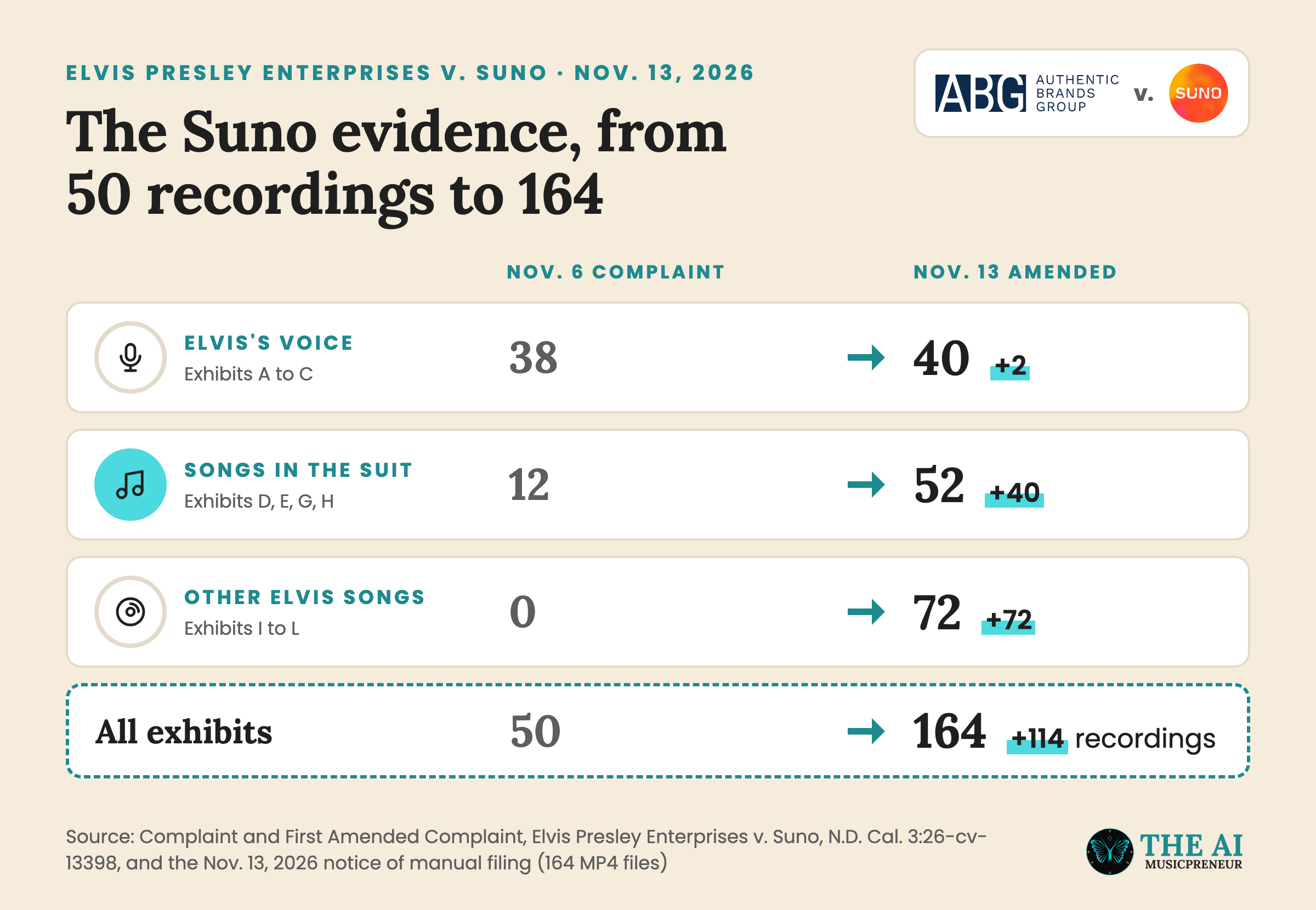
The biggest jump is in songs that are part of the case. Exhibits D, G and H now hold 48 recordings the plaintiffs say copy Elvis songs they own, up from 9 in Exhibit D alone. The voice exhibits, A to C, go from 38 to 40, and Raleigh’s Exhibit E goes from 3 to 4.
Exhibits I to L are new territory: 72 outputs of Elvis songs that aren’t among the 859 works. The complaint says they’re there “to show the breadth of the infringement Suno engages in” and to back up its claim that the copying was willful, which is what unlocks the top statutory rate of $150,000 per work.
All 164 files went to the court as MP4 videos. A notice filed the same day says the plaintiffs sent them in 11 batches through a court Box link, because of a 20-file limit per upload, and mailed a flash drive with the full set to the judge’s chambers.
The new Suno outputs the amended Elvis complaint singles out
The complaint names a few of the new recordings in its text. Exhibit A-5 is what the filing calls a “complete reproduction” of “Can’t Help Falling in Love”, with the full lyrics, a slightly reworded first line and a simulation of Elvis’s voice. Digital Music News reports that the Suno page shown in that video carries a February 2026 creation date.
Exhibit H-8, a Suno output titled “Recording session”, explains an odd overlap in the numbers. The complaint says that single track copies 7 Elvis songs, 5 of them in the case and 2 that aren’t.
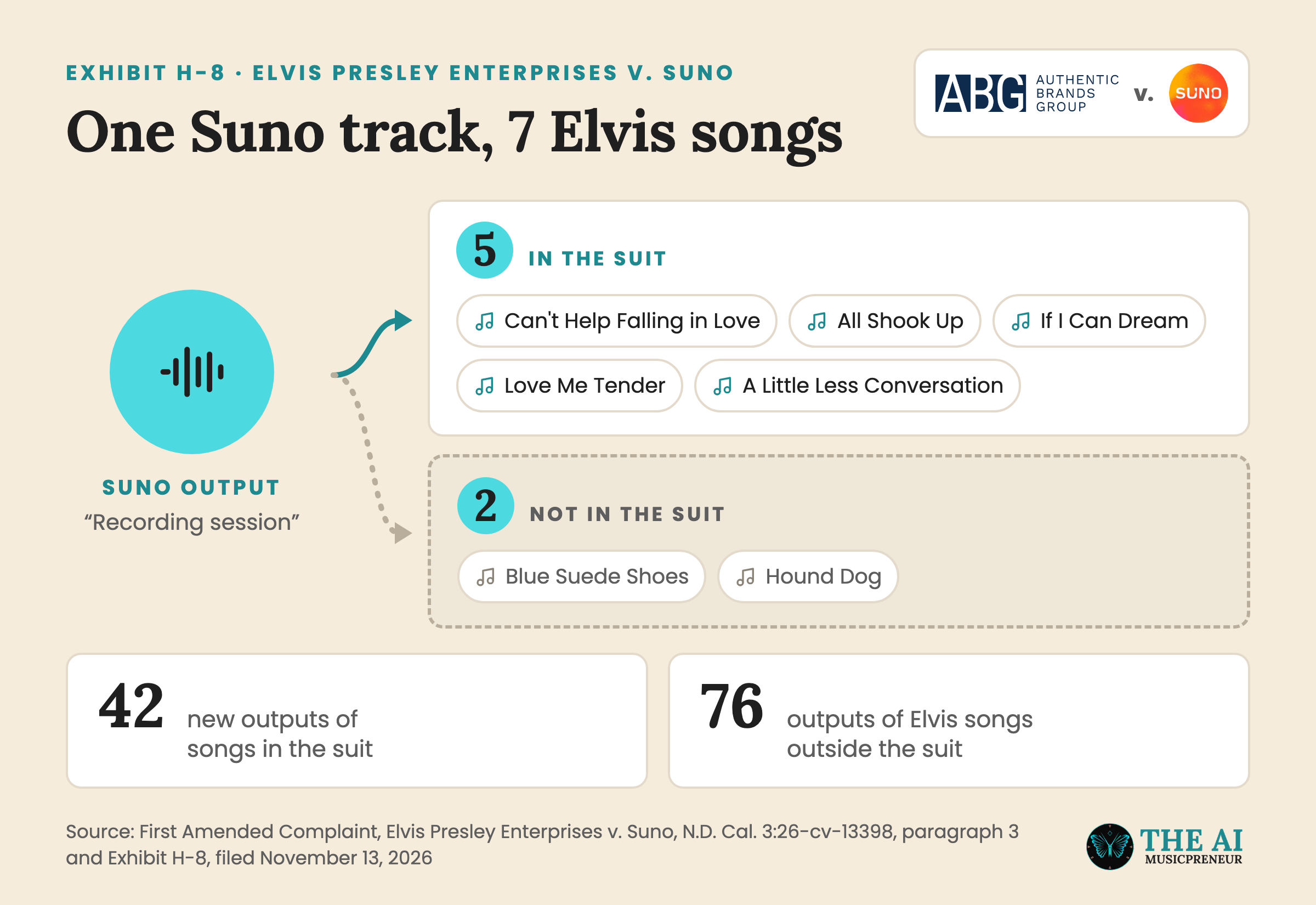
That’s why the complaint counts 76 outputs of songs outside the suit, not 72. H-8 and 3 medleys from the original filing, Exhibits A-1, A-3 and A-4, land in both groups.
2 smaller additions target the voice claim. Exhibit C-13, “That’s when my heartache begins – reworked”, is described as a new example of Elvis’s simulated voice laid over a song he recorded that the plaintiffs don’t own. And a footnote says Exhibit G-2, “Falling in Love with You”, simulates his voice in the first 2 lines and throughout.
Can Suno make Elvis Presley songs? Suno’s prompt filter against the 164 recordings
Suno says it doesn’t let you ask. After the original suit, it told press outlets that it doesn’t “trade on anyone’s name or likeness” and doesn’t allow “prompts for specific artists’ names and songs”. The amended complaint calls that a repurposed version of what Suno wrote 3 days before the Elvis filing, in its motion to dismiss Jason Isbell’s lawsuit.
Suno, in a post-filing statement to various press outlets, doubled down on its false claim that its service does not 'trade on anyone's name or likeness'
The name filter is real. Type an artist’s name into Suno and it swaps in genre words instead, which I showed with a Metallica prompt in my first piece on this case.
The complaint’s argument is about what gets through anyway. It says its exhibits come from exactly the kind of prompts for specific artists or songs that Suno told a Massachusetts federal court it has never allowed, and that Suno told Billboard don’t exist.
Whether those outputs break the ELVIS Act is for a judge to decide, and Suno hasn’t answered in court yet. Nobody in this case is suing Suno users.
What happens next in Elvis Presley Enterprises v. Suno
An amended complaint replaces the original, so the November 13 version is now the one Suno has to answer. Under Rule 15 of the Federal Rules of Civil Procedure, Suno’s response is due 14 days after it’s served with the new version, or later if its original deadline runs longer.
The case is assigned to Magistrate Judge Joseph C. Spero, and the CourtListener docket sets November 23, 2026 as the deadline for both sides to consent to him or decline. In Reservoir’s Suno case, Reservoir declined and the case moved to a district judge.
Both cases come from the same lawyer, Richard Busch, who amended Reservoir’s Suno complaint 2 days before this one, also adding recorded outputs. In the Isbell case, Suno’s first response was a motion to dismiss.
I log every filing in this case on the Elvis Presley Enterprises v. Suno tracker.
Frequently asked questions
Did Elvis Presley Enterprises raise its damages demand against Suno in the amended complaint?
No. The First Amended Complaint still lists 859 works in Exhibit F and asks for up to $128.85 million in statutory copyright damages, $2,147,500 for circumvention and $21,475,000 for removing copyright management information. It also still puts ELVIS Act damages above $50 million and asks for them to be tripled.
How did Elvis Presley Enterprises deliver the 164 Suno recordings to the court?
As MP4 video files, lodged manually. A notice filed on November 13, 2026 says the plaintiffs sent them in 11 batches through a court-designated Box link because of a 20-file limit per transmission, and mailed a flash drive with the full set to the judge's chambers. The complaint also links each exhibit as a Vimeo folder.
Why does the amended Elvis Presley Enterprises complaint include Suno outputs of Elvis songs that are not in the lawsuit?
The complaint says Exhibits I to L, 72 outputs of Elvis songs outside the 859 works, are there to show the breadth of Suno's alleged infringement and to support the claim that it was willful. Willfulness matters because it raises the statutory maximum to $150,000 per work. The plaintiffs do not seek damages for those extra songs.
About the author
Covering AI music tools, industry shifts, and news for music creators and professionals. Twice-weekly newsletter at aimusicpreneur.com.