Universal and Sony agree to pause part of the second Suno lawsuit, but not discovery into how v6 was trained

My stack My fav 6 tools for AI music after testing 70+
-
 ElevenMusic · Music generation
-
 Moises · Stem separation
-
 Controlla · Voice swap & cloning
-
 Cryo Mix · Mixing + mastering
-
 Neural Frames · Music videos
-
 ONCE · Distribution
Some links are affiliate links — I earn a commission at no cost to you. Every tool here is one I run myself and truly believe in. This stack is proven.
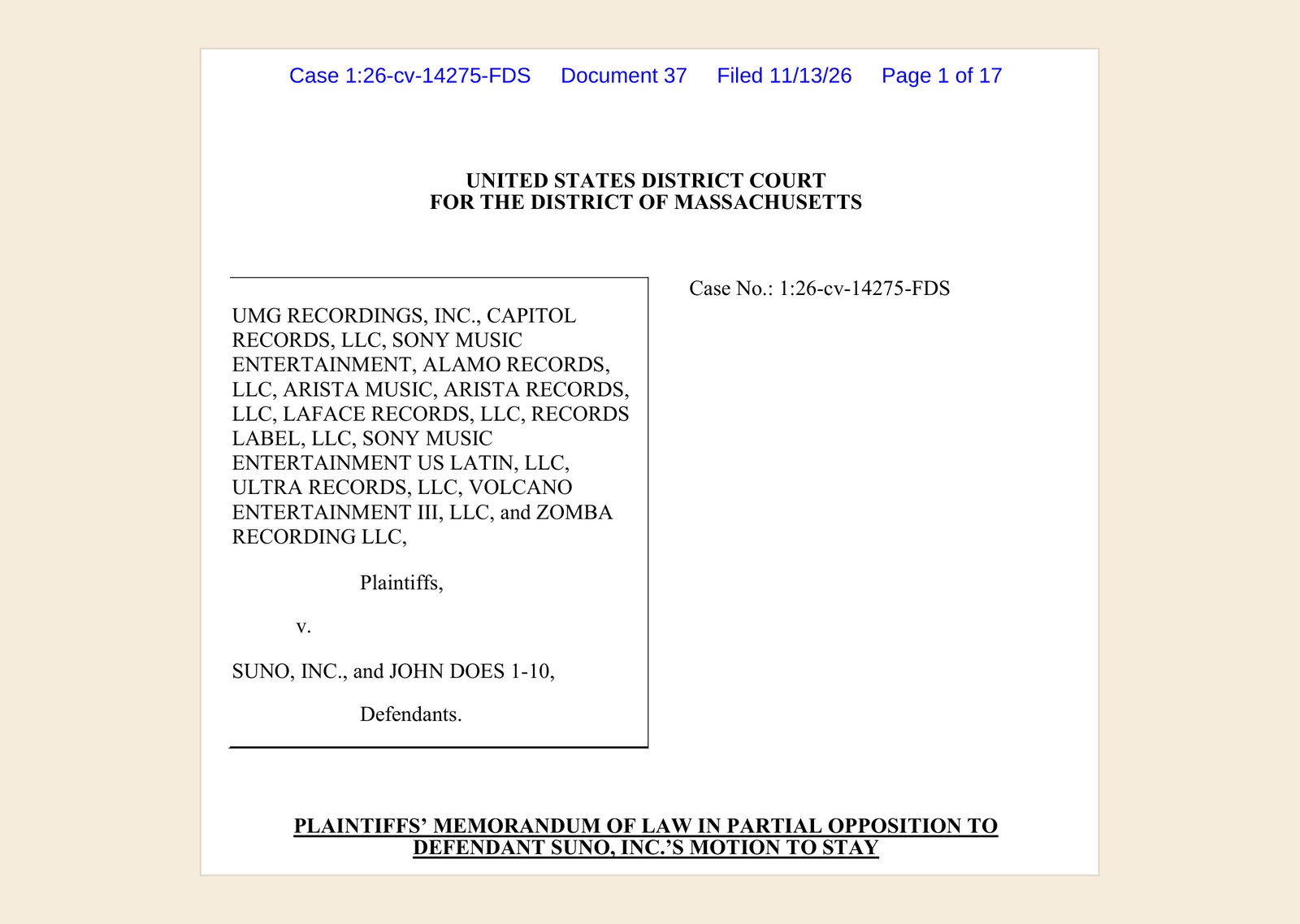
Suno asked a Boston federal judge on October 30, 2026 to pause the second lawsuit Universal Music Group and Sony Music filed against it, the one over 60,202 recordings and the v6 models. On November 13 the labels answered with a counteroffer: the ownership checks on those recordings can wait, but discovery into how v6 was trained should keep going.
“Delay would not merely postpone building the record, it would degrade it,” the labels’ lawyers at Hueston Hennigan wrote in their partial opposition. Suno wants everything on hold until Judge F. Dennis Saylor IV rules on summary judgment in the labels’ first lawsuit, and motions in that case aren’t due until June 22, 2027.
AllHipHop first reported the November 13 filing. I read both sides’ papers on the docket. The fight is over where, if anywhere, v6 gets examined.
Why Suno asked Judge Saylor to pause Universal and Sony’s v6 lawsuit
Suno’s 11-page memo says the second case is “not new.” It names the same defendant and the same claims as the first case, and Suno says the only material difference is 560 works there against more than 60,000 here.
It leans on Saylor’s own words. When he refused to add 61,026 recordings to the first case on August 18, his order said a separate case “could proceed on a different schedule, or indeed be stayed pending resolution of the fair use issue.”
Suno’s logic runs both ways. A fair use win in the first case, or a ruling that YouTube’s “rolling cipher” isn’t a protected technical measure, could knock out claims here too. A loss would make ownership discovery on 60,000 works necessary anyway, so Suno says waiting avoids “expensive, duplicative litigation.”
It also goes after the labels’ “market dilution” theory, the idea that Suno’s outputs hurt their recordings by competing with them even when no output copies a song. Suno cites Bartz v. Anthropic, the US government’s statement of interest in the OpenAI case and the Patry on Copyright treatise, which calls the theory “nuts.”
On the risk of a stale record, Suno says it “is and has been retaining relevant data in accordance with its legal preservation obligations.” It answered the complaint on October 20 with the same defenses it pleads in the first case, fair use first.
The labels don’t disagree with all of that.
What Universal and Sony would pause, and what they want to keep moving in the Suno v6 case
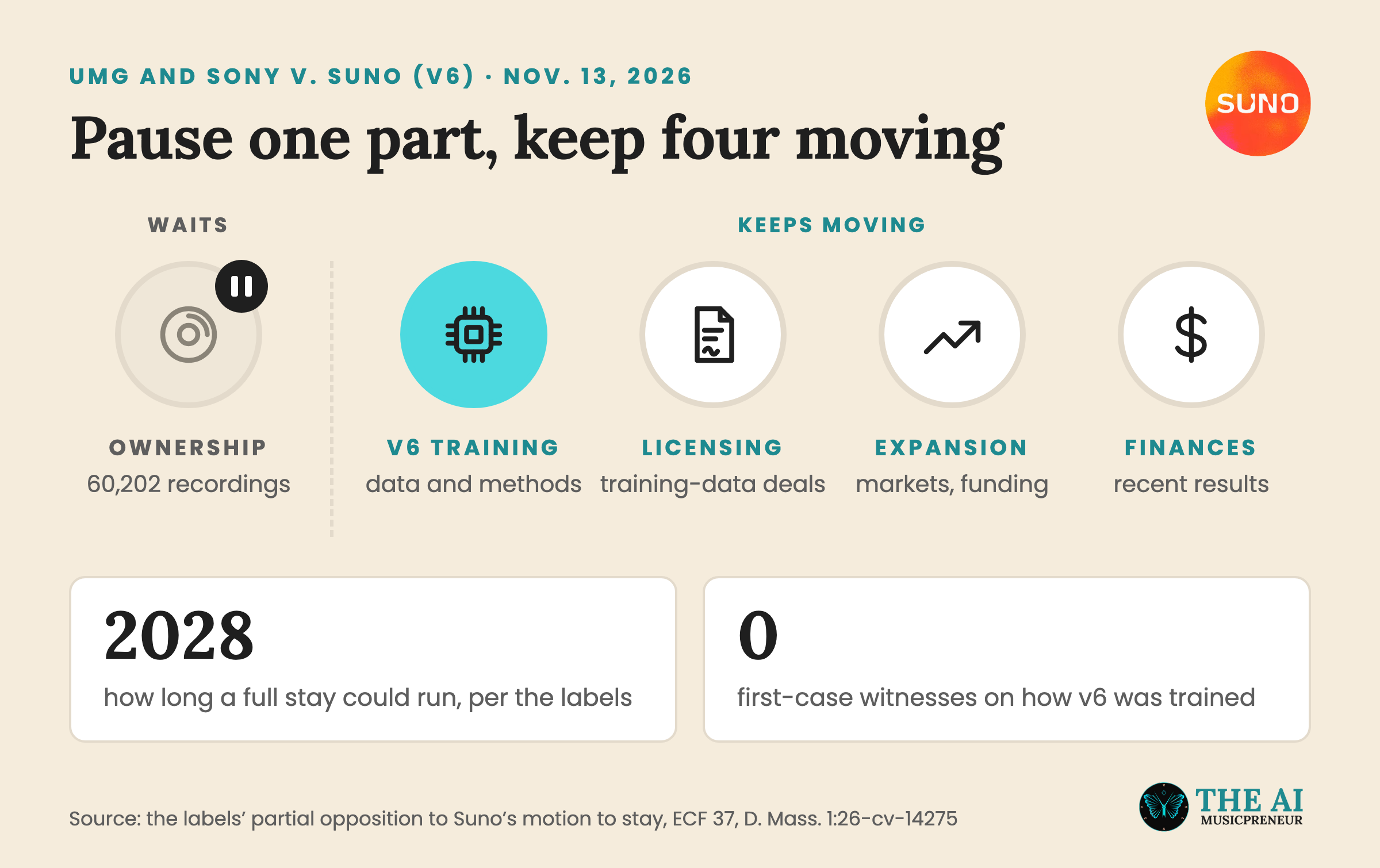
The labels agree the fair use ruling in the first case “will, at the very least, be instructive.” So they accept that discovery into who owns each of the 60,000-plus recordings, known as chain of title, can wait for it.
What they oppose is freezing everything “for a period that could realistically extend into 2028, while Suno continues to train, release, license, and monetize models.” Their plan keeps discovery open on 4 subjects:
- Suno’s newer models, including v6, and the data, methods and provenance behind their training.
- Suno’s efforts to license training data from rightsholders.
- Suno’s expansion into new markets and product features, its funding rounds and what it told investors.
- Suno’s financial condition after the first case’s record closes.
In return, the labels would hand over their own evidence on the market for licensing recordings as AI training data, their deals with AI developers and how AI music affects the value of their catalogues. Everything already produced in the first case would count in this one, so no witness sits twice and no document gets handed over twice.
If Saylor wants a broader stay anyway, the labels have a fallback. They ask for that cross-use order now, a preservation order covering training datasets, model checkpoints, user-interaction and preference data and engineering documents for every Suno model including v5, v5.5 and v6, and a stay that lifts automatically when he rules on summary judgment, not after appeals.
What is discovery in the Suno lawsuit, and why is v6 outside it?
Discovery is the stage of a lawsuit where each side has to show the other what it has. That means handing over documents, answering written questions under oath and putting witnesses in depositions, where they answer on the record.
The labels say the first case’s record stops short of v6, “at Suno’s insistence.” Suno collected its documents in February 2025 and has resisted collecting again. In a February 13, 2026 email, its lawyers agreed to answer key written questions through v5 only.
Its corporate witnesses cover models through v5.5. On v6, they only testify about features tied to Suno’s Warner Music deal and how the training-data mix changed. No witness in the first case has been designated to testify about how v6 was trained, the labels say.
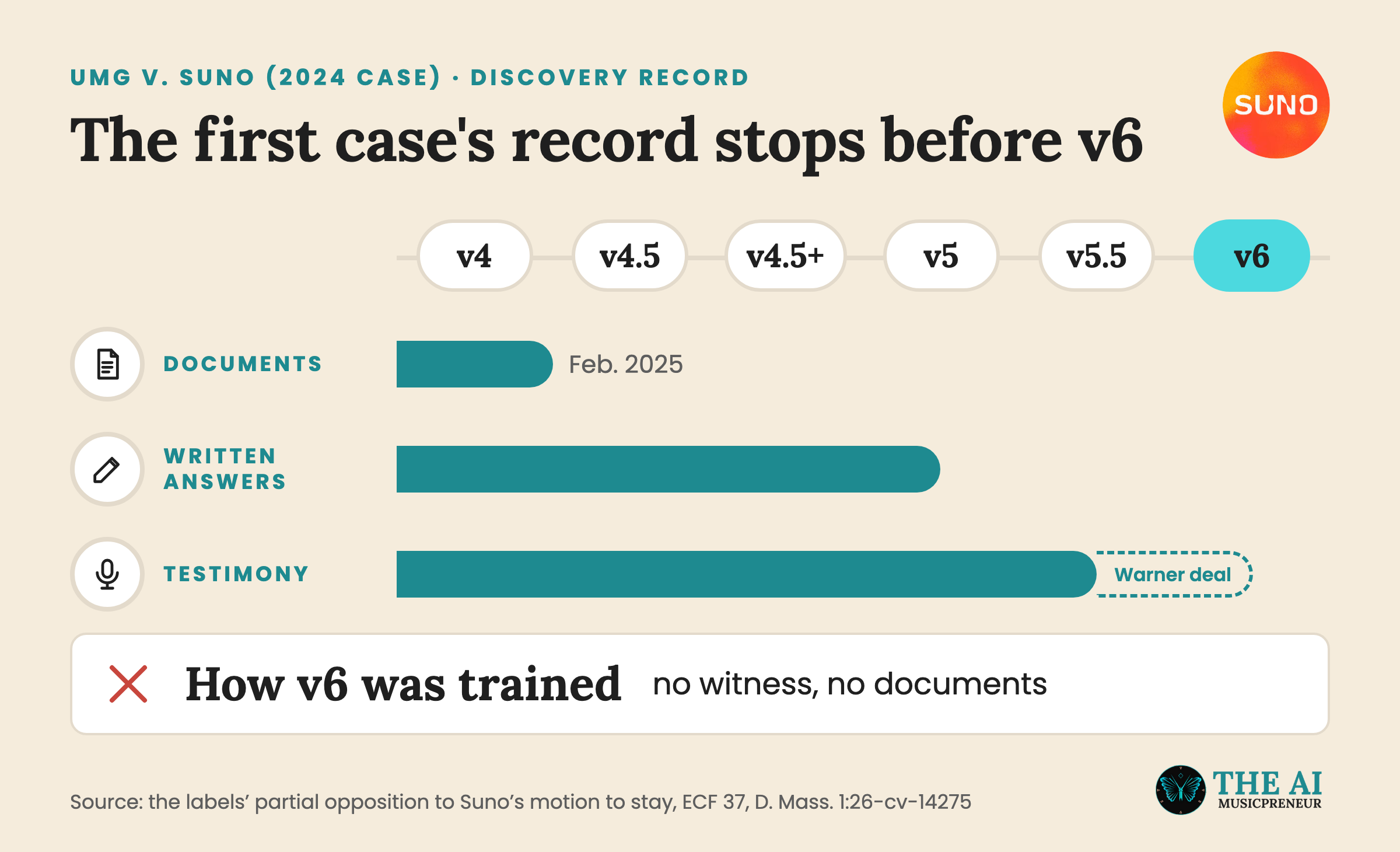
That gap covers the main v6 claim in the second complaint. The labels allege v6 learned from user creations, uploads and the outputs of older models, and that Suno used “knowledge distillation” to carry those models’ behavior forward.
Either that conduct is part of the fair use record in Suno I, in which case Suno should produce the discovery there, or it is not, in which case the discovery must proceed here.
The labels add a timing point. An October 23 email from Suno’s lawyers says its witness on pre-training data collection no longer works at Suno, though Suno will still designate him. The labels describe him as the engineer responsible for Suno’s data scraping and training-data acquisition.
What happens next in Suno’s motion to stay the v6 lawsuit
Saylor hasn’t ruled, and there is no hearing on the docket as of November 16. Neither filing asks the court to switch v6 off, so nothing changes in the app while he decides.
For anyone making songs on Suno, the detail to watch is the preservation request. It names user-interaction and preference data, the same signals Suno says helped train v6, and Suno’s terms already license what you make for training, with no opt-out.
The labels also argue Suno can’t claim hardship from discovery it will face elsewhere. Their filing lists 6 other suits over the same training, including Elvis Presley Enterprises and Eight Mile Style from November 6 and Reservoir from October 21.
Fact discovery in the first case closes on November 20, 2026. I’ll add Saylor’s decision on the stay to the UMG and Sony v. Suno (v6) tracker when it lands.
Frequently asked questions
Is Universal and Sony's v6 lawsuit against Suno on hold?
Not yet. Suno asked Judge F. Dennis Saylor IV to stay the case on October 30, 2026, and the labels filed a partial opposition on November 13. As of November 16 the judge has not ruled, so the case is not paused.
Is Suno keeping its v6 training data during Universal and Sony's lawsuit?
Suno's October 30, 2026 motion says it is retaining relevant data under its legal preservation obligations. If the court grants a broader stay, Universal and Sony want a preservation order covering training datasets, model checkpoints, user-interaction and preference data, and engineering documents for every Suno model, including v5, v5.5 and v6.
Did Suno's training-data witness leave the company during Universal and Sony's lawsuit?
Yes, according to an October 23, 2026 email from Suno's lawyers filed as an exhibit on November 13. The email says the witness Suno designated on pre-training data collection no longer works at Suno, and that Suno will still designate him as its corporate witness on those topics.
What is the market dilution theory in Universal and Sony's lawsuits against Suno?
It is the labels' argument that Suno's outputs harm the market for their recordings by competing with them, even when no single output copies a song. Suno calls the theory legally unsupported and wants Judge Saylor to rule on it in the first case before the second one moves.
About the author
Covering AI music tools, industry shifts, and news for music creators and professionals. Twice-weekly newsletter at aimusicpreneur.com.