Believe and TuneCore put 2 consent checks between your music and Suno
My stack My fav 6 tools for AI music after testing 70+
-
 ElevenMusic · Music generation
 -
 Moises · Stem separation
 -
 Controlla · Voice swap & cloning
 -
 Cryo Mix · Mixing + mastering
 -
 Neural Frames · Music videos
 -
 ONCE · Distribution
Some links are affiliate links — I earn a commission at no cost to you. Every tool here is one I run myself and truly believe in. This stack is proven.
Nine days after Believe and Suno announced their licensing deal, Believe founder and CEO Denis Ladegaillerie put a number on how much say individual artists get. Two. A Believe or TuneCore artist has to say yes twice before a single track reaches Suno’s training data, and a no at either step keeps it out for good. He gave the detail to Music Business Worldwide on September 16, 2026.
Artist sensitivity is rightly very high over AI, and our view is there's no compromise. The artist must consent first, period.
What Believe’s two layers of consent actually ask
The first layer is a plain switch. It asks whether you want your music considered for AI programs at all, and if you leave it off, nothing else happens.
Say yes and you land on a list, not in a dataset. Believe then comes back to you with each deal separately, by name.
“We will contact all artists who opted in for their music to be considered in our AI programs and tell them: ‘Here’s the Suno deal, do you want to participate or opt out?’” Ladegaillerie said. “And if it’s the [latter], we’ll opt them out.”
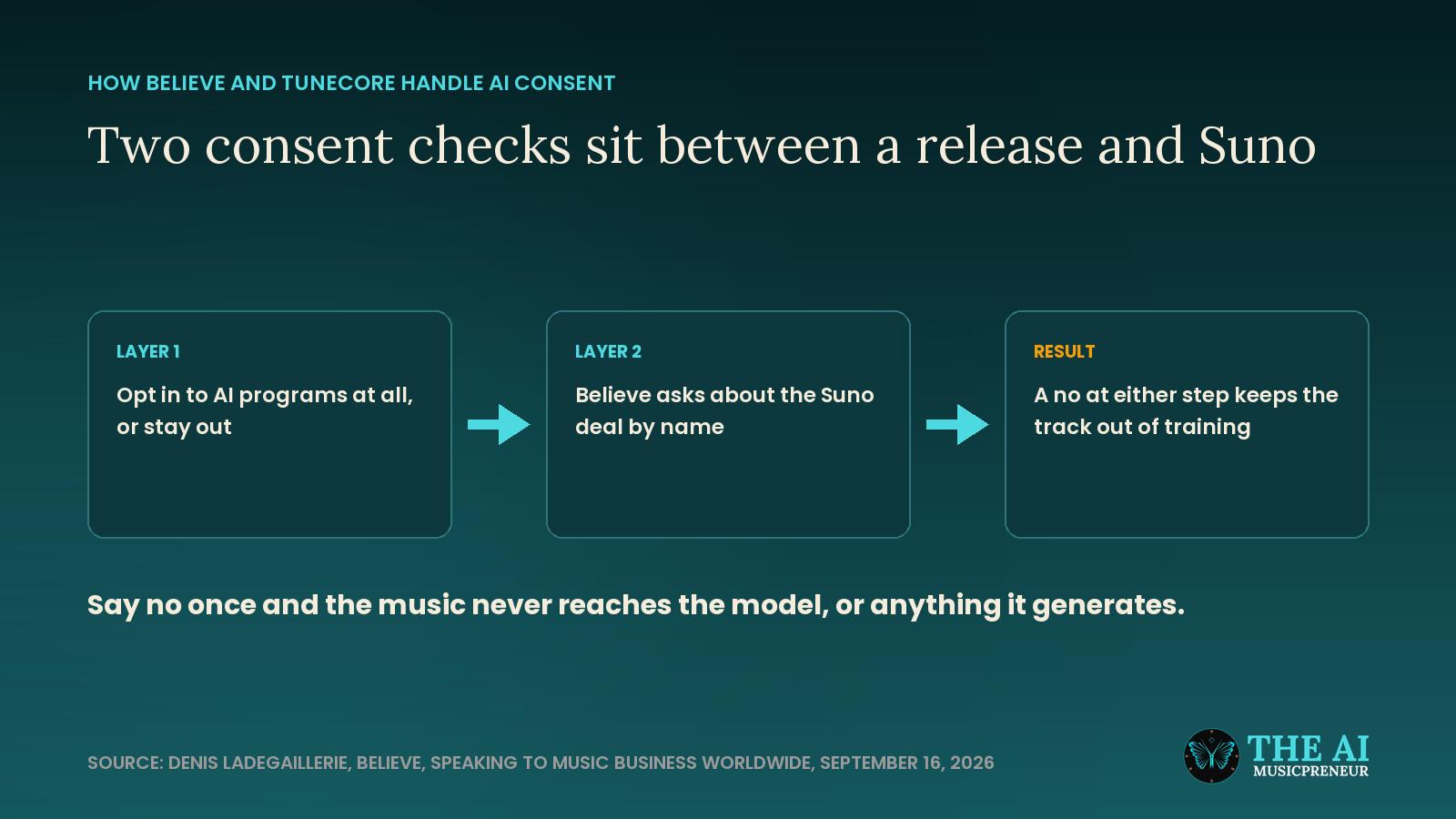
The second step is the one worth reading closely, because a general yes to AI is not a yes to Suno. Spotify, YouTube and Suno each get their own question, so you can sit out one and take another.
Opting out has a second effect most artists miss. If your music never enters the training data, it also cannot turn up inside anything the model produces later.
Why Believe still blocks tracks from Suno’s older models
The deal looked strange at first, because this is the same company that started blocking Suno-made tracks in April 2026. That policy is still running.
Believe draws the line at the model, not the company. Music from Suno’s V6 models can be distributed through Believe and TuneCore, while anything made on the earlier models stays blocked.
Suno says V6 was trained from scratch on a different dataset that leaves out anything it has not licensed. That claim is the whole basis of the deal.
“Our standard is straightforward: protected material used to train the new model must be licensed or otherwise expressly authorized,” Ladegaillerie said. “That is the standard we have applied consistently, and Suno’s new model meets it.”
What changed Believe’s mind about Suno
Ladegaillerie pointed at guardrails rather than at money. Suno has committed to audio fingerprinting, which means checking a track against a database of known recordings, plus watermarking and monthly caps on how many songs a subscriber can download.
Retiring every earlier model after the V6 launch mattered too. “We felt in the past two or three months the level of controls at Suno has significantly increased,” he said.
It is worth remembering who is still on the other side. Universal and Sony have not settled and remain in court against Suno over the training of its pre-V6 models.
What Ladegaillerie expects AI to pay Believe artists
He is not selling this as a windfall, which is the most useful thing in the interview.
“AI revenues for us next year are likely to remain a small share of [Believe’s total turnover],” he said. “I stand by what I’ve said in the past: Generative AI represents a marginal revenue opportunity, and a marginal revenue threat for the music industry.”
Suno said in February it had reached $300 million in annual recurring revenue and 2 million paid subscribers, so there is a real pot to split. How Suno calculates payouts is still not public, though the company has pointed to some form of revenue share with its licensing partners.
If you distribute through TuneCore and you have never looked at your AI settings, that is where I’d start this week, because the first question is the one that decides whether you get asked the second.
Frequently asked questions
What are Believe's two layers of AI consent?
The first layer is a general opt-in asking whether an artist wants their music considered for AI programs at all. The second layer presents each specific deal, such as Suno, Spotify or YouTube, and lets the artist decline that one on its own. An artist has to pass both to end up in a training set.
What happens to a TuneCore artist who opts out of the Suno deal?
That artist's music is expressly excluded from training Suno's models, according to Denis Ladegaillerie. Because the music never enters the training data, it also cannot feed anything those models later generate.
Does opting into Believe's AI programs mean agreeing to every AI deal?
No. Ladegaillerie told Music Business Worldwide that Believe contacts every artist who cleared the first opt-in and asks about each partnership by name. The first yes only puts an artist on the list to be asked.
What are the four principles in Believe's responsible AI framework?
Consent, control, compensation and transparency. Ladegaillerie called these the non-negotiable drivers behind how Believe approached the Suno partnership.
Can Believe artists distribute music made with Suno V6?
Yes. Tracks generated by Suno's V6 models and future industry-partnered models are eligible for distribution through Believe and TuneCore. Music from Suno's earlier models stays blocked.
About the author

Covering AI music tools, industry shifts, and news for music creators and professionals. Twice-weekly newsletter at aimusicpreneur.com.