Uploading AI-generated music to streaming platforms in 2026: every major platform has different rules.
My stack My fav 6 tools for AI music after testing 70+
-
 ElevenMusic · Music generation
 -
 Moises · Stem separation
 -
 Controlla · Voice swap & cloning
 -
 Cryo Mix · Mixing + mastering
 -
 Neural Frames · Music videos
 -
 ONCE · Distribution
Some links are affiliate links — I earn a commission at no cost to you. Every tool here is one I run myself and truly believe in. This stack is proven.
What’s allowed on Spotify can get you banned on Bandcamp
As of March 2026, every major streaming platform enforces a different policy on AI-generated music. Bandcamp explicitly bans tracks “produced entirely or mainly by AI.” Spotify allows AI-assisted music if properly disclosed using DDEX ERN standards. Apple Music just launched voluntary transparency tags that labels and distributors choose whether to apply.
This patchwork creates real risk for working artists. A track that passes on one platform can trigger removal on another. If you distribute across services, your catalog compliance status varies by destination.
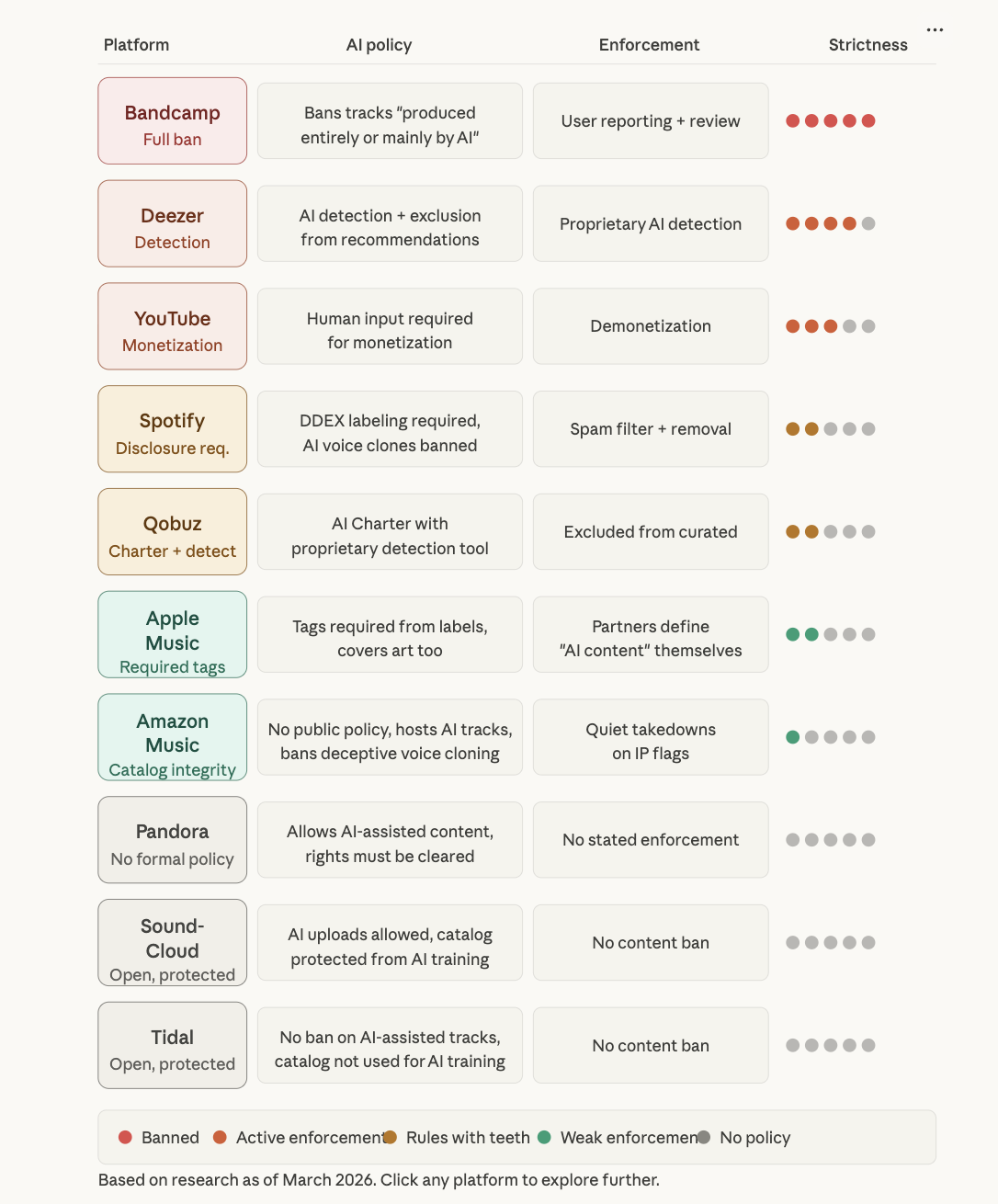
Platform policy breakdown shows wide enforcement gap
The takeaway: Most platforms rely on voluntary disclosure, but Deezer uses independent technical detection that catches undisclosed AI content.
Here’s how each major platform handles AI music:
| Platform | Policy | Enforcement |
|---|---|---|
| Bandcamp | Full ban on AI-generated music | User reporting + platform review |
| Deezer | AI detection + exclusion from recommendations | Proprietary AI detection tool |
| YouTube Music | Human input required for monetization | Demonetization or removal |
| Spotify | DDEX labeling required, AI voice clones banned | Spam filter + content removal |
| Qobuz | AI Charter with detection tool | Excluded from curated sections |
| Apple Music | Self-reported AI tags, opt-in for labels/distributors, cover art included | Partners define “AI content” themselves, no hard enforcement |
| Amazon Music | No public policy, hosts AI tracks, bans deceptive AI voice cloning | Quiet takedowns on IP flags |
| Pandora | Allows AI-assisted content via distributors, rights must be cleared | No stated enforcement |
| SoundCloud | AI uploads allowed, catalog protected from AI training | No content ban |
| Tidal | No ban on AI-assisted tracks, catalog not used for AI training | No content ban |
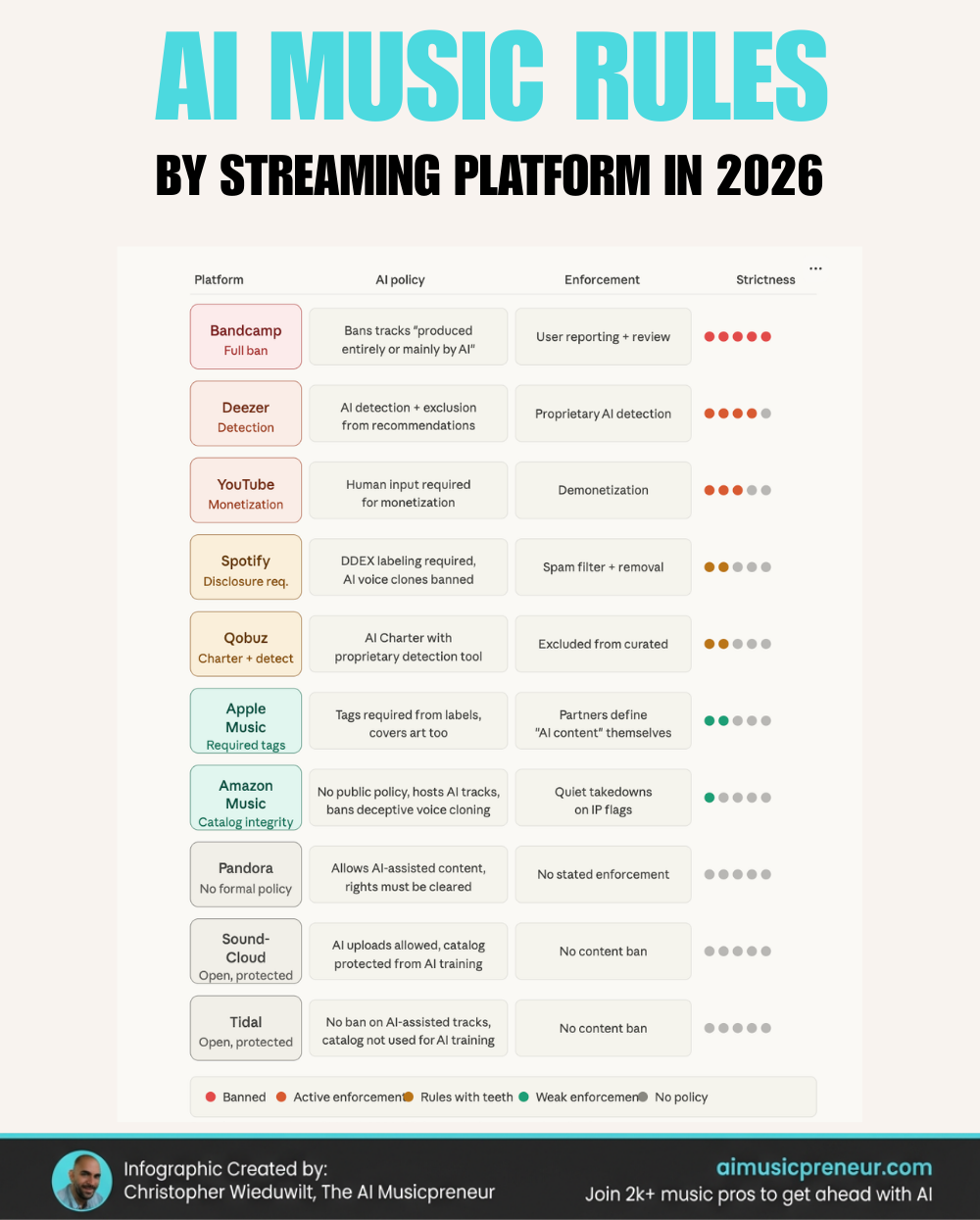
Download my cheatsheet below:
Deezer detection data reveals AI music flood
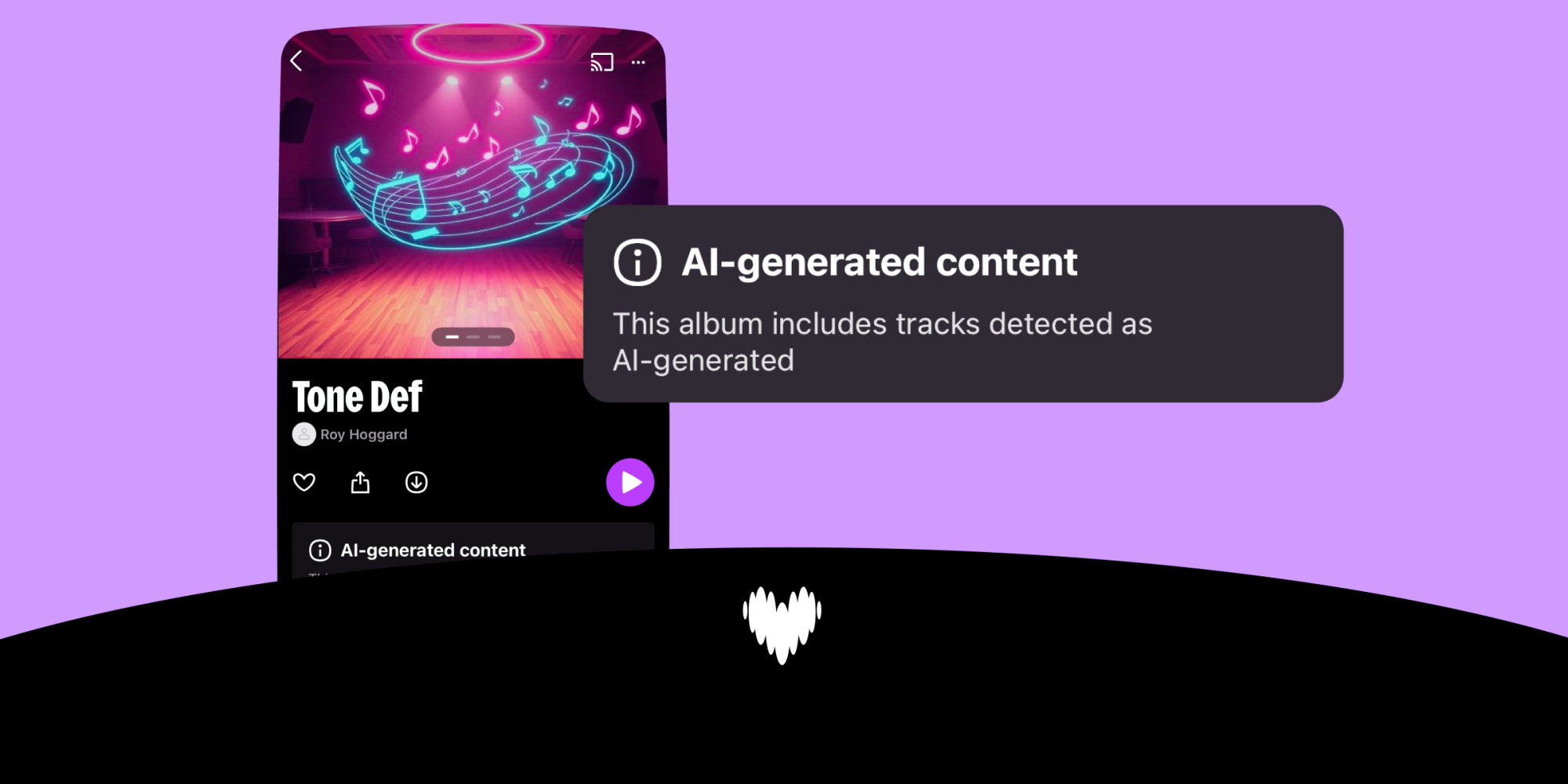
Deezer’s numbers tell the clearest story of where the industry is headed. The platform now receives over 60,000 fully AI-generated tracks every day. That’s up from 10,000 daily uploads when detection launched in January 2025.
AI content now accounts for roughly 39% of all daily deliveries to Deezer. The platform has tagged over 13.4 million AI-generated tracks total. Up to 85% of streams on AI-generated music were fraudulent in 2025, contributing to streaming fraud that dilutes royalty pools.
In China, the situation is more extreme. AI-generated works accounted for 56.9% of independently released new songs during Q1 2025.
Self-reporting creates compliance blind spots

Apple’s new transparency tags highlight the core tension. Labels and distributors decide whether to tag content as AI-generated. Apple defers the definition of “AI-generated” to content providers. The technical specification describes tags as optional, noting that if omitted, “none is assumed.”
This means undisclosed AI music can reach listeners on Spotify, Apple Music, SoundCloud, and Amazon without any flag. Only Deezer catches it independently. Platforms know this gap exists. Detection will expand.
Deezer CEO Alexis Lanternier stated: “We know that the majority of AI-music is uploaded to Deezer with the purpose of committing fraud, and we continue to take action.”
How to audit your catalog before enforcement tightens
Run a music catalog audit now. For every track, check whether your distributor’s current metadata includes AI disclosure. Review your distributor metadata options through DistroKid, TuneCore, or CD Baby.
Key audit steps:
- Identify any tracks using AI for composition, vocals, or production
- Check if your distributor supports DDEX AI metadata fields
- Remove AI-heavy tracks from Bandcamp before enforcement flags them
- Disclose AI use proactively on platforms that accept it
- Monitor YouTube monetization status for AI-assisted content
Early disclosure builds trust and protects against retroactive removal. The DDEX AI metadata standard will likely become the cross-platform baseline within 18-24 months. Apple’s opt-in tags will probably become mandatory once voluntary adoption rates prove low.
Historical parallel points to coming standardization

This mirrors the early MP3 era when platforms set wildly different rules for digital downloads. Some banned them. Some embraced them. Most had no policy. Industry standardization came years later, after significant market damage.
AI music policy is at the same chaotic early stage. AI legal protections are still developing. Major labels have already begun AI takedowns at scale. Bandcamp’s full ban position will become harder to maintain as AI-assisted music becomes indistinguishable from human-created work.
Frequently asked questions
Can I upload AI-generated music to Spotify?
Yes, if it is properly disclosed using DDEX metadata and does not use unauthorized AI voice clones of real artists. Spotify explicitly bans vocal impersonations but allows AI-assisted music with proper labeling.
What happens to AI music already uploaded without disclosure?
Currently, most platforms take no retroactive action. But as detection improves, undisclosed AI content risks flagging, exclusion from recommendations, or removal. Deezer and YouTube pose the highest risk for undisclosed content.
Is using AI mastering the same as AI-generated music?
Most platforms draw the line at AI-generated audio content, not AI-assisted tools like mastering or mixing. Apple’s new policy explicitly leaves this definition to distributors. The grey zone is real, and you should check your distributor’s specific guidance.
Which platform has the strictest AI music policy?
Bandcamp has the strictest policy with an outright ban on music “”produced entirely or mainly by AI.”” The platform reserves the right to remove any music on suspicion of being AI-generated and encourages users to report suspected content.
How do I know if my distributor supports AI disclosure metadata?
Contact your distributor directly or check their help documentation for DDEX AI metadata fields. Major distributors like DistroKid, TuneCore, and CD Baby are updating their systems to support the new transparency requirements rolling out across platforms.
About the author

Covering AI music tools, industry shifts, and news for music creators and professionals. Twice-weekly newsletter at aimusicpreneur.com.