Does Spotify allow AI music? Spotify's AI-generated music policy in 2026

SIQA Summit, LA, 12th November 2026 Ozzy Osbourne's former bassist is sharing a stage with Suno. I'm moderating:

Blasko
Bassist (Ozzy Osbourne, Rob Zombie)

Sam Berger
Artist Partnerships at Suno

RoccStar
Grammy Award-winning producer and songwriter

Drake Murphy
A&R at PlayPulse / Create Music Group

Janie Jennings
Founder, Creative's Flow Ecosystem

Chris Wieduwilt
Moderator
Limited capacity only
Does Spotify allow AI music? Yes. As of November 2026, you can release songs made with AI on Spotify, including tracks that are fully AI-generated, and they earn royalties on the same terms as every other song.
What Spotify removes is narrower: clones of a real artist’s voice made without permission, and spam. Two more rules decide how far an AI track travels once it’s live, the AI Persona badge and the 1,000-stream royalty threshold.
If you release on more than one platform, my AI music rules for every streaming platform puts them side by side.
Does Spotify allow AI music in 2026?
Spotify allows AI music in 2026. Songs made partly or fully with AI tools can be uploaded through a distributor and earn royalties like any other track. Spotify removes AI voice clones of real artists made without their permission, filters spam out of recommendations, and labels artists whose identity is AI-generated.
Spotify put its position in writing on September 25, 2025, when it announced its AI protections. The same post says “all music is treated equally, regardless of the tools used to make it.”
We support artists' freedom to use AI creatively while actively combating its misuse by content farms and bad actors.
So is AI music allowed on Spotify without telling anyone? Yes. Disclosure is optional. What Spotify does care about is which kind of AI release you’re putting out.
What counts as AI music on Spotify: 4 cases
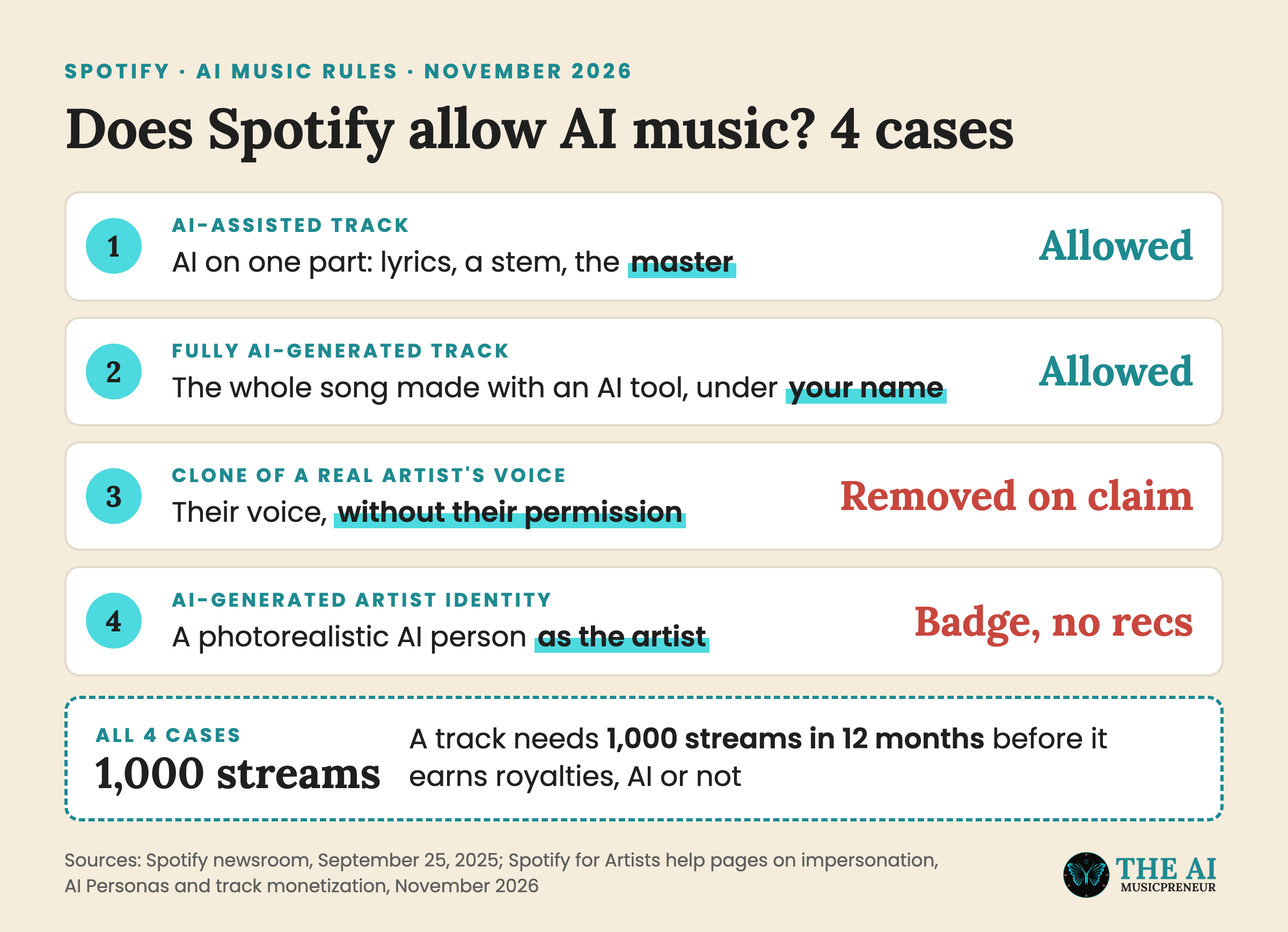
Spotify calls AI use in music “a spectrum, not a binary”, and its rules split AI releases into 4 cases. Two are allowed as they are. Two get removed or limited.
AI-assisted tracks on Spotify
You wrote and played the song, and AI helped with one part: the lyrics, a stem, the mix or the master. Spotify treats this like any other release.
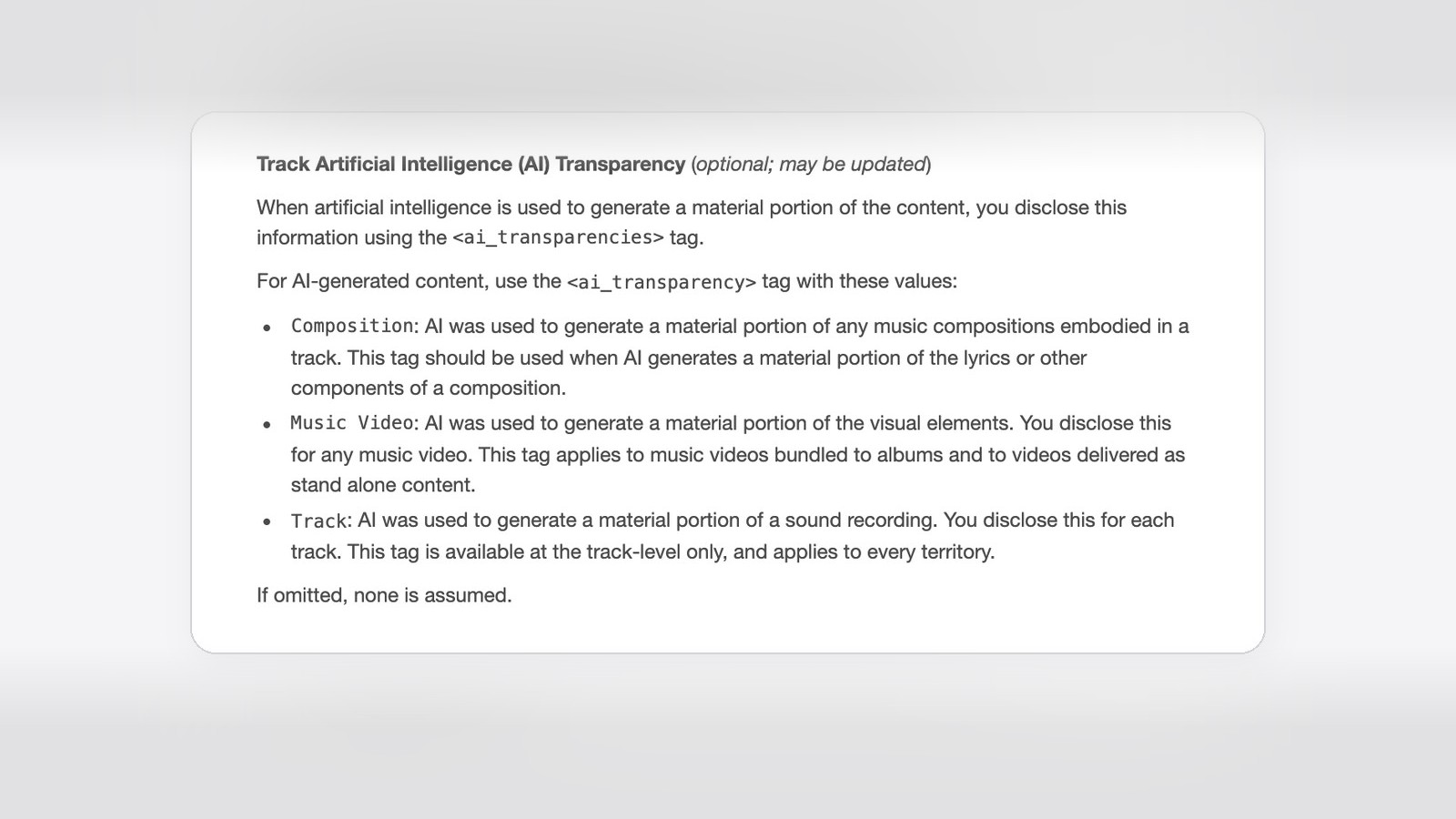
Spotify’s AI credits page lists lyrics, vocals, instrumental performances and production as the parts you can mark as AI-generated. If AI and a human both worked on the same role, you credit them separately.
Fully AI-generated tracks on Spotify
A song made start to finish in a tool like Suno or Udio is allowed too. Spotify hasn’t banned fully AI-generated music, and these tracks get paid under the same royalty rules as everything else. My ranking of the top 10 AI artists on Spotify shows what the biggest ones earned in 2025.
The catch sits one step earlier, at your distributor. Believe and TuneCore, for example, block tracks made on unlicensed AI platforms like Suno before they ever reach Spotify.
AI voice clones of real artists on Spotify
This is the hard line. Spotify’s impersonation policy says it will remove music that impersonates another artist’s voice without their permission, “whether that’s using AI voice cloning or any other method.”
The rule covers a song pitched as an “AI version” of an artist, and a song that never names the artist but uses a clearly recognizable copy of their voice. Removal starts with a claim from the artist or someone acting for them, because Spotify can’t tell a cleared feature from a clone on its own. Certain forms of parody are an exception.
AI-generated artist identities and the AI Persona badge
If your artist profile shows a photorealistic AI-generated person, Spotify gives it an AI Persona badge. Spotify says the badge “is about the identity you present as an artist, not whether you use AI to make your music.”
The badge comes with a cost. Music from AI Personas isn’t included in editorial or personalized recommendations unless a listener engages with the artist, for example by following them.
Those 4 cases decide whether a track stays up. Three more rules decide how far it gets.
Spotify’s AI-generated music policy in 2026: spam, credits and royalties
Spotify’s music spam filter
Spotify announced a music spam filter in September 2025 and said it would roll it out conservatively over the following months. The filter tags uploaders and tracks that use spam tactics and stops recommending them. In its October 20, 2026 update, Spotify named the tactics it hunts for: mass uploads, duplicates, SEO manipulation, spammy playlist networks and artificially short tracks.
The same update says Spotify took more than 50 million slop and spam tracks out of recommendations in 2026. On top of that, it removed more than 75 million “spammy tracks” altogether for serious or repeated violations. Spotify doesn’t say how many of those 75 million were made with AI, which I broke down in what each number counts.
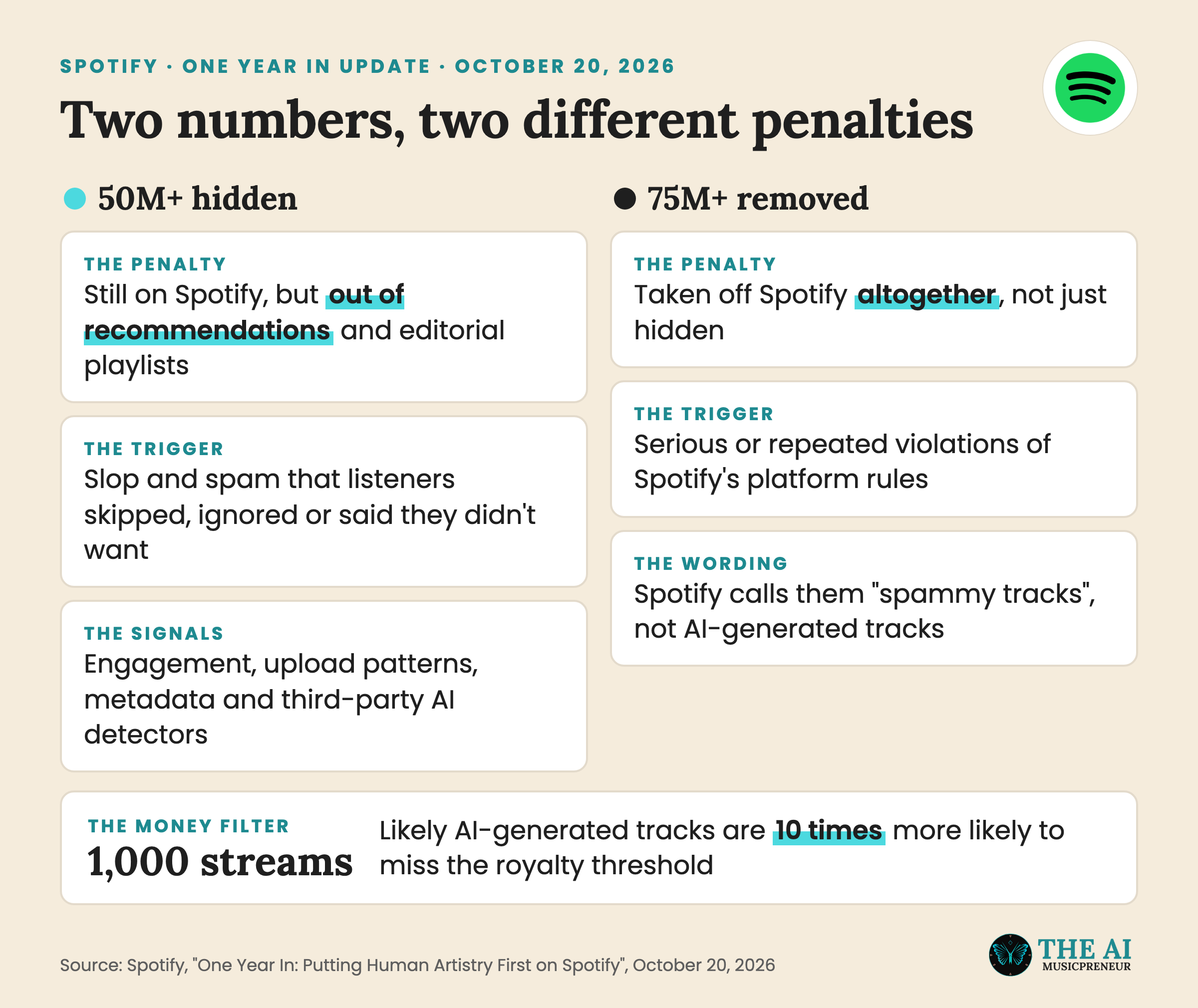
So when people say Spotify is cracking down on AI music, this is the crackdown. It goes after volume and deception, and a track can be hidden from recommendations while it’s still on the platform.
Spotify AI credits
AI credits are how you tell listeners which parts of a song used AI. Spotify launched them in April 2026. They’re optional, they’re in beta, and you add them through your distributor when you upload, if your distributor supports them.
Listeners see them in Song credits, inside the Now Playing view on mobile. They don’t show on your artist profile or as a label on the track. Spotify’s September 2025 post says the credits are “not about punishing artists who use AI responsibly or down-ranking tracks for disclosing information about how they were made.”
Spotify’s 1,000-stream royalty rule
Since April 2024, a track needs at least 1,000 streams in the previous 12 months to join the royalty pool, plus a minimum number of unique listeners that Spotify doesn’t publish. That’s on Spotify’s track monetization page.
Spotify now calls the threshold “a first line of defense for human artists against the wave of AI-generated content.” Tracks that are likely AI-generated are 10 times more likely to fall below it.
That’s the honest answer to how to monetize AI music on Spotify. Each track has to find 1,000 streams from real listeners in 12 months, and uploading more tracks doesn’t change that, because mass uploads are one of the spam signals above.
How to upload AI music to Spotify without getting removed
Can you upload AI music to Spotify yourself? Only through a distributor. Spotify’s help page says to work with one, and Spotify keeps a list of preferred and recommended distributors.
Step 1: Pick a distributor that delivers your AI tool’s tracks to Spotify
Your distributor’s AI rules apply before Spotify’s do. Check which AI tools it accepts, and whether it offers AI credits.
My guides to DistroKid’s AI rules and TuneCore’s AI policy cover two of the biggest. My AI music distribution roundup compares 7.
Step 2: Make sure no real artist’s voice is on your Spotify release
If a voice model sounds like a specific singer, or you prompted it to, that’s case 3, and Spotify removes it once the artist files a claim. Licensed voices are a different story: Spotify says some artists choose to license their voices to AI projects, and that’s their call.
Step 3: Add AI credits to your Spotify release if your distributor offers them
Mark the roles AI produced (lyrics, vocals, instruments or production) and credit any human work in the same role separately. It’s optional, and Spotify says it won’t down-rank you for it.
Step 4: Release AI music on Spotify at a human pace
Mass uploads, duplicates and very short tracks are exactly what the spam filter looks for. A batch of near-identical tracks in one week fits that pattern, so release the way a band would: one song at a time, each with a reason to exist.
Step 5: Decide what your Spotify artist profile shows
If your artist image is a photorealistic AI person, expect the AI Persona badge, and with it no recommendations by default. You can also self-disclose in Spotify for Artists, under Artist Settings, then Profile & Identity, then AI Persona.
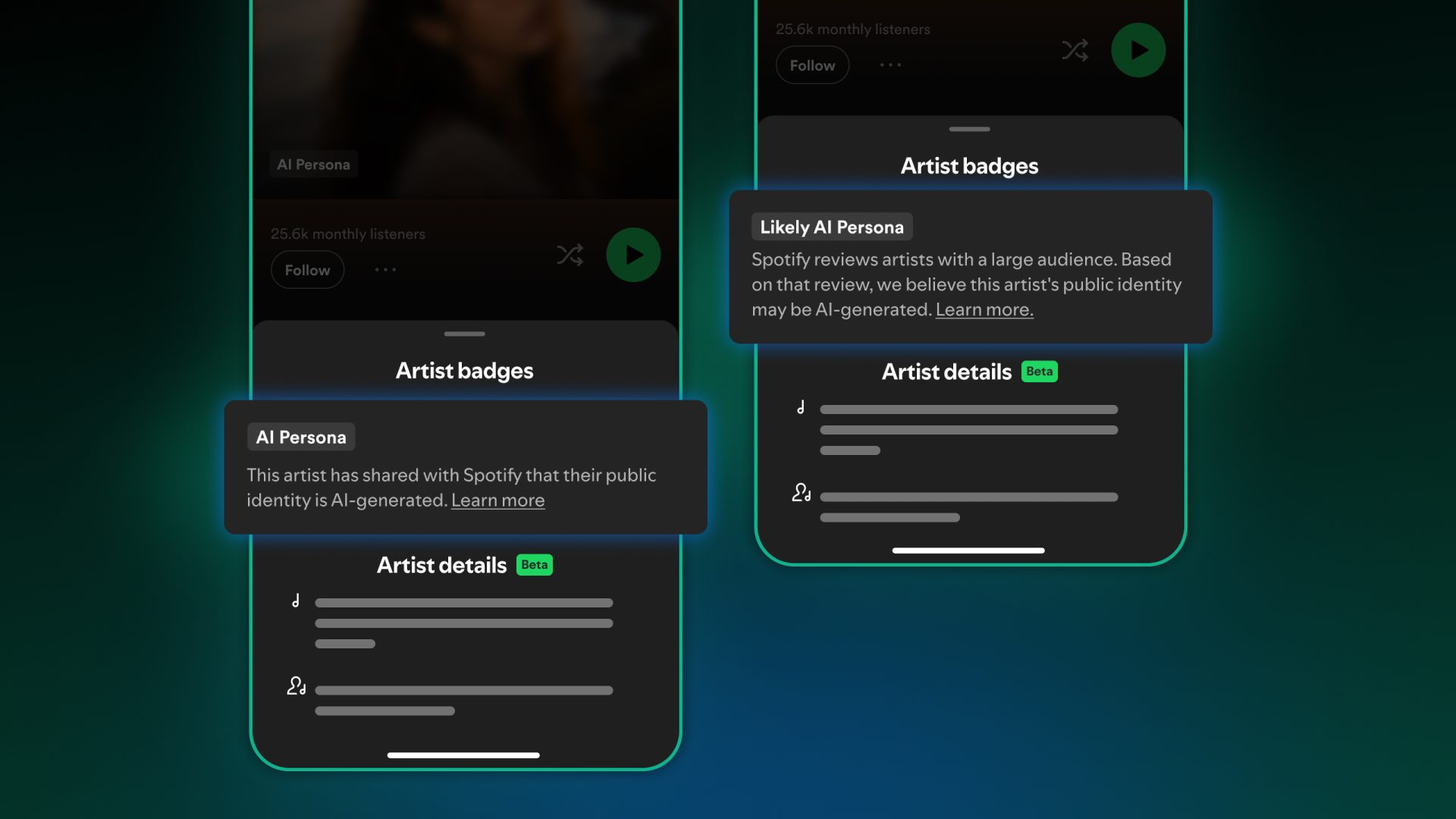
A real person who uses AI tools doesn’t get the badge. If Spotify applies a Likely AI Persona badge, you get a notification in Spotify for Artists and can confirm it or appeal.
Bonus tips for releasing AI music on Spotify
Turn on Spotify’s Artist Profile Protection
Artist Profile Protection lets you review releases that list you as an artist before they appear on your profile. Thousands of artists joined the beta, and Spotify says it opens to all artists by the end of 2026.
It’s built for what happened to Bridgit Mendler, when a fake EP sat on her official profile.
Spotify’s AI remix tool is a separate product
Spotify’s planned AI covers and remixes tool lets fans remix licensed songs inside the app. It has nothing to do with uploading your own AI tracks. I’m following it in my coverage of the tool’s $4 to $5 add-on.
Key takeaways: Spotify’s AI music rules in November 2026
Where Spotify stands on AI music right now:
- Spotify allows AI-assisted and fully AI-generated music, and pays it like any other track.
- AI clones of a real artist’s voice get removed once the artist files a claim.
- Spam tactics like mass uploads get tracks hidden from recommendations, or removed.
- AI credits are optional, and they go through your distributor.
- A photorealistic AI artist identity gets the AI Persona badge and drops out of recommendations by default.
- Every track needs 1,000 streams in 12 months to earn royalties.
Releasing beyond Spotify? Check the rules for DistroKid, TuneCore, Bandcamp and Apple Music, or see every platform in my streaming platform rules hub.
Frequently asked questions
Can I upload AI music to Spotify without a distributor?
No. Spotify's help page tells artists to work with a distributor to get music on Spotify, and it lists preferred and recommended distributors in Spotify for Artists. Each distributor also has its own rules on which AI tools it accepts.
Do AI-generated songs earn royalties on Spotify?
Yes, on the same terms as any other track. A song needs at least 1,000 streams in the previous 12 months, plus a minimum number of unique listeners that Spotify doesn't publish, before it earns. Spotify says tracks that are likely AI-generated are 10 times more likely to fall below that threshold.
Does Spotify's AI Persona badge apply to a cartoon or fictional AI artist?
Not unless the character looks like a photorealistic AI-generated person. Spotify's help page says the badge doesn't apply to a stage name or fictional character that doesn't depict a photorealistic AI human, or to a real person who uses AI tools to make music.
Does adding AI credits hurt a song's reach on Spotify?
Spotify says no. Its September 25, 2025 announcement says AI credits are not about punishing artists who use AI responsibly or down-ranking tracks for disclosing how they were made. The credits show up in Song credits on mobile, not as a label on the track.
Can you remove a Likely AI Persona badge from your Spotify profile?
Not by yourself. When Spotify applies a Likely AI Persona badge, you get a notification in Spotify for Artists and can confirm it by self-disclosing or file an appeal. If you do nothing, the badge stays, and Spotify makes the final call after its review.
About the author
Covering AI music tools, industry shifts, and news for music creators and professionals. Twice-weekly newsletter at aimusicpreneur.com.