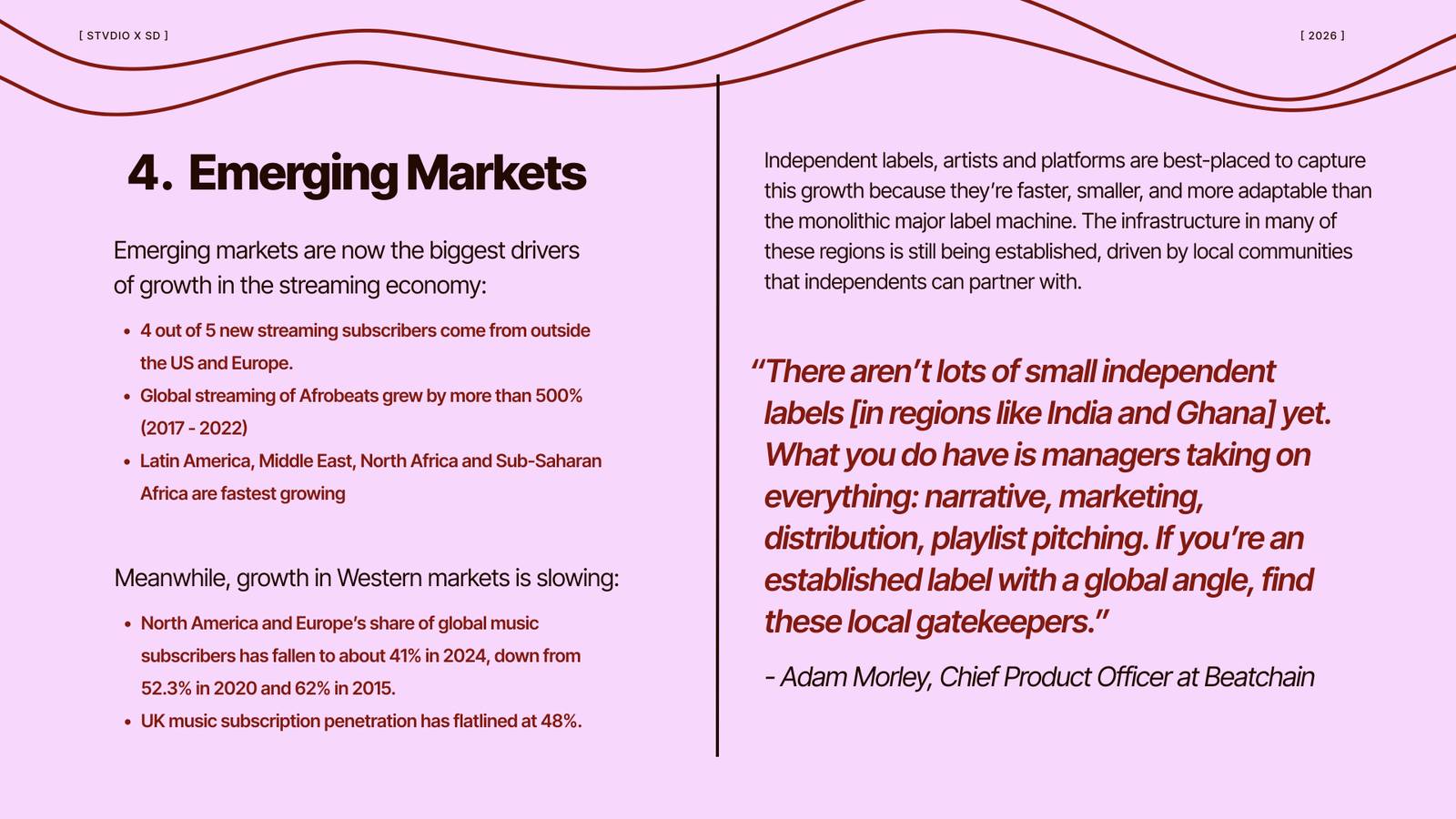
4 of 5 new streaming subscribers now come from outside the US and Europe: 5 places an indie release has room
My stack My fav 6 tools for AI music after testing 70+
-
 ElevenMusic · Music generation
 -
 Moises · Stem separation
 -
 Controlla · Voice swap & cloning
 -
 Cryo Mix · Mixing + mastering
 -
 Neural Frames · Music videos
 -
 ONCE · Distribution
Some links are affiliate links — I earn a commission at no cost to you. Every tool here is one I run myself and truly believe in. This stack is proven.
You release a single. You pitch it to the same editorial playlists as 120,000 other tracks that day. You watch it land in a US and UK market where subscriber growth has flatlined and the biggest platforms are busy sorting AI uploads.
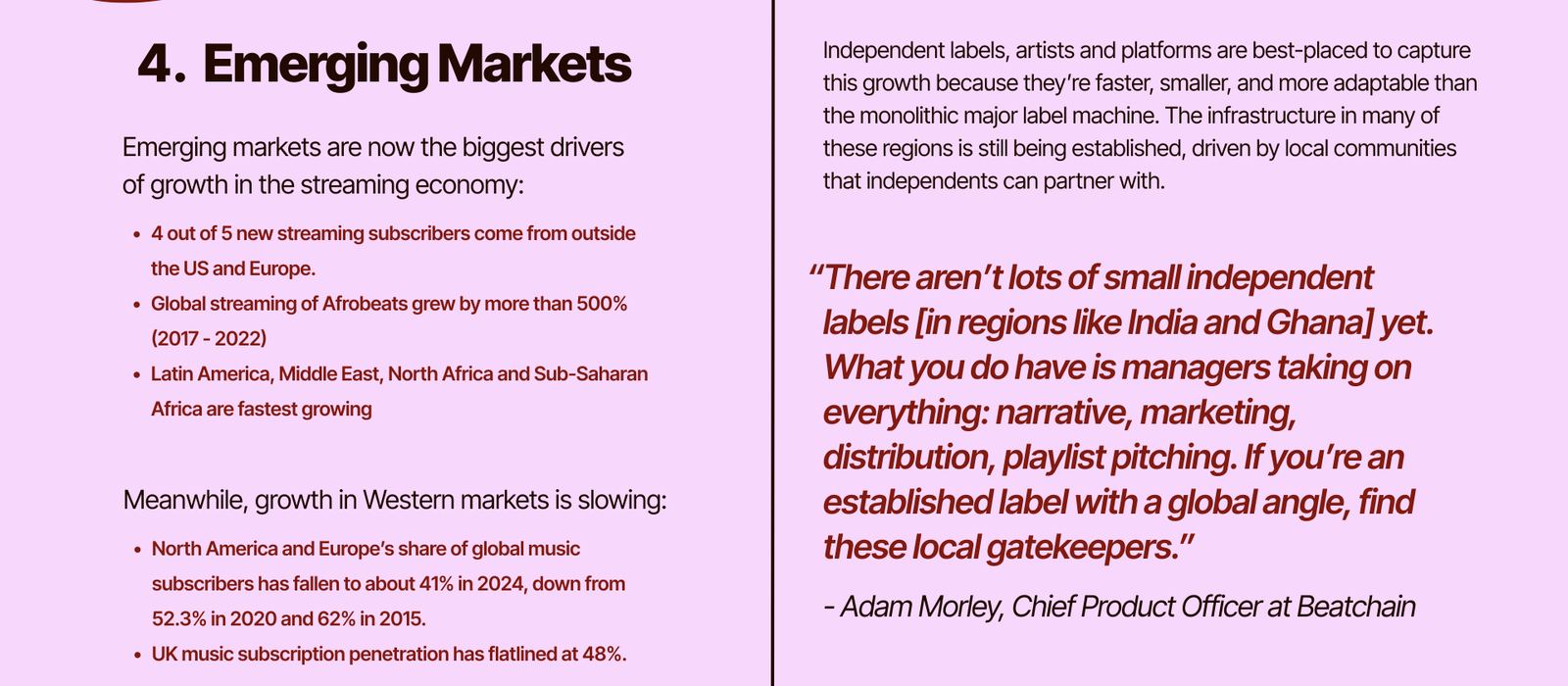
The Independent Music 2026 report has a different map. Four out of five new streaming subscribers now come from outside the US and Europe, and the niche platforms serving audiophiles and indie fans are growing faster than Spotify. Here are 5 places the report says an independent release still has room, with the numbers behind each one.
The 5 markets and platforms where independent releases still have room
The Western numbers first, because they explain the rest. North America and Europe’s share of global music subscribers has fallen to about 41% in 2024, from 52.3% in 2020 and 62% in 2015. UK subscription penetration has stopped at 48%. The growth moved, and these five places are where it went.
1. Nigeria and Afrobeats, Through Audiomack
Global streaming of Afrobeats grew by more than 500% between 2017 and 2022, and the platform that caught it in Nigeria was not Spotify.
Audiomack has clocked more than 58 billion Afrobeats streams in Nigeria in the five years since opening an office there, and is now the number one music app in the country on both iOS and Android. It got there by fitting local reality rather than exporting a Western subscription.
Here’s what that looked like in practice:
- Daily, weekly and monthly Audiomack+ passes instead of one monthly price
- Around 1.9 billion offline downloads across Africa, built for patchy connectivity
- Partnerships with local telcos and payment providers so people could actually pay
If your music has any West African audience at all, Audiomack is a distribution target, not an afterthought. I covered how African musicians are handling the AI side of that same growth earlier this year.
2. Latin America, the Middle East and Sub-Saharan Africa
The report names Latin America, the Middle East, North Africa and Sub-Saharan Africa as the fastest-growing streaming regions on earth.
The infrastructure in many of those regions is still being built, and the report’s argument is that independents are better placed to work with it than a major label is, because they’re smaller and can move with local communities rather than around them.
There aren't lots of small independent labels in regions like India and Ghana yet. What you do have is managers taking on everything: narrative, marketing, distribution, playlist pitching. If you're an established label with a global angle, find these local gatekeepers.
That quote is the whole playbook for a small label. The gatekeeper in Lagos or Bogota is a manager, not a platform.
3. Qobuz and the Audiophile Niche
Qobuz hit 1.2 million monthly active users and grew subscriber revenue 45% in 2025.
It’s small next to Spotify. It’s also growing more than 4 times faster, and the report credits an artist-centric brand, high-fidelity audio and editorial playlists picked by people. The listeners it attracts are exactly the audiophiles and independent music fans who pay for records rather than skip through them.
My earlier piece on Qobuz’s growth and its stance on AI music covers why that audience is worth chasing on purpose.
4. Cantilever, the Curated App 24 Indie Labels Bought Into
Cantilever runs about 10 hand-picked indie albums a month, adds new ones every few days, and rotates the old ones off.
That’s the opposite of a catalog, and the payout model is the opposite of Spotify’s too. Royalties are user-centric, meaning each subscriber’s fee is split only among the albums that person actually listened to that month. Every featured album gets a turn at the top of the home page.
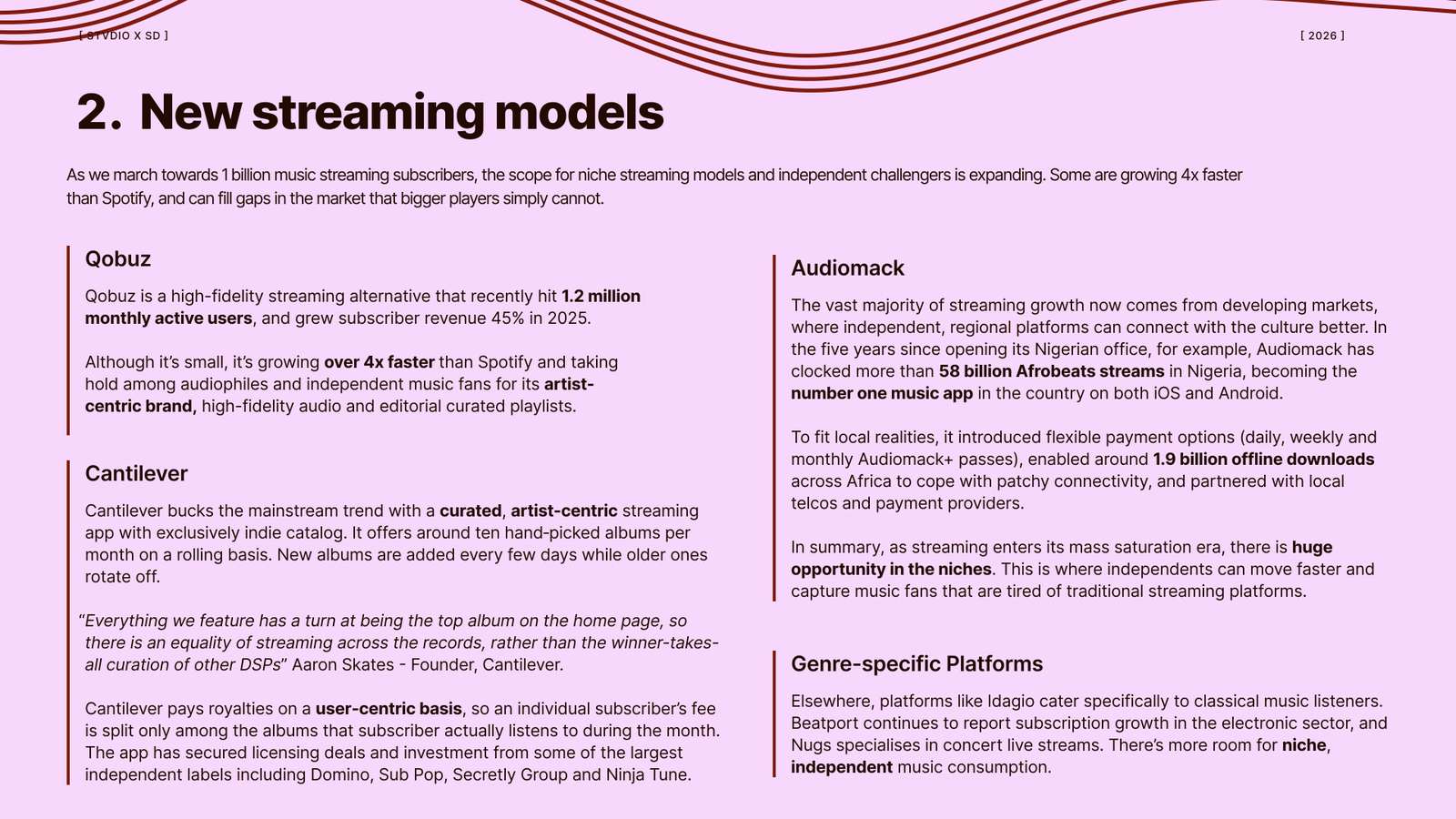
Founder Aaron Skates describes it in the report as an equality of streaming across the records, rather than the winner-takes-all curation of other DSPs.
Twenty-four indie labels invested in it in 2026 through ORCA, and Domino, Sub Pop, Secretly Group and Ninja Tune are among the licensors.
Here’s when Cantilever makes sense for a release:
- The album is the unit, not the single
- Your label or distributor already has a licensing relationship with it
- You’d rather be 1 of 10 for a month than 1 of 100,000 forever
5. Genre Platforms: Idagio, Beatport and Nugs
The report closes the chapter with three platforms that own one genre each.
Idagio serves classical listeners. Beatport keeps reporting subscription growth in electronic music. Nugs specialises in concert live streams. None of them is trying to be everything, which is the point: a platform that only serves your genre puts your release in front of people who already chose it.
How to fold this into your next release plan
Pick one of the five, not all of them. Add Audiomack to your distribution list if you have any African audience. Pitch Qobuz’s editorial team if your record is one people sit down with. Ask your distributor whether Cantilever is reachable. And if your genre has a home platform, put it ahead of the Spotify editorial pitch on the calendar, because the odds are better.
My 10-step release plan has a slot for platform pitching in week 3. That’s where these go.
Quick recap of the five:
- Nigeria via Audiomack: 58 billion Afrobeats streams, number one app in the country
- Latin America, MENA and Sub-Saharan Africa: the fastest-growing regions, reached through local managers
- Qobuz: 1.2 million monthly users, growing 4x faster than Spotify
- Cantilever: 10 albums a month, user-centric royalties, 24 indie labels behind it
- Idagio, Beatport, Nugs: one genre each
The Western market you’ve been pitching into is 41% of global subscribers and falling. Which of the other 59% does your music already belong to?
Frequently asked questions
Which regions are the fastest growing streaming markets according to the Independent Music 2026 report?
Latin America, the Middle East, North Africa and Sub-Saharan Africa. The report says 4 out of 5 new streaming subscribers come from outside the US and Europe, and that global Afrobeats streaming grew by more than 500% between 2017 and 2022.
How did Audiomack become the number one music app in Nigeria?
By fitting local conditions instead of importing a Western model. The Independent Music 2026 report credits daily, weekly and monthly Audiomack+ passes, around 1.9 billion offline downloads across Africa to cope with patchy connectivity, and partnerships with local telcos and payment providers. The result is more than 58 billion Afrobeats streams in Nigeria in five years.
How does Cantilever pay royalties differently from Spotify?
Cantilever uses a user-centric model, so each subscriber's fee is split only among the albums that subscriber actually listened to that month. Spotify pools all revenue and divides it by total streams. Cantilever also features only around 10 hand-picked indie albums at a time, and every album gets a turn at the top of the home page.
What is the North America and Europe share of global music subscribers in 2024?
About 41%, according to the Independent Music 2026 report, down from 52.3% in 2020 and 62% in 2015. UK music subscription penetration has flatlined at 48%, which the report uses as the clearest sign that Western streaming growth has stalled.
About the author

Covering AI music tools, industry shifts, and news for music creators and professionals. Twice-weekly newsletter at aimusicpreneur.com.