Does DistroKid allow AI music? The 2026 rules, AI credits and the new ACRCloud AI tag

SIQA Summit, LA, 12th November 2026 Ozzy Osbourne's former bassist is sharing a stage with Suno. I'm moderating:

Blasko
Bassist (Ozzy Osbourne, Rob Zombie)

Sam Berger
Artist Partnerships at Suno

RoccStar
Grammy Award-winning producer and songwriter

Drake Murphy
A&R at PlayPulse / Create Music Group

Janie Jennings
Founder, Creative's Flow Ecosystem

Chris Wieduwilt
Moderator
Limited capacity only
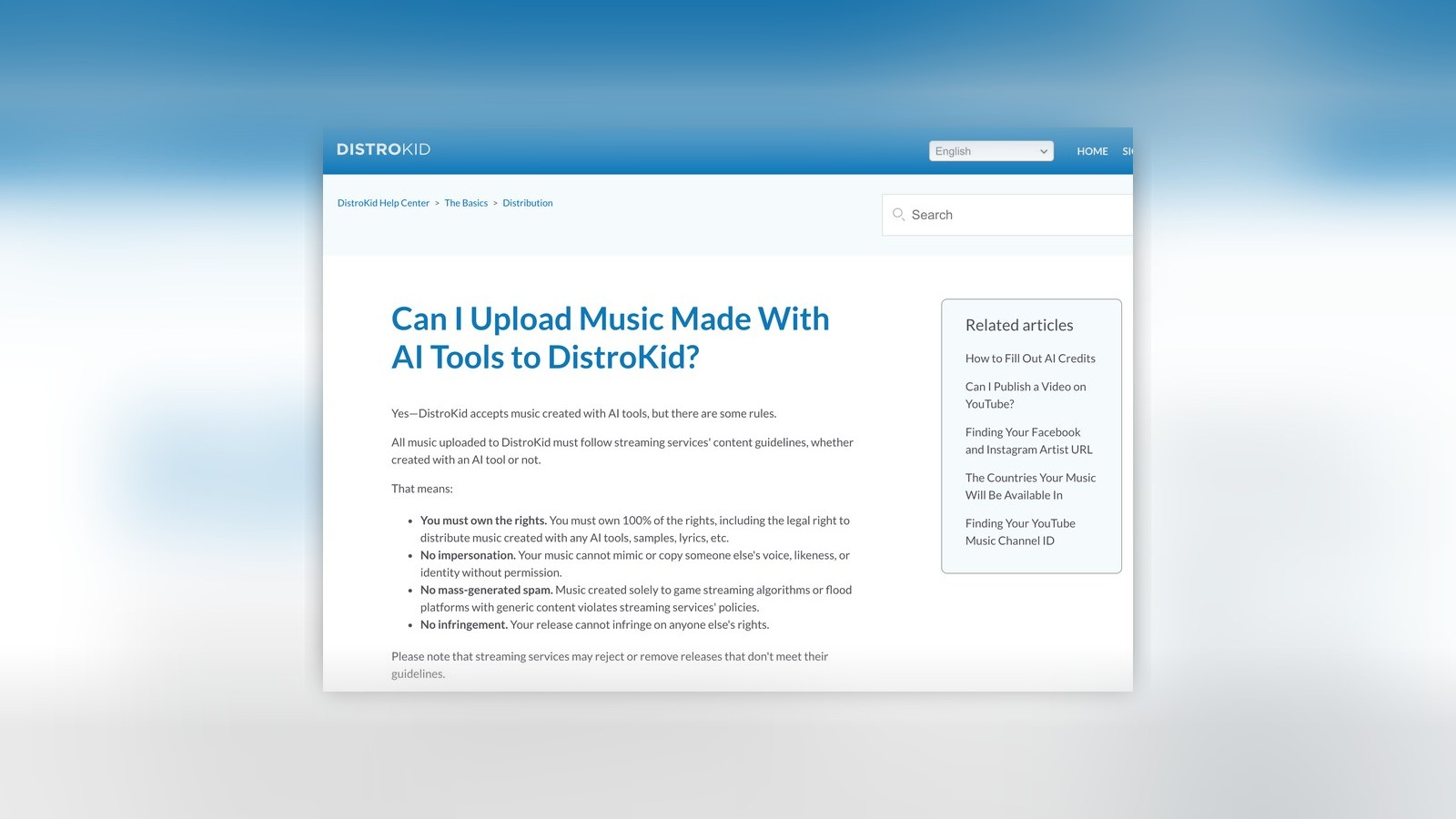
Does DistroKid allow AI music? Yes. DistroKid’s help center says it “accepts music created with AI tools, but there are some rules”, and as of November 10, 2026 there are 4 of them: you own 100% of the rights, you don’t copy someone else’s voice, you don’t upload mass-generated spam, and you don’t infringe anyone’s rights.
Those rules reach most AI music out there. DistroKid carried 77.6% of AI releases with a known distributor in SIQA’s Mid-Year 2026 report, so its rules are the first ones most Suno songs meet.
For every other platform, see my AI music upload rules by platform.
DistroKid’s AI-generated music policy in 2026, in plain words
DistroKid’s AI music policy allows songs made with AI tools as long as you own 100% of the rights, including the right to distribute what the AI tool made. Your music can’t copy someone else’s voice without permission, can’t be mass-generated spam, and can’t infringe anyone’s rights. Streaming services can still reject or remove it.
Here are the 4 rules in DistroKid’s own words, from its AI tools help article (last updated August 19, 2026):
- Rights: “You must own 100% of the rights, including the legal right to distribute music created with any AI tools, samples, lyrics, etc.”
- Impersonation: “Your music cannot mimic or copy someone else’s voice, likeness, or identity without permission.”
- Spam: “Music created solely to game streaming algorithms or flood platforms with generic content violates streaming services’ policies.”
- Infringement: “Your release cannot infringe on anyone else’s rights.”
The last line of that article is the one people skip: streaming services “may reject or remove releases that don’t meet their guidelines.” DistroKid delivers the release, and Spotify, Apple Music and the rest still decide what stays up.
So what does DistroKid treat as AI in the first place?
What counts as AI music on DistroKid
DistroKid splits AI use into 2 groups: AI you used as a tool, and AI that generated part of the track. Only the second group needs AI credits.
AI as a tool on DistroKid: no AI credit needed
Pitch correction, auto-tune, AI-assisted mixing or mastering and other AI-assisted workflows don’t need a credit. A song you wrote, played and sang, then mastered with an AI mastering tool, goes up like any other release.
AI-generated lyrics, music or audio on DistroKid: add AI credits
If AI wrote the lyrics, composed the melody, or generated any of the audio (vocals or instrumental tracks), you add AI credits. The upload form gives you 4 boxes, and you tick every one that applies:
- The lyrics: AI wrote the words.
- The music: AI composed the melody.
- All of the audio: everything the listener hears is AI-generated.
- Part of the audio: some of it is AI and some is human.
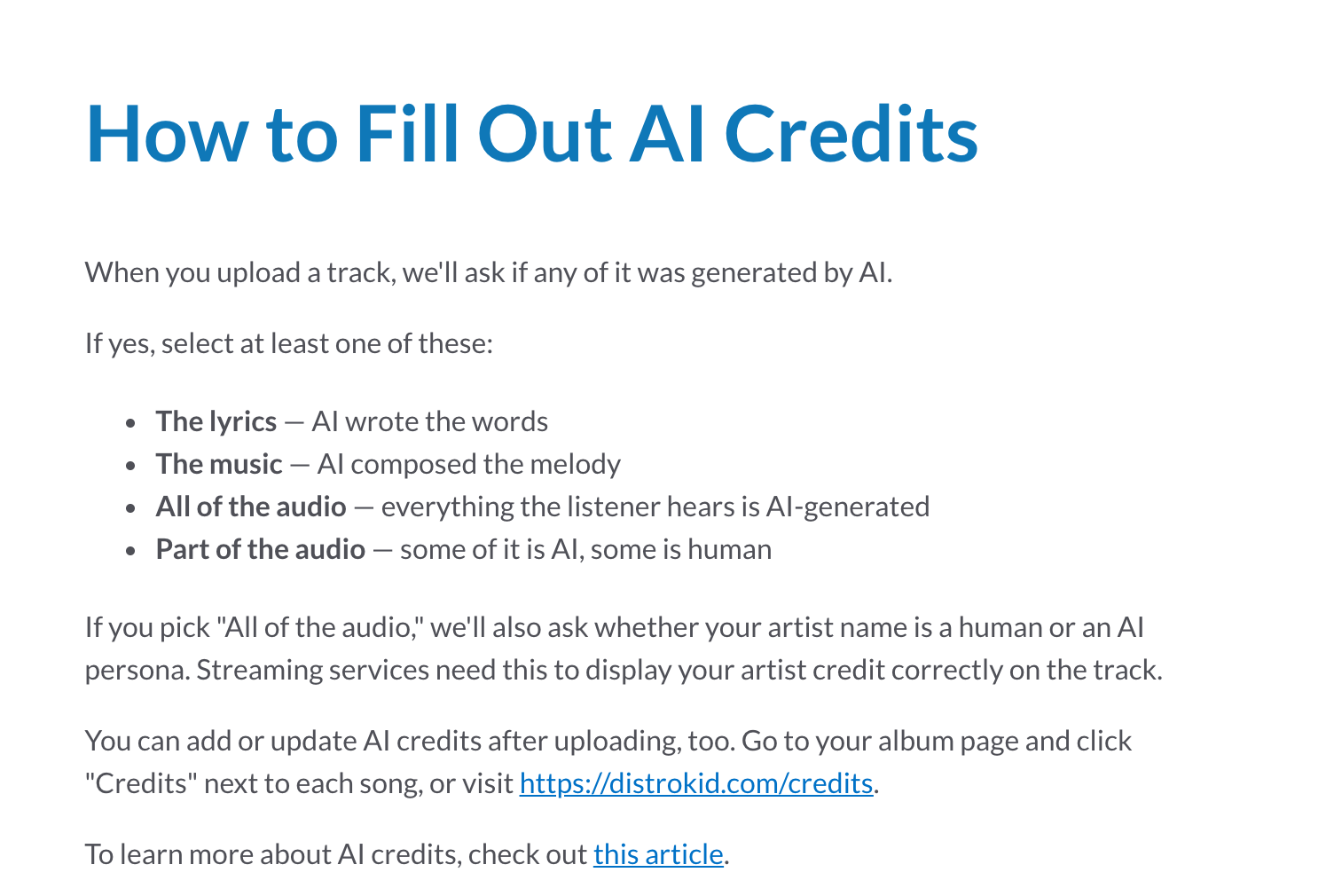
Pick “All of the audio” and DistroKid asks if your artist name is a human or an AI persona, so streaming services can credit the track correctly. DistroKid says Spotify, Apple Music and YouTube currently show AI credits to listeners (full walkthrough in its How to Fill Out AI Credits article).
AI voice clones and sound-alikes on DistroKid
A voice clone of another singer needs that person’s permission, or it breaks the impersonation rule. The rule names someone else’s voice, likeness or identity, so a clone of your own singing voice, like the one Suno Voices builds after a verification step, isn’t what that wording covers.
Sound-alikes are out either way. DistroKid’s help center says covers or tribute songs that sound very close to the original “aren’t accepted by streaming services”.
That leaves the biggest question: is the song yours to release at all?
Can you upload AI music to DistroKid from Suno or Udio?
You can upload AI music to DistroKid from any generator, as long as you hold the commercial rights. DistroKid’s help center doesn’t name any AI music generator, as of November 10, 2026, so your generator’s own terms answer the rights question:
- Suno: songs made on a Pro or Premier plan come with commercial use rights, and Suno says you can distribute them “using the distributor of your choice”. Songs made on the free plan can’t be monetized, and Suno’s distribution help article says subscribing later “will not give you a retroactive license for the song.”
- Udio: downloads have been switched off since October 29, 2025, so nothing you make in Udio leaves the app to be uploaded anywhere.
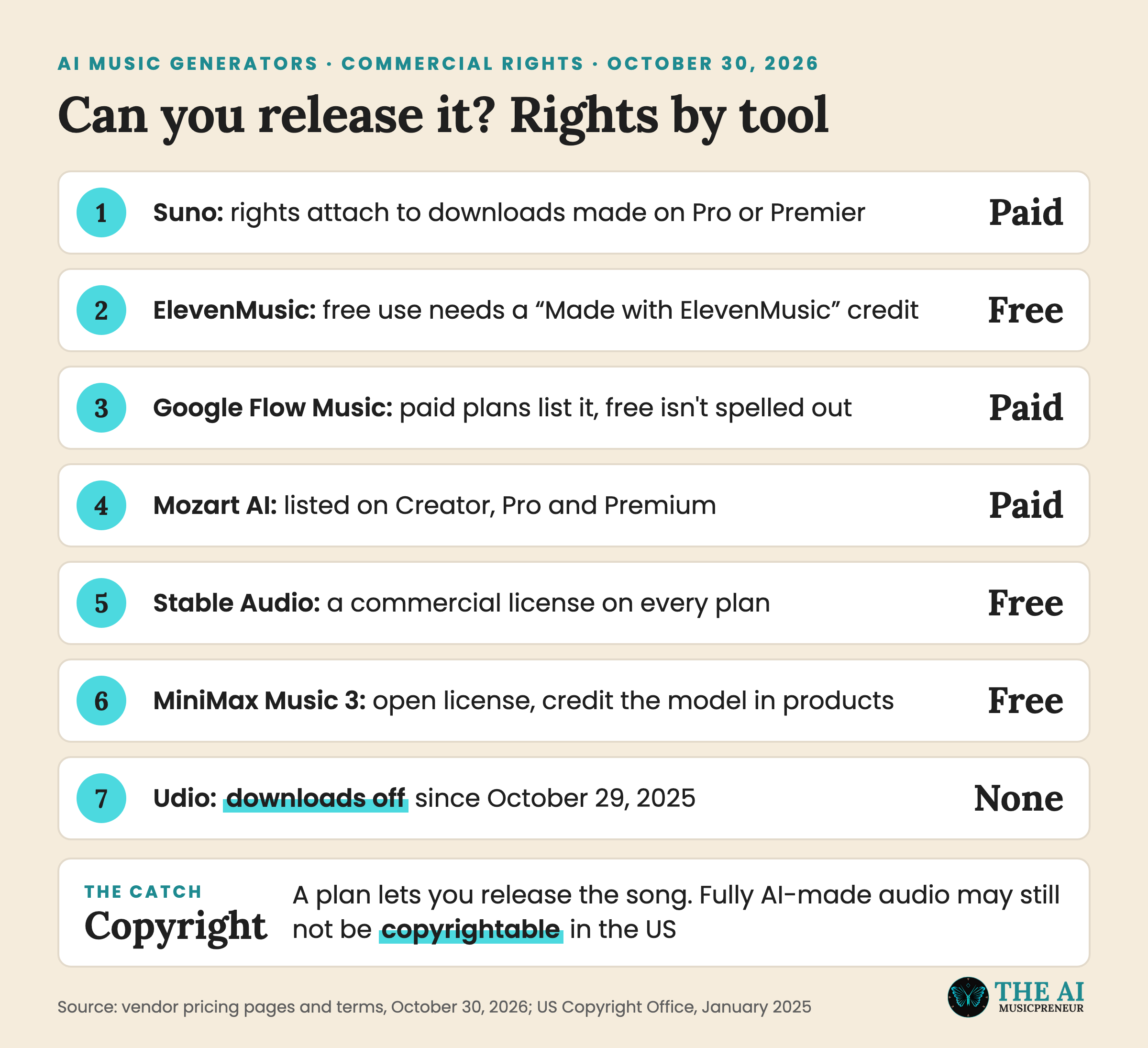
TuneCore handles this differently. Believe and TuneCore began blocking tracks from unlicensed generators like Suno in April 2026. DistroKid has no list like that and leaves the generator question to you.
How to upload AI music to DistroKid without getting rejected
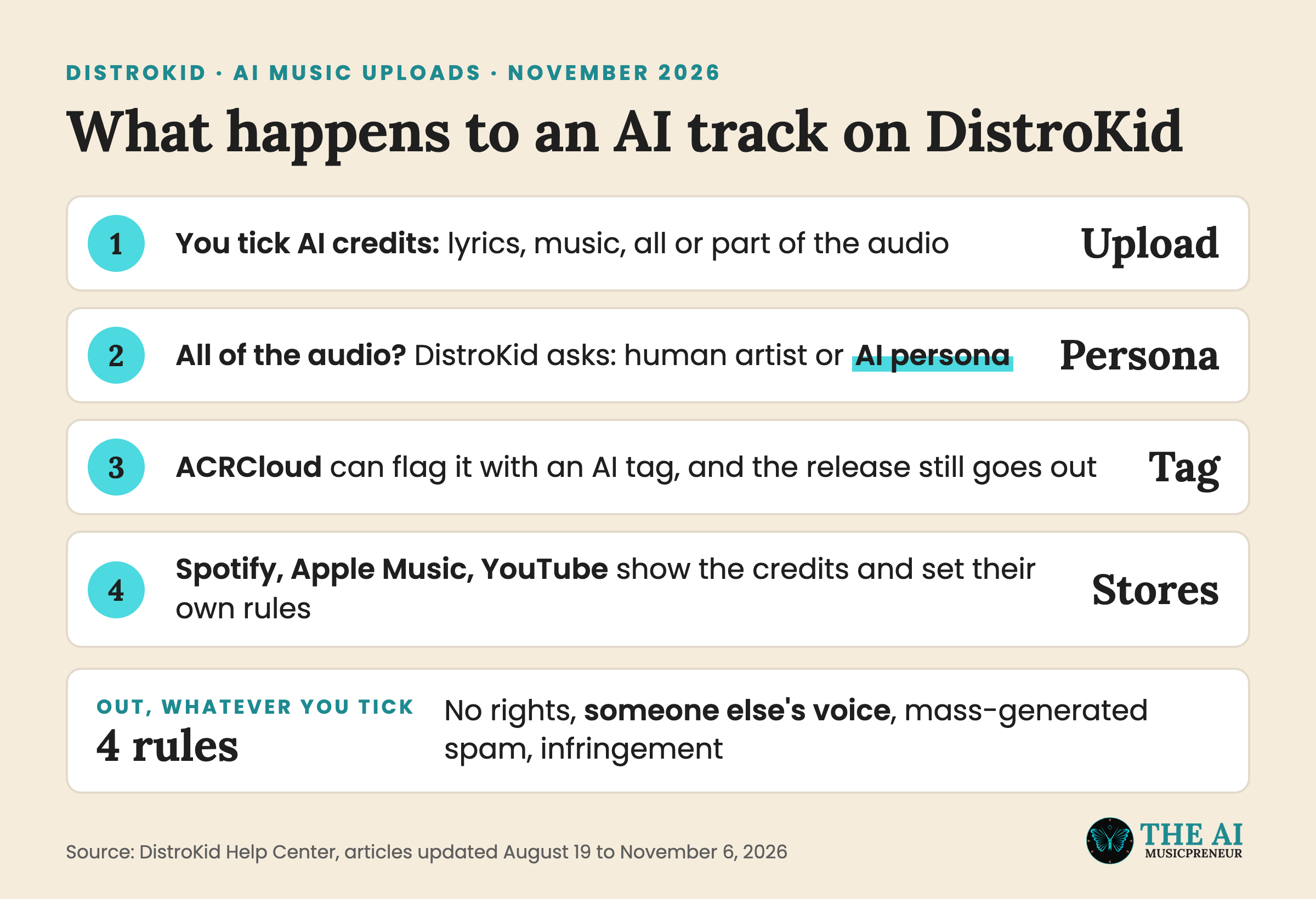
These 5 steps follow DistroKid’s own rules, in the order you hit them. Here’s the route your track takes:
Step 1: Check your commercial rights before you upload to DistroKid
Look up the plan you were on the day you made the song. On Suno, a free-plan song stays non-commercial even after you upgrade.
Step 2: Fill out DistroKid’s AI credits honestly
Tick every part AI generated. Got it wrong? Fix it later from your album page by clicking Credits next to each song.
Step 3: Keep someone else’s voice out of your DistroKid release
No celebrity voice model and no vocal that mimics a real singer, unless you have their permission. The same goes for cover art that copies a real artist’s.
Step 4: Skip mass uploads and paid streams on DistroKid
DistroKid defines spam as music made to game streaming algorithms or flood platforms with generic content, so a catalog of near-identical tracks is what that rule is written for. Paid streams are the other trap: DistroKid says a release with mostly artificial streams will likely be removed, those royalties won’t be paid, and your account can be closed.
Step 5: If DistroKid rejects your release, read the email first
The rejection email says what got flagged, and you usually delete and re-upload to fix it. If you think it was a mistake, reply to that email. Artwork problems are the exception, because you can replace the artwork in place.
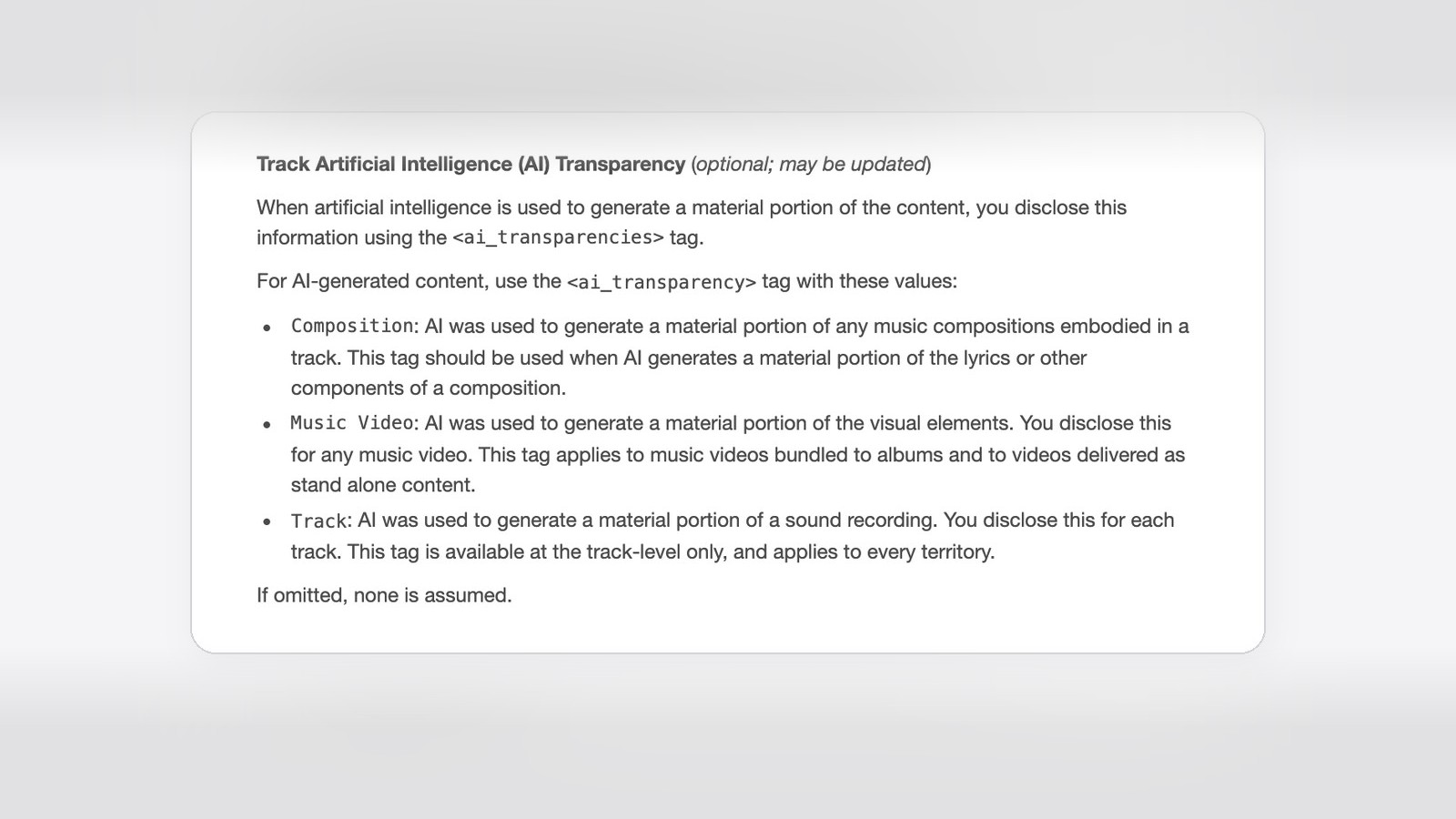
DistroKid’s ACRCloud AI tag, and what it does to your release
DistroKid added a help article on November 2, 2026 about a new AI tag. The tag appears when ACRCloud, an independent detection company, flags a track as potentially AI-generated.
DistroKid says the tag is informational: “Your track still goes out to all streaming platforms.” Each streaming platform decides how to display it.
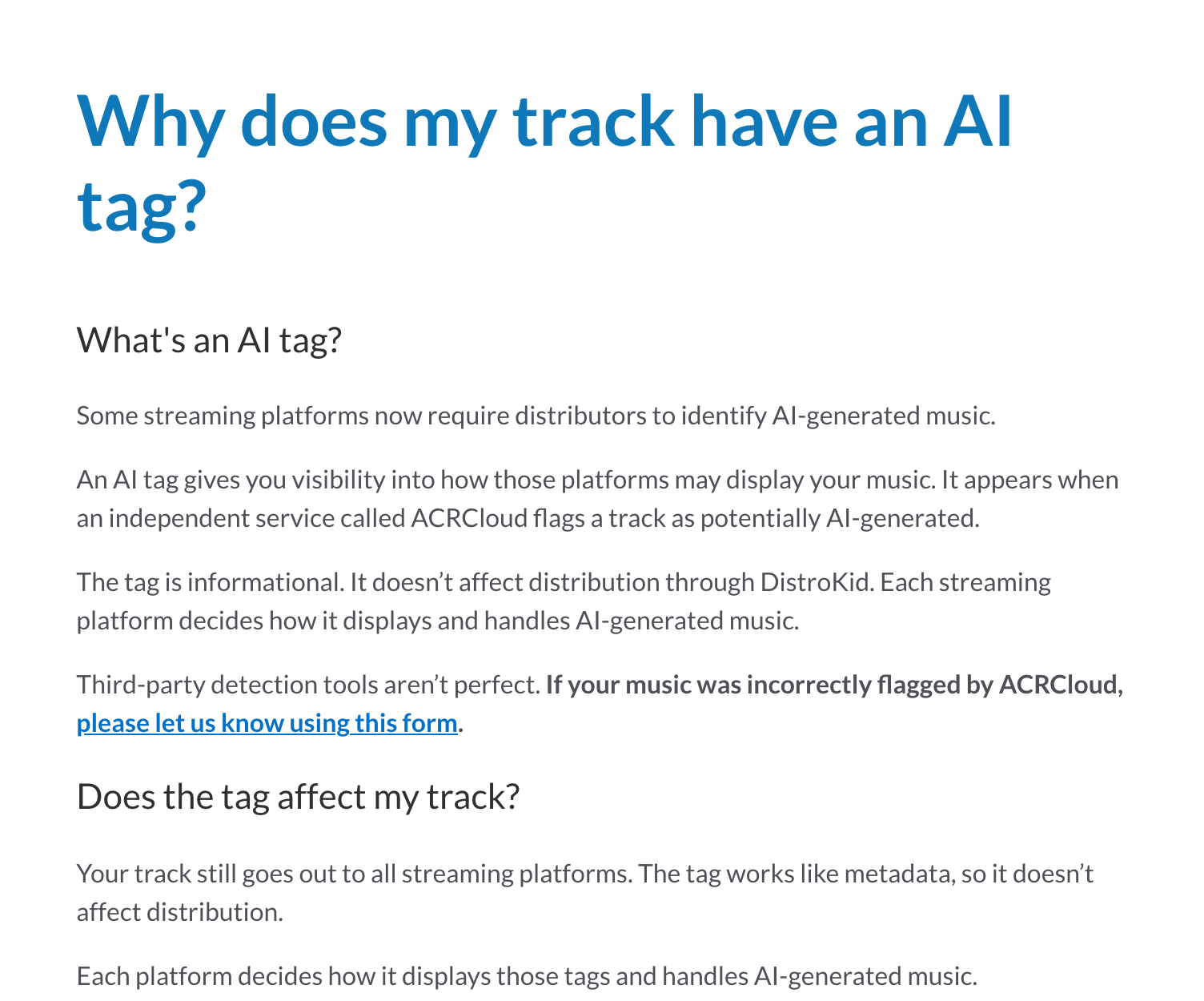
If you used AI, DistroKid says there’s nothing you need to do. If you didn’t, its AI tag article admits “third-party detection tools aren’t perfect”, links a form to dispute the tag, and says DistroKid tells the platforms right away when a tag shouldn’t be there.
Detectors do get human music wrong. SubmitHub’s detector flagged all 23 of Coloured Tears’ hand-made covers as AI, plus 7 of the 1980s originals they covered.
Why the UMG v. DistroKid lawsuit isn’t a ban on AI music
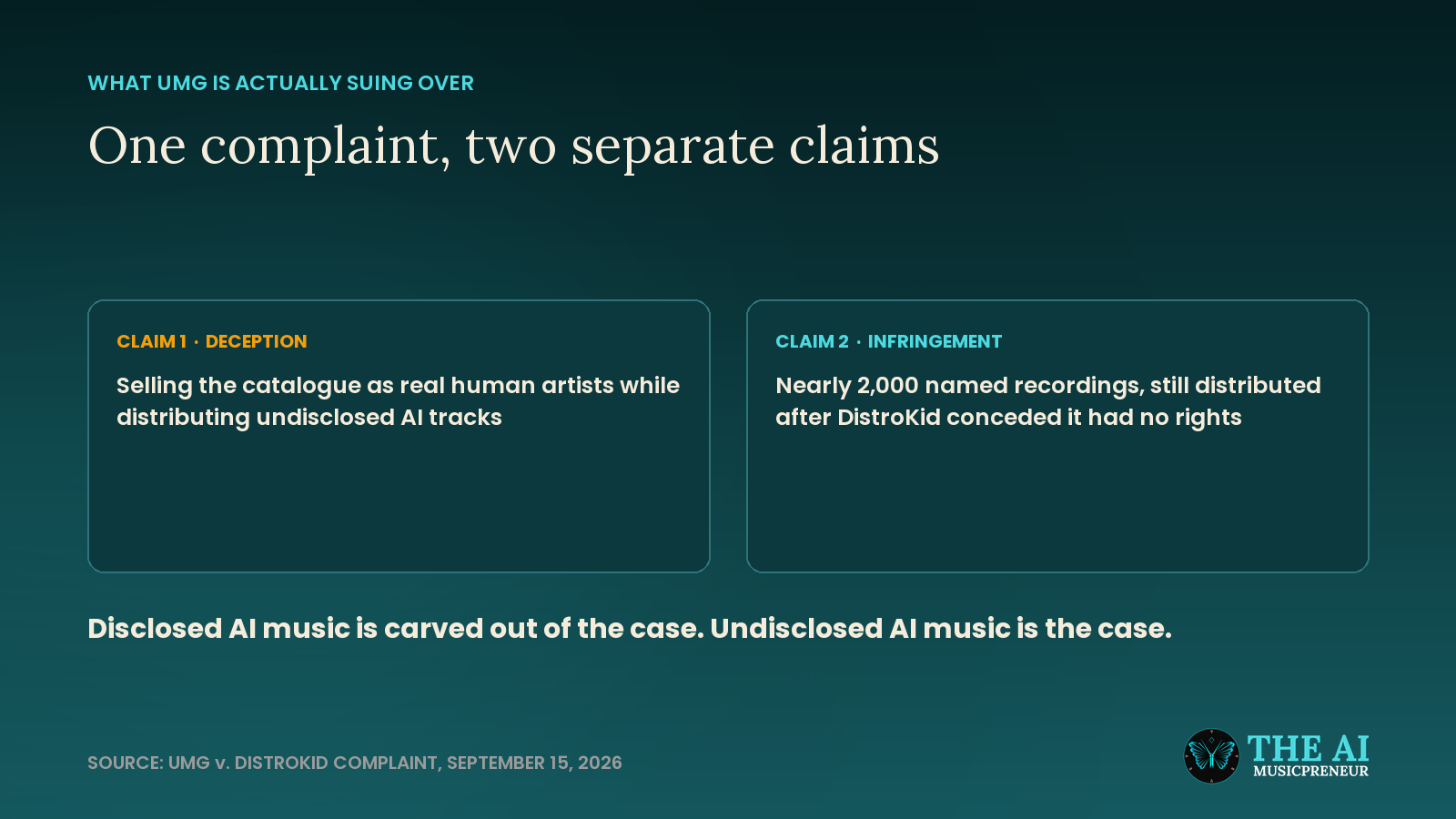
Universal Music Group sued DistroKid in a Delaware federal court on September 15, 2026. The complaint says it is “not about the distribution of AI-generated music when clearly disclosed as such”. It goes after undisclosed AI tracks sold as human artists, plus nearly 2,000 recordings UMG says infringe its rights.
It still reaches AI uploaders. On October 10, DistroKid confirmed it had removed a small number of recordings over UMG’s claims, and artists say they got no warning. Separately, the UMG and Sony subpoena from their lawsuit against Suno asks DistroKid how many tracks its third-party AI prediction model scored as likely AI each month. My UMG v. DistroKid case tracker follows both.
The one category the complaint leaves out is AI music that’s labeled as AI, and the AI credits box is how you label it.
Bonus tips for releasing AI music on DistroKid
Keep your session files for every AI release on DistroKid
If ACRCloud tags a song you made by hand, or a takedown lands, your stems, project files and prompts are what you can show. After a valid counter-notice, DistroKid waits 10 business days before a removed track can come back.
Check Spotify’s AI Persona badge before you release as an AI persona
Spotify runs its own AI Persona badge, and music from badged profiles is kept out of editorial, algorithmic and personalized recommendations by default. Read my Spotify AI music rules before you release a fully AI project.
Key takeaways: does DistroKid allow AI music?
DistroKid allows AI music, and its policy on AI-generated music fits in 4 rules. Here’s the short version:
- You need 100% of the rights, including the right to distribute what your AI tool made.
- AI as a tool (mixing, mastering, pitch correction) needs no credit, while AI lyrics, melody or audio needs AI credits.
- Your generator’s plan decides the rights: Suno Pro or Premier yes, Suno free no, and Udio downloads are off.
- The ACRCloud AI tag is informational and doesn’t stop distribution.
- UMG’s lawsuit targets undisclosed AI music, and AI music labeled as AI is left out of it.
Every platform sets its own AI rules, and I have a guide for each: Spotify, Bandcamp, TuneCore and Apple Music. If you’re still picking the best distributor for AI music, my best AI music distribution services roundup compares 7 of them.
Frequently asked questions
Does DistroKid ask whether your album artwork is AI-generated?
Yes. When you upload a release, you can tell DistroKid whether AI generated your artwork, and its help article on the question went up on October 15, 2026. Choose yes for an image made from a text prompt or an illustration made with AI, and no if you only used AI to edit an image, adjust its colors or clean up the background.
Does DistroVid ask if a music video was made with AI?
Yes. When you upload a video to DistroVid, you can tell DistroKid whether AI generated its visuals. Choose yes for a video made from a text prompt or image, AI-made footage or animation, or performers created with AI, and no if AI only helped you edit, color-correct or clean up the footage.
Can you add AI credits to a DistroKid release after it goes live?
Yes. DistroKid says you can add or update AI credits after uploading. Open your album page and click Credits next to each song, or go to the Credits page in your DistroKid account.
How long does DistroKid take to review a wrong AI tag?
DistroKid says it typically replies by email within 24 to 48 hours after you submit its AI tag form. If the tag shouldn't be there, it says it will tell the streaming platforms right away.
About the author
Covering AI music tools, industry shifts, and news for music creators and professionals. Twice-weekly newsletter at aimusicpreneur.com.