3 in 4 AI tracks are distributed through DistroKid, and TuneCore's share fell by two thirds
My stack My fav 6 tools for AI music after testing 70+
-
 ElevenMusic · Music generation
 -
 Moises · Stem separation
 -
 Controlla · Voice swap & cloning
 -
 Cryo Mix · Mixing + mastering
 -
 Neural Frames · Music videos
 -
 ONCE · Distribution
Some links are affiliate links — I earn a commission at no cost to you. Every tool here is one I run myself and truly believe in. This stack is proven.
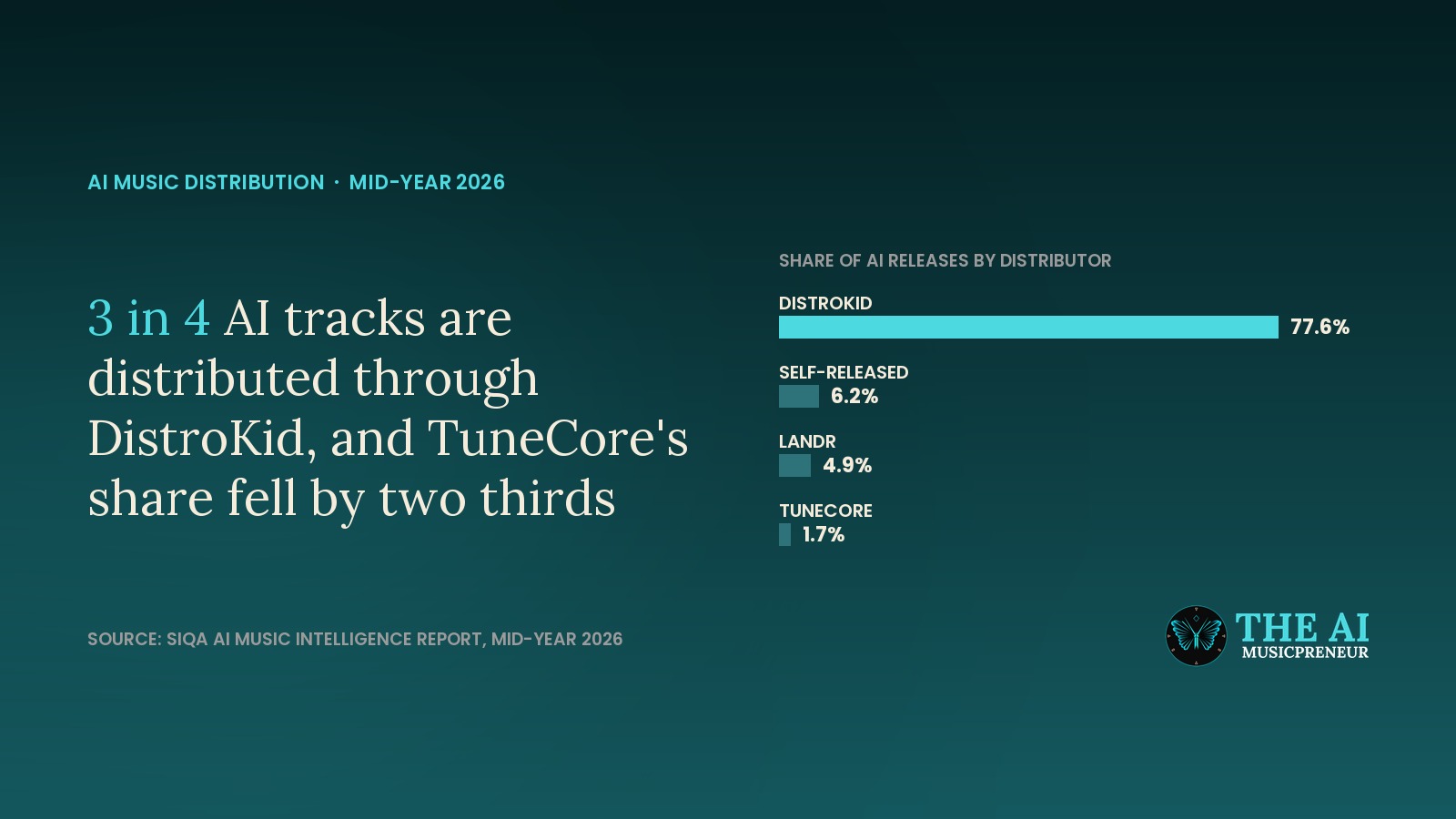
DistroKid carried 77.6% of the AI music that reached streaming services between April and August 2026, according to the Sonic Intelligence Academy’s Mid-Year 2026 report. That is up from 75.8% in Q1, and it works out at roughly 3 in every 4 AI tracks.
The number that moved is TuneCore. It handled 4.7% of AI releases in Q1 and 1.7% at mid-year.
Why TuneCore’s AI music share fell from 4.7% to 1.7%
The drop lines up with April 2026, when Believe and TuneCore started blocking unlicensed Suno tracks. SIQA does not name a cause and I would not print one as fact. No other distributor moved that sharply in the same window.
It is the cleanest cause-and-effect line in the whole report. A distributor changed its policy in April, and by August its share of this category had fallen by roughly two thirds.
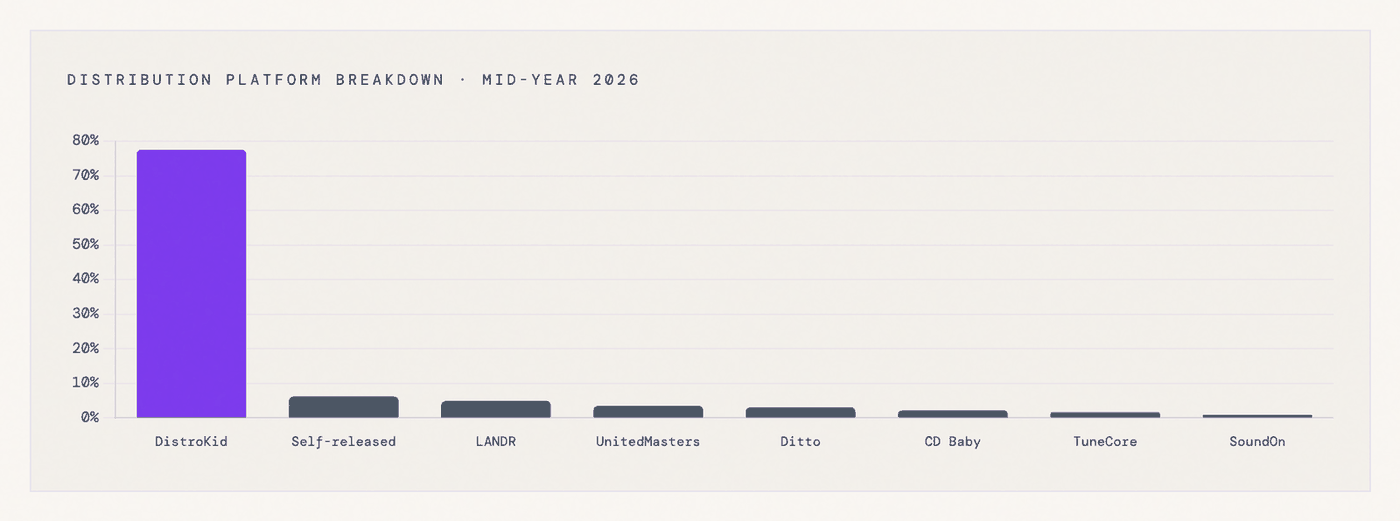
The rest of the field is thin. Self-released tracks come second at 6.2%, then LANDR at 4.9%, UnitedMasters at 3.5% and Ditto at 3.1%. CD Baby held flat at 2.1%. SoundOn, TikTok’s distributor, appears in SIQA’s data for the first time at 0.9%.
Distribution policy is the real gatekeeper for AI music
SIQA calls DistroKid’s share a policy stance rather than a preference, and that reading holds up. The distributor that stayed open to AI music inherited the creators.
Here is the part worth sitting with if you work anywhere near this. A song blocked at the upload form never reaches a streaming service, never gets a stream count, and never enters a dataset like this one. That makes distribution the first and hardest filter in the chain, well ahead of chart eligibility rules or platform labels.
Two things follow for the industry. A distributor that closes its door loses these creators inside a quarter, as TuneCore’s numbers show. And a distributor that stays open inherits the entire category along with whatever liability arrives with it.
What CVC’s DistroKid stake means for AI music releases
The pipe carrying 3 in 4 AI releases changed hands this year. CVC Capital Partners bought a majority stake in DistroKid in July 2026.
I’m not going to predict a policy change from an ownership change, because private equity buying a distributor tells you nothing on its own about upload rules. What it does mean is that one commercial decision, at one company, now sits between most AI music and the streaming services.
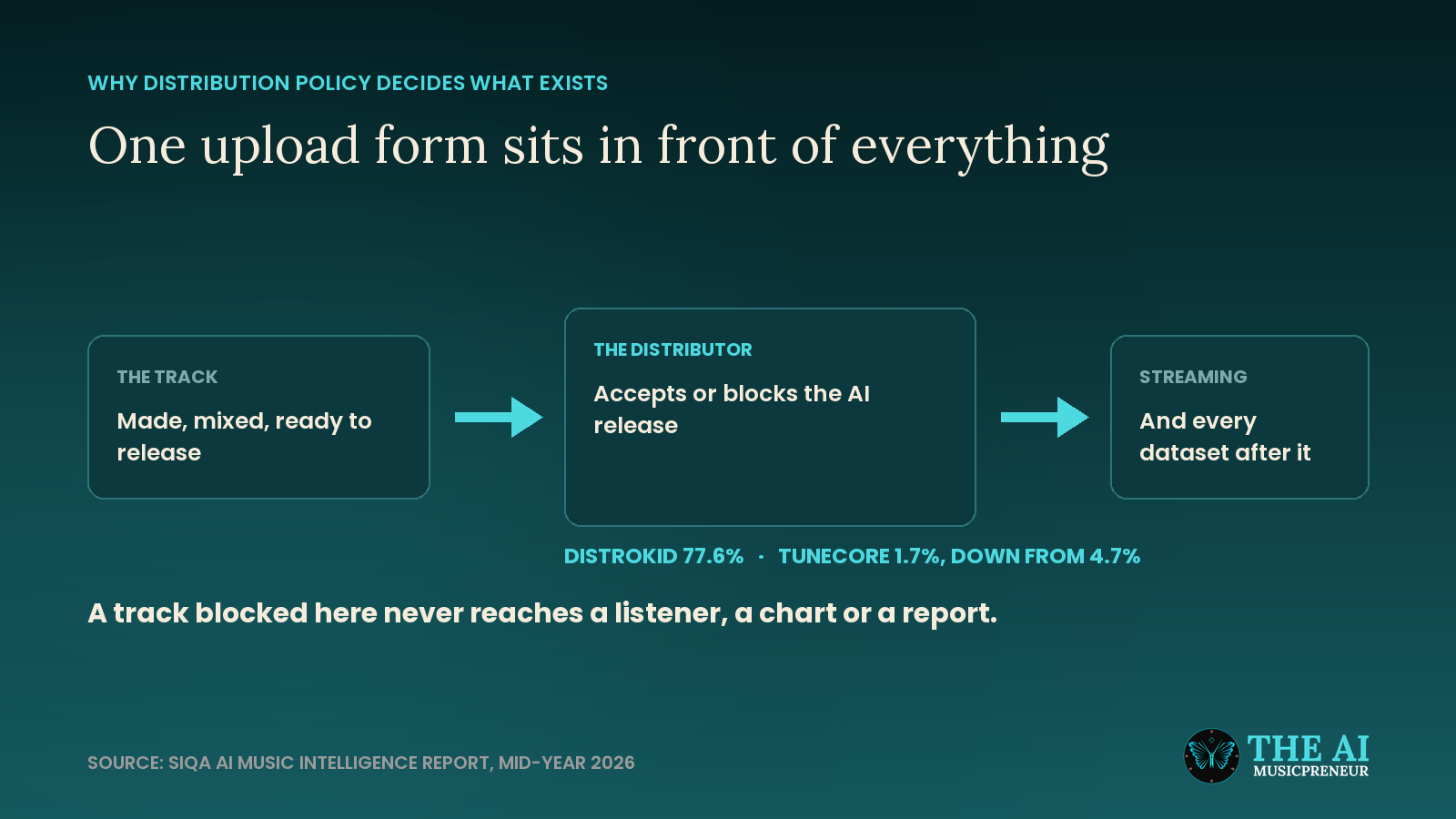
If you release music with AI in the chain, the practical move is narrow and worth doing before your next upload. Read your distributor’s AI policy page and check what it requires you to disclose, because getting that wrong can cost you the release rather than just the chart placement. My AI music distribution roundup ranks the options by exactly that, with the caps and policies attached.
Three quarters of this category depends on one company continuing to say yes. That is the fact I’d keep in view, whichever side of the upload form you sit on.
Frequently asked questions
What share of AI music did DistroKid distribute in SIQA's Mid-Year 2026 report?
DistroKid accounted for 77.6% of mid-year AI releases that carried distributor data, up from 75.8% in the Q1 2026 report. That is roughly 3 in every 4 AI tracks reaching streaming services through a distributor. The remaining share splits across self-released tracks at 6.2%, LANDR at 4.9%, UnitedMasters at 3.5%, Ditto at 3.1%, CD Baby at 2.1%, TuneCore at 1.7% and SoundOn at 0.9%.
Why did TuneCore's share of AI music fall between Q1 and mid-year 2026?
TuneCore handled 4.7% of Q1 AI releases and 1.7% at mid-year. The fall lines up with April 2026, when Believe and TuneCore started blocking unlicensed Suno tracks from distribution. SIQA does not name a cause, but the timing matches and no other distributor moved that sharply in the same window.
Which distributors appear in SIQA's Mid-Year 2026 AI music distribution data?
Eight routes to streaming appear: DistroKid at 77.6%, self-released at 6.2%, LANDR at 4.9%, UnitedMasters at 3.5%, Ditto at 3.1%, CD Baby at 2.1%, TuneCore at 1.7% and SoundOn at 0.9%. The figures cover only mid-year submissions where the creator disclosed distributor data.
Why does a distributor's AI policy decide whether a track appears in AI music data?
SIQA only counts commercially released tracks, so a song blocked at the distribution stage never enters the dataset at all. That makes distribution policy the practical gatekeeper for AI music, ahead of chart rules or streaming platform labels. A distributor that closes its door to AI music removes those creators from the record within a quarter.
About the author

Covering AI music tools, industry shifts, and news for music creators and professionals. Twice-weekly newsletter at aimusicpreneur.com.