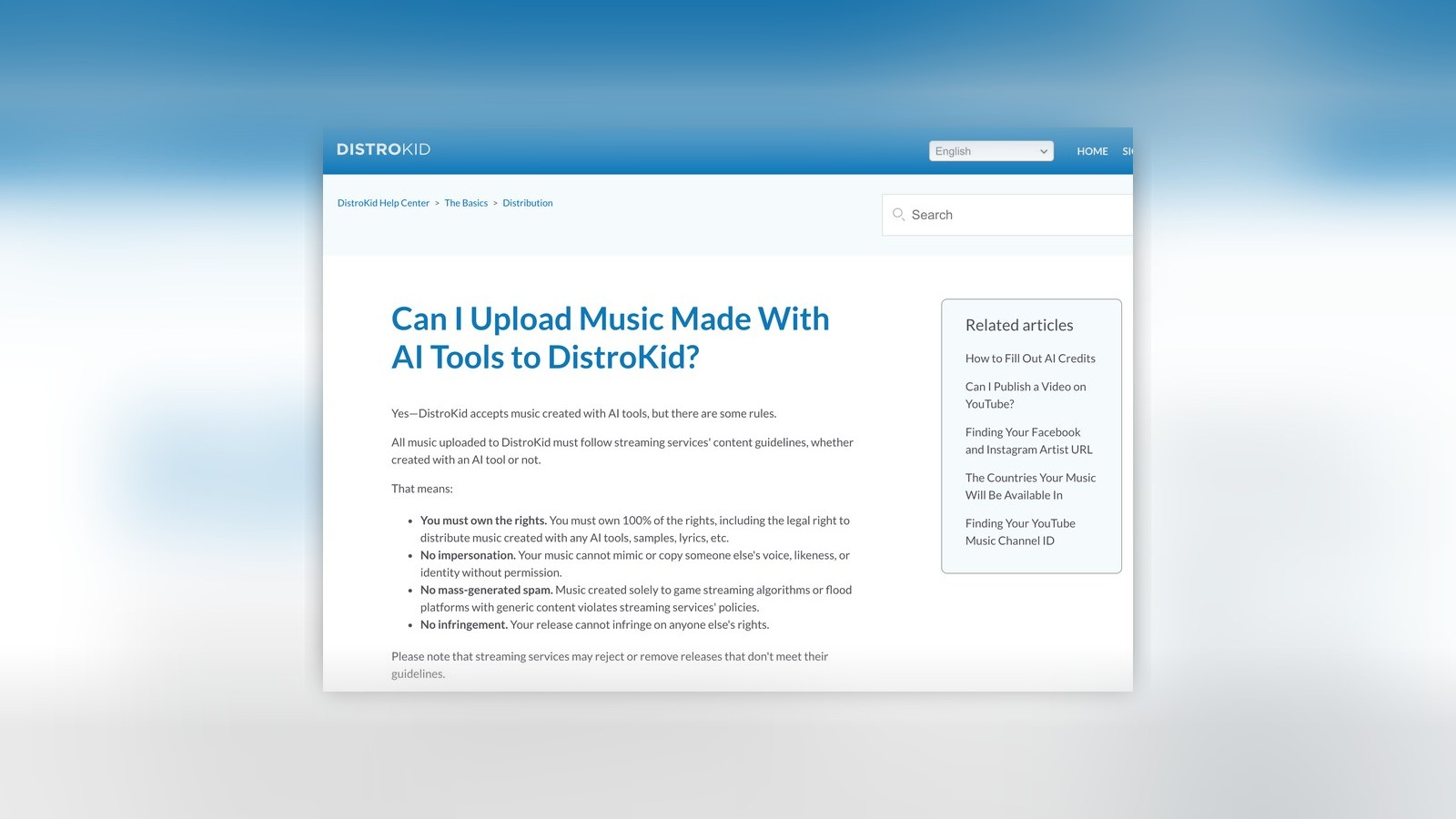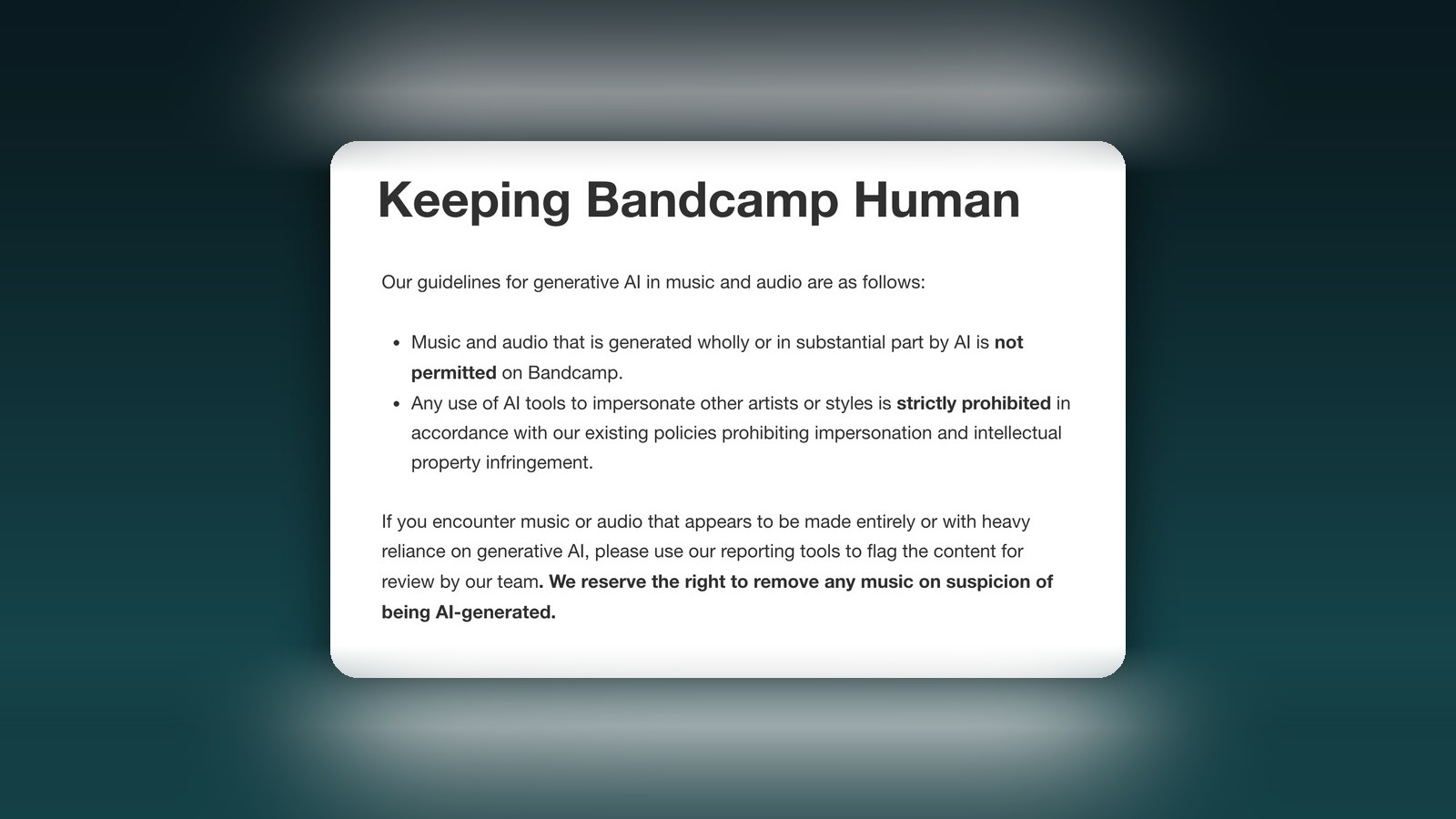
TuneCore AI generated music policy (2026): what you can release, and what gets blocked

SIQA Summit, LA, 12th November 2026 Ozzy Osbourne's former bassist is sharing a stage with Suno. I'm moderating:

Blasko
Bassist (Ozzy Osbourne, Rob Zombie)

Sam Berger
Artist Partnerships at Suno

RoccStar
Grammy Award-winning producer and songwriter

Drake Murphy
A&R at PlayPulse / Create Music Group

Janie Jennings
Founder, Creative's Flow Ecosystem

Chris Wieduwilt
Moderator
Limited capacity only
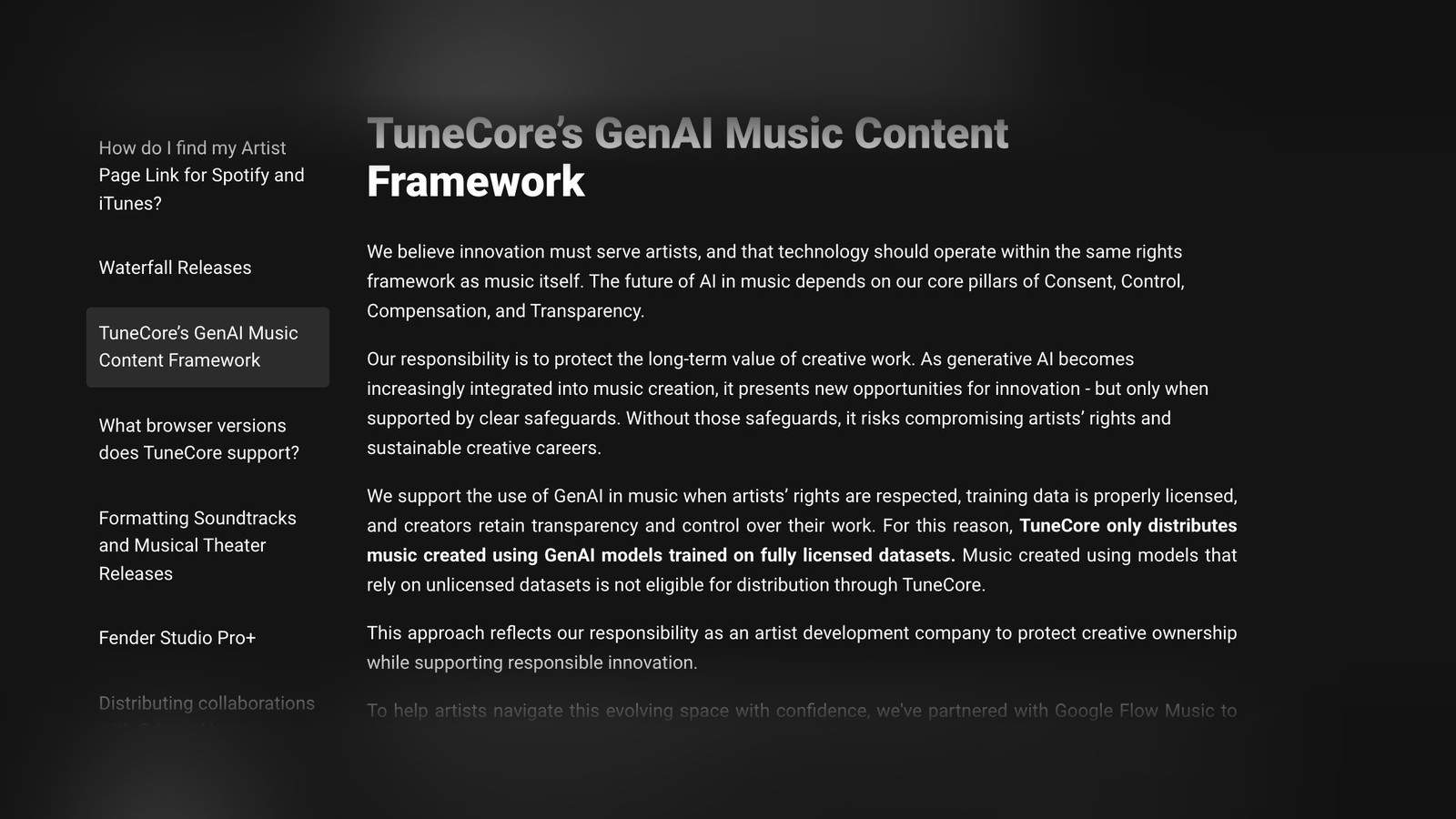
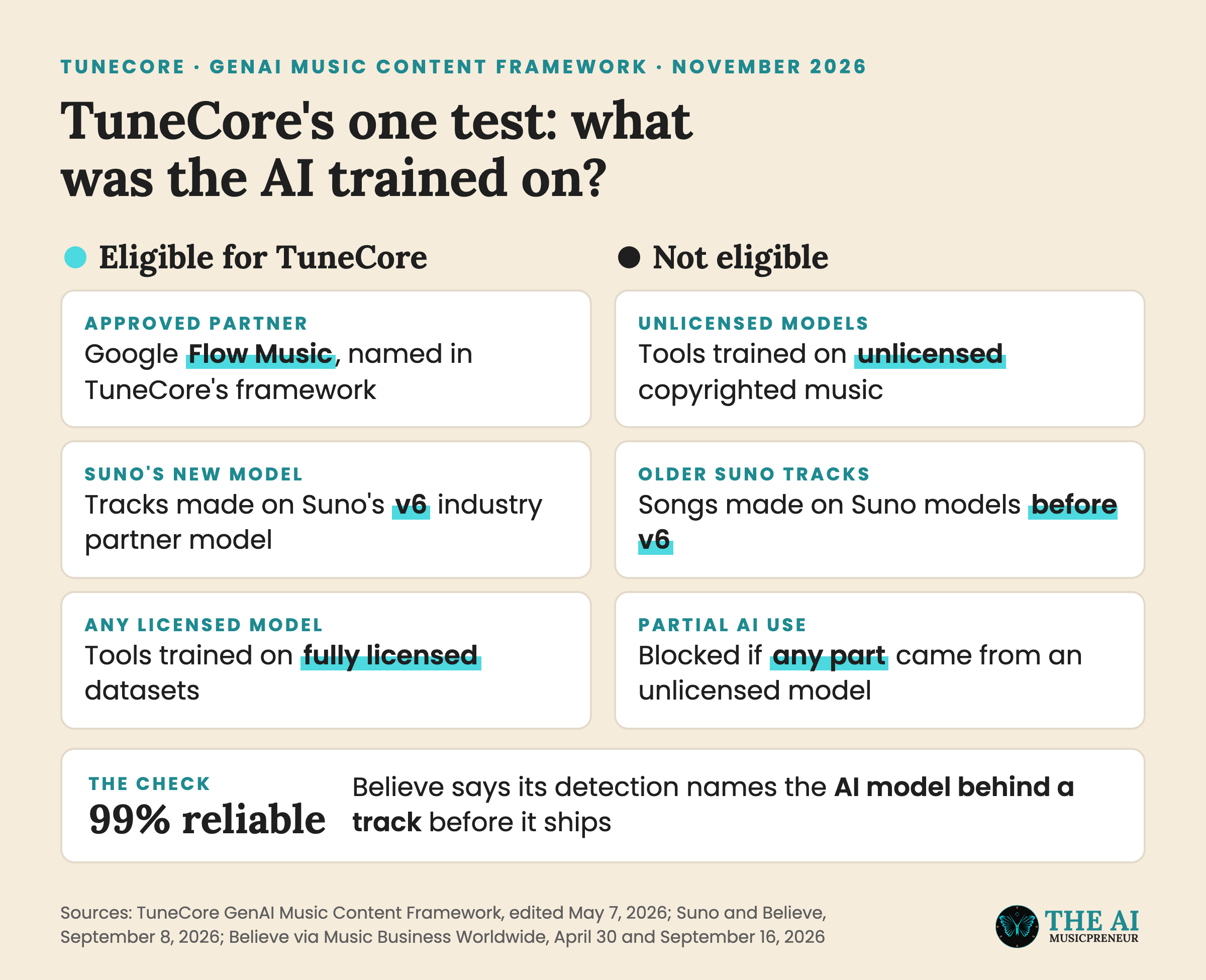
TuneCore’s AI generated music policy comes down to one question: what was the AI trained on?
If the model behind your track was trained on fully licensed music, TuneCore will distribute it. If it was trained on unlicensed music, TuneCore won’t, and that holds even if AI only made one part of the song.
TuneCore calls the page its GenAI Music Content Framework. It went up on March 5, 2026 and was last edited on May 7, 2026, which is before the Suno deal Believe signed in September. I checked it again on November 10, 2026. (The rules for every other platform sit in my breakdown of AI music rules by platform.)
What is TuneCore’s AI generated music policy?
TuneCore’s AI generated music policy is the rule that decides which AI-made tracks TuneCore will distribute. TuneCore only accepts music made with generative AI models trained on fully licensed datasets. Music made with models trained on unlicensed copyrighted works is not eligible, even if AI was used for only part of the track.
Why TuneCore checks what the AI was trained on
TuneCore builds the policy on 4 principles it repeats across its AI pages: consent, control, compensation and transparency. Its reasoning is simple. A model trained on unlicensed songs never asked those artists, never paid them, and gave them no say.
Believe, the Paris company that owns TuneCore, turned that into enforcement on April 30, 2026. It started automatically blocking tracks made on what it called “pirate studios”, and said its detection was 99% reliable at naming the model behind a track. Suno was on that list.
You could see the effect within a few months:
Over the same period, DistroKid’s share went up to 77.6% of AI releases.
Does TuneCore allow AI music? 5 kinds of AI track and where each one lands
Yes, TuneCore allows AI music, as long as every AI tool in the chain passes the licensed-training test. Here’s how that plays out for the 5 kinds of AI track that land in an upload form.
AI-assisted tracks made with licensed tools
This is the easy case. TuneCore names Google Flow Music as an approved partner that is “ready for TuneCore distribution”, and TuneCore artists get bonus Flow Music credits through a banner on their dashboard. Believe partnered with Google in May 2026 to put Flow Music in front of its artists.
Flow Music is the only tool TuneCore names. Believe also signed partnerships with ElevenLabs and Udio on April 30, but the framework doesn’t list them. TuneCore says it is “actively building a network of partners” and will add more over time.
Tracks from unlicensed AI models
Not eligible. If the model was trained on copyrighted music without licences, TuneCore won’t distribute what it makes, and Believe’s detection is there to catch the model before the release ships.
TuneCore’s own advice for tools that stay vague: “If a tool doesn’t clearly explain where its training data comes from or how it’s licensed, we recommend proceeding with caution.”
Tracks where AI only made one part
This is the one that catches people out. A human-written song with one AI synth line or one AI backing vocal from an unlicensed model fails the same way a fully generated track does.
If GenAI is used at any point in the creation of a track, the tools involved must rely on fully licensed datasets for the music to be eligible for distribution.
100% AI-generated tracks
TuneCore’s 2026 framework doesn’t mention fully AI tracks at all. It only asks what the model was trained on.
An older TuneCore page does. The GrimesAI distribution guide, last edited in July 2023, says “TuneCore will not distribute any works that are 100% AI-generated”. TuneCore hasn’t said whether that 2023 line still applies next to the 2026 framework, so if your track has no human part at all, ask TuneCore support before you upload.
AI voice clones of real artists
The only voice model TuneCore documents is GrimesAI, the AI version of Grimes’ voice she agreed to share. The 2023 rules for it are strict:
- You need an Unlimited Distribution plan.
- Every release splits revenue 50/50 with GrimesAI, however much of the track uses the voice.
- GrimesAI gets a main or featured artist credit.
- The vocal stem has to come from the official Elf.Tech platform.
- The release can’t go to YouTube Content ID.
TuneCore describes no route for cloning the voice of an artist who hasn’t agreed to it.
Suno is the one case that changed during 2026, so it gets its own section.
TuneCore and Suno in 2026: v6 tracks are eligible, older Suno tracks are not
Suno went from blocked to eligible at TuneCore in about 4 months:
Suno’s announcement is the line that matters: “All tracks created by artists using Suno’s new industry partner model will also become eligible to distribute through Believe and TuneCore.” That model shipped the next day as v6, v6-wild and v6-mini.
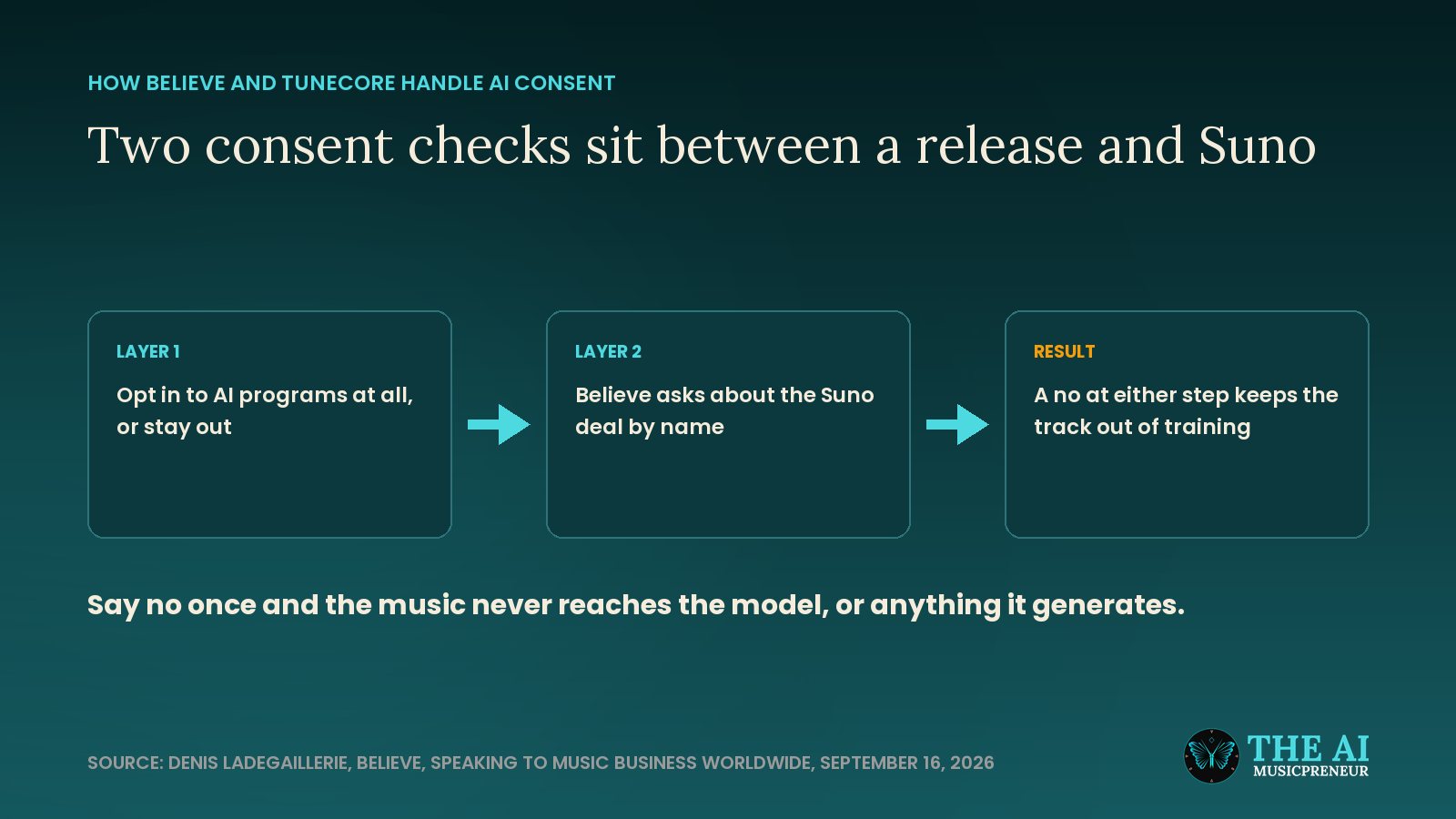
So a song you generate on Suno today runs on v6 and qualifies. A song you made on v5.5 in the summer doesn’t, even if you release it now. Believe CEO Denis Ladegaillerie confirmed the older models stay blocked when he explained Believe’s 2 consent checks on September 16.
Suno’s download caps travel with the deal too. Suno says its watermarking and download limits (20 songs a month on Pro, 60 on Premier) apply to music distributed through Believe and TuneCore, as part of the Suno and Believe partnership.
There are 2 caveats:
- TuneCore’s own framework page still names only Flow Music as an approved partner. The Suno eligibility comes from Suno’s and Believe’s announcements, not from TuneCore’s help center.
- Universal and Sony sued Suno a second time on September 18, 2026, this time over v6. TuneCore hasn’t said the case changes anything for distribution.
TuneCore Publishing and AI: why a distributed AI track can earn no songwriting royalties
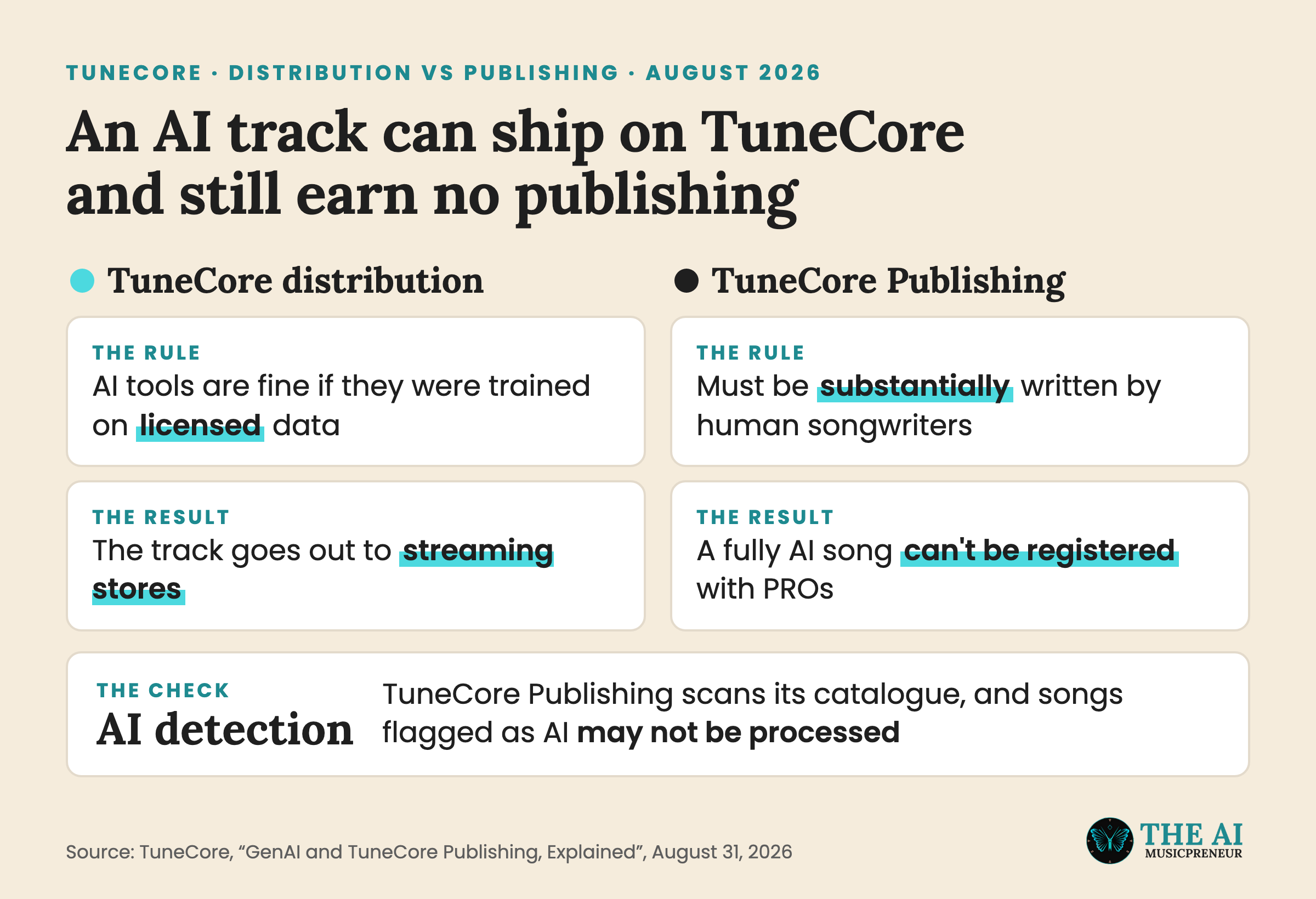
TuneCore runs distribution and publishing on different rules, and the gap matters if you write with AI.
On the recording side, the licensed-training test is all that counts. On the songwriting side, TuneCore Publishing says the works it represents “must be substantially created by human songwriters”.
A composition generated entirely by AI can’t be registered with PROs and CMOs. Those are the societies that collect songwriting royalties, like ASCAP and BMI in the US or PRS in the UK. No registration means no publishing income from that song through TuneCore.
TuneCore Publishing also runs AI detection across the catalogue it administers, and songs flagged as likely AI-generated “may not be processed”. It published that page on August 31, 2026.
How to release AI music on TuneCore without getting rejected
Here are 4 steps, in the order you’d do them before an upload.
Step 1: Check what your AI tool was trained on
TuneCore lists 3 things to look for in any AI tool:
- Clear information about how the tool is trained.
- An explicit statement that it uses licensed or rights-cleared music.
- Terms of service that spell out who owns the output and how you can use it.
If you can’t find all 3, TuneCore’s advice is to proceed with caution. For Flow Music and Suno v6, the announcements above already answer it.
Step 2: Write down the model version behind every AI part
Note which tool and which version made each part of the track. For Suno that means v6, v6-wild or v6-mini. One stem from an older Suno model is enough to make the whole release ineligible.
Step 3: Keep a human songwriter on the song if you want publishing royalties
If you plan to register the song with TuneCore Publishing, write the lyrics and melody yourself or with your co-writers. AI can still play on the recording.
Step 4: Keep proof of how you made the track
If a release gets flagged, you’ll want to show which tool made what. Save the project file, the generation history and a copy of the tool’s licence page with the date you checked it.
Bonus tips for TuneCore AI releases
These 2 go beyond the upload itself.
Decide on TuneCore’s AI & Data Protection Program 2.0 separately
Releasing AI music and letting AI train on your music are 2 different switches at TuneCore. The AI & Data Protection Program 2.0, last edited on July 1, 2026, is the second one.
Join it and your catalogue can go into licensed AI training deals. For any deal that could be linked to your voice or your music, TuneCore gives you a 20-day review window before anything goes to the partner, and you can opt out of a single deal or leave the program.
Spotify’s AI remix deal is another separate opt-in
Believe and TuneCore also signed Spotify’s AI covers and remixes deal in October, with its own two-step opt-in. Saying yes to one AI deal at TuneCore never signs you up for the others.
Key takeaways on TuneCore’s AI generated music policy
Here’s the short version:
- TuneCore distributes AI music only when every AI tool involved was trained on fully licensed data.
- One AI part from an unlicensed model makes the whole track ineligible.
- Suno v6 tracks qualify since September 2026, and tracks from older Suno models don’t.
- Google Flow Music is the only tool TuneCore’s framework names as approved.
- TuneCore Publishing won’t register a song written entirely by AI, even when the recording is distributed.
The same questions for the other platforms: DistroKid, Spotify, Bandcamp and Apple Music.
Frequently asked questions
Is Google Flow Music approved for TuneCore distribution?
Yes. TuneCore's GenAI Music Content Framework names Google Flow Music as an approved partner whose output is ready for TuneCore distribution. TuneCore artists also get bonus Flow Music credits through a banner on their TuneCore dashboard.
When did TuneCore last update its GenAI Music Content Framework?
TuneCore published the page on March 5, 2026 and last edited it on May 7, 2026, according to its help center. That's before the September 8, 2026 Believe and Suno deal, which is why the page still names only Google Flow Music as an approved partner.
What does TuneCore charge when Spotify flags a track for artificial streams?
TuneCore passes on Spotify's penalty of €10 a month for each track with high levels of artificial streaming. It charges your TuneCore balance or the payment method on file, in your local currency, and emails you an invoice that names the affected tracks.
Did TuneCore sign IFPI's Streaming Integrity Initiative?
No. When IFPI launched the Streaming Integrity Initiative on September 14, 2026 with 27 companies, Believe and its TuneCore platform were not on the launch list, and neither was DistroKid.
About the author
Covering AI music tools, industry shifts, and news for music creators and professionals. Twice-weekly newsletter at aimusicpreneur.com.