




Ircam Amplify AI Music Detector
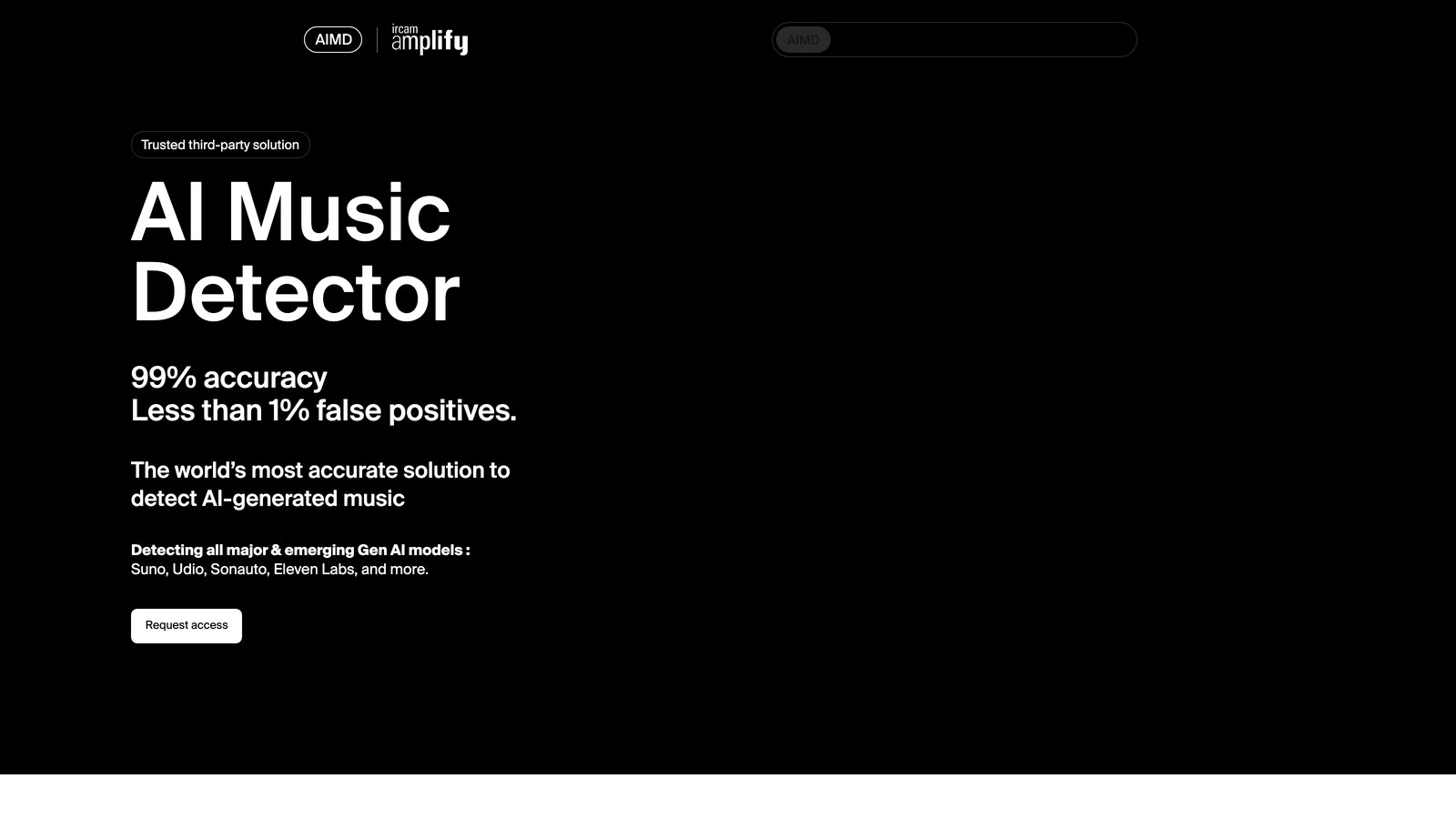
Ircam Amplify's AIMD claims 99% accuracy and under 1% false positives, scanning 250,000 tracks an hour through an API. Access is gated, pricing is not public.
What is the Ircam Amplify AI Music Detector and how does it work?
AIMD, the AI Music Detector from Ircam Amplify, is an enterprise detection API aimed at the organisations that move music at volume: streaming services, distributors, labels, collecting societies, and publishers. Ircam Amplify is the commercial arm of IRCAM, the Paris audio research institute.
It describes itself as a “trusted third-party solution”, which is a claim about position as much as accuracy. Among the AI music detection tools here, it is the one built explicitly to sit between parties who need a result neither of them produced.
How it works:
- Request access through the site, since there is no self-serve signup
- Connect via the RESTful API or SDK
- Submit tracks at volume, with throughput stated at more than 250,000 within an hour depending on server capacity
- Receive a verdict on whether the recording was generated
- Detection models are maintained against new generators and versions as they ship
The named coverage is Suno, Udio, Sonauto, Eleven Labs, “and more”. It is not a tool an artist checks one song with.
How much does the Ircam Amplify AI Music Detector cost?
Ircam Amplify publishes no pricing for AIMD.
| Plan | Price | What you get |
|---|---|---|
| AIMD | Not published, access request required | API and SDK detection at catalogue scale |
Pricing changes frequently, and here it is not disclosed at all. Verify current terms at Ircam Amplify. There is no free tier, no trial, and no checkout, so evaluating it means starting a sales conversation.
What does Ircam Amplify’s 99% accuracy claim actually cover?
The company states 99% accuracy and less than 1% false positives, and calls AIMD “the world’s most accurate solution to detect AI-generated music”. Those are vendor figures.
- No test set is published, so the numbers cannot be independently reproduced or compared against another vendor’s
- A sub-1% false-positive rate still misfires at scale: on a catalogue of 250,000 tracks, under 1% is still up to 2,500 recordings wrongly flagged
- The claim covers detection of generated audio, not attribution of how much human work went into a track
- Coverage is model-by-model, which is why the company lists “Update Ready” as a feature
- That update cadence is itself the tell: a detector has to be retrained every time a generator ships, so any accuracy figure is a snapshot
That last point is worth sitting with. Keeping current with the latest AI models is sold as a benefit, and it is also an admission that detection is a treadmill rather than a solved problem.
What Ircam Amplify does not tell you
The gap here is access as much as capability. This page documents what the company publishes, because there is no public route to test the claims.
- Detection reads the finished file, so it cannot see who wrote, played, or arranged anything
- A “trusted third party” label describes a market position, not an accountability mechanism: it is not stated who carries the cost when a false positive takes down a legitimate release
- Throughput of 250,000 tracks an hour is qualified as depending on server capacity, so real-world figures will vary by deployment
- Pricing, contract terms, and response times are all undisclosed
Several sites currently publish “reviews” of AIMD despite there being no public access to it. Treat any scored review of this product with suspicion, including the ones ranking well.
What are some use cases for the Ircam Amplify AI Music Detector?
- Screening uploads at DSP scale: the throughput figure targets platforms processing tens of thousands of tracks a day.
- Distributor pre-distribution checks: catching generated content before it enters the supply chain rather than after.
- Collecting society and PRO registration checks: verifying submissions where copyright status depends on how a work was made.
- Publisher catalogue audits: checking an acquired catalogue for generated content.
- Meeting transparency obligations: EU AI Act rules require AI-generated audio to be labelled, and labelling at scale needs detection at scale.
- Feeding chart eligibility decisions: proposed AI chart rules depend on determinations someone has to make.
If you are an independent artist, this is the wrong tool in the category. The free scanners exist for that job.
How much does the Ircam Amplify AI Music Detector cost?
Ircam Amplify does not publish pricing. Access runs through a request form and pricing is agreed directly.
Is there a free version of the Ircam Amplify AI Music Detector?
No. There is no free tier, no trial, and no self-serve signup.
How accurate is Ircam Amplify’s AI Music Detector?
The company claims 99% accuracy with less than 1% false positives. No test set is published, so the figure is a vendor claim rather than an independently verified result.
Which AI music platforms does Ircam Amplify detect?
The site names Suno, Udio, Sonauto and Eleven Labs, and states that models are kept up to date as new generators appear.
Who is the Ircam Amplify AI Music Detector built for?
Its own page names DSPs, distributors, labels, CMOs and PROs, and music publishers. It is not aimed at individual artists.