





Cyanite
Cyanite AI tags songs with genre, mood, BPM and key, searches catalogs by prompt or sonic similarity, and flags Suno and Udio tracks. Free for 5 songs a month.
What is Cyanite and how does it work?
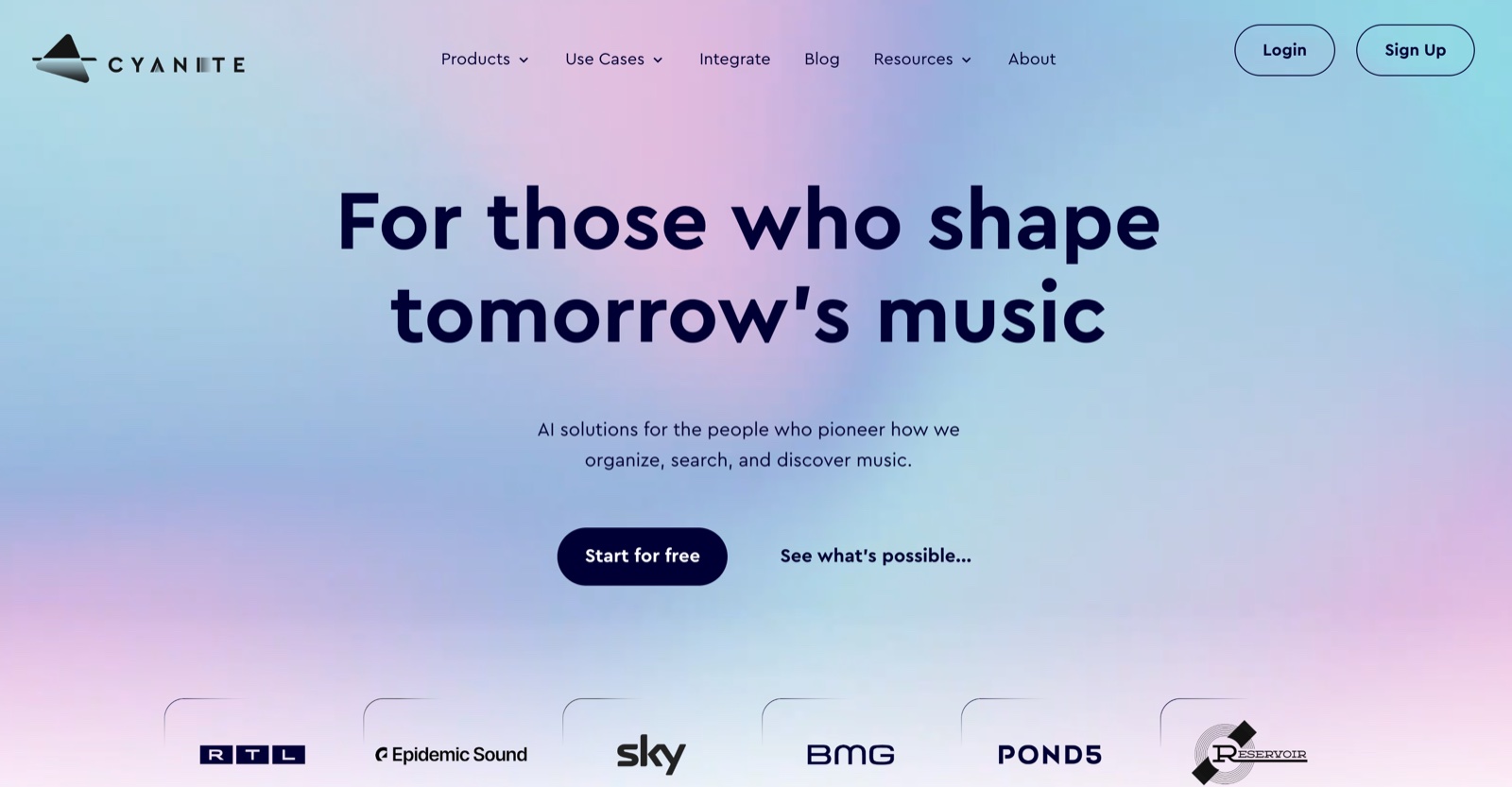
Cyanite reads music instead of making it. Upload a track and it returns genre, mood, BPM, key, instruments, and a written description of how the song sounds. The Berlin and Mannheim company behind it, founded in 2019, runs this analysis for BMG, Warner Chappell, Epidemic Sound, and Sky. I covered its audio-first tagging in my piece on Anghami’s 2.5 million song catalog.
How it works:
- Upload an mp3 (any bitrate, up to 15 minutes) in the web app, or send tracks through the API
- The model listens to the full track, start to finish, so a mood change in the bridge gets caught
- Tags and an auto-written description come back in under 30 seconds
- Search your library by similarity to a reference track, or type what you need in plain English
Built for publishers, sync teams, distributors, streaming services (DSPs), music-tech platforms, audio branding agencies, and music libraries. Artists can also use the web app to analyze up to 5 tracks per month for free, for example to generate metadata for playlist pitching.
How much does Cyanite cost?
Cyanite runs a free tier for individuals and custom quotes for companies:
| Plan | Price | What you get |
|---|---|---|
| Web app free | €0 | 5 song analyses per month with the full tag set |
| Creator credits | Not published | Extra analyses via self-service subscription inside the app |
| Enterprise | Custom quote | API subscription plus usage-based analysis fees and search subscriptions (if applicable), volume discounts |
A free program called Cyanite For Innovators covers selected non-commercial and research projects.
Anyone can start with 5 free analyses per month, available through both the web app and API. For individual artists and creators who need more, additional credits are available as one-time purchases or through a monthly subscription. Businesses with larger catalogs or high-volume workflows can access separate business plans and volume-based pricing. Pricing changes frequently, verify current plans at Cyanite pricing.
What metadata does Cyanite’s auto-tagging generate?
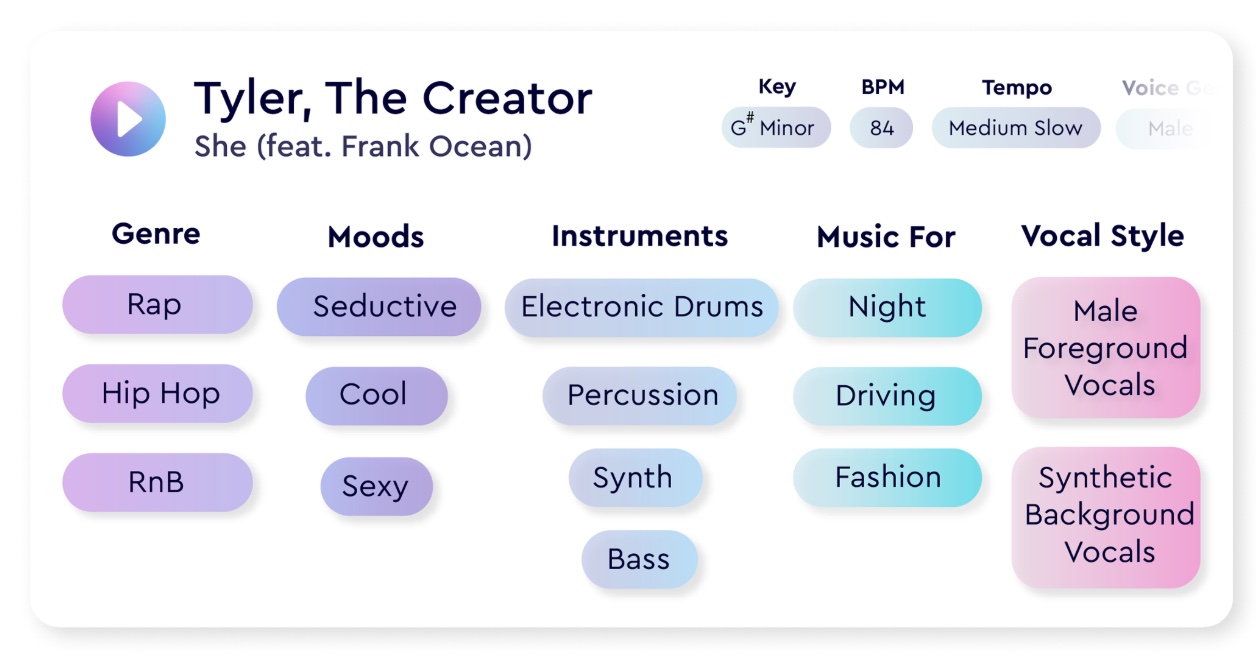
The tag set goes deeper than genre and BPM. Each analyzed track returns:
- Genre and subgenre
- Mood, energy level, and emotional profile
- BPM, tempo, and key
- Instruments and vocal characteristics
- Musical era and character
- “Music for” categories, the scenes and activities a track fits
- A plain-language description written from the audio, without an external LLM
The full taxonomy is public in Cyanite’s taxonomy sheet, so you can check whether your niche is covered before uploading anything.
Cyanite claims up to 99% tagging accuracy and 1 million tracks analyzed in under 12 hours. Both numbers come from Cyanite itself, no third party has benchmarked them. The SyncMyMusic founder Jesse Josefsson, who tested several auto-taggers after 10,000+ sync placements, put it this way: rival tools returned genres and mood tags that were “not even close” to acceptable, while members called Cyanite’s output “so accurate, it was almost spooky.”
How good is Cyanite’s AI music search?
Search is where the tagging engine turns into a workflow. Two modes:
Similarity Search takes one or up to 50 reference tracks and finds songs in your catalog with the same sound, vibe, and era, filterable by Cyanite or custom tags. Thematic, the creator platform co-founded by Michelle Phan with over 1 million creators, runs its recommendation engine on it.
Free Text Search takes a prompt instead. Type “uplifting indie folk for a summer road trip” or describe a film scene, and it matches the meaning against your catalog. No ChatGPT underneath, the semantics run on Cyanite’s own models.
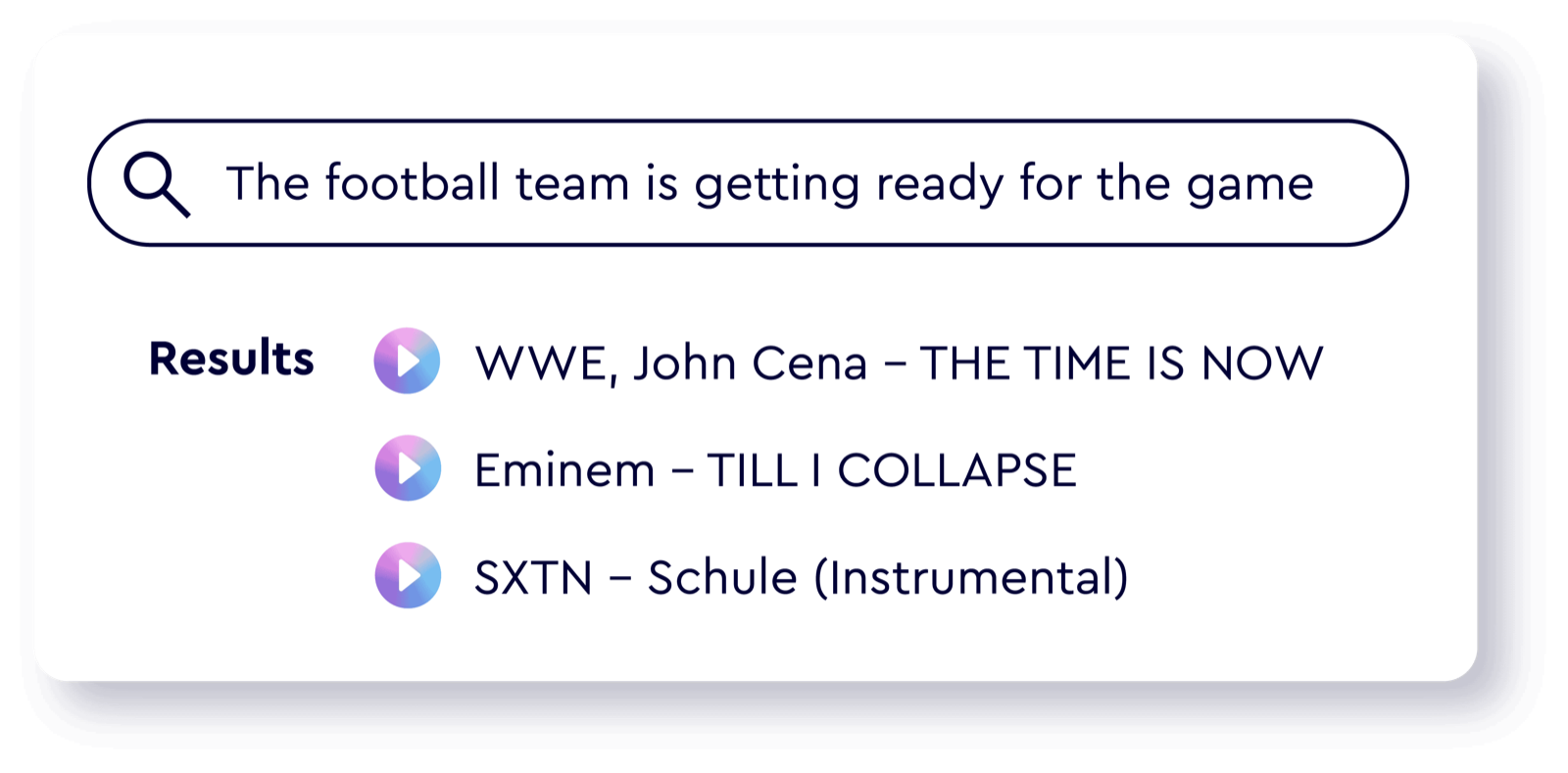
Melodie Music, an Australian licensing platform, layered both on top of its human editorial tagging. Managing director Evan Buist’s framing stuck with me: “It doesn’t use AI to generate content; it uses AI to uncover it.”
Can Cyanite detect AI-generated music from Suno and Udio?
Yes. Cyanite’s AI Music Detection identifies tracks generated by Suno, Udio, Lyria 3, Mureka, and ElevenLabs, with more models planned. It ships as a REST API and a web app, and access starts with a request form.
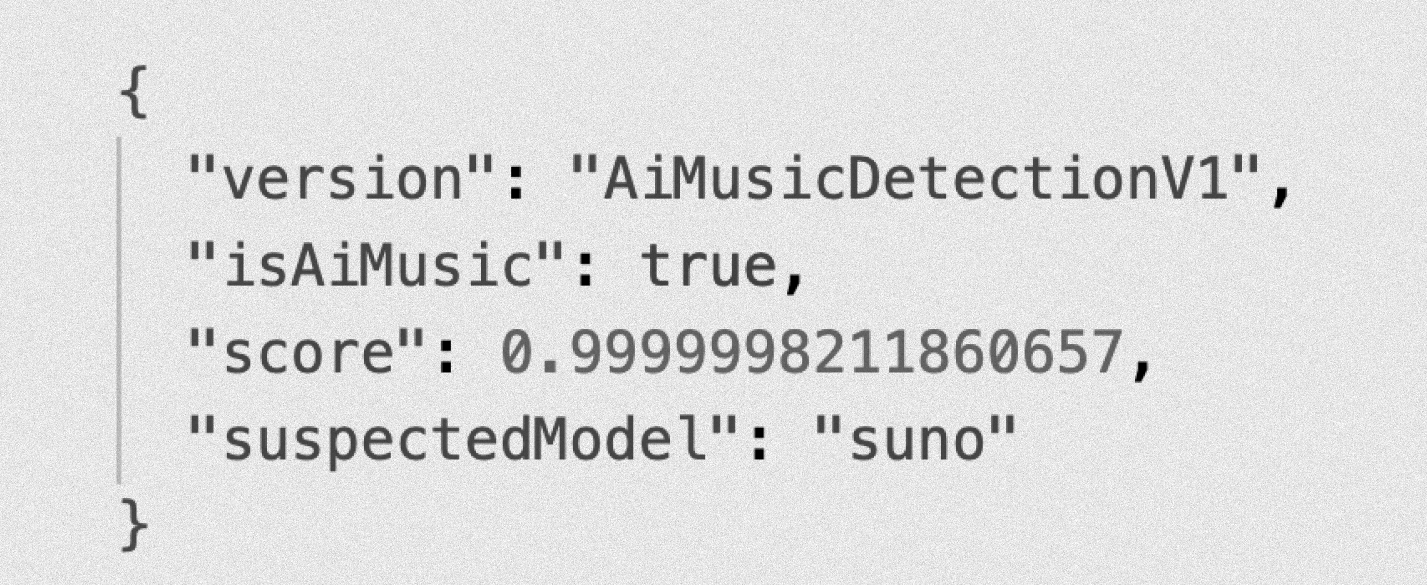
The design choice worth knowing: Cyanite calibrates against false positives, at the cost of catching fewer AI tracks. The company states 99 out of 100 AI-generated tracks from supported models get detected, the chance of flagging human music as AI is “negligible,” and the algorithm survives watermark removal. Vendor claims, all of them. No independent benchmark exists for this category, which I also flag on AHA Music’s free detector.
The need is already there. In Cyanite’s own industry survey with Marmoset and MediaTracks, 97% of music professionals want to know whether music is AI-generated, and 80% don’t trust artists to self-disclose. Once detection enters those workflows, restraint matters as much as the detection rate: a false AI label can cost a human artist playlist placements and distribution. A detector built by a company with no ties to any label, platform, or AI model provider has a cleaner seat at the table than one built by a streaming service scanning its own uploads.
How does Cyanite’s AI music detection compare to Deezer and Ircam Amplify?
The 3 detectors answer different questions about the same problem. One scope note before the tables: this comparison covers detection only. Cyanite’s free 5 analyses per month apply to tagging and descriptions, not detection, which sits behind an access request.
| Cyanite | Deezer AI Music Detector | |
|---|---|---|
| Access | Access request, REST API and web app | Free, inside Deezer’s own platform |
| Detection scope | Suno, Udio, Lyria 3, Mureka, ElevenLabs, down to the vocal vs. instrumental layer | Fully AI-generated tracks from models like Suno and Udio |
| Built by | Independent metadata company, no platform or model ties | A streaming service scanning its own uploads |
| Best for | Catalogs wanting detection plus the metadata to act on it | Listeners checking playlists, Deezer’s own moderation |
| Cyanite | Ircam Amplify | |
|---|---|---|
| Access | Access request, REST API and web app | Access-gated, no public pricing |
| Detection scope | Model coverage plus per-layer analysis (vocals, instrumental) | Segment-level detection, claims 250,000 tracks scanned per hour |
| Built by | Independent metadata company, no platform or model ties | IRCAM audio research spin-off, detection is the whole product |
| Best for | Teams deciding what happens to a flagged track next | Catalog-scale screening only |
The Deezer AI Music Detector works as a free consumer check, inside Deezer’s own walls; its business version scans uploads for fully AI-generated tracks only. Ircam Amplify does detection and nothing else, behind an access gate with no public pricing, and I haven’t seen enough of it to recommend it either way. Cyanite is the only one of the 3 where a flagged track arrives with tags attached, so a catalog team sees what the track is, not just what made it. It’s the one I’d test first. Cyanite’s own buyer’s guide to AI music detection tools compares more of the field. It’s written by the vendor, but it’s the most complete map of the category I’ve found.
What are some use cases for Cyanite?
Where Cyanite earns its place in a music business:
- Answering sync briefs: publishers report replying to briefs 5x faster with similarity search instead of memory
- Building your own music tool: CEO Markus Schwarzer says vibe-coded tools became Cyanite’s #1 revenue driver in 2026. SyncMyMusic built its SyncMatch platform on the API with make.com and ChatGPT in 2.5 months, no developer on the team
- Playlist pitching: pull genre and mood tags for your own tracks before a Spotify pitch, the workflow agency Chromatic Talents uses for mood-based playlists
- Catalog cleanup: distributors auto-tag incoming releases instead of trusting whatever metadata arrives
- Audio branding: agencies map songs to brand values with data instead of taste arguments
- Catalog system integration: tags sync into SourceAudio, Synchtank, Reprtoir, Harvest Media, and Cadenzabox
The API side puts Cyanite closer to Music AI than to any consumer app: infrastructure you build on, with a web app on top for everyone else. The two already overlap in practice: Music AI’s music metadata module is powered by Cyanite.
Frequently Asked Questions
Is Cyanite free?
Partly. The web app analyzes 5 songs per month for free with the full tag set, and any free account can create an API integration with test credits. Everything beyond 5 songs is a paid credit subscription or an enterprise contract.
What audio formats does Cyanite support?
The web app takes mp3 files of any bitrate up to 15 minutes long. For large catalog uploads, Cyanite also ingests wav, mp4, and FLAC.
Can you export Cyanite’s tags?
Free users can’t export from the library view. Business customers can request a CSV of their tags, and API users receive full results as JSON.
Does Cyanite have an API?
Yes. The API covers tagging, descriptions, similarity search, and free text search, and any free account qualifies for an integration. AI Music Detection ships separately via REST API.
How accurate is Cyanite’s AI music detection?
Cyanite states 99 out of 100 AI tracks from supported models (Suno, Udio, Lyria 3, Mureka, ElevenLabs) get detected, with a negligible false-positive rate on human music. Those are the company’s own figures. No independent test of AI music detectors exists yet.
Can Cyanite tell you your own song’s genre and mood?
Yes, and the free tier covers it. Upload your track, and the tags plus description give you the metadata language for playlist pitches and sync submissions.