Taylor Swift files to trademark her voice in the UK, EU and Australia, and Australia accepted it in 6 days
My stack My fav 6 tools for AI music after testing 70+
-
 ElevenMusic · Music generation
 -
 Moises · Stem separation
 -
 Controlla · Voice swap & cloning
 -
 Cryo Mix · Mixing + mastering
 -
 Neural Frames · Music videos
 -
 ONCE · Distribution
Some links are affiliate links — I earn a commission at no cost to you. Every tool here is one I run myself and truly believe in. This stack is proven.
It took IP Australia 6 days to accept Taylor Swift’s voice as a trademark.
Swift’s company, TAS Rights Management, filed a sound mark for the words “Hey, it’s Taylor Swift” in Australia on October 6, 2026, and IP Australia accepted it on October 12. The same week, the company filed in the UK and the EU, 5 new applications in total, Music Business Worldwide reported on October 14.
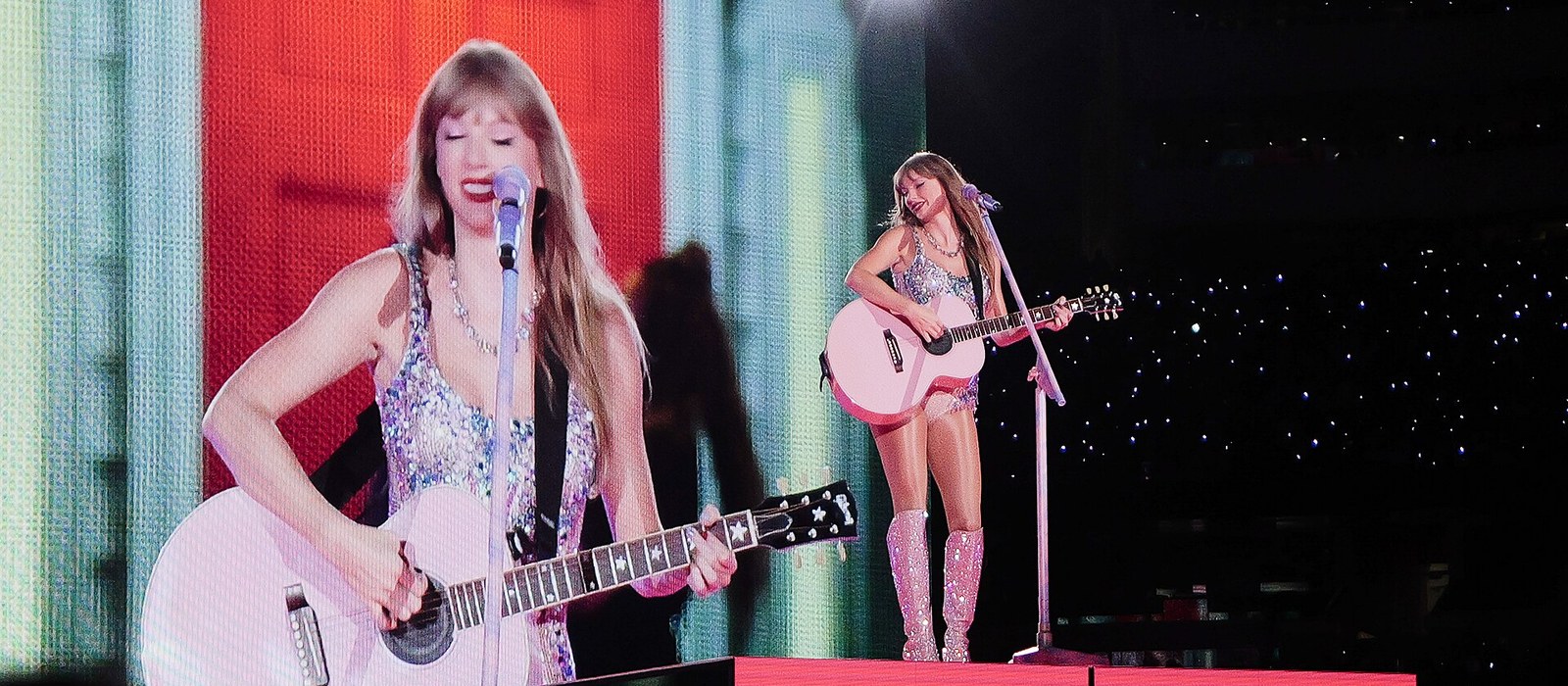
They follow the 3 applications TAS Rights Management filed at the US Patent and Trademark Office on April 24, 2026: Swift saying “Hey, it’s Taylor”, Swift saying “Hey, it’s Taylor Swift”, and a photo of her holding a pink guitar on stage.
What Taylor Swift’s voice trademarks cover in the UK, EU and Australia
In the UK, the company filed a sound mark on October 6. The UKIPO record says it “consists of the spoken words HEY, IT’S TAYLOR SWIFT.” A second UK application on October 7 covers the same stage photo as the US filing, down to the iridescent bodysuit and silver boots.
The EU got the same pair: a sound mark on October 6 and the photo on October 7. Both UK and both EU applications are still in examination. Australia only got the sound mark, and it’s the one that’s furthest along.
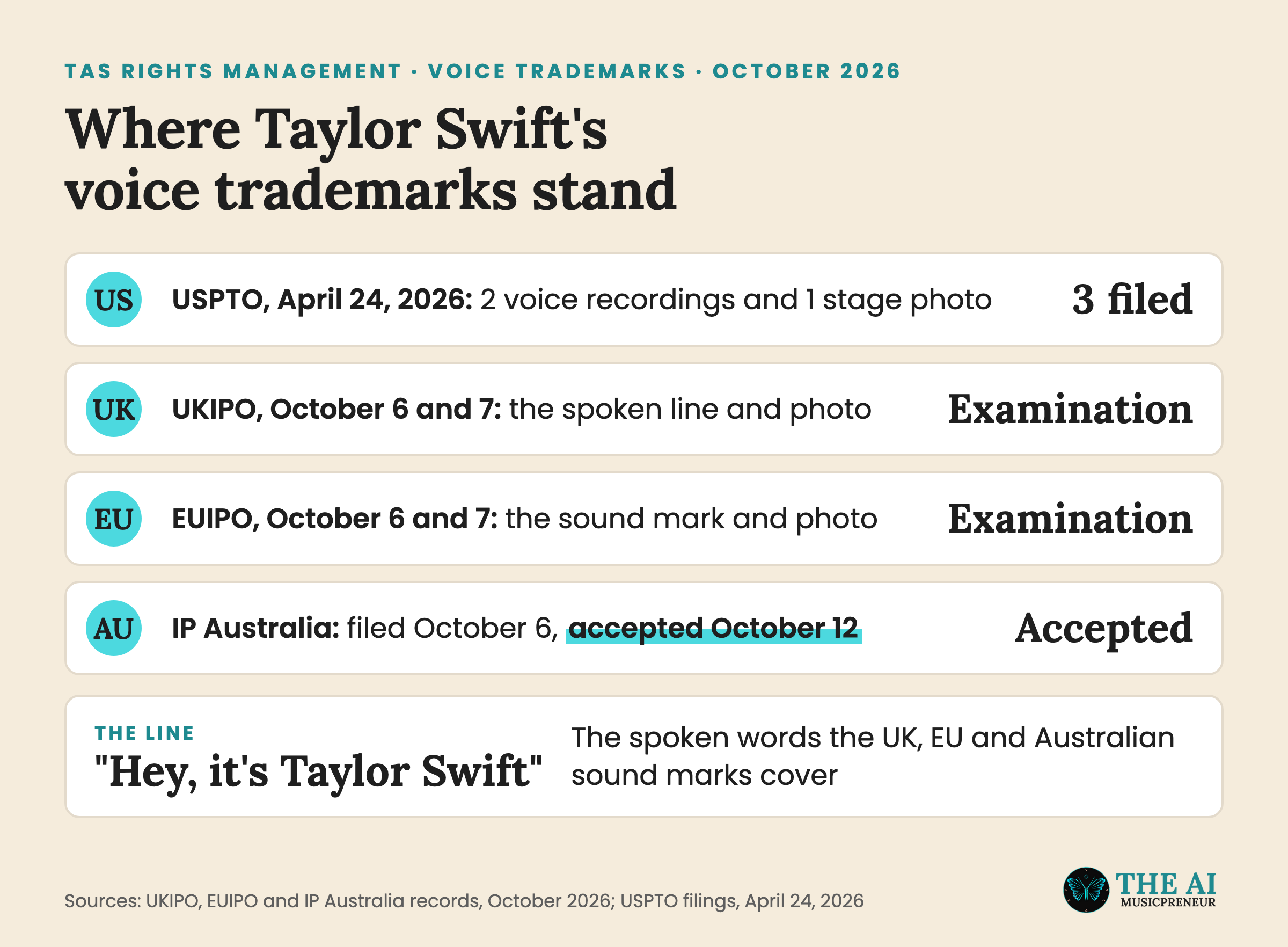
The filings also share a date. The UK and Australian filings claim April 24, 2026 as their priority date. Under the Paris Convention, you get 6 months after your first filing to file the same mark in other member countries and keep that first date. So in the UK and Australia, Swift’s claim counts as if she had filed it in April.
Can a sound mark stop an AI clone of Taylor Swift’s voice?
Nobody knows yet. A trademark normally protects a sign that tells you who a product comes from, like a logo or a jingle. Swift is trying to make her spoken voice that sign, and IP attorney Josh Gerben of Gerben IP, who first spotted the US filings, wrote in April that this “has not been tested in court before.”
Theoretically, if a lawsuit were to be filed over an AI using Swift's voice, she could claim that any use of her voice that sounds like the registered trademark violates her trademark rights.
His point is the “confusingly similar” standard. Trademark law stops exact copies and anything close enough to confuse people, and an AI clone of Swift’s voice is built to sound exactly like her. The US filings also include Swift’s signed consent to register her “likeness (including but not limited to signature, voice and image)” in the US and abroad.
Swift isn’t the only one trying. Lionel Richie filed 4 voice applications in June, and the Backstreet Boys filed one on June 24. They’re all filing as AI fakes spread: Sony Music has asked platforms to remove more than 260,000 AI deepfake tracks of its artists.
If you’re not Taylor Swift, a trademark is a long shot, because it only protects a voice that already works as a brand (I explain why in can you trademark a voice). The protections built for everyone else are laws like Denmark’s digital replica bill and the stalled US NO FAKES Act. Next up is Australia, where the opposition window on Swift’s sound mark runs until around mid-December 2026. If nobody opposes it by then, it can move on to registration.
Frequently asked questions
What is TAS Rights Management?
TAS Rights Management, LLC is Taylor Swift's company. It is listed as the owner on all 5 voice and image trademark applications filed in the UK, the EU and Australia in October 2026, and on the 3 US applications from April.
When does the opposition period for Taylor Swift's Australian voice trademark end?
Anyone opposing a mark in Australia typically has 2 months from the publication of its acceptance. IP Australia published the acceptance of Swift's sound mark on October 12, 2026, so the window runs until around mid-December 2026.
Which services do Taylor Swift's Australian and EU voice trademarks cover?
Both are filed under Class 41 of the Nice Classification, which covers entertainment services. The Australian record lists services such as providing information in the field of music and entertainment and a website featuring non-downloadable audio recordings.
Did Giorgia Meloni file a voice trademark at the EUIPO before Taylor Swift?
Yes. Spanish news agency EFE reported that Italian Prime Minister Giorgia Meloni filed a similar application at the EUIPO a day before Swift's EU sound mark arrived on October 6, 2026.
About the author

Covering AI music tools, industry shifts, and news for music creators and professionals. Twice-weekly newsletter at aimusicpreneur.com.