





Music AI
Music AI is a professional audio platform for stem separation, voice swapping, mastering, and mixing, sold per minute or on a $25/mo plan. Free tier available.
What is Music AI and how does it work?
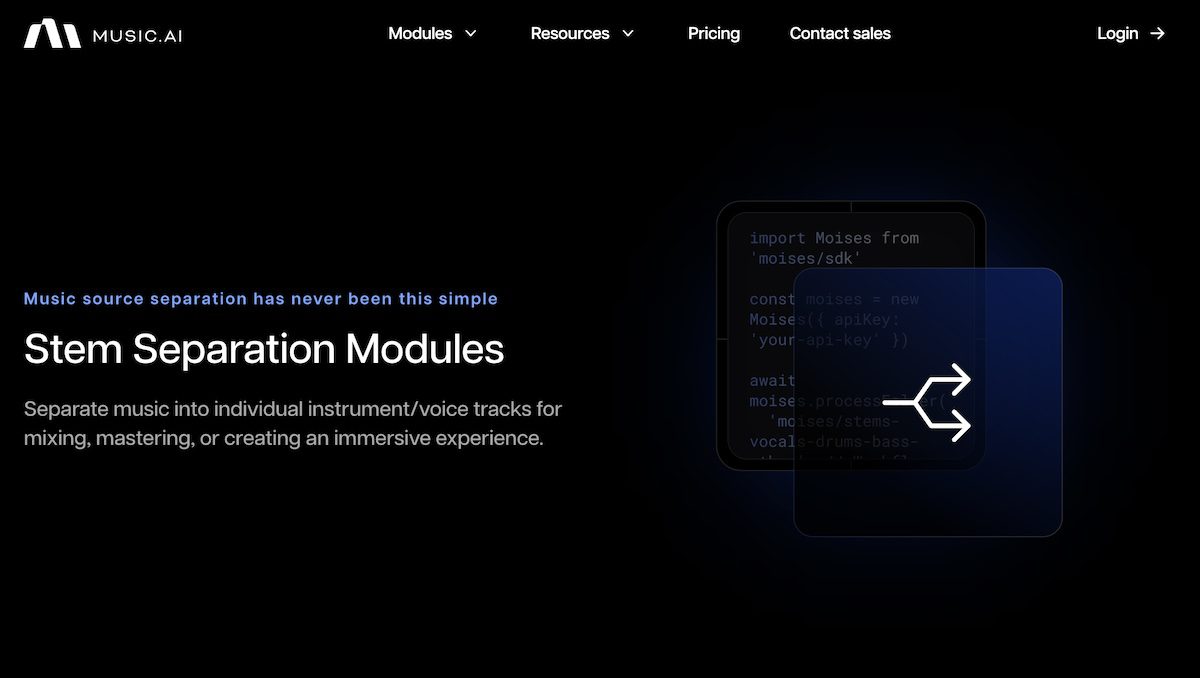
Music AI is a professional audio platform from the company behind Moises. It started as best-in-class stem separation and grew into a full toolkit of audio modules that you run through a web dashboard or an API. The same models that power major-label and post-production workflows are available to anyone who signs up at music.ai.
Where Moises is the consumer app, Music AI is the professional and developer side: you upload audio, pick from a catalog of modules, and chain them into a pipeline.
How it works:
- Create an account and upload a track to the Music AI dashboard
- Choose modules: stem separation, voice swapping, mastering, mixing, lyric transcription, or tagging
- Run them on their own or chain several into one processing pipeline
- Pull results back through the web app or wire the API into your own product
- Developers can embed the SDK to run separation locally on devices
Music AI fits producers who need the highest separation quality and teams building audio features on top of an API.
How much does Music AI cost?
Music AI charges per minute by module, with a flat plan on top:
| Plan | Price | What you get |
|---|---|---|
| Pay as you go | $0 to start | 48h storage, 2 concurrent jobs, per-minute module fees |
| Professional | $25/mo | 10 concurrent jobs, $25 monthly credit, 100GB storage, 5% module discount |
| Business / Enterprise | Custom | SLAs, dedicated engineer, private AI models, volume discounts |
Module rates run from about $0.05 per minute for instrumental separation to $0.20 per minute for AI mastering, with mixing and spatial upmixing higher. Pricing changes frequently, so verify current rates at Music AI pricing. The Professional plan pays off once your monthly processing clears the included $25 credit.
How good is Music AI’s stem separation?
It is among the best available, which is the main reason to choose the platform:
- Music AI claims a 15.8% higher SDR (signal-to-distortion ratio) than its nearest competitor
- Standard separation splits vocals, drums, bass, guitars, and keys
- Drum-level separation isolates kick, snare, toms, hi-hat, and cymbals as separate stems
- Cinematic mode splits dialogue, music, and effects for film and TV post
- Clean-up stems remove bleed and artifacts from already-separated tracks
For a deeper field test against the alternatives, see our AI stem splitter roundup.
How does Music AI compare to LALAL.AI and AudioShake?
All three sit at the professional end of separation, but they sell it differently.
| Music AI | LALAL.AI | |
|---|---|---|
| Starting price | Free, then $25/mo | Per-minute packs |
| Core use case | Full audio platform plus API | Fast, focused stem separation |
| Key differentiator | Many modules beyond separation | Simple pay-per-use splitter |
| Free tier | Yes (48h storage) | Limited free minutes |
| Best for | Developers and pipelines | One-off high-quality splits |
| Music AI | AudioShake | |
|---|---|---|
| Starting price | Free, then $25/mo | Subscription and licensing |
| Core use case | Separation plus mastering and tagging | Separation for rights and sync |
| Key differentiator | Broad module catalog | Licensing-grade stems for catalogs |
| Free tier | Yes | Limited |
| Best for | Building audio features | Labels clearing and re-syncing catalogs |
Choose LALAL.AI when you want fast, one-off splits without a subscription. Choose AudioShake when you are clearing a catalog for sync and licensing. Choose Music AI when you need many audio operations or an API behind your own product.
What are some use cases for Music AI?
- Professional remix and production: high-fidelity stems for serious remix and edit work
- Post-production audio: cinematic mode for film and TV dialogue and music isolation
- AI product backends: API and SDK access for apps that need separation or tagging
- Mastering and mixing at scale: run AI mastering and automix across a batch of tracks
- Catalog tagging and classification: auto-detect genre, mood, instruments, and language
- Lyric and speech transcription: pull text and subtitles from audio and video
- Sample creation: extract usable elements from existing recordings for new productions
Music AI is most valuable to professional producers, post engineers, and product teams who process audio in volume and need separation quality to come first.
Frequently Asked Questions
Is Music AI free?
Music AI has a free pay-as-you-go entry point with 48-hour storage and 2 concurrent jobs, but each module still bills per minute. The $25/mo Professional plan adds a monthly credit, permanent storage, and more concurrent jobs.
Is Music AI for musicians or developers?
Both, but it leans toward developers and businesses. Solo musicians who want a friendly app are usually better served by Moises, which is built by the same company on top of the same models.
Can you use Music AI output commercially?
Yes. Music AI is sold as a professional and enterprise audio service, and processed stems and outputs are intended for commercial production, post, and product use. Check the current terms for any module-specific limits.
What modules does Music AI offer?
Stem separation, voice swapping, AI and reference mastering, mixing and automix, lyric and speech transcription, plus classification modules for genre, mood, instruments, language, and content ID.
Does Music AI have an API?
Yes. Music AI exposes its modules through an API, and an Embedded SDK lets developers run separation locally inside apps and devices.