
Cyanite will scan Paradise Worldwide's releases for AI music before they reach streaming services
My stack My fav 6 tools for AI music after testing 70+
-
 ElevenMusic · Music generation
 -
 Moises · Stem separation
 -
 Controlla · Voice swap & cloning
 -
 Cryo Mix · Mixing + mastering
 -
 Neural Frames · Music videos
 -
 ONCE · Distribution
Some links are affiliate links — I earn a commission at no cost to you. Every tool here is one I run myself and truly believe in. This stack is proven.

Paradise Worldwide, the Berlin-headquartered music distributor, will run Cyanite’s AI music detector over its releases before they are delivered to streaming services. MusikWoche reported the partnership on September 25, 2026.
The DSP then gets a recommendation on whether the track should carry an AI label, based on whether Cyanite reads it as fully or partly AI-generated. The streaming service still makes the call.
Cyanite’s detector covers Suno, Udio, Lyria, Mureka and ElevenLabs, and the company says it works with more than 200 music companies. The deal runs through the Berlin AI Think Tank, which Paradise Worldwide backs together with AIxchange, AFEM, Fraunhofer IDMT and Music Tech Germany.
How Cyanite’s AI check runs inside Paradise Worldwide’s delivery
Today, a track uploaded to a distributor goes out to the DSPs with whatever metadata the uploader typed in. Cyanite put it bluntly in its LinkedIn announcement: “At no point information is shared on whether, and to what extent, AI was involved in creating that track.”
The new step sits in the middle. Paradise Worldwide receives the track, Cyanite’s detection runs over the audio, and the result goes to the DSP with the delivery.
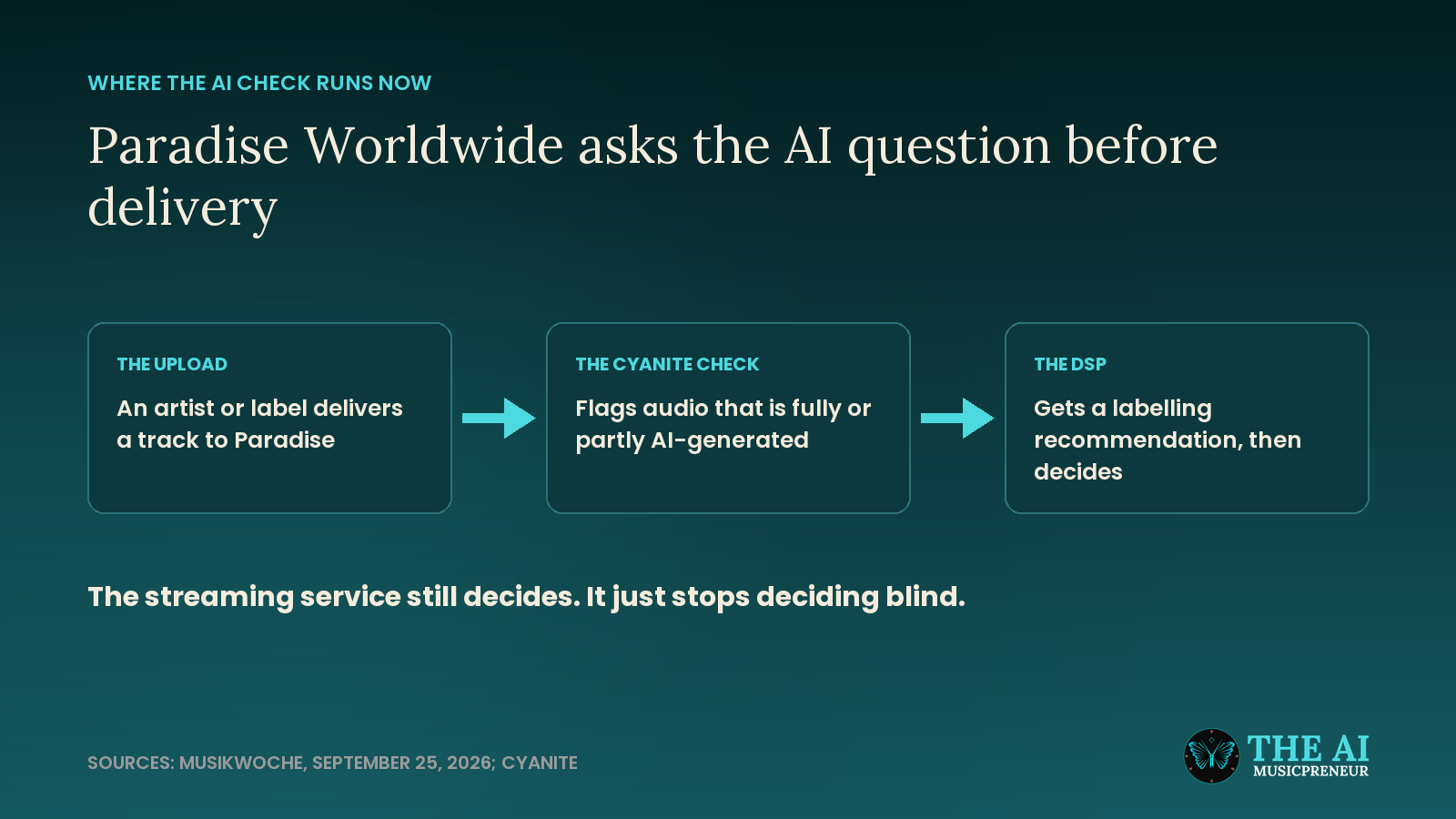
The detector reads the audio itself, so it doesn’t depend on the artist’s own declaration or on the metadata. It currently recognises output from 5 generators: Suno, Udio, Google’s Lyria, Mureka and ElevenLabs.
Ralph Böge, Managing Director of Paradise Worldwide and Chairman of AIxchange, was careful about the scope when he spoke to MusikWoche.
As far as technically possible, we want to take on this classification for DSPs.
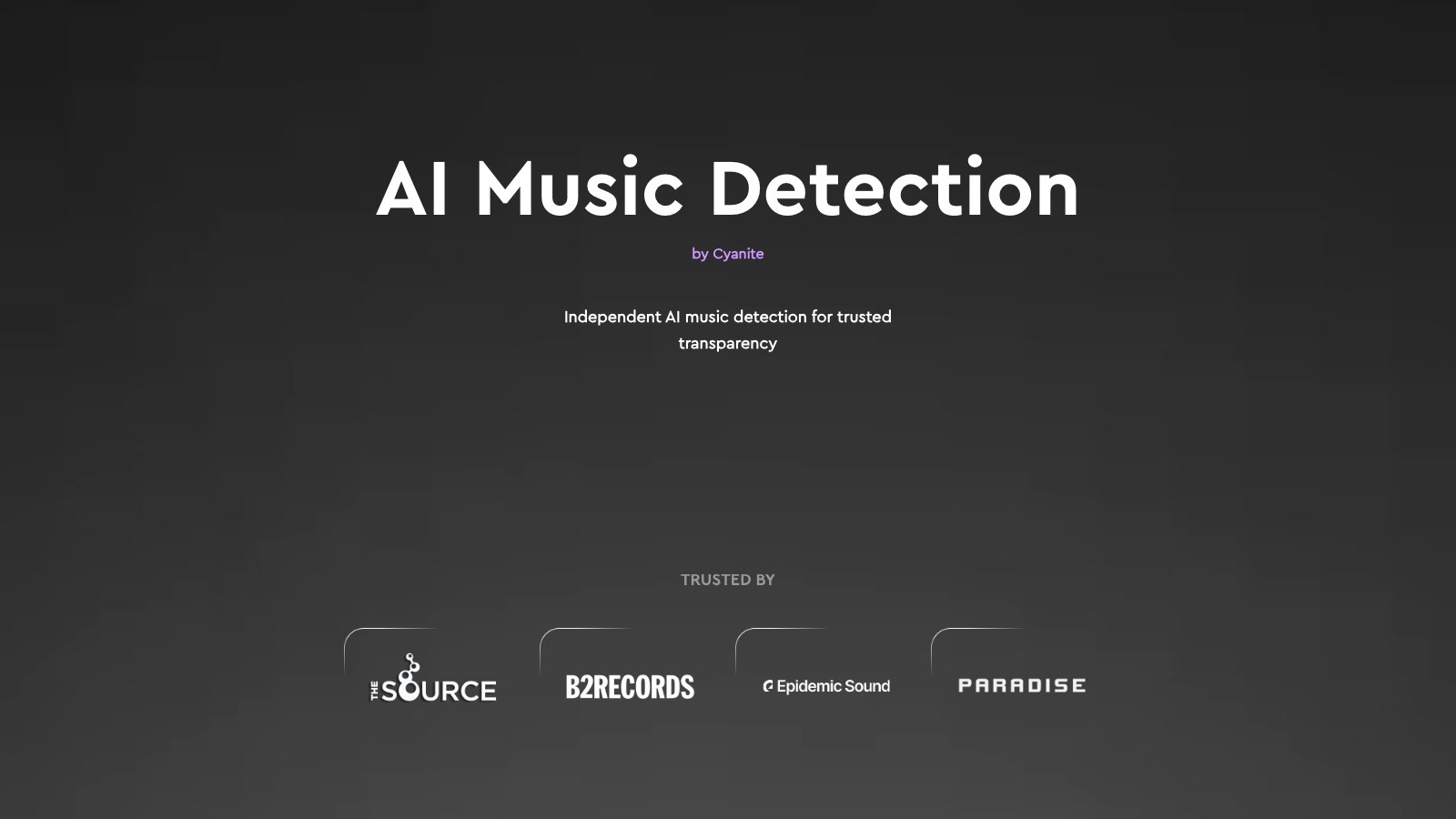
Paradise is already listed as a customer on Cyanite’s AI Music Detection page, in the “Trusted by” row next to Epidemic Sound, The Source and B2Records.
Why Cyanite and Paradise Worldwide moved AI detection to the distributor
The argument is about timing. Once a track is live and earning, every fix is a takedown or a relabel, so a distributor that asks first can send the answer along with the track.
Cyanite’s own line on LinkedIn: “a check at distribution level is better than no check at all, and it’s where the whole industry can actually benefit from it.”
Markus Schwarzer, Cyanite’s CEO and co-founder, aimed it squarely at Big Tech. “Big tech companies are using their market power to create facts on the ground, while central questions about training data, rights and transparency remain unresolved,” he told MusikWoche (translated from German).
Böge described the DSP side of the same problem: “DSPs often don’t know to what extent the content they stream, monetize or download is fully or partly AI-generated.”
The Berlin AI Think Tank behind the deal was founded in 2025 at the CIC Business Hub Berlin. Besides detection, it works on rights clearance and a European licensing standard for AI platforms.
Detection is the group’s second tool. The first was AIxchange’s Creative Weight Attribution, a model that measures how much each song contributed to an AI output, which Dutch collecting society Buma/Stemra has already piloted.
Where Paradise Worldwide’s check sits next to Deezer, Apple Music and TuneCore
Cyanite’s point that no AI information travels with a delivery is fair for most uploads. But a few platforms already ask the question, each at a different point:
- Deezer and Qobuz run their own detectors, and Qobuz started showing AI tags on September 24, 2026.
- Apple Music told partners on August 20, 2026 that it will show Made With AI labels, built only from tags that labels and distributors submit. Apple runs no detection of its own for those labels.
- Believe and TuneCore already detect at the distributor, and they use it to block tracks from unlicensed AI platforms like Suno.
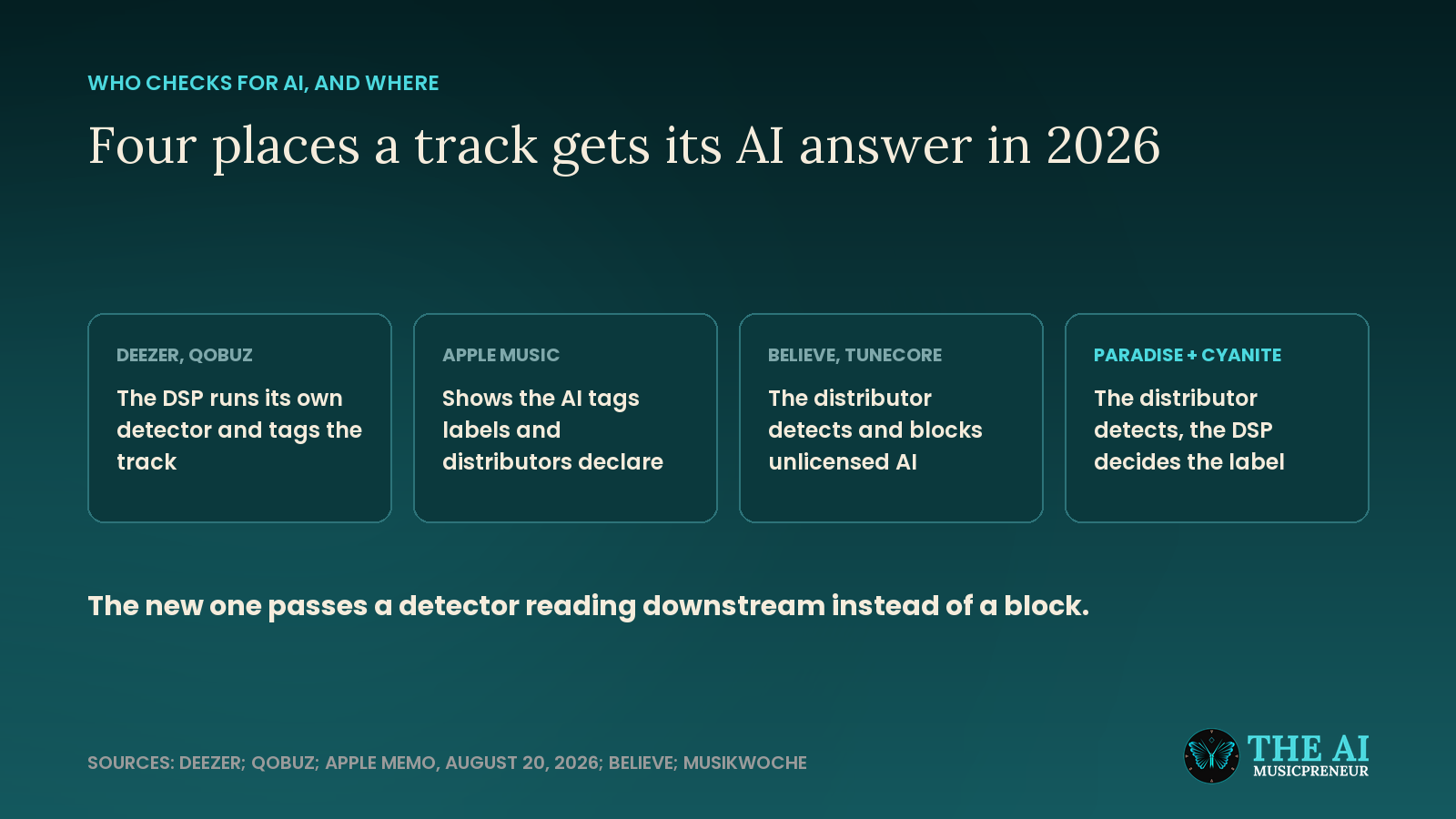
So the new part is the combination: a distributor running an independent detector and passing the result downstream as a recommendation, not a block.
It also lines up with IFPI’s Streaming Integrity Initiative, launched September 14, 2026, which asks distributors to vet uploads for “AI-related risks” without defining what that means. Paradise Worldwide wasn’t among the 27 launch supporters, but a named detector at upload is a more specific answer to that clause than the pledge gives.
What Cyanite admits its AI music detection still can’t settle
Credit to Cyanite for saying this part out loud: “We know AI music detection isn’t a solved problem. Tracks can be partly generated, or processed in ways that blur the signal.”
That’s the hard case. Your own vocals over a Suno instrumental, or a Suno idea you re-recorded in your DAW, is exactly the kind of hybrid track a detector struggles to call.
Cyanite calls its approach “deliberately conservative”, prioritising fewer false positives over a higher detection rate, and claims it catches 99 out of 100 AI tracks from the models it supports. Those are Cyanite’s own numbers, and there’s no published independent benchmark behind them yet.
A false flag costs a real artist real money. In October 2025, an original song was wrongly flagged as AI and removed from Apple Music and iTunes.
Whether Spotify, Apple Music and the rest act on Cyanite’s reading is the next thing to watch.
Frequently asked questions
What is Paradise Worldwide?
Paradise Worldwide is a music distributor and rights company headquartered in Berlin, with teams in Mexico, New York and Africa. Its Managing Director, Ralph Böge, also chairs AIxchange. In September 2026 it partnered with Cyanite to check releases for AI-generated music before they are delivered to streaming services.
Which AI music generators can Cyanite's AI music detection identify?
Cyanite says its detector currently identifies music generated by Suno, Udio, Lyria, Mureka and ElevenLabs, with more models to follow. It claims to catch 99 out of 100 AI tracks from those models while keeping false positives negligible. Those are Cyanite's own figures, and no independent benchmark has been published.
What is the Berlin AI Think Tank?
The Berlin AI Think Tank is a music-industry group founded in 2025 at the CIC Business Hub Berlin. It is backed by Paradise Worldwide, AIxchange, AFEM, Fraunhofer IDMT and Music Tech Germany. It works on AI detection, Creative Weight Attribution, rights clearance and a European licensing standard for AI platforms.
Will Paradise Worldwide block AI-generated tracks after the Cyanite check?
Neither company has said it will block tracks. The announced plan is to pass Cyanite's result to DSPs as a recommendation on how to label fully or partly AI-generated music, and the streaming service decides what to do with it. That differs from Believe and TuneCore, which block tracks made on unlicensed AI platforms.
About the author

Covering AI music tools, industry shifts, and news for music creators and professionals. Twice-weekly newsletter at aimusicpreneur.com.