
Modulate raises $25M, and says its AI music detector hits 95% precision across 76 genres
My stack My fav 6 tools for AI music after testing 70+
-
 ElevenMusic · Music generation
 -
 Moises · Stem separation
 -
 Controlla · Voice swap & cloning
 -
 Cryo Mix · Mixing + mastering
 -
 Neural Frames · Music videos
 -
 ONCE · Distribution
Some links are affiliate links — I earn a commission at no cost to you. Every tool here is one I run myself and truly believe in. This stack is proven.

Modulate just raised $25 million, and the Boston audio AI company has now raised $60 million in total. Modulate announced the round on September 28, 2026. Future Ventures led it, and existing investors Hyperplane and Lakestar joined.
The music part of the story is a number Modulate first published in June. Its AI music detector “achieved 95% precision across 76 unique genres” in internal testing against music generators including Suno 5.5. Digital Music News put that figure back in the headlines alongside the raise.
That 95% is a precision score, and only a precision score. Modulate hasn’t published how many AI tracks the detector misses, which is a separate number called recall.
Modulate’s $25 million round: who invested and what the money pays for
Future Ventures, the firm Steve Jurvetson co-founded, led the round, with Hyperplane and Lakestar putting in money again. Modulate didn’t attach a series letter to it. Lakestar also led Modulate’s $30 million Series A back in August 2022.
Modulate says the money goes into AI and machine-learning research, product and engineering, developer relations and partnerships. That includes “new industry models” and new SDKs and APIs for developers.
The leadership changed too. Carter Huffman, the co-founder who was CTO, is now CEO, and Mike Pappas, who was CEO when the music detector launched in June, is now chairman, Music Business Worldwide reported. The two met as physics undergraduates at MIT and started Modulate in 2017.

Huffman’s quote in the announcement is about voice: “Voice is becoming a primary interface for AI, and that creates a whole new set of problems that can’t be solved from a transcript,” he said in the announcement. TechCrunch reported that Modulate has 40 to 45 employees, plans to hire 10 more, and was valued at $170 million before the round, based on PitchBook data.
Music doesn’t come up once in that September 28 announcement, so here’s where it sits in Modulate’s business.
Where AI music detection fits inside Modulate’s Velma platform
Velma is Modulate’s main product. It listens to live conversations for emotion, tone, intent, fraud attempts and synthetic voices, and it runs on what Modulate calls an Ensemble Listening Model: more than 100 small, specialised audio models working together instead of one giant model. Modulate says its models now analyse more than 10 million hours of audio a month, for jobs like fraud prevention, voice-agent monitoring and game voice chat moderation through its ToxMod tool.
AI music detection is one model on that menu. Modulate launched it on June 24, 2026, and I covered how the API works at the time. The short version: one model finds which parts of a clip are music, a second scores the vocal for AI, a third scores the instrumental, and every 4-second window gets its own verdict before the API returns one for the whole clip.
It costs $0.07 per hour of audio on Modulate’s self-serve API, so a 3-minute song works out to about a third of a cent. Modulate pitches it at streaming services, distributors, rights organisations, publishers and labels. It says it sees “early market interest from major music labels and distribution platforms”, but it hasn’t named a music customer.
That leaves the 95%, and what it does and doesn’t tell you about a track you upload.
How accurate is Modulate’s AI music detector? What 95% precision measures
Here’s the exact claim from Modulate’s June 24 launch release: “On internal testing against leading music generation models, including Suno 5.5, Modulate AI Music Detection achieved 95% precision across 76 unique genres.”
An AI music detector listens to a track and gives it a score for how likely it is to be AI. Precision answers one question about those scores: when the detector says “this is AI”, how often is it right? At 95%, out of every 100 tracks it flags, 95 really are AI and 5 are human songs flagged by mistake.
Recall answers the other question: out of all the AI tracks in the pile, how many did the detector catch? A detector can score high on precision and still let a lot of AI through, as long as the tracks it does flag are the right ones. Modulate hasn’t published a recall figure, a false-positive rate, the size of its test set, or any generator besides Suno that it tested against.
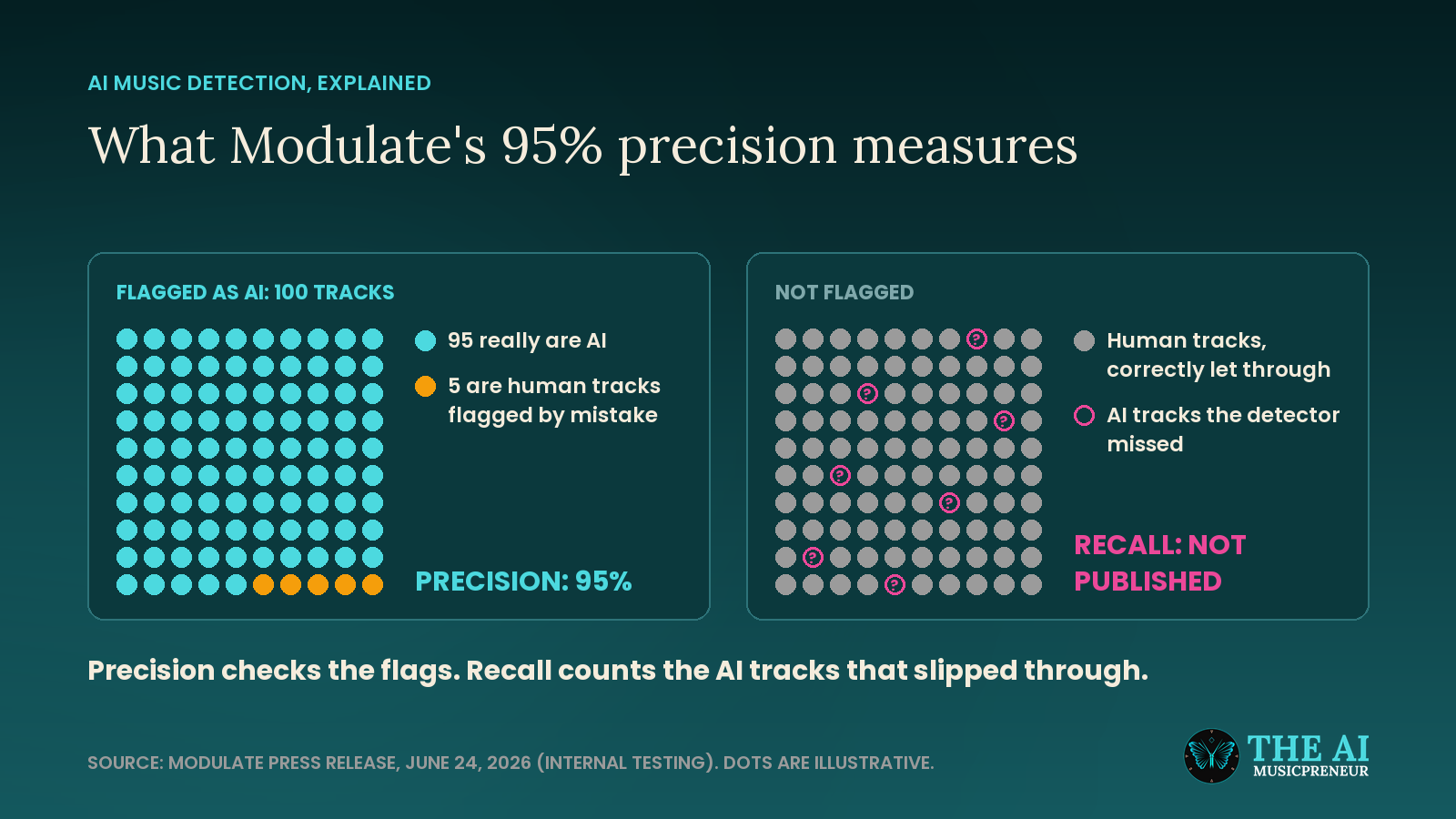
Platforms can also move the cut-off. Modulate’s API page says platforms can “adjust the precision/recall tradeoff without retraining” by setting separate thresholds for vocals and instrumentals. Raise the threshold and fewer human tracks get flagged, but more AI slips through. Lower it and the reverse happens.
Modulate didn’t say which setting produced the 95%.
AI music detection is an extremely hard problem because the technology is changing quickly and the content itself is so diverse.
Other detectors report different numbers, so they don’t line up side by side. Ircam Amplify’s detector claims 99% accuracy and under 1% false positives, where accuracy counts right calls on AI and human tracks together. SubmitHub’s 85% cut-off is a threshold on one track’s score, not a measure of the detector at all.
And researchers have already fooled a commercial detector by resampling audio to 22.05 kHz.
What happens to an AI-flagged track on Deezer, Qobuz and Spotify in 2026
A detector only produces a score. What happens to your track depends on the platform policy the score feeds, and those policies already differ:
- Deezer received close to 90,000 fully AI-generated tracks a day in June 2026, more than half of all new uploads. It tags them, and it now deletes AI tracks used for stream fraud plus AI tracks nobody has streamed in 6 months.
- Qobuz started tagging AI-generated music on September 24, 2026, and says 60% of streams on AI-identified tracks are fraudulent and get excluded from royalty payouts.
- Spotify said its AI Persona badge would mark AI-generated artist identities from mid-September 2026 and keep them out of recommendations by default.
Modulate is pitching its API at the step before all of that. Its API page says it flags AI tracks at ingestion “before they dilute payouts for legitimate human artists.”
Because it scores vocals and instrumentals separately, a hybrid track gets a score for every 4-second section as well as one for the whole clip. Modulate’s June release names that exact case: “Others may use human vocals over AI-generated backing tracks.”
Modulate says it keeps testing the detector “across a wide range of genres, musical traditions, vocal techniques, production styles, and AI generation platforms.” It hasn’t given a date for publishing recall or false-positive figures from that testing.
Frequently asked questions
Who is Modulate's CEO after the September 2026 funding round?
Co-founder Carter Huffman, previously Modulate's CTO, is now CEO. Mike Pappas, who was CEO when Modulate launched its AI music detector in June 2026, has become chairman. The two founded Modulate in 2017 after meeting as physics undergraduates at MIT.
What was Modulate valued at before its $25 million round?
PitchBook data cited by TechCrunch put Modulate's valuation at $170 million before the round. Modulate has not disclosed a valuation itself, and it has not given a post-money figure for the $25 million round.
How much does Modulate's AI music detection API cost per song?
Modulate charges $0.07 per hour of audio on its self-serve API, so a 3-minute song costs about a third of a cent to scan. Pricing is pay-as-you-go, with enterprise plans available.
Which AI music generators did Modulate test its 95% precision claim against?
Modulate says it tested against "leading music generation models, including Suno 5.5", across 76 genres. Suno 5.5 is the only generator it names, and the testing was internal rather than an independent benchmark.
About the author

Covering AI music tools, industry shifts, and news for music creators and professionals. Twice-weekly newsletter at aimusicpreneur.com.