SIQA Mid-Year 2026 report: 9 findings from 1,743 verified AI tracks, and a Warner artist at #1
My stack My fav 6 tools for AI music after testing 70+
-
 ElevenMusic · Music generation
 -
 Moises · Stem separation
 -
 Controlla · Voice swap & cloning
 -
 Cryo Mix · Mixing + mastering
 -
 Neural Frames · Music videos
 -
 ONCE · Distribution
Some links are affiliate links — I earn a commission at no cost to you. Every tool here is one I run myself and truly believe in. This stack is proven.
The Sonic Intelligence Academy (SIQA) published its second AI music data report in September 2026, and sent it to members on September 14. The Mid-Year 2026 edition covers 1,743 verified submissions from 886 artists in 54 countries.
It also tracks 20 weekly cycles of the SIQA Top 100 AI Songs chart, from April 1 to August 20, 2026.
The headline numbers: fully AI-generated tracks fell to 13.9% of submissions, Suno’s share rose to 92.8%, Gospel overtook R&B/Soul in the Top 10, and a Warner Music artist debuted at #1 and stayed there.
One thing to hold in mind while reading. Every track’s classification is self-disclosed by the creator at submission and then verified by SIQA. So this is a portrait of the people who submit to SIQA’s charts, not of all AI music on Spotify.
I read the whole report, compared every number against the Q1 2026 report, and checked the chart runs against my own weekly chart coverage. Here are the 9 findings, what I make of each, and what they set up for the rest of the year.
1. R&B/Soul still leads SIQA submissions at 32%, and Gospel nearly doubled to 14%
R&B/Soul made up 32.0% of mid-year submissions. In Q1 it was 31.7%. Two reporting windows, same answer: the people submitting to SIQA’s charts write vocal-led, emotional songs first.
Gospel is the mover. It went from 8.1% of Q1 submissions to 14.0% at mid-year, the fastest-growing genre in the dataset. Pop sits at 12.0% and Country at 9.9%.
Hip-Hop/Rap slid from 11.8% to 7.1%. SIQA still calls it the category’s biggest chart underperformer, so fewer people are submitting rap, and the ones who do still struggle to convert.
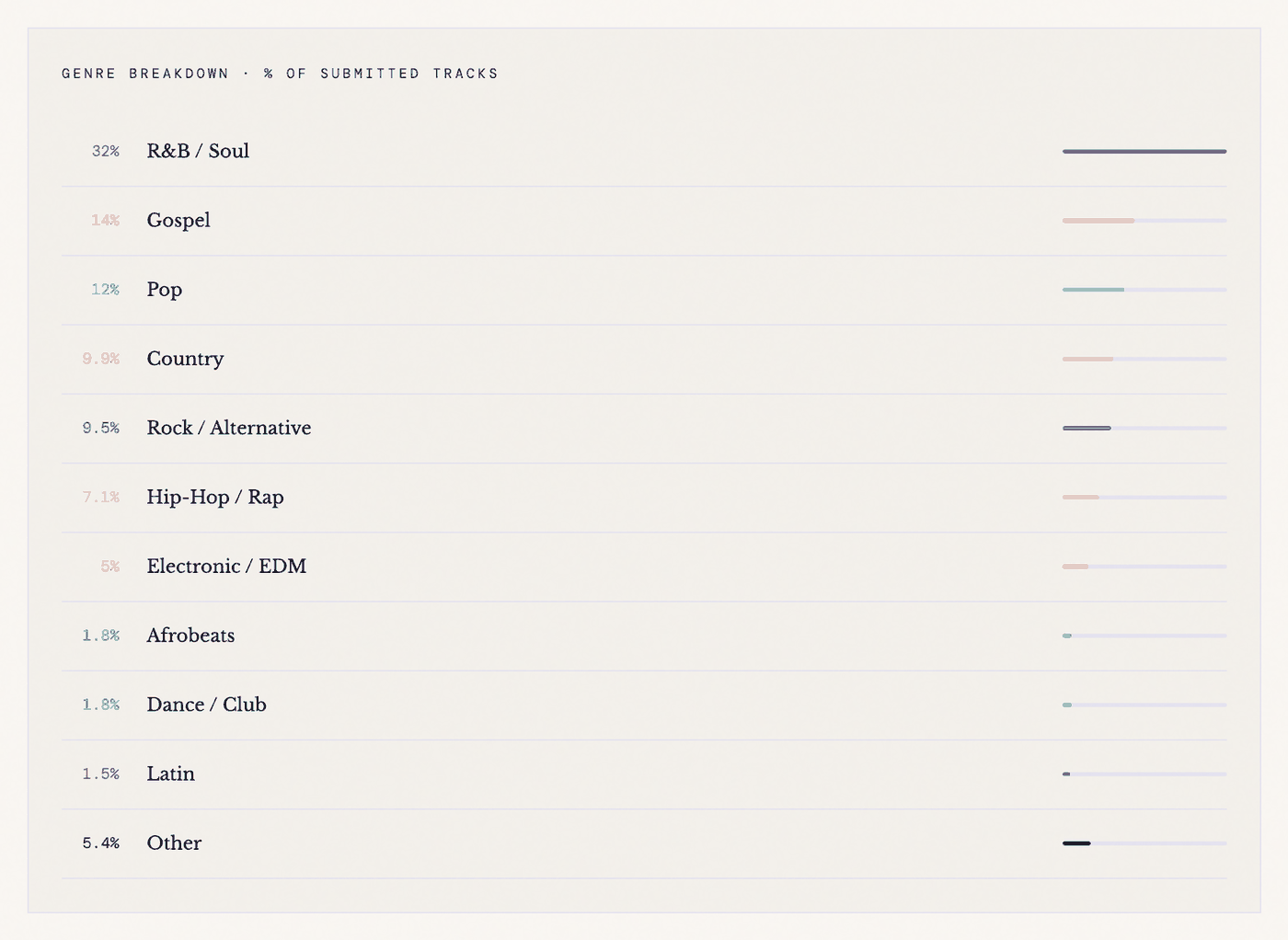
My read: Gospel’s growth is audience pull, not tool push. Nothing about Suno got more gospel-shaped between April and August. What changed is that Gospel tracks kept charting, and creators followed the charts. Finding 6 has the chart side of that story.
2. Fully AI-generated tracks fell to 13.9% of SIQA submissions
SIQA sorts every track into 1 of 3 tiers the creator picks at submission. AI-Assisted means a human directs the work and AI tools enhance the output. Human + AI Hybrid means the artist uses AI to reproduce their own voice, so the voice model comes only from the submitting artist. Fully AI-Generated means end-to-end machine generation with human curation.
All 3 tiers moved in the same direction between the two reports:
- AI-Assisted: 48.4% in Q1, 51.7% at mid-year
- Human + AI Hybrid: 32.4% in Q1, 34.4% at mid-year
- Fully AI-Generated: 19.2% in Q1, 13.9% at mid-year
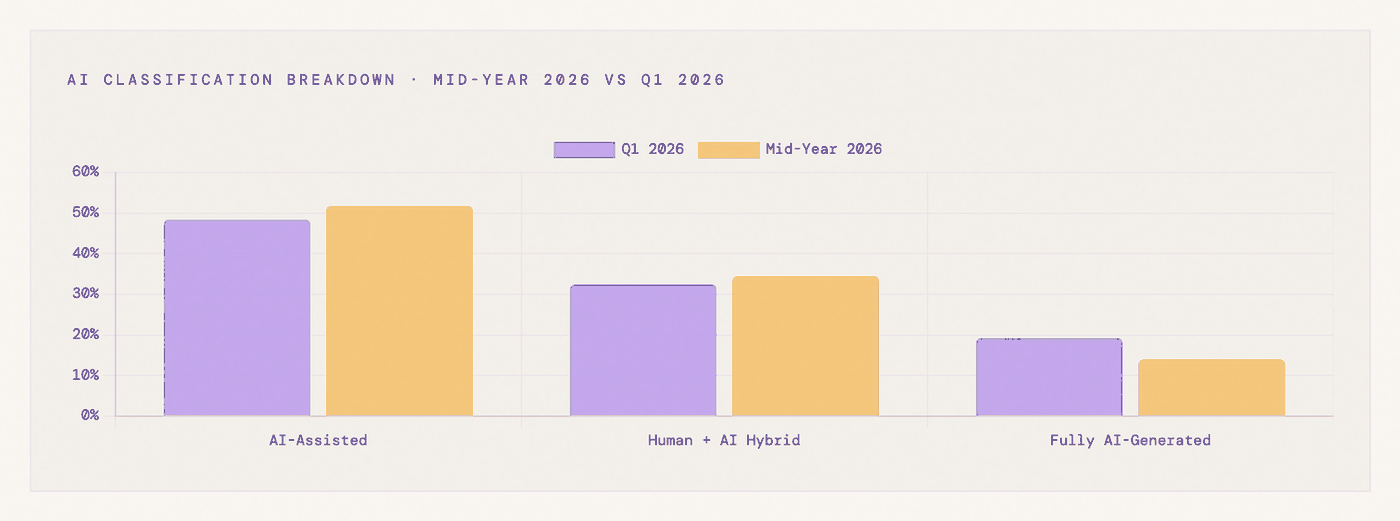
That is a 5.3-point drop in fully generated work in one reporting period. SIQA reads it as creators leaning further into human contribution as the category matures. I think that is part of it.
The other part is incentive. The tier is self-disclosed, and the cost of the fully-AI label went up all year. In July, 11 major music companies proposed chart eligibility rules that would exclude most of what SIQA charts today, and 5 days after this data window closed, ARIA shut fully AI-generated songs out of Australia’s official charts.
When a label costs you chart access, fewer people pick it. That does not make the data wrong. It means the number measures what creators claim, and the claim now carries a price.
3. Suno powers 92.8% of SIQA’s mid-year submissions
Suno appeared in 92.8% of submitted tracks, up from 90.4% in Q1. SIQA expected the tool mix to spread out over the period. It concentrated instead.
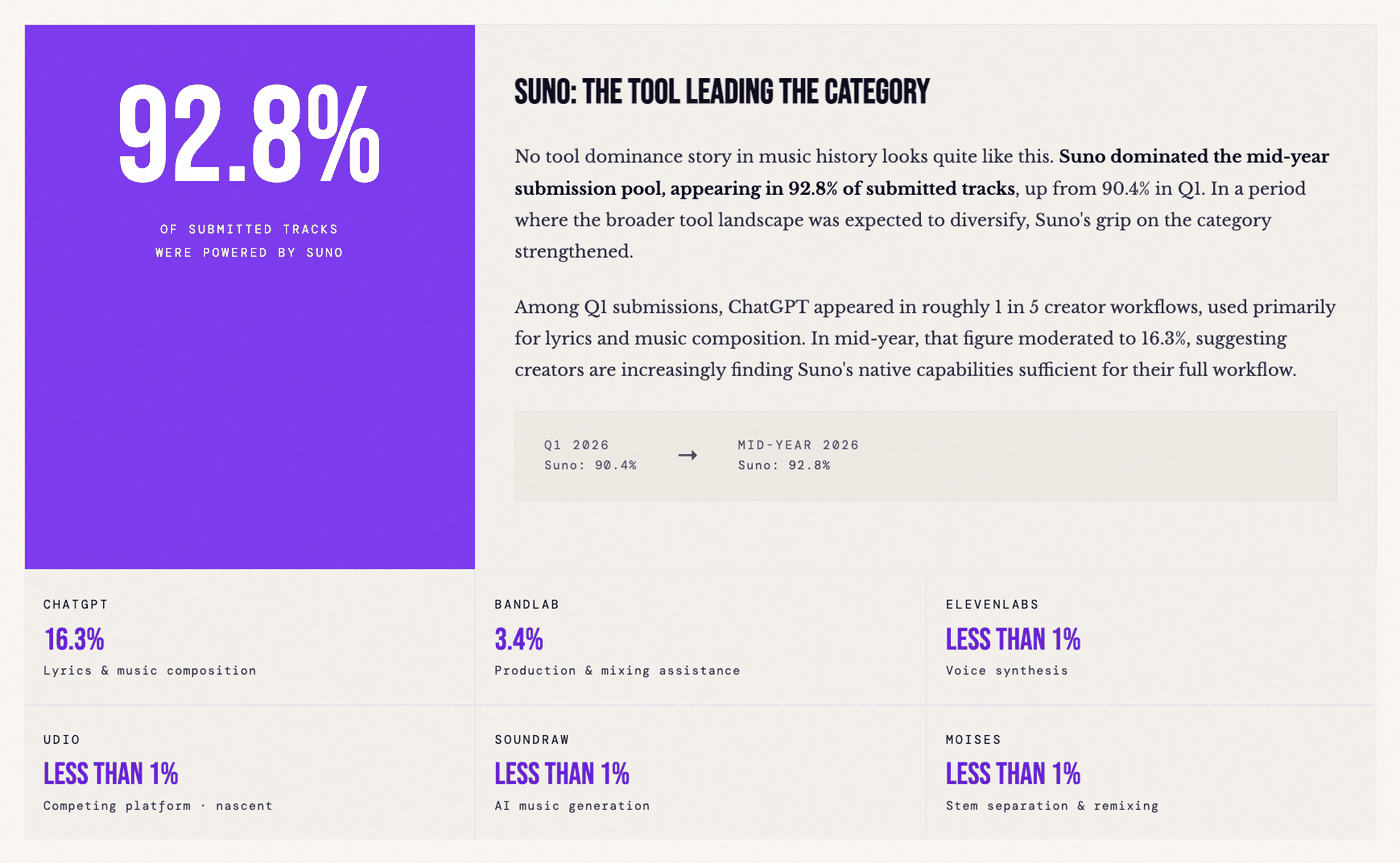
My read goes one step past SIQA’s. Every track in this pool was released through a distributor and verified, so this is a sample of AI music that reached the streaming services. If 92.8% of that sample is Suno, then roughly 9 in 10 AI tracks on Spotify are probably Suno output. SIQA does not claim that and I can’t verify it, but nothing in the data points anywhere else.
ChatGPT is the only other tool with a real share, at 16.3% of workflows, mostly for lyrics and composition. That is down from roughly 1 in 5 in Q1, which SIQA reads as creators finding Suno’s own lyric tools good enough.
The rest of the field:
- BandLab: 3.4% of tracks, for production and mixing help
- ElevenLabs, Udio, Soundraw and Moises: each below 1%
Two things about timing. The data window closed on August 20, so none of this reflects Suno v6, which went live on September 9 and retired every older model. It also predates the download caps Suno introduced 6 days earlier.
The full-year report will be the first one that shows whether either change moved the number.
Udio at under 1% is the line I would watch. Its walled-garden policy stopped users from downloading and monetising what they made, and a chart built on commercial releases cannot see a tool whose output cannot be released.
4. The UK becomes the clear second market in SIQA’s 54-country pool
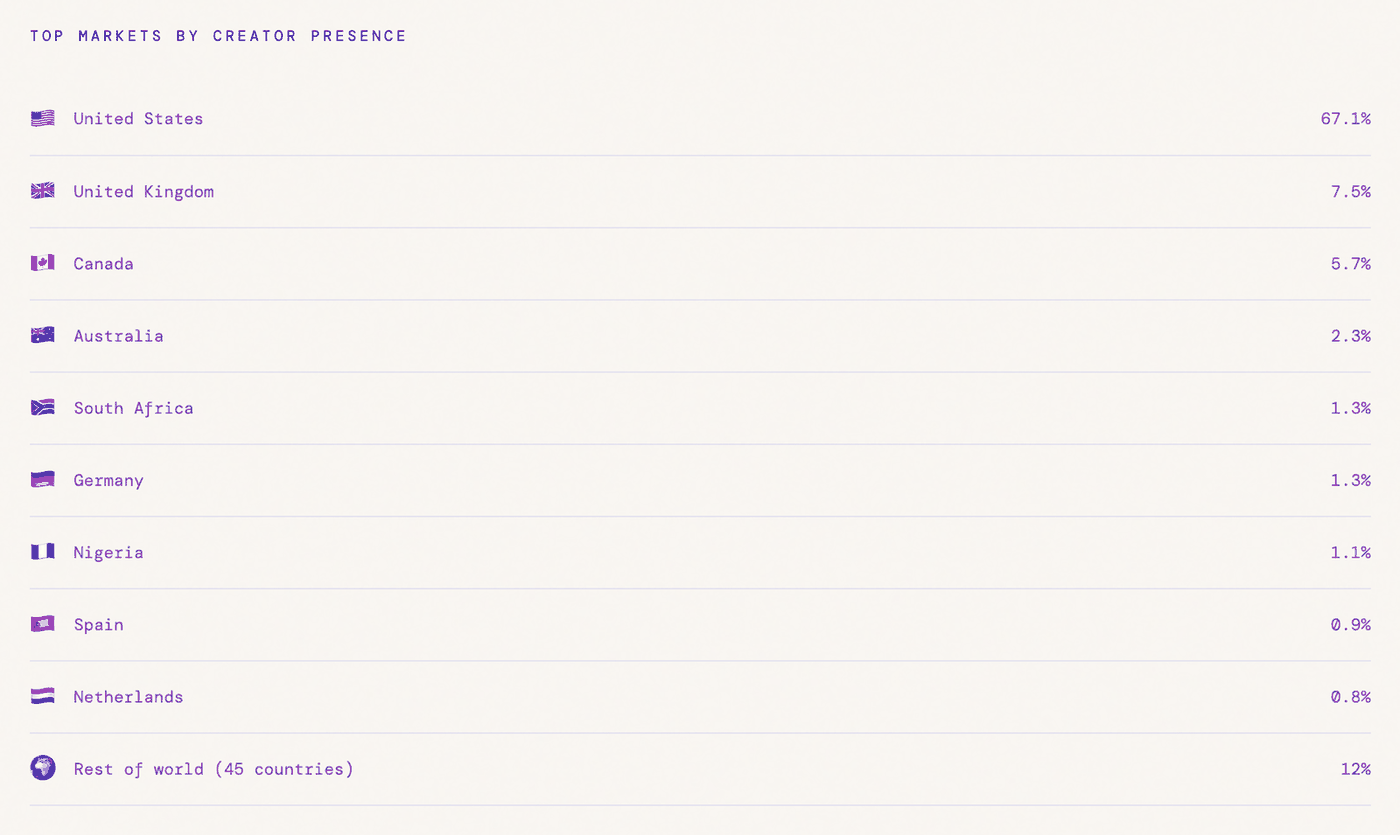
The United States accounted for 67.1% of mid-year submissions, down a little from 68.3% in Q1. The other 32.9% came from 53 countries on 6 continents.
The United Kingdom climbed from 5.4% to 7.5%, the biggest international gain in the dataset. Canada is third at 5.7%.
The rest of the movement:
- Australia entered the top 5 for the first time at 2.3%, replacing Nepal
- Spain appeared in the top 10 at 0.9%
- Nigeria doubled from 0.5% to 1.1%, the fastest-growing African market
Two numbers SIQA does not dwell on. The country count fell from 57 to 54. And Germany dropped from 3.2% of submissions to 1.3%.
I can’t tell from the report why German submissions fell by more than half in the same months the GEMA case against Suno was moving through the Munich court. It might be noise in a small sample. It is the one line in the geography table I would ask SIQA about.
Australia deserves a sentence too. Its chart body, ARIA, shut fully AI-generated songs out of the official charts on August 25, after months of warning it would. Australian creators moved toward SIQA before the door closed. A ban on one chart pushes people toward a chart that will have them.
5. DistroKid handles 77.6% of SIQA’s AI music distribution
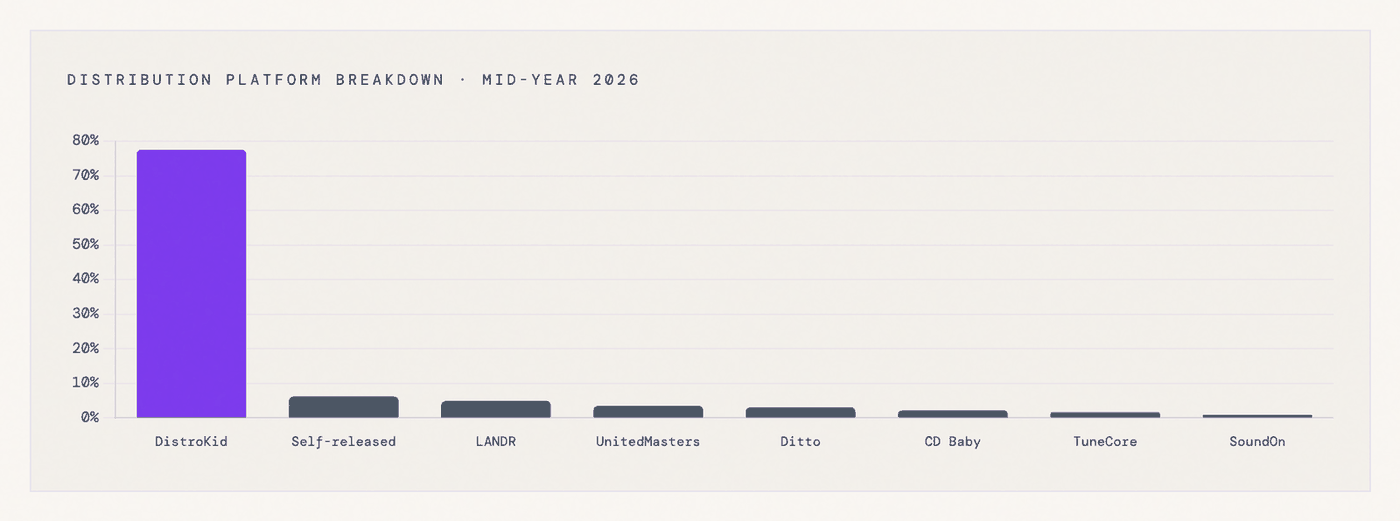
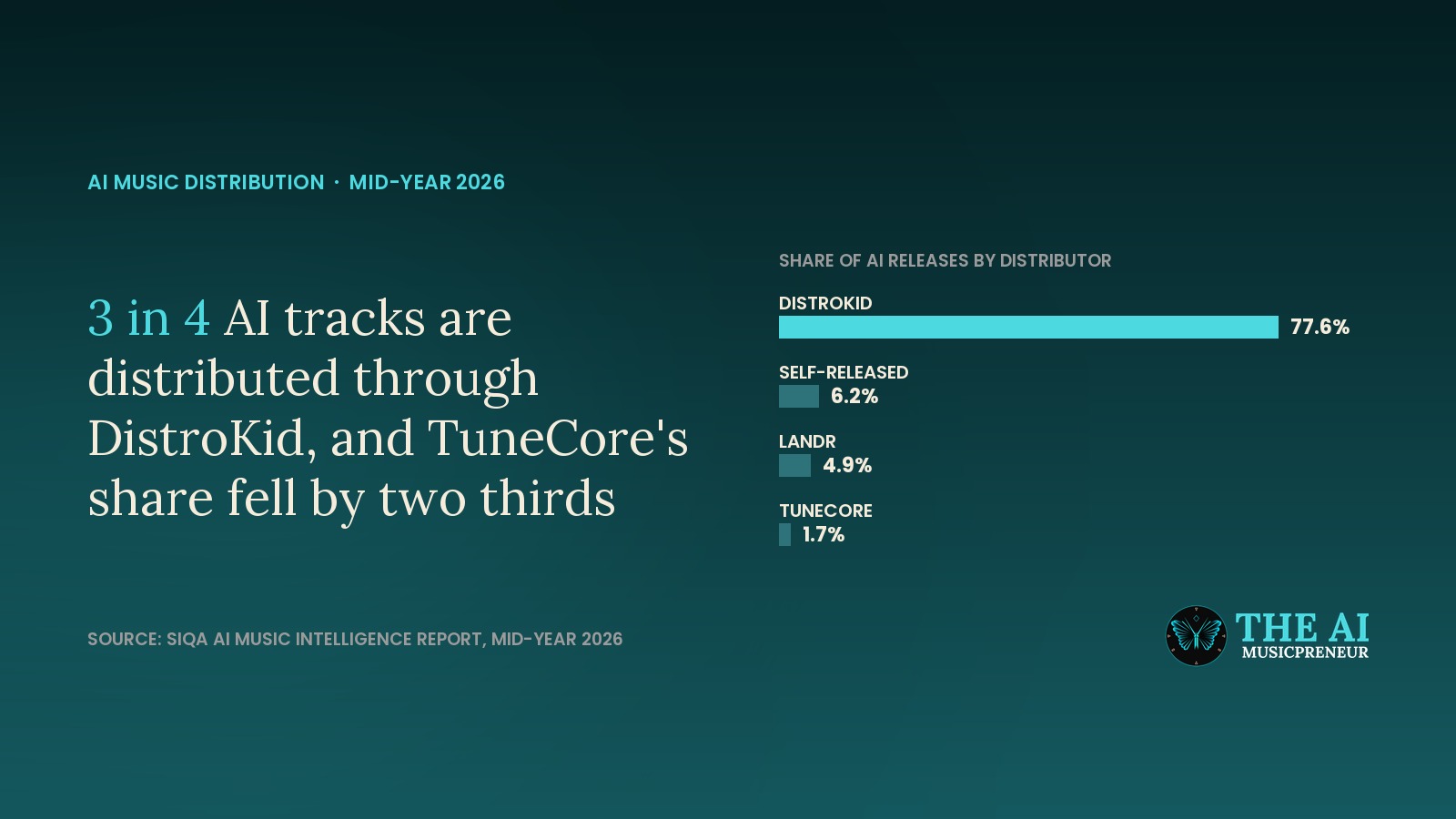
DistroKid carried 77.6% of mid-year submissions with distributor data, up from 75.8% in Q1. Self-released is second at 6.2%, then LANDR at 4.9%.
The number to compare against Q1 is TuneCore. It handled 4.7% of Q1 tracks and 1.7% at mid-year. That fall lines up with April 2026, when Believe and TuneCore started blocking unlicensed Suno tracks.
CD Baby held at 2.1%. SoundOn, TikTok’s distributor, appears for the first time at 0.9%.
SIQA calls DistroKid’s share a policy stance as much as a preference: the distributor that stayed open to AI music won the creator relationship. It is also the pipe CVC Capital Partners bought a majority stake in this year. If you release AI-assisted music, your distributor’s AI policy now decides whether you exist in datasets like this one at all. My AI music distribution roundup ranks the options by exactly that.
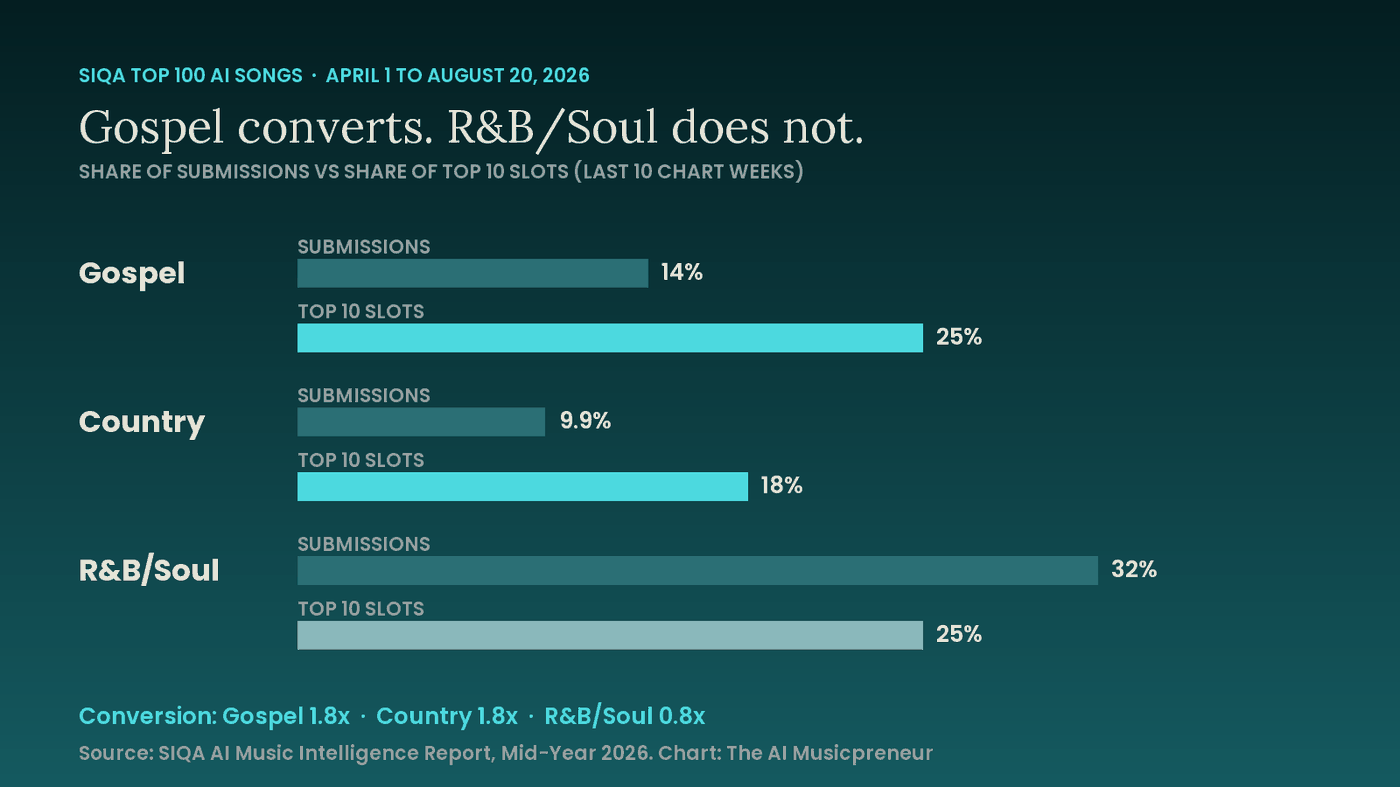
6. Gospel overtook R&B/Soul in the SIQA Top 10 during the back half of 2026
Across all 20 chart weeks, R&B/Soul held 44% of Top 10 slots and Gospel held 19%. Those averages look like Q1. They hide a reversal.
Split the period in half and it reads differently:
- First 10 weeks (April 7 to June 9): R&B/Soul filled 63% of Top 10 slots, Gospel 13%
- Last 10 weeks: both sat at 25%
- From Week 22 on June 30, Gospel held more Top 10 positions than R&B/Soul in 6 of the final 8 cycles
The conversion rate tells it best. Gospel had 14% of submissions and took a quarter of back-half Top 10 slots, a 1.8x conversion. R&B/Soul had 32% of submissions for the same quarter.
The names behind it. Thompsxn Therapy’s “DON’T PLAY WITH ME” anchored the genre for the whole period. The Gospel #1 changed hands twice in August, first to Nyqki Niqole’s “Girl, I Am Anointed”, then back to Thompsxn Therapy, then to Delana Hope’s “I Speak Blessings”, which jumped from #48 to #4 on the Top 100 in 3 weeks.
Country ran the same arc at smaller scale. It tripled its Top 10 share from 6% to 18% between the two halves behind Dust & Harmony’s “You Problem”, and hit a period-high 12 tracks in the Top 100 in the final week. The slots Gospel and Country gained came almost entirely out of R&B/Soul.
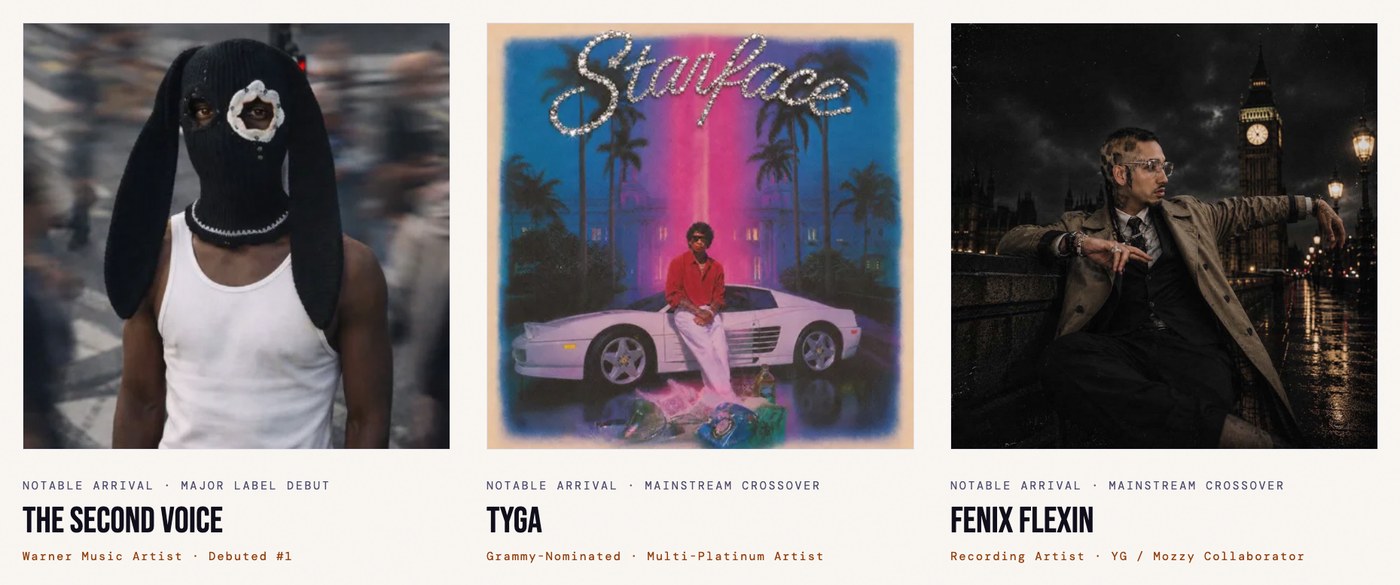
7. A Warner Music artist debuted at #1 on the SIQA Top 100, and Tyga and Fenix Flexin charted
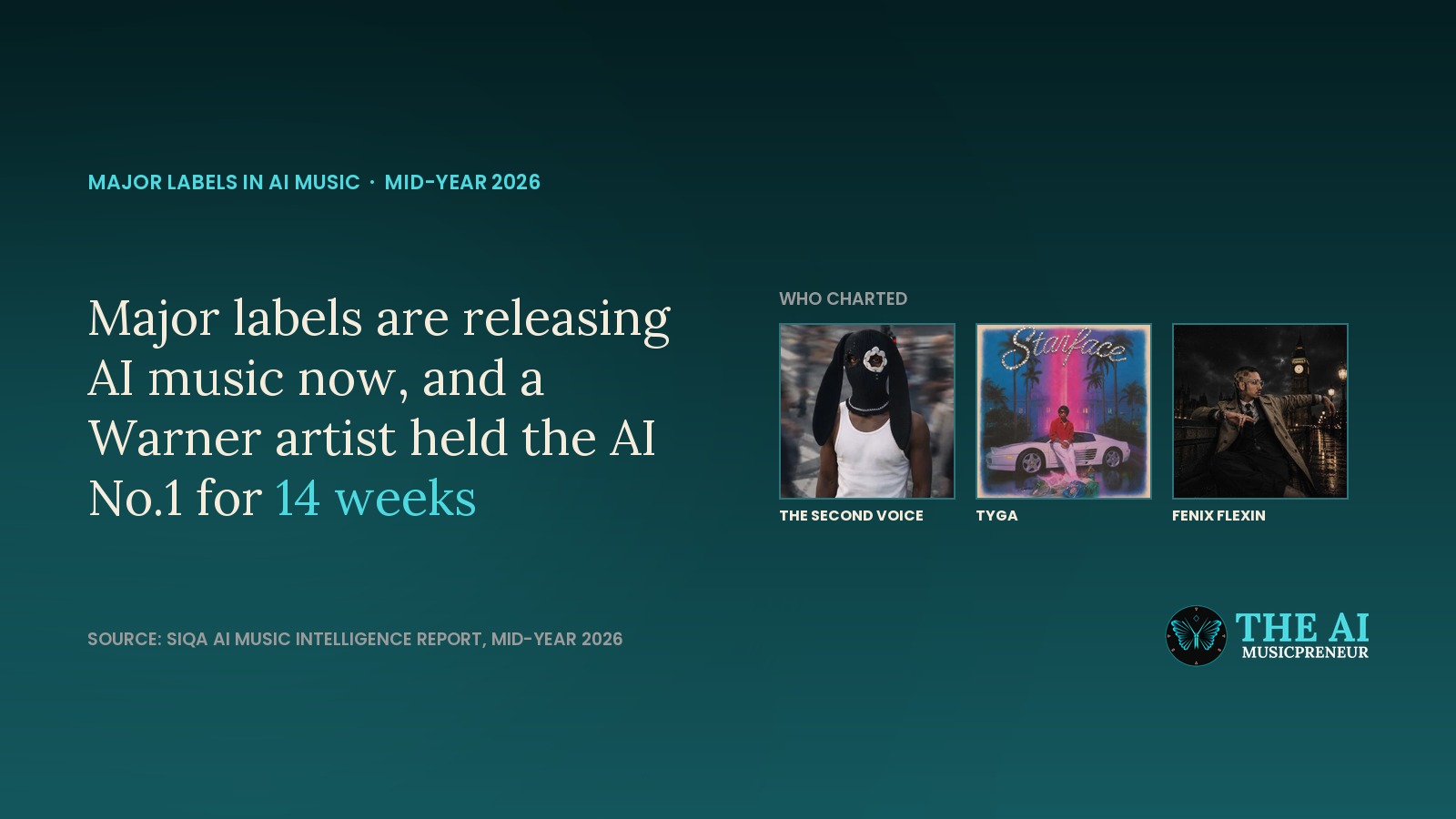
The Second Voice, released through Warner’s Spinnin’ Records, debuted at #1 with “Let Me Be” and did not move. SIQA’s summary page puts the run at 14 straight weeks at the top, which matches my week-by-week chart coverage. The durability table inside the report lists the same act at 5 weeks in the Top 10, and the two numbers don’t agree. I’m going with 14, because I counted them.
It is the first major-label-affiliated AI artist to reach #1 in SIQA’s verified chart history. In Q1 the industry arrivals were 2 Grammy-recognised names charting in the 70s and 80s. At mid-year a Warner act owned the top slot from May through August.
The mid-year period is the moment AI music stopped being a category the industry was watching and became one it was participating in.
Tyga charted in the same period, peaking at #8 with 3 weeks in the Top 10, the first mainstream Hip-Hop crossover on the chart. He had already confirmed to VIBE that he used Suno on $TARFACE. Fenix Flexin charted too, with “RUBBERZ”, the Hot 100 single he admitted in August was made with Treblo.
One classification note. SIQA lists all 3 arrivals as AI-Assisted. My Artist Index files “RUBBERZ” under Fully AI-Generated, based on Treblo’s own classifier and Fenix’s admission.
Both can be true at once, because the SIQA tier is what the submitting creator declares. The gap between what an artist declares and what a detector finds is the fight of the next 12 months, and SIQA’s new registry is its answer to it. More on that below.
8. Female-presenting artists held 56% of SIQA Top 10 slots across 20 weeks
SIQA counted 200 weekly Top 10 slots over the period. Female-presenting artists held 56% of them, male-presenting artists 35%, and neutral or group acts the remaining 9%.
The period closed with 6 of the 10 Top 10 positions female-presenting.
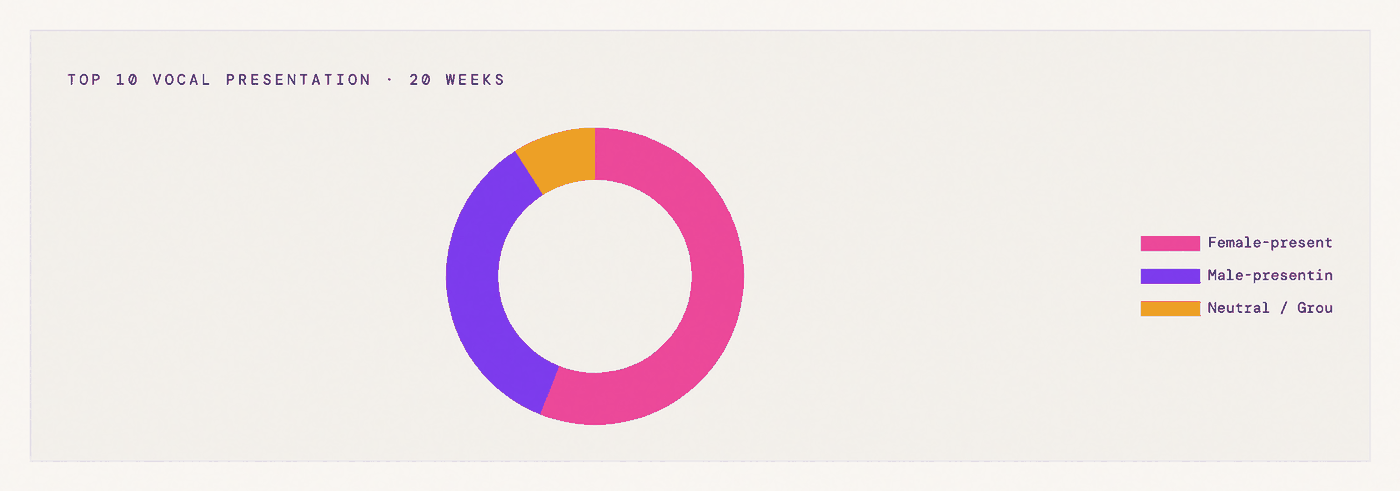
SIQA measures the vocal presentation of the artist persona, read from the name, the artwork and the music. It does not measure the gender of the human behind the project. Those are 2 different things, and in a category where the vocal is often generated, they can point in opposite directions.
Q1 reported the same lean, with female-presenting artists at 37.2% of all chart positions and 70% of the Top 10 by Week 9. Mid-year shows it held for 20 more weeks. Olivia B. Moore’s “Love Notes” and Xania Monet’s multiple entries carried a lot of it.
In practice, the female AI vocal is the default sound of the charting AI record right now. That says something about what Suno renders best and something about what listeners click.
9. Thompsxn Therapy and Olivia B. Moore each logged 7 weeks in the SIQA Top 10
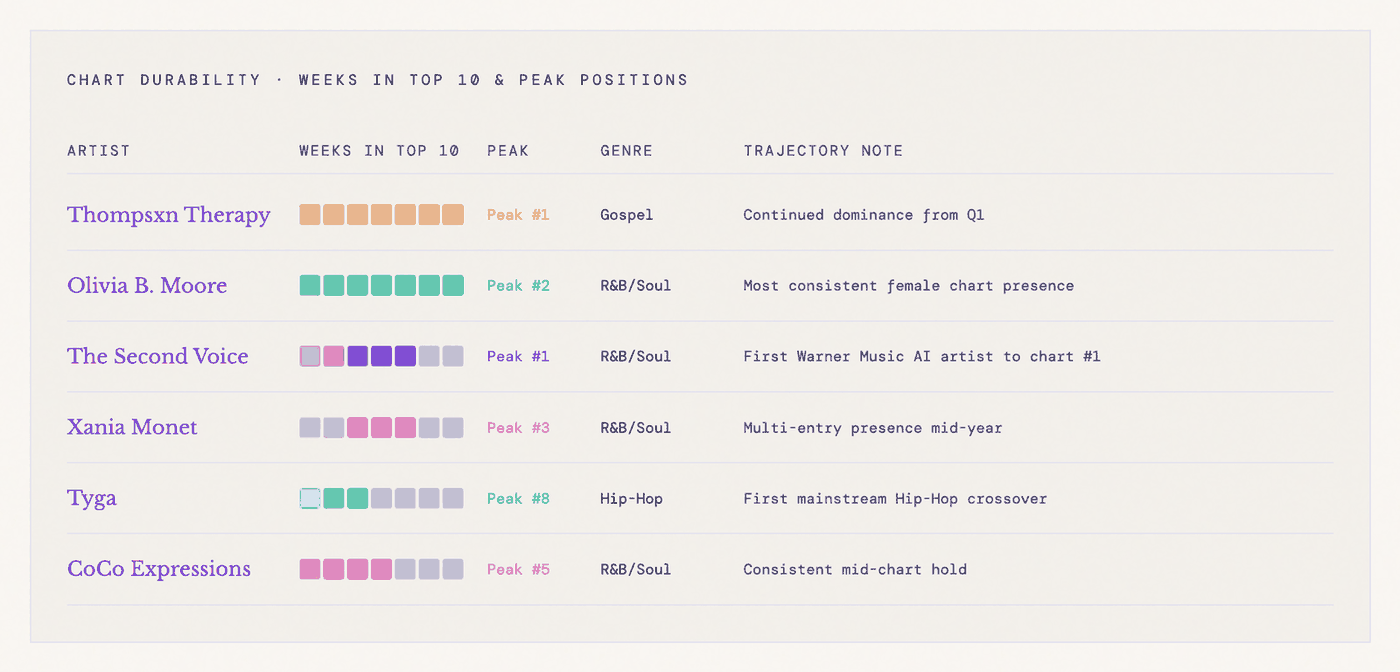
SIQA’s chart durability table lists 6 acts:
- Thompsxn Therapy, Gospel: 7 weeks in the Top 10, peak #1
- Olivia B. Moore, R&B/Soul: 7 weeks, peak #2
- The Second Voice, R&B/Soul: 5 weeks listed, peak #1 (see finding 7)
- Xania Monet, R&B/Soul: 5 weeks, peak #3
- CoCo Expressions, R&B/Soul: 4 weeks, peak #5
- Tyga, Hip-Hop: 3 weeks, peak #8
The table stops at 7 boxes, so read 7 as a floor. Thompsxn Therapy’s “DON’T PLAY WITH ME” sat inside the Top 10 every week I tracked it through August 18, by then in its 27th straight week on the chart.
Olivia B. Moore started making music after losing her IT job, and in June she was the only artist with 2 songs charting at once.
SIQA’s point is that a strong debut is easy and a 7-week hold is not. A hold needs listeners who come back the next week without a playlist telling them to. Q1 asked whether AI artists could build that. Mid-year has 6 names that did.
What SIQA’s Mid-Year 2026 report sets up for the rest of 2026
The report closes with its own forecast, and most of it lines up with what I’m seeing. Here is what I’d expect the full-year report to show, and what to do about it now.
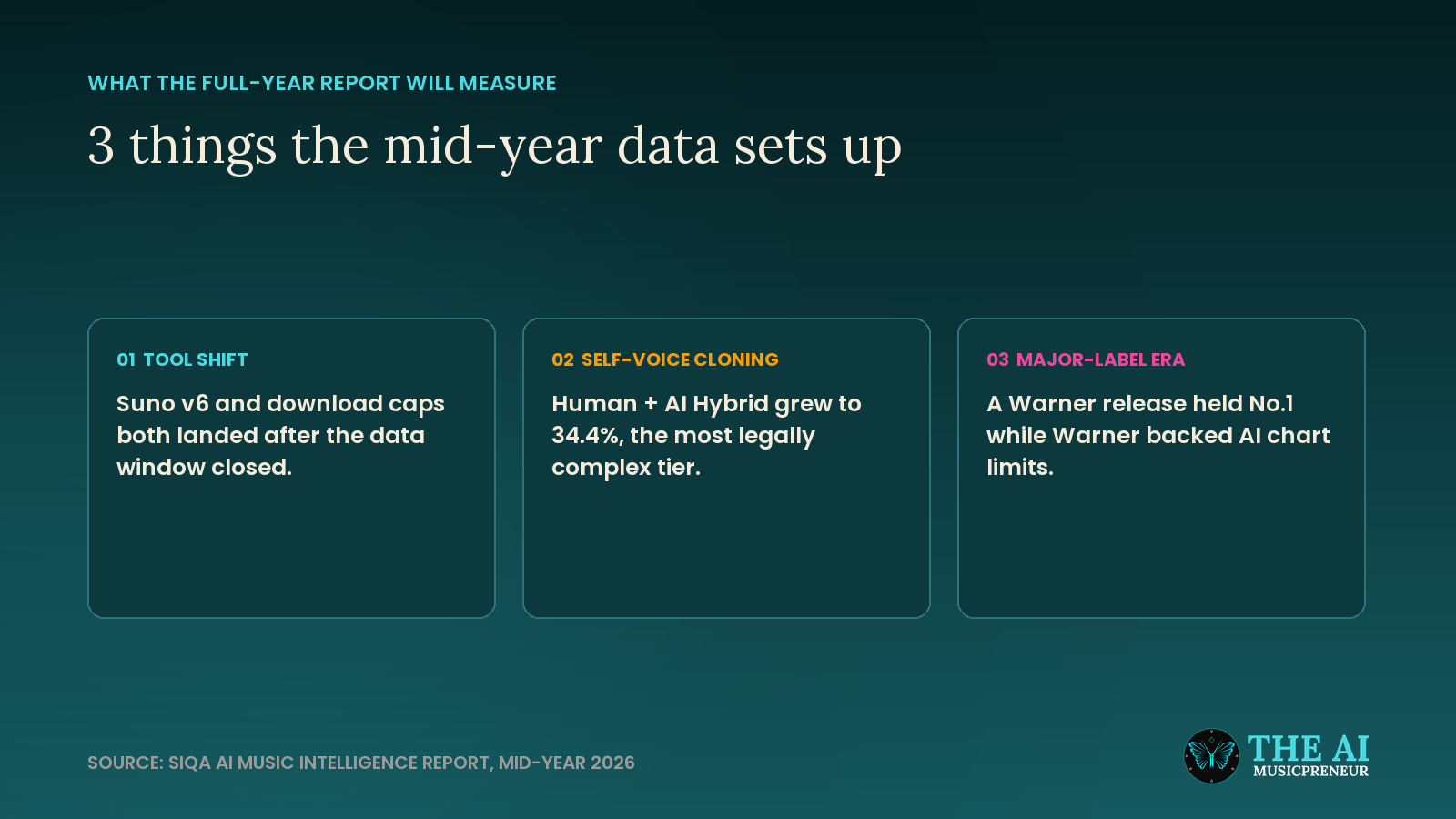
Suno v6 and the download caps land in the next window. The mid-year pool was made on the older Suno models, and Suno retired all of them on September 9. The full-year data will be the first to show whether creators kept submitting at the same rate, and whether the tool share finally moves.
Self-voice cloning is the tier to watch. Human + AI Hybrid grew from 32.4% to 34.4%. SIQA calls it the most legally complex tier, and I agree. It is also the tier where an established artist can enter without changing what they sound like, which is why the next Warner name probably shows up there.
The major-label era started, and the labels’ own rules would exclude it. A Warner act held #1 for 14 weeks on a chart that the 11-company proposal from July would not recognise. Somebody at Warner is going to have to decide which chart they believe.
The SIQA Verified Registry is the structural change. SIQA launched it alongside the report, with an iOS app, under the line “To verify, not flag.” Artists register how AI was used at the source, and anyone can check it at registry.thesiqa.com. That flips the model every detector runs on. A detector guesses after the fact. A registry records the claim before release, and the Fenix Flexin case shows why the two will keep disagreeing until the registry has enough entries to matter.
If you release music with AI in the chain, 3 things follow from this report. Pick the tier honestly and register it, because the incentive to under-declare is now visible in the data. Check your distributor’s AI policy before you upload, because TuneCore’s share shows what happens when a pipe closes. And submit to the chart, because 886 artists is still a small room and the first SIQA AI Music Awards arrive on November 13.
1,743 tracks. 886 artists. 54 countries. Q1 asked whether AI music had an audience. Mid-year answered with a Warner artist at #1 for 14 straight weeks.
Frequently asked questions
What does the SIQA AI Music Intelligence Report Mid-Year 2026 cover?
The Mid-Year 2026 report is SIQA's second AI music data report. It covers 1,743 verified submissions from 886 artists in 54 countries, collected between April 1 and August 20, 2026, plus 20 complete weekly cycles of the SIQA Top 100 AI Songs chart. All classification data is self-disclosed by the submitting creator and verified by SIQA.
How much AI music was fully AI-generated in SIQA's Mid-Year 2026 report?
13.9% of mid-year submissions were classified as Fully AI-Generated, down from 19.2% in Q1 2026. AI-Assisted tracks made up 51.7% and Human + AI Hybrid tracks, where the artist clones their own voice, made up 34.4%. SIQA reads that as 86.1% of submissions involving meaningful human creative contribution.
Did Suno's share of AI music submissions grow between SIQA's Q1 and Mid-Year 2026 reports?
Yes. Suno appeared in 92.8% of mid-year submissions, up from 90.4% in Q1 2026. ChatGPT fell from roughly 1 in 5 workflows to 16.3%, BandLab appeared in 3.4% of tracks, and ElevenLabs, Udio, Soundraw and Moises each sat below 1%. The data window closed before Suno v6 launched on September 9, 2026.
Which distributor did most AI artists use in SIQA's Mid-Year 2026 report?
DistroKid handled 77.6% of mid-year submissions with distributor data, up from 75.8% in Q1. Self-released tracks came second at 6.2%, then LANDR at 4.9%, UnitedMasters at 3.5%, Ditto at 3.1%, CD Baby at 2.1%, TuneCore at 1.7% and SoundOn at 0.9%. TuneCore's share fell from 4.7% in Q1.
Which artists held the SIQA Top 10 longest in the Mid-Year 2026 report?
SIQA's chart durability table lists Thompsxn Therapy (Gospel, peak #1) and Olivia B. Moore (R&B/Soul, peak #2) at 7 weeks each in the Top 10, the maximum the table displays. The Second Voice and Xania Monet follow at 5 weeks, CoCo Expressions at 4 and Tyga at 3. SIQA's summary page separately credits The Second Voice with 14 straight weeks at #1.
About the author

Covering AI music tools, industry shifts, and news for music creators and professionals. Twice-weekly newsletter at aimusicpreneur.com.