Universal Music discussed going private with Apollo, TPG and Blackstone after its shares fell 29% this year
My stack My fav 6 tools for AI music after testing 70+
-
 ElevenMusic · Music generation
-
 Moises · Stem separation
-
 Controlla · Voice swap & cloning
-
 Cryo Mix · Mixing + mastering
-
 Neural Frames · Music videos
-
 ONCE · Distribution
Some links are affiliate links — I earn a commission at no cost to you. Every tool here is one I run myself and truly believe in. This stack is proven.
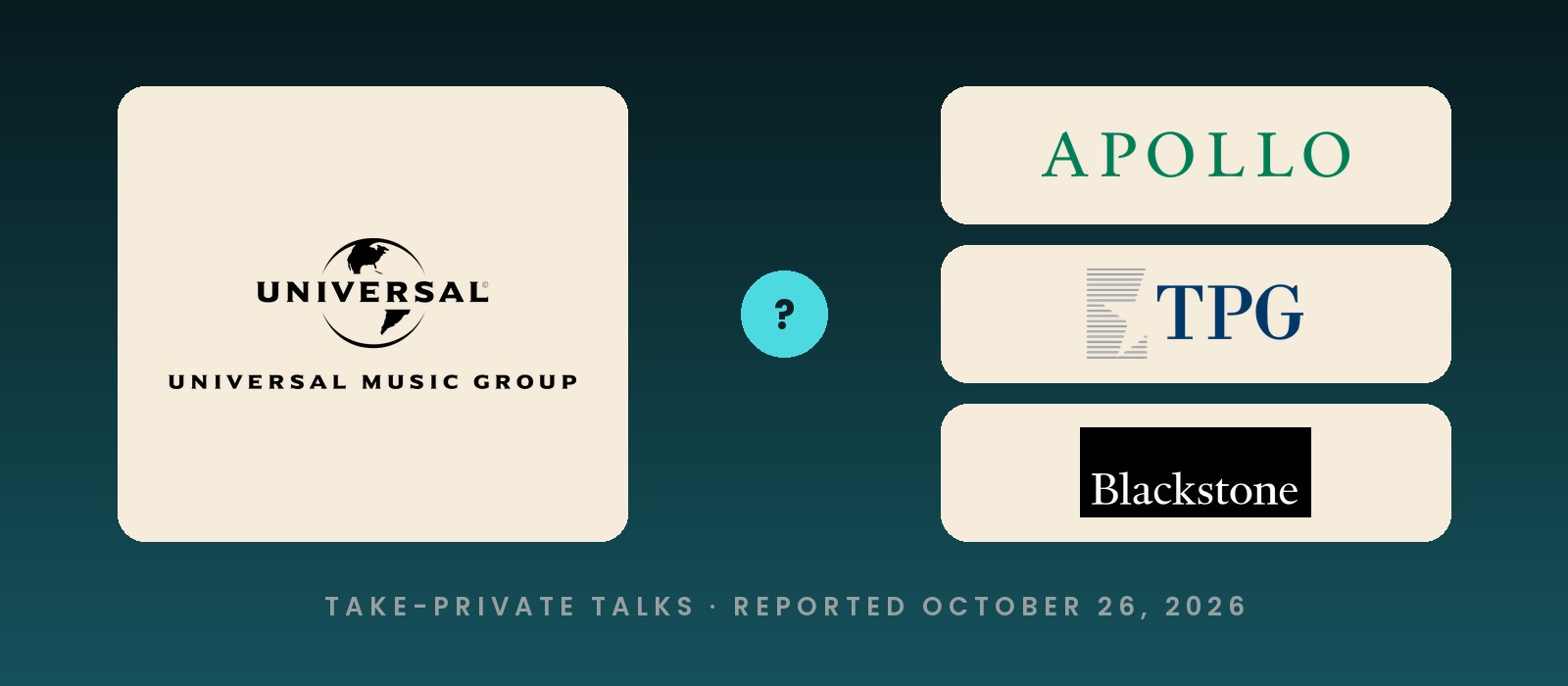
Universal Music Group’s management held preliminary talks earlier this year with Apollo, TPG and Blackstone about taking the company private, Bloomberg reported on October 26, 2026, in a story Reuters picked up. The talks didn’t progress, and UMG hasn’t started a sale process.
The report lands with UMG’s shares down about 29% this year, below the price the company listed at in 2021. That leaves the biggest of the 3 major labels with a market value of roughly €29 billion, about $32 billion, according to Indian Television’s write-up of the Bloomberg story.
What Bloomberg reported about Universal Music’s talks with Apollo, TPG and Blackstone
Bloomberg’s sources say the talks were held by UMG’s management, and the board knows about them. Reuters asked all 4 companies for comment, and UMG, Apollo, TPG and Blackstone didn’t immediately respond.
Going private would mean a buyer purchasing UMG’s shares and taking the company off the Amsterdam stock exchange. Any buyer would have to deal with 2 big shareholders first. The Bolloré family controls more than 30% of UMG through Vivendi and its own holdings, and Tencent owns more than 11%.
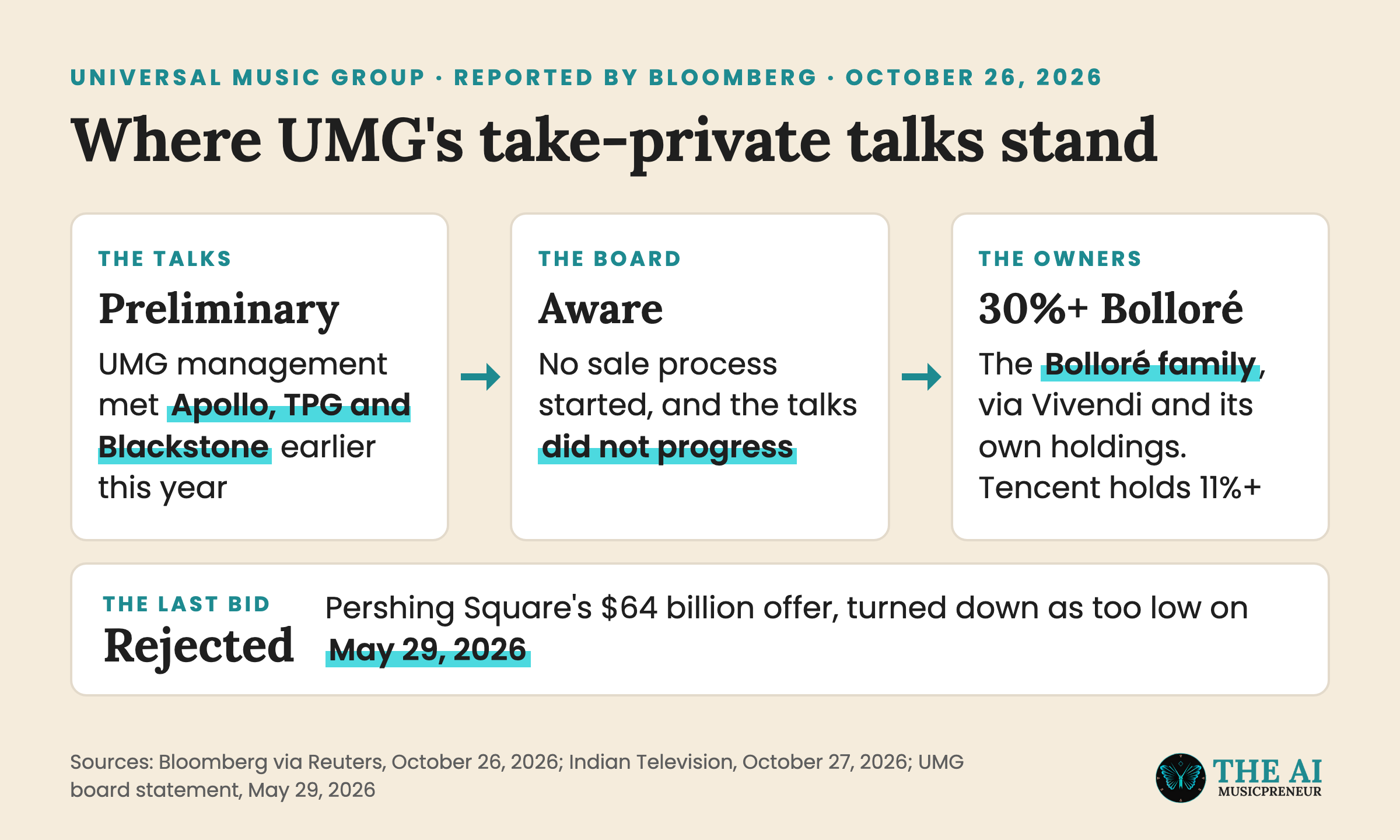
The talks come months after another buyout attempt. On April 7, Bill Ackman’s Pershing Square proposed a deal valuing UMG at €30.40 a share, about €55.75 billion or $64.31 billion, according to Reuters’ report on the bid. On May 29, UMG’s board turned it down unanimously, saying it “fundamentally and materially undervalues UMG.”
The Bolloré side agreed. In May, Cyrille Bolloré said Ackman’s price was too low, and at his own firm’s shareholder meeting he said this about selling, as quoted by Indian Television:
Perhaps we'll sell a few percent one day. We'll see. But we can't sell too early.
So why is a company whose board said in May it’s worth more than €30.40 a share trading at roughly half that?
Why Universal Music stock is down in 2026
UMG hasn’t pinned its share price on one cause. The reasons on record come from analysts and reporters, and AI shows up in most of them:
- AI fears and market share: Reuters’ April report on Ackman’s bid said fears of AI disrupting the music industry had played a role in UMG’s “lacklustre performance.” Wells Fargo analysts noted that UMG’s share of the music market was sliding and streaming growth was slowing.
- A delayed US listing: the same Reuters report said UMG pushed back its plans to list in the US in March.
- AI tracks, indie distributors, slower streaming: Indian Television’s October 27 piece points to 3 pressures investors are weighing. AI-generated tracks could take a bigger slice of listening and royalty pools, independent distributors offer artists better terms, and streaming growth has slowed in the US and Western Europe.
- Spotify got the AI bump, UMG didn’t: when the Spotify AI remix deal landed in May, CMU noted on June 1 that Spotify’s shares jumped from around $430 to nearly $530 while Universal “stayed pretty much flat.”
UMG’s own numbers point the other way. In its May 29 statement it said it took a 33% share of recorded music in 2025, its highest in 12 years, and that its artists held 9 of the top 10 spots on IFPI’s Global Artist Chart.
The same statement lists “challenges related to generative AI” among the risks investors should weigh.
What Universal Music says in public about its AI deals, and what it doesn’t
UMG has signed a string of AI deals since 2025. It settled its lawsuit with Udio in October 2025, backed Spotify’s AI remix tool in May, and licensed Hook’s fan remixes in August. In September it signed ElevenLabs to a multi-year deal, and on October 22 it licensed TYGER’s adaptive gaming music.
The rates in those deals aren’t public. The Associated Press reported that the financial terms of the Udio settlement weren’t disclosed. UMG and ElevenLabs didn’t publish a revenue split when they announced their deal, and Spotify still hasn’t published a payout rate for its remix tool.
What the public does hear about UMG and AI mostly comes through its life as a listed company. On UMG’s Q4 2025 earnings call, chief digital officer Michael Nash told investors AI music was under 0.5% of organic consumption. And when UMG rejected Ackman, Lucian Grainge promised shareholders “greater insight into the drivers of our performance.”
Frequently asked questions
What price did Bill Ackman's Pershing Square offer for Universal Music Group in April 2026?
Pershing Square's April 7, 2026 proposal valued Universal Music Group at about €30.40 a share, a 78% premium to the previous close of €17.10, or about €55.75 billion ($64.31 billion) in total. UMG's board unanimously rejected it on May 29, 2026, saying it fundamentally and materially undervalued the company.
How much of Universal Music Group do the Bolloré family and Tencent own?
The Bolloré family controls more than 30% of Universal Music Group through Vivendi and its own holdings. In April 2026 Reuters put Bolloré Group's stake at 18.5% and Vivendi's at 13.4%. Tencent owns more than 11%.
What did Universal Music Group's board promise shareholders after rejecting Pershing Square's bid?
In its May 29, 2026 statement, UMG's board pointed to an expanded share buyback, plans to monetize half of its Spotify equity stake, and more detailed financial disclosure so that its business can be better assessed and understood.
When did Universal Music Group start trading on the stock market?
Universal Music Group listed on Euronext Amsterdam in September 2021, when Vivendi spun it off. In October 2026 its shares were trading below that 2021 listing price after a drop of about 29% during the year.
About the author

Covering AI music tools, industry shifts, and news for music creators and professionals. Twice-weekly newsletter at aimusicpreneur.com.