The AI Music Briefing #15: A Vienna engineer trained an AI on licensed MIDI, and it exports finished Ableton projects
The week of August 10–14, 2026, when 3 browser studios shipped in 48 hours: Riffle went public, Suno released Studio 2.0 with MIDI and a plugin builder, and Beat Shaper proved licensed training data works at indie scale. Plus BMG licenses Suno without a lawsuit.
My stack My fav 6 tools for AI music after testing 70+
-
 ElevenMusic · Music generation
 -
 Moises · Stem separation
 -
 Controlla · Voice swap & cloning
 -
 Cryo Mix · Mixing + mastering
 -
 Neural Frames · Music videos
 -
 ONCE · Distribution
Some links are affiliate links — I earn a commission at no cost to you. Every tool here is one I run myself and truly believe in. This stack is proven.
Issue #15 · the week of August 10–14, 2026 · ~7 min read. The Friday read for music industry professionals working at the intersection of AI and the traditional music business. Curated by Christopher Wieduwilt.
What’s in store:
- Top Story: a Vienna engineer trained an AI on licensed MIDI, and it exports finished Ableton projects
- Suno Studio 2.0: the 6 updates worth knowing, with tutorials landing next week
- D’Addario says the words the guitar community waited for: “We got this wrong”
High Signal News: Suno Studio 2.0, the BMG deal, and Spotify’s AI Persona badge
Suno Studio 2.0 ships MIDI, a chat bar, and plugins you build by typing
Suno released its biggest Studio update on August 13, for Premier subscribers at $24 a month.
The parts worth your time:
- MIDI, the most requested addition. Import, record and edit it on the timeline, play parts in from a controller or your typing keyboard, and design sounds in a new wavetable synth. A MIDI clip doubles as a prompt for a new audio generation, and Convert to MIDI runs the trip in reverse.
- A chat bar (beta) reads every track in your session. It generates instruments and vocals, tidies and colour-codes your project, and builds working audio plugins from a plain description. Building plugins costs no credits at launch; Suno says a credit structure may come later.
- 7 factory effects including sidechain compression and convolution reverb, automation curves, advanced stem separation, and 32-bit/48kHz multitrack export with no caps, while the rest of the platform gets download limits on September 3.
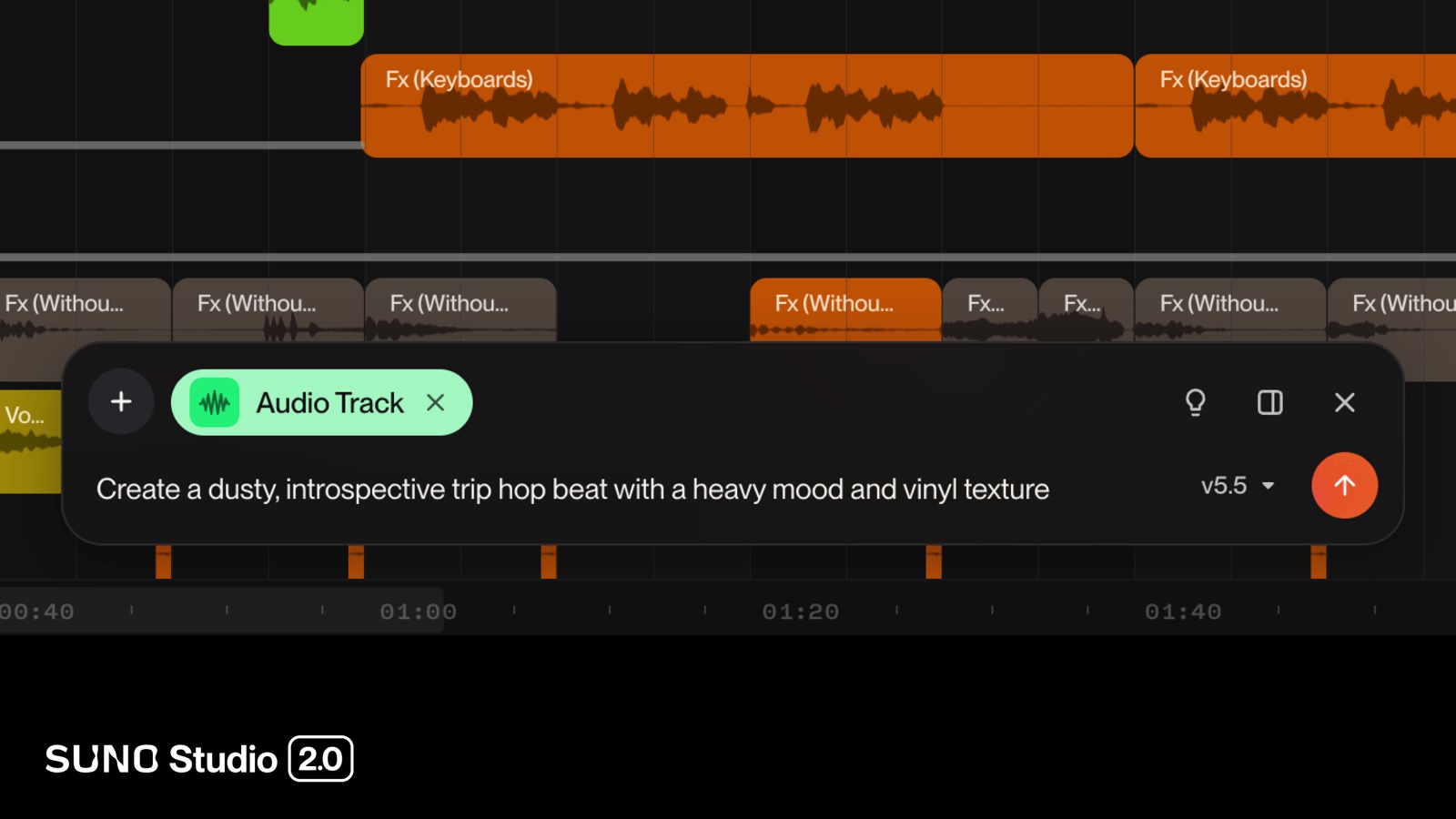
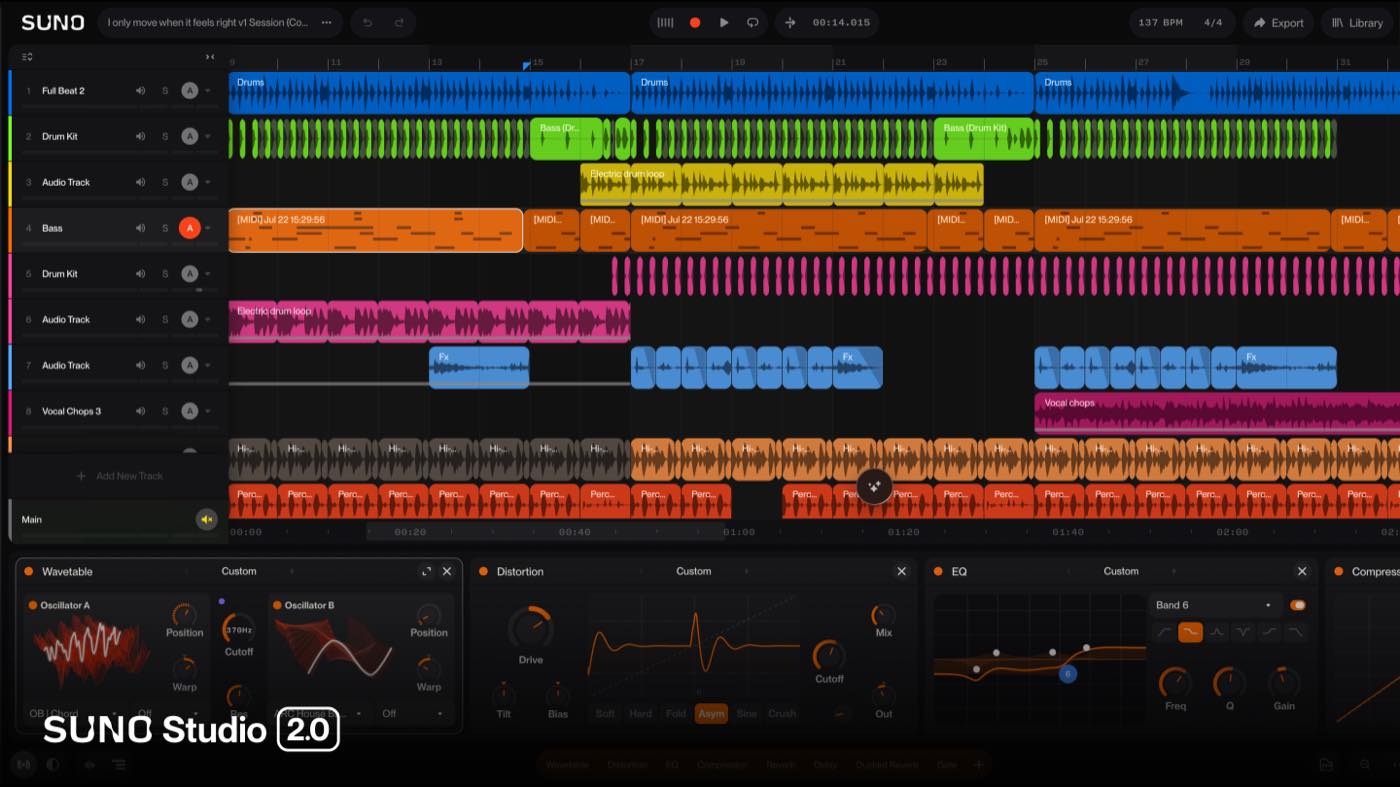
Two limits Suno concedes itself: no VST or Audio Units support, and no pitch correction yet.
Next week I’m publishing a tutorial series on each piece: MIDI in both directions, recording and comping vocals, mixing with the full effects rack, and building your own plugins.
Suno signs BMG across recordings and publishing, with artists opting in
BMG became the first significant rightsholder to license Suno since Warner settled 9 months ago, announced August 12. The deal covers recorded music and publishing in one frame, so songwriters are named in an AI licensing deal for the first time. Participation is opt-in, participants get paid, and prior use is settled. BMG never sued.

Spotify will badge AI personas and keep them out of recommendations by default
From mid-September, profiles built on AI-generated identities carry an AI Persona badge, and their music is excluded from editorial, algorithmic and personalized recommendations by default. Self-disclose and you get “AI Persona”. Get flagged by Spotify’s review team and you get “Likely AI Persona”, with notice and an appeal route. The badge marks the identity, not the music.
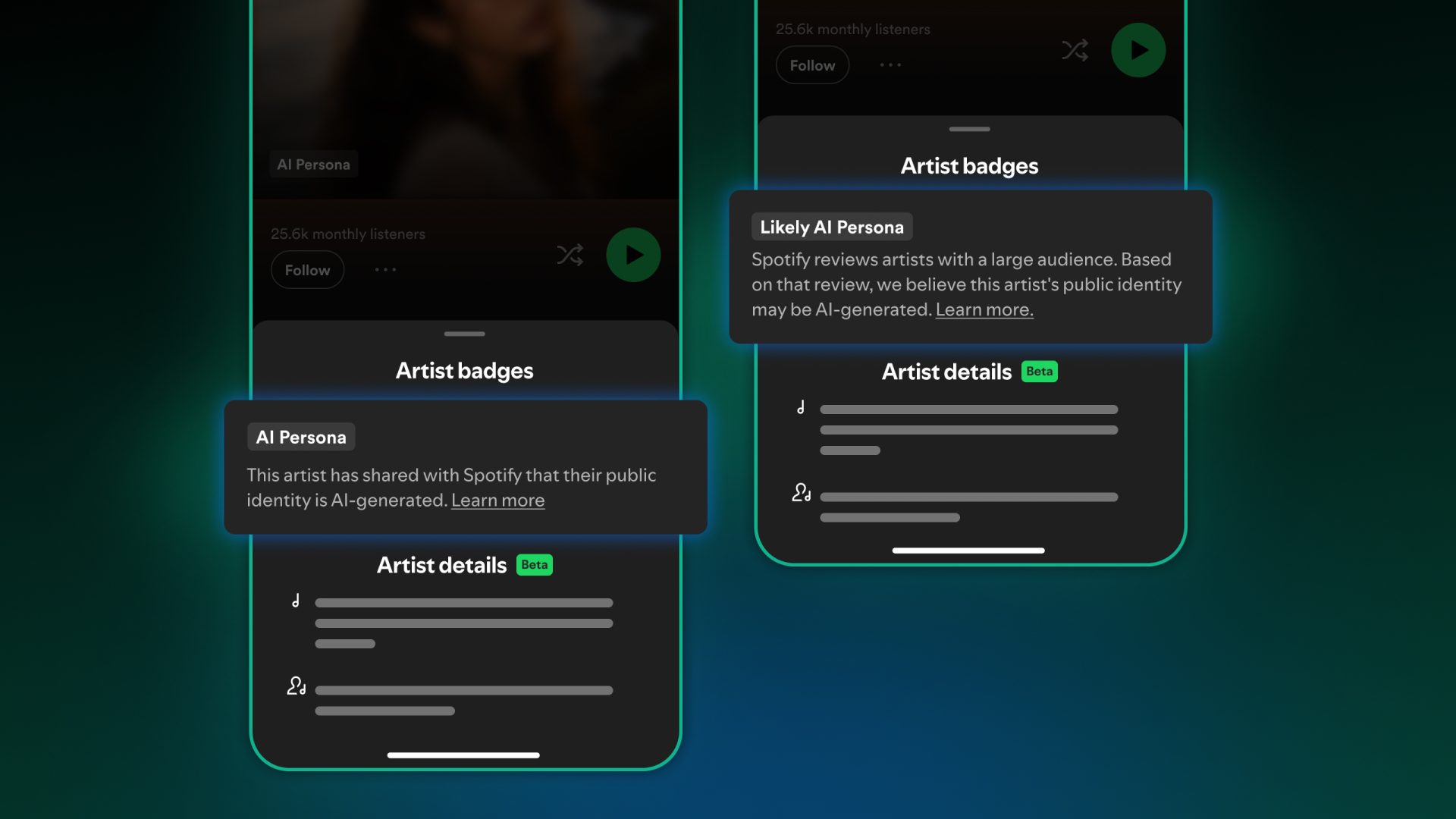
What this means for you → If you use AI tools under your own real name, this badge is not aimed at you. If you run a synthetic artist, discovery now defaults to off.
Anthropic watermarks every Claude output, and lyrics written with it now carry the mark
Every Claude model launched on or after August 2 embeds a watermark in the text it generates, woven into the words themselves. It survives copy and paste and can persist through some editing, so a verse drafted in Claude carries the mark into your session notes. No public detector exists yet. The trigger: the EU AI Act’s Transparency Code.
D’Addario admits Suno Studio made its string demo after weeks of denials
“We got this wrong.” D’Addario confirmed on August 10 its NYXL HD demo track came from Suno Studio, after a flat denial backed by a Logic session and a second story blaming AI mixing tools. The company says it was fed false information, and now requires employees and creative partners to disclose any generative AI use.
Riffle opens its multiplayer studio to everyone after 7,000 testers
Riffle’s browser studio went public on August 12 after a 3-month early-access run with 7,000 musicians. The launch adds a full-screen timeline editor, an MPC-style sampler with custom kits, and an assistant reading your MIDI. Riffle positions itself between pro DAWs built for finishing and prompt platforms built for output, and it is the only one of this week’s 3 browser studios built around real-time collaboration.
Tyga confirms Suno on $TARFACE, and the new chart rules now apply to him
Tyga told VIBE his team “definitely used AI as a tool” on the July 31 album, for ’80s synths and a guitar solo, and compared the backlash to Auto-Tune. The writing and vocals stay his, he says. The IFPI coalition’s July rules tie chart eligibility to whether the AI service used is authorized, which makes $TARFACE the first celebrity test case.
AI Music Lawsuit Tracker
The 3 core cases sat still again. The 3 cases moved by judges on August 5 (Woulard v. Udio, AFM v. Universal & Warner, Concord v. Anthropic II) are all waiting on rulings, with nothing new this week.
RIAA v. Suno: partly settled, with Sony and Universal pushing for 61,026 recordings
RIAA v. Suno: Partly settled. Warner settled in November 2025, and Sony and Universal are still pushing to expand the case to 61,026 recordings, an expansion Suno urges the court to deny.
This week: No change this week. BMG’s August 12 licensing deal sits outside the case; the 2 plaintiffs stayed in court.
RIAA v. Udio: Sony alone still litigating over 30,117 recordings
RIAA v. Udio: Mostly settled. Sony alone is still litigating, and filed a second suit in July 2026 over 30,117 recordings.
This week: No change this week.
GEMA v. Suno: decided, and the appeal window is open
GEMA v. Suno: Decided. GEMA won on July 31, 2026. Suno must disclose revenues and pay damages, and can still appeal.
This week: No change this week. The appeal window is open and nothing has been filed.
→ Full case files and timelines
Top Story: a Vienna engineer trained an AI on licensed MIDI, and it exports finished Ableton projects
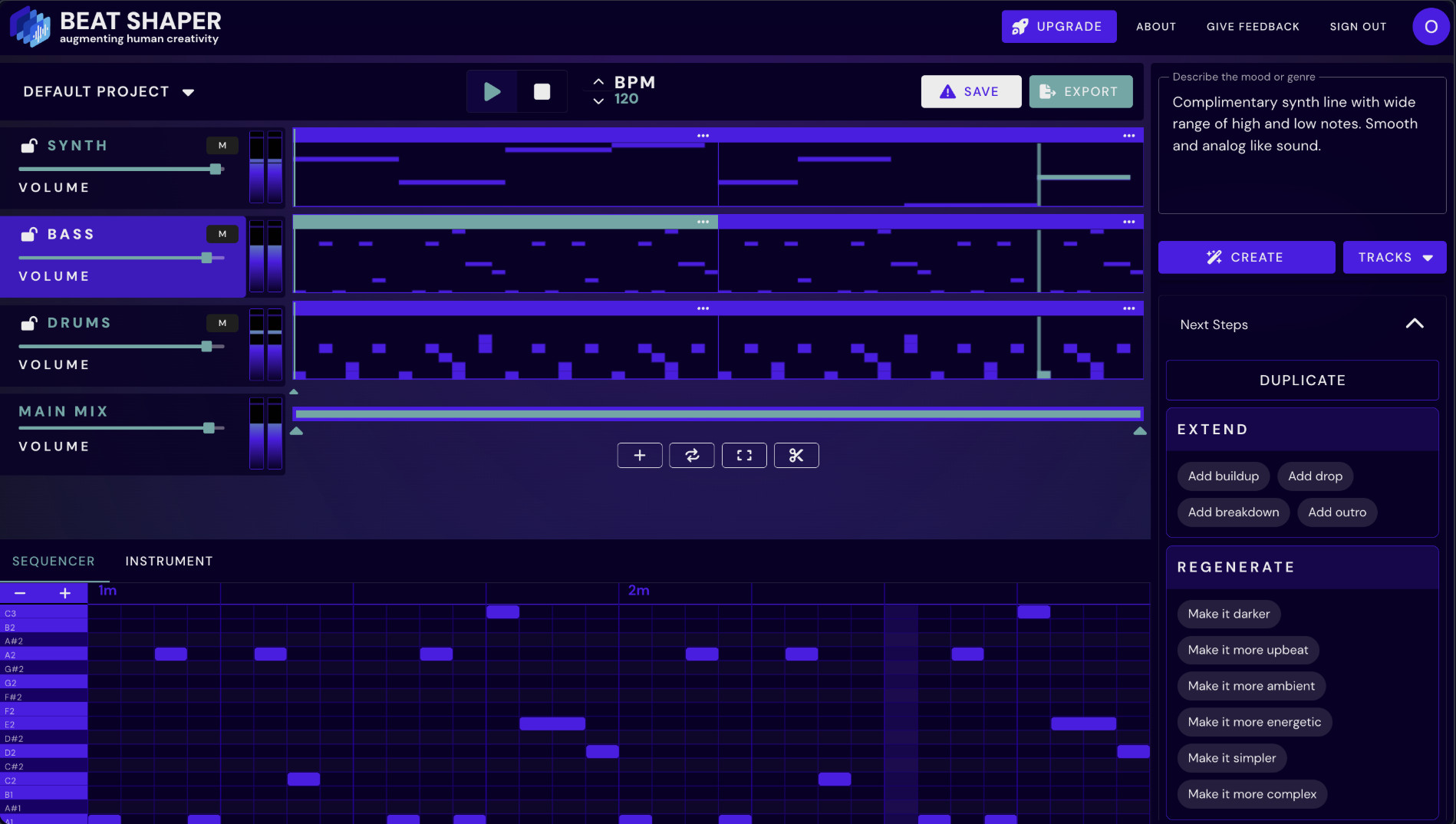
Beat Shaper turns a text prompt into a multitrack MIDI loop in the browser: drums, bass, synth, kit and tempo, with every note editable after generation. The model trained on MIDI loops licensed from sample-pack providers explicitly for machine learning. No scraped catalogs anywhere in the chain.
Suno and Udio are still defending RIAA suits over scraped training data. ElevenMusic licenses at label scale, Lemonaide through direct producer deals. Beat Shaper is the proof the licensed posture works at indie scale, and the payoff for you is concrete: a club track or a sync brief with no rights uncertainty inherited from the dataset.
How Beat Shaper generates editable MIDI in the browser
You type a prompt, “a dark minimal techno loop”, or push sliders for genre, mood and energy across Techno, House, Acid, Drum & Bass, Hip-Hop and Trance. The engine answers with a cohesive 2-bar loop: drum pattern, kit, tempo, bassline and synth patch. Everything stays open after generation. Move notes in the piano roll, tweak the synth in real time, or regenerate the drums and keep the bassline. The MIDI is the model’s native output, so nothing needs transcription cleanup; Suno converts audio to MIDI at 10 credits per pass, and reviewers rate the result a rough sketch.
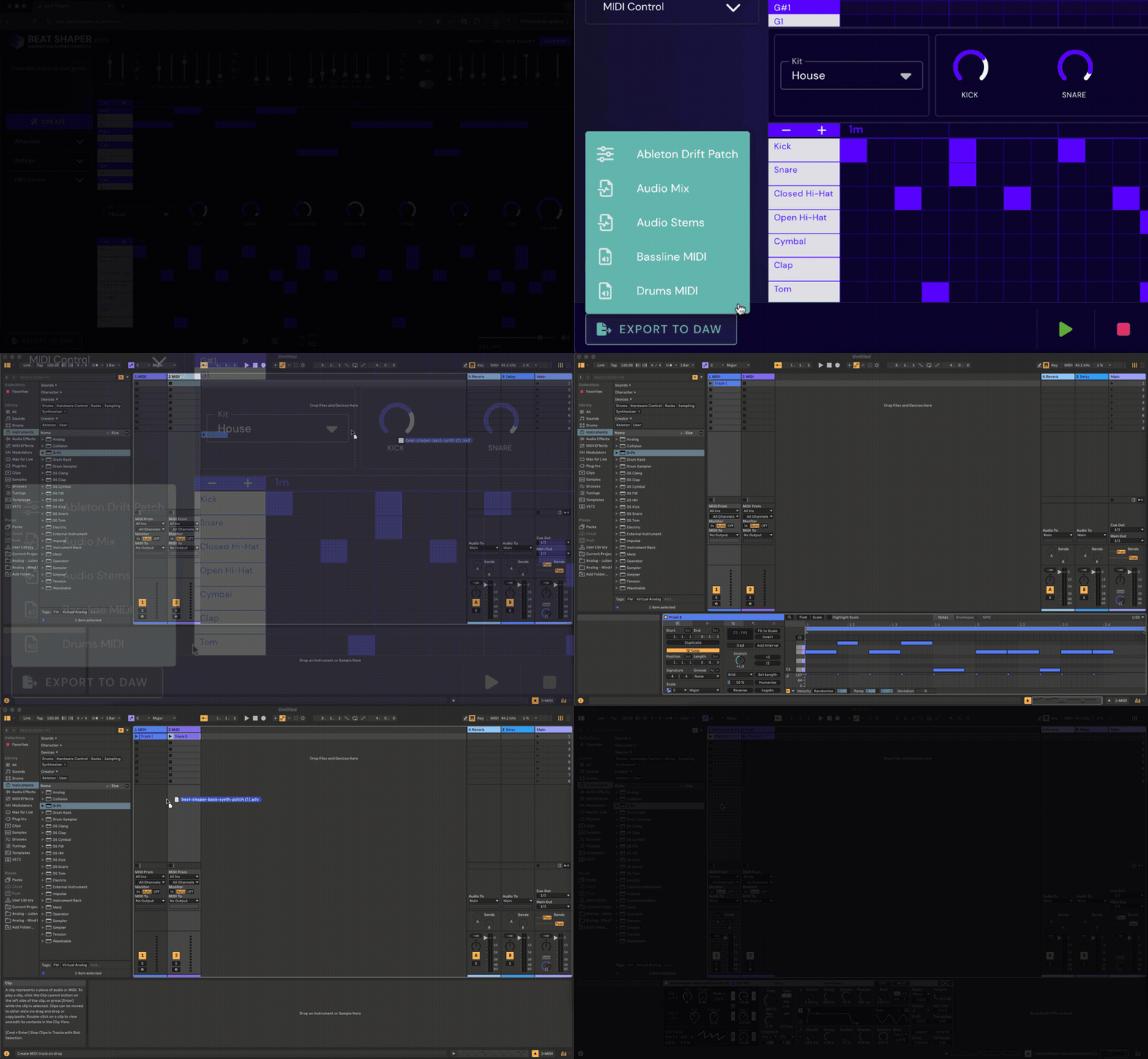
What opens in Ableton Live when you export a Beat Shaper track
Exports run to MIDI, WAV, MP3, or, on the Producer plan, what Beat Shaper calls “an entire Ableton Live project file”. Drums land in a Drum Rack with the Beat Shaper kit, and bass and synth MIDI load into Drift patches matched to the browser sound, which the company describes as nearly identical with minor tonal differences. Drift needs Live 11.3 or newer; plain MIDI and audio work in Logic, FL Studio and Cubase too.
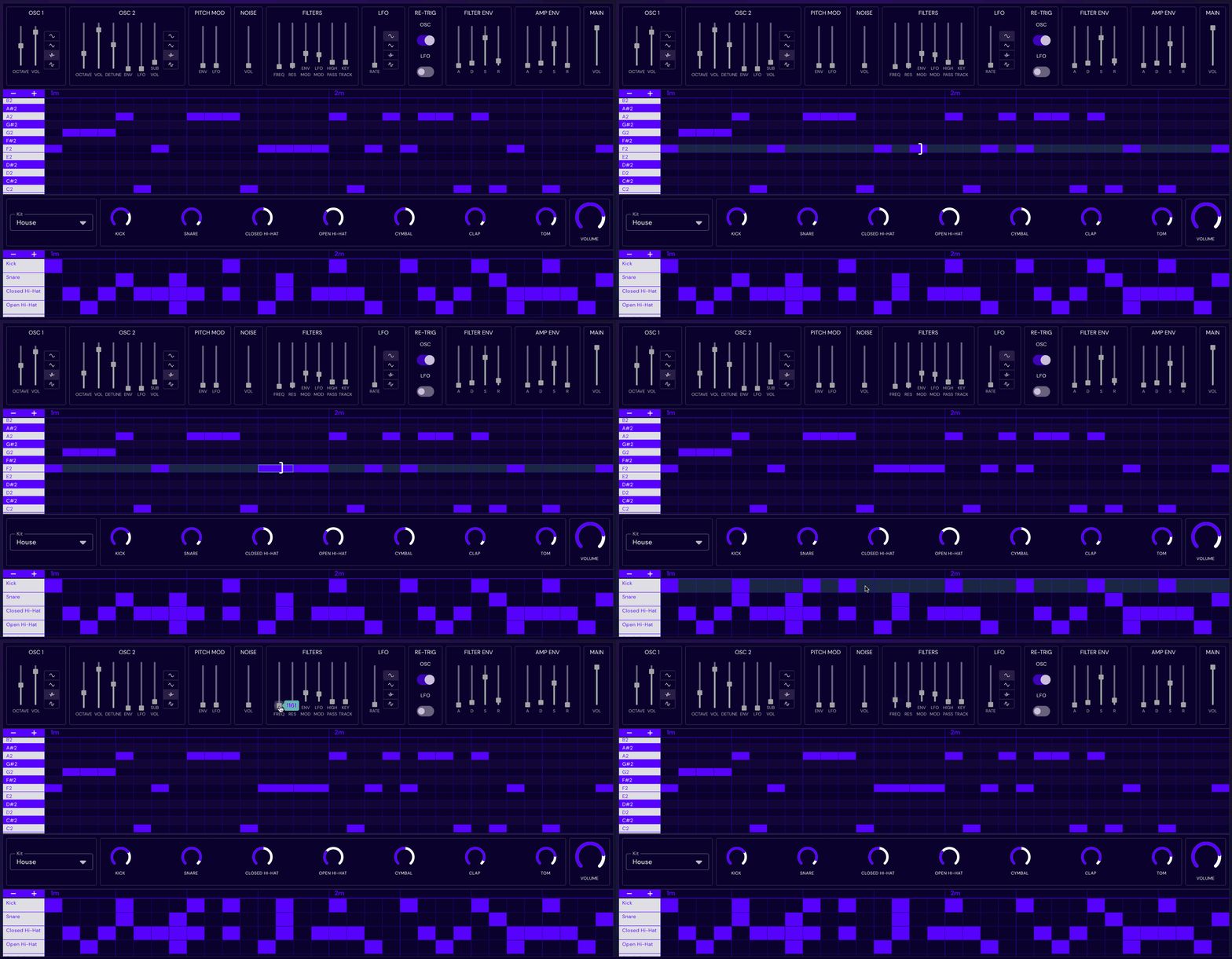
Beat Shaper’s Max for Live device generates MIDI inside Ableton Live 12
The device puts the generation engine on a MIDI track inside Live 12. Genre dials blend instead of switching, so you can pull a house pattern toward techno, and mood dials cover Darkness, Energy, Groove and Weirdness. Each instrument routes to its own target track, and generated clips land in the slots you chose, queued for playback. It needs Live 12 Suite, or Standard with the Max for Live add-on, plus an internet connection, because generation runs on Beat Shaper’s servers.
Taylor Peer has circled this tool for 10 years
In a flood of AI production tools with anonymous teams, this one has a face. Founder and ML engineer Taylor Peer spent 8 years on language-processing problems at Cortical.io in Vienna, released electronic music in the UK and US, and built his first AI drum machine a decade ago, before Transformer models existed. Beat Shaper went through the Wavelab incubator at the Munich University of Music and Theatre.

The free Starter plan has unlimited generations. Creator is 9 euros a month, Producer 28. Readers of this briefing get 30% off Creator and Producer for 3 months with the code STUDIO30 at checkout. My full breakdown, including the piano roll and the Max for Live workflow, is on the site.
Music Intelligence: Suno’s plugin builder, Thomas Bangalter, and the BrooklynVegan autopsy
The prompt structure behind Suno Studio’s plugin builder
The working prompt structure for Suno Studio’s plugin builder, from Suno’s own launch videos: name the effect, name the reference hardware, name the controls you want. Asked for a tremolo like an old organ rotary cabinet, Studio planned a dual-LFO design, built it, and named it Rotor Glow. It also shipped a stereo doubler with the width knob wired backwards. Henry Phipps, Studio Product Manager, on camera: “This is technology that’s still in development.”
Thomas Bangalter’s objection no licensing deal can answer
Every mechanism the industry shipped this year answers ownership: deals, badges, watermarks, licensed datasets. Thomas Bangalter refused AI this week without mentioning rights once. His objection is prompting, because his ideas don’t start as words. The artists still holding out after the deals land are holding out for a reason no contract reaches.
Sandra Burciaga Olinger on what killed BrooklynVegan
Veeps gutted BrooklynVegan, Alternative Press, Revolver and Goldmine in early August. Grimy Goods founder Sandra Burciaga Olinger named the cause most coverage stepped around: Google’s AI Overviews, “wiping out massive amounts of ad network and affiliate revenue while sending fewer readers to the websites that created the content”. My answer to it, the model I run on this site, is here.
Artist Index: Fenix Flexin
Fenix Flexin: the first known fully AI-generated song to reach a major US chart
New in the index: Fenix Flexin, the Shoreline Mafia rapper whose “RUBBERZ” peaked at No. 58 on the Hot 100, the first known fully AI-generated song to reach a major US chart. He denied it for 2 months and admitted it on August 7, after a producer teardown and Treblo’s own detector said otherwise.
→ Browse the full Artist Index
My Take: Suno owned the week twice, and the BMG deal is the structural move

Suno owned this week twice, and I think the second move matters more long-term.
Studio 2.0 is a big release. MIDI on the timeline, automation, advanced stem separation, and plugins you build by describing them. Suno added more production depth in one update than most DAWs ship in a year. I haven’t tested the whole thing yet, so expect a couple of articles next week once I’ve pushed every feature properly.
The BMG deal is the structural one. Recordings and publishing in a single agreement, songwriters named for the first time, prior use settled, and no lawsuit anywhere in the story.
Warner needed a courtroom to get to the table. BMG walked in on its own. When licensing starts happening without litigation first, training data turns from an existential fight into a rate negotiation.
Hold the 2 moves next to each other: the product gets deeper while the catalog gets legal.
That’s a company building to stay.
One thing to do this weekend: test Beat Shaper on your next track
If you produce electronic music, give the free Starter plan one session this weekend and see how far it carries you toward your next track. Prompt a loop, pull the drums apart in the piano roll, regenerate the bassline until it sits. The tool never takes control away from you: it hands you the MIDI, and every note stays yours to edit afterwards.
→ Start with my full walkthrough
About The AI Music Briefing
The AI Music Briefing is a weekly Friday read for music industry professionals working at the intersection of AI and the traditional music business. Curated and written by Christopher Wieduwilt, founder of The AI Musicpreneur. Browse every issue of the briefing.
Got a tip, a story, or a partnership idea? Reach out any time. Every message lands directly in my inbox.
Always rooting for you,
Christopher
About the author
Covering AI music tools, industry shifts, and news for music creators and professionals. Twice-weekly newsletter at aimusicpreneur.com.