The AI Music Briefing #12: GEMA put licensed AI training data on sale, days before its Suno verdict
The week of July 20–24, 2026, when the licensed AI rail took shape: GEMA sold 178,000 cleared audio files as PLAI, SOCAN wired attribution for 200,000 creators, and Indonesia drafted a style-imitation ban. Underneath it, AI passed half of Deezer's daily uploads.
My stack My fav 6 tools for AI music after testing 70+
-
 ElevenMusic · Music generation
 -
 Moises · Stem separation
 -
 Controlla · Voice swap & cloning
 -
 Cryo Mix · Mixing + mastering
 -
 Neural Frames · Music videos
 -
 ONCE · Distribution
Some links are affiliate links — I earn a commission at no cost to you. Every tool here is one I run myself and truly believe in. This stack is proven.
Issue #12 · the week of July 20–24, 2026 · ~7 min read. The Friday read for music industry professionals working at the intersection of AI and the traditional music business. Curated by Christopher Wieduwilt.
GEMA put licensed AI data on sale. Next Friday it learns if it beat Suno in court.
The AI money question got concrete this week: who supplies the data, who gets credited, and who gets paid.
GEMA launched PLAI, a licensed training set of 178,000 cleared files, with transcription firm Klangio as its first customer. SOCAN named Musical AI its attribution partner for about 200,000 creators, and Indonesia drafted Southeast Asia’s first AI copyright law with a ban on style imitation. Underneath the rail-building, Deezer said AI passed 50% of its daily uploads, more than 90,000 tracks a day in June, and Suno admitted a 2025 breach exposed 55.3 million users’ data it never disclosed. The licensed, attributed lane is getting built while the unlicensed flood and the trust problems keep growing.
What’s in store:
- Top Story: Joe Nichols says the artists who deny using AI are lying
- GEMA’s PLAI puts cleared data on sale days before its Suno verdict
- AI crosses half of Deezer’s daily uploads
- Suno admits a 55-million-user data breach it kept quiet
- Lawsuit Tracker: the GEMA verdict lands next Friday
- My Take
High Signal News: GEMA’s licensed dataset, Deezer’s upload flood, and Suno’s quiet breach
GEMA launches PLAI, a licensed AI training dataset, with Klangio signing on first
GEMA put 178,000 cleared audio files on sale as PLAI, bundling sound, metadata, and author plus master rights in one product, with transcription firm Klangio as first customer. It targets tools that analyze or transcribe music, not ones that generate songs. GEMA is selling licensed data to non-generative AI in the same week it awaits its Suno verdict.

For a tool builder, this is the first clean path to train on real music without a lawsuit. For a rights holder, it’s a new revenue line that pays on input, not output.
AI passed half of Deezer’s daily uploads: 90,000 tracks a day in June
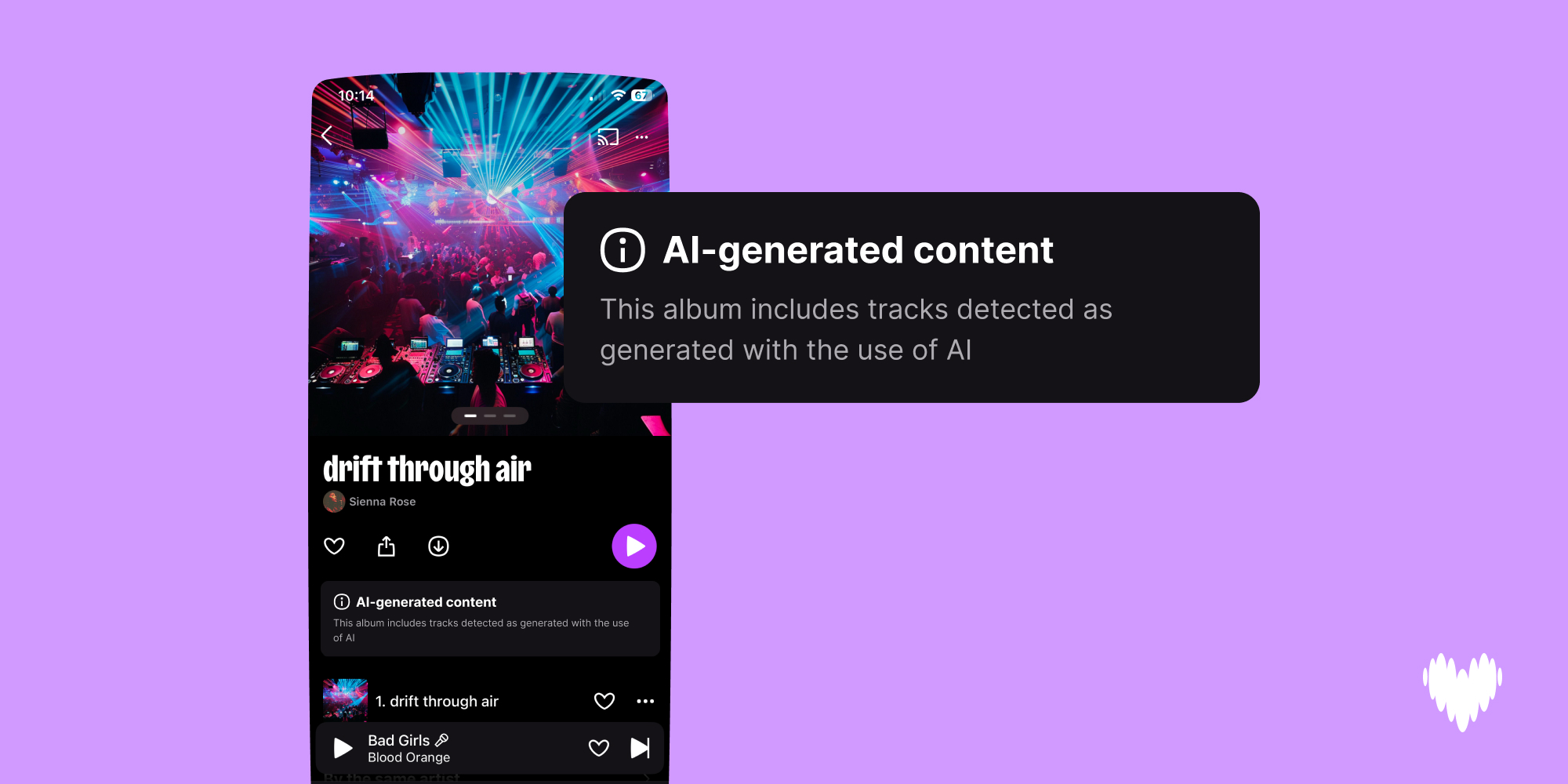
Deezer says more than 90,000 AI-generated tracks were uploaded daily in June, over 50% of everything coming in, the first time AI crossed half. The share climbed fast: 18% in early 2025, 39% in January, 44% in April. Deezer’s detection flags Suno and Udio tracks and now scans Apple Music and Spotify playlists too.
Suno admits a 2025 breach exposed 55 million users’ personal data
Suno confirmed a November 2025 breach that exposed 55.3 million users’ email addresses, plus names, addresses, and partial card data. It never told the affected users. This lands on top of the mid-July source-code leak, so a platform millions of creators pay for now has a trust problem on two fronts, weeks before its GEMA verdict.
SOCAN names Musical AI its opt-in attribution partner for 200,000 creators
SOCAN, Canada’s performing rights society, named Musical AI its approved AI attribution partner. Creators opt in, and Musical AI produces split-sheet-style reports that trace AI royalties back to the humans whose work fed a generation. It covers SOCAN’s roughly 200,000 members and pairs with PLAI as the other half of a licensed, attributed rail.
Publishers refile the Anthropic lyrics case around direct infringement
Concord, BMG, and other publishers refiled their case against Anthropic, moving direct copyright infringement and CMI removal to the front after the Cox ruling narrowed secondary liability. This is the lyrics-training front, separate from the Suno and Udio audio suits.
How publishers plead against a text-model maker after Cox becomes the template for every lyrics claim that follows.
Indonesia drafts Southeast Asia’s first AI copyright law, with a style-imitation ban
Indonesia’s draft copyright bill would ban AI imitation of a creator’s style, pay publishers for training use, and mandate AI disclosure. A style-imitation ban is a stronger swing than most Western drafts, which stop at training and disclosure. If it passes, it sets a marker other markets will cite.
TikTok tests AI likeness detection with US creators, ID scan required
TikTok is testing an opt-in tool that scans the platform for deepfakes and AI likenesses of you. You verify with a selfie and government ID through Jumio, and TikTok flags matches. It’s detection and notice, not a takedown guarantee, but it’s the model platforms are converging on for protecting a face and voice.
Splice cuts staff and refocuses on next-generation AI tools
Splice restructured with layoffs while pointing its roadmap at next-generation AI tools, including its ElevenLabs work. The sample library that trained a generation of producers is rebuilding around AI, and the cuts show what it’s paying for that.
AI Music Lawsuit Tracker
RIAA v. Suno: no ruling yet on the 61,026-recording expansion
RIAA v. Suno: Partly settled. Warner settled in November 2025; Sony and Universal are still litigating and are moving to expand the case to 61,026 recordings, an expansion Suno is urging the court to deny after the parallel Udio ruling.
This week: No change this week. Judge Saylor has not ruled on the expansion motion, and dispositive motions are set for April 9, 2027.
RIAA v. Udio: Sony files a second lawsuit over the barred recordings
RIAA v. Udio: Mostly settled. Universal and Warner settled in late 2025; Sony alone is still litigating after a judge blocked its bid to expand the original case.
This week: On July 20, Sony filed a second Udio lawsuit asserting 30,117 of the barred recordings, rebuilding the exposure the first ruling had cut.
GEMA v. Suno: the Munich verdict lands July 31
GEMA v. Suno: Awaiting verdict. The Munich Regional Court rules on July 31, 2026.
This week: No change this week. The verdict lands next Friday.
AFM v. Warner & Universal: the union calls the labels’ contract reading nonsensical
AFM v. Warner & Universal: Both majors moved to dismiss in July 2026, arguing the 2023 union contract never covered AI licensing.
This week: On July 17, the AFM opposed the dismissal, telling Judge Ramos that Article 21(a) is ambiguous and imposes an independent “shall pay” duty for all new uses, and calling the labels’ reading “nonsensical.”
→ Full case files and timelines
Top Story: Country’s traditionalists already use AI, and Joe Nichols said so out loud
Joe Nichols, a country singer with 5 number 1 hits and over 3 million monthly listeners, told Taste of Country that artists who claim they never touch AI or Suno are “lying through their teeth.” He released his own new single, “Say La V,” on July 17.
The loudest line against AI music is that serious musicians don’t use it. A charting traditionalist saying the opposite, with a hit to point at, breaks that line better than any tool demo. It also reframes the week: while the industry builds licensed rails, the humans on top are already working with AI in plain sight.
“Say La V” was written by 3 Nashville songwriters, among them Brett Warren, who has co-written for Taylor Swift, Tim McGraw, and Faith Hill. No AI wrote a word of it. Once the song was done, they ran it through Suno to cut a demo and pitched that demo to artists. Nichols passed at first, could not stop humming the melody, and cut his own country version. He also runs his own writing through Suno to hear how a song reads.
Nichols draws a line between using AI to prototype and letting it write for you. He does the first and refuses the second.
“Whether they know it or not is sometimes another story… they’re lying through their teeth,” Joe Nichols told Evan Paul on Taste of Country.
Luminate says 54% of musicians accept AI tools. Nichols is what that number looks like inside a major-label country career.
Most AI creators never ship the first output. They mold it: split the track into stems, keep what works, regenerate the rest, and cut take after take until one is right. Samuel Smith, who lost his guitar playing to Parkinson’s, hummed melodies into his phone and ran 150 attempts through Suno and Udio to keep one demo. The skill is taste, and taste stays human.
The defensible line is molded versus dumped. Nashville already proved the molded side sells, and your artists are probably closer to it than your press release admits.
Music Intelligence: the $6.1M AI earnings number and the chaos economy
The top 10 AI artists earned an estimated $6.1M, but the source went dark

A Kapwing study estimates the top 10 AI music artists earned about $6.1 million combined. I pulled it apart: the number is quotable, but the database behind the ranking now looks offline, which is a problem when the whole figure rests on it. The study gets the direction right (AI acts are earning real money), so treat the $6.1M as a headline, not a fact. For numbers you can check, the SIQA charts are the better source.
As AI floods music, the winners are the companies managing the chaos
The money is not flowing to AI songs, or to the artists fighting them. It’s flowing to infrastructure. The Kobalt and Revelator deals show the value moving to whoever runs the plumbing: rights data, payments, distribution. The one asset an independent artist can still own outright is the direct relationship with fans.
My Take: the week the licensed rail stopped being a promise

Most of this week read like bad news. A 55-million-user breach at Suno. AI past half of Deezer’s uploads. Three fresh legal filings. Doom, if you squint.
I read it the other way. The building started. GEMA sold cleared data, SOCAN wired attribution, Patreon blocked the scrapers, and Indonesia drafted the first law. The licensed, attributed rail that two years of lawsuits kept pointing at landed in a single week.
Joe Nichols handed me the human half. A country singer with 5 number 1 hits says the pros already use Suno, and the work is the deciding, which stays human. I back the creators who mold a track through 150 takes and keep only what works. The slop is something else: a one-prompt output dumped out for the royalties, and yes, there is a flood of that. Taste splits the molded from the dumped, and it always has.
July 31 the GEMA verdict tells us whether the courts back the rail or the flood. I know which side I would build on.
One thing to do this weekend: run one track through a stem-split-and-regenerate pass
Pick a demo you almost like. Split it into stems, keep the parts that work (say the drums and bass), and regenerate only the parts that don’t in Suno Studio. Do it twice.
The point isn’t a finished song, it’s feeling the molding process Joe Nichols and every serious AI creator uses: keep 1, kill 2, repeat. My stem guide walks the steps.
20 minutes, coffee included.
About The AI Music Briefing
The AI Music Briefing is a weekly Friday read for music industry professionals working at the intersection of AI and the traditional music business. Curated and written by Christopher Wieduwilt, founder of The AI Musicpreneur. Browse every issue of the briefing.
Got a tip, a story, or a partnership idea? Reach out any time. Every message lands directly in my inbox.
Always rooting for you,
Christopher
About the author
Covering AI music tools, industry shifts, and news for music creators and professionals. Twice-weekly newsletter at aimusicpreneur.com.