As AI floods music, the industry's biggest winners are the companies managing the chaos
My stack My fav 6 tools for AI music after testing 70+
-
 ElevenMusic · Music generation
 -
 Moises · Stem separation
 -
 Controlla · Voice swap & cloning
 -
 Cryo Mix · Mixing + mastering
 -
 Neural Frames · Music videos
 -
 ONCE · Distribution
Some links are affiliate links — I earn a commission at no cost to you. Every tool here is one I run myself and truly believe in. This stack is proven.

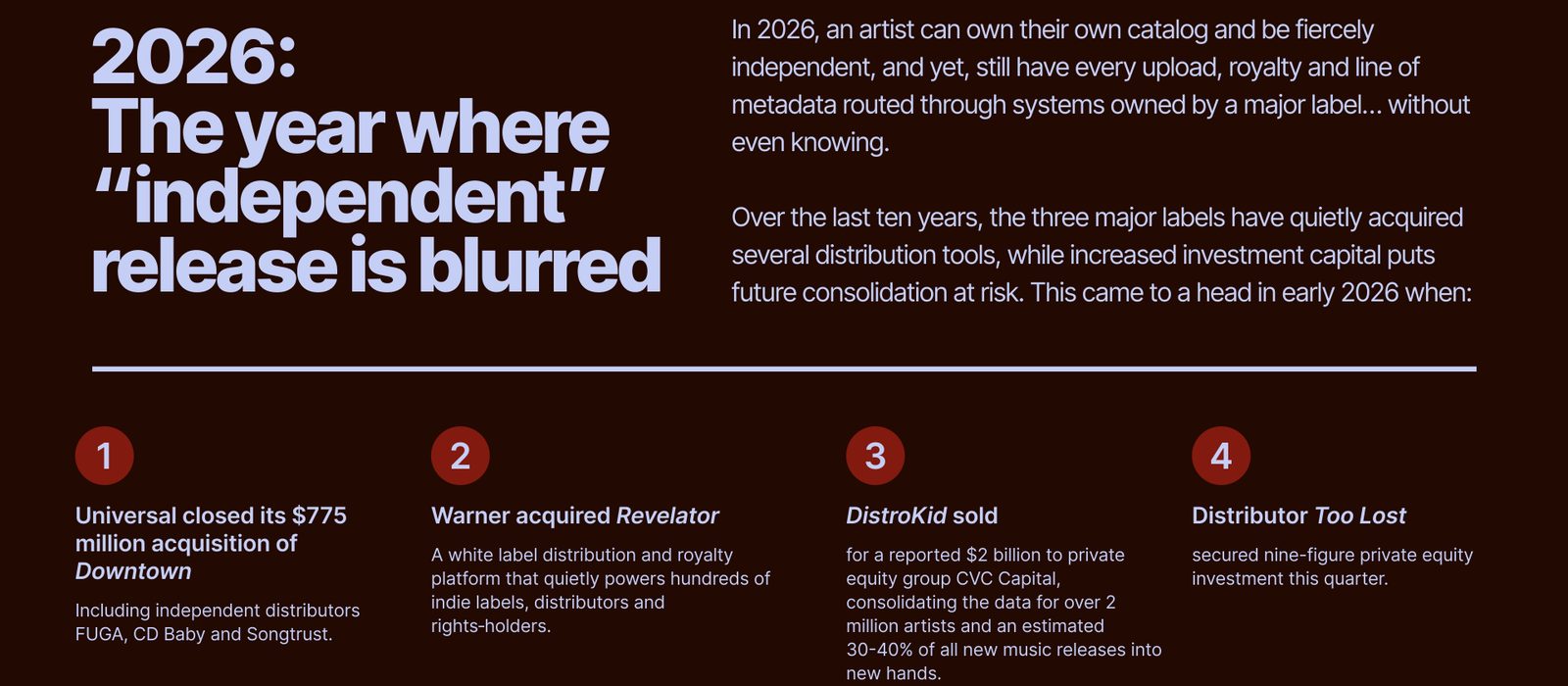
The AI music boom has winners, and a lot of them never make a song. The money is flowing to the companies that run the systems behind the music: distribution, rights data, and getting people paid.
Digital Music News founder Paul Resnikoff has a name for this moment: the “chaos economy.” Catalog deals, AI-generated output, and record-breaking trends are all firing at once, and the businesses that keep that chaos organized are emerging as the new class of big winners.
The ‘chaos economy’ behind the AI music boom
Open Digital Music News on any morning and the blitz of mega-deals, AI launches, and record-smashing numbers can feel relentless. On the ground, that means companies drowning in data overload and disconnected systems. The ones solving it are quietly getting rich.
Infrastructure has never been more critical, or more lucrative.
That’s the shift. When songs were scarce, the value sat with whoever owned the hits. Now that songs are close to infinite, the value moves to whoever can track, sort, and pay for all of them.
Why the money moved to infrastructure: Kobalt and Revelator
Look at where the big checks are going. Primary Wave’s multi-billion-dollar purchase of Kobalt handed Kobalt investor Francisco Partners an estimated $600 million-plus, a few years after it bought in. Tucked inside that deal are Kobalt properties like KOSIGN and AMRA, which handle indie publishing admin and digital collection.
Warner Music Group made a similar move, buying the indie distribution and rights platform Revelator. Revelator, led by Bruno Guez, has spent years solving distribution and payout problems for independent artists, and it leans on the payments firm Tipalti to handle a messy chain of global payouts and tax compliance.
Neither deal is about a star signing. Both are about owning the backend that moves the music and pays the bills, which has become the expensive, hard part of running a major.
The flood that infrastructure has to handle
The reason this got urgent is volume. Deezer was first to warn the industry about a wave of AI-generated tracks hitting streaming, and it now reports that more than half of its daily uploads are AI-generated.
That’s the flood the backend has to sort, tag, and pay out on. Some of it earns real money, too. A recent study put the top AI acts at millions in estimated streaming revenue, which means the rights and royalty plumbing now has to track machine-made tracks as carefully as human ones.
The $6 billion question: infrastructure for controlled AI music
Resnikoff frames the next move as a $6 billion question: how do these infrastructure plays get built for AI itself? The answer is starting to show up in walled gardens.
Spotify’s AI remixing concept and Udio’s licensed relaunch are both attempts to build controlled spaces where AI music gets made, tracked, and paid for inside the rules. The connective standards under those systems are where the next round of winners will be decided. Whoever builds the rails that credit rights holders inside AI tools sets the terms everyone else lives with.
The infrastructure independent artists can actually own
You can’t buy Kobalt. But the logic that’s driving these deals runs at your scale too.
The majors are paying billions to own systems that route other people’s audiences. Your version is smaller and cheaper, and you already have access to it: a direct line to the people who want what you make.
Frequently asked questions
What is the music industry's 'chaos economy'?
It's a term from Digital Music News founder Paul Resnikoff for the current music business, where catalog deals, AI-generated output, and record-breaking trends are all happening at once. His argument is that the money increasingly flows to the backend companies that keep that chaos organized, from distribution to rights tracking to royalty payouts.
Why is Warner Music Group buying infrastructure companies like Revelator?
Warner Music Group acquired Revelator, an indie-focused distribution and rights platform led by Bruno Guez, in 2026. Managing distribution, rights data, and mass payouts at scale has become one of the hardest parts of the business, so owning that backend helps a major service its roster faster. Revelator uses the payments firm Tipalti to handle global payouts and tax compliance.
What was the Primary Wave and Kobalt deal?
Primary Wave acquired music publisher and rights-administration company Kobalt in a multi-billion-dollar deal in 2026. Kobalt investor Francisco Partners is estimated to have made $600 million-plus on the sale, a few years after buying in. The deal also included Kobalt properties KOSIGN and AMRA, which handle indie publishing administration and digital collection.
How can independent artists compete in the AI music chaos economy?
The lesson from the big infrastructure deals is that value moves to whoever organizes the flood and owns the relationship with listeners. An independent artist can't buy a distribution platform, but they can own a direct fan audience through an email list and a real relationship with a few hundred to a thousand supporters. That direct channel is the one asset a stream flood can't bury.
About the author

Covering AI music tools, industry shifts, and news for music creators and professionals. Twice-weekly newsletter at aimusicpreneur.com.