The top 10 AI music artists earned an estimated $6.1 million. The database behind the ranking looks offline.
My stack My fav 6 tools for AI music after testing 70+
-
 ElevenMusic · Music generation
 -
 Moises · Stem separation
 -
 Controlla · Voice swap & cloning
 -
 Cryo Mix · Mixing + mastering
 -
 Neural Frames · Music videos
 -
 ONCE · Distribution
Some links are affiliate links — I earn a commission at no cost to you. Every tool here is one I run myself and truly believe in. This stack is proven.
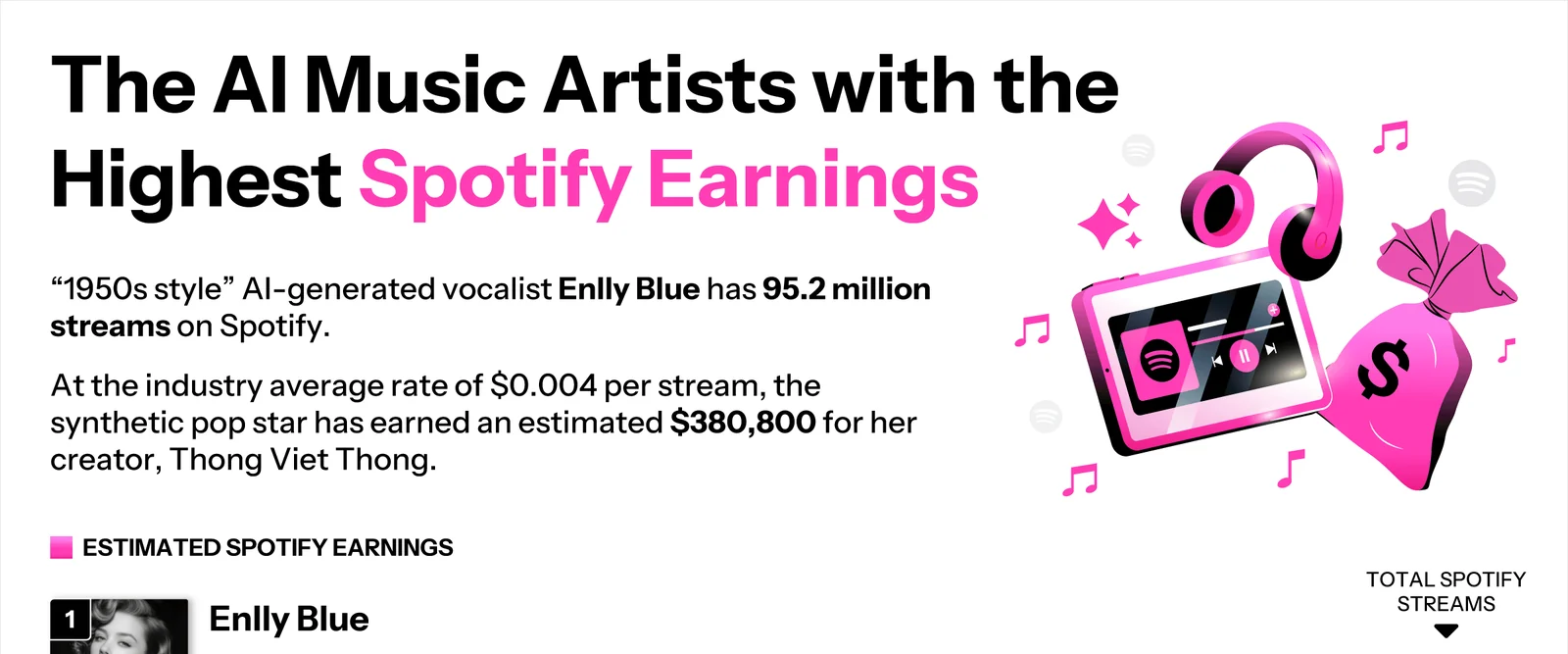
AI music artists are making real money, and now there’s a number on it. A new study from Kapwing, covered this week by MusicTech, estimates the 10 biggest AI acts have earned about $6.1 million between them, off more than 2.3 billion Spotify streams and YouTube views.
That figure is worth quoting. The list under it is the part I’d handle with care.
What the Kapwing study counted
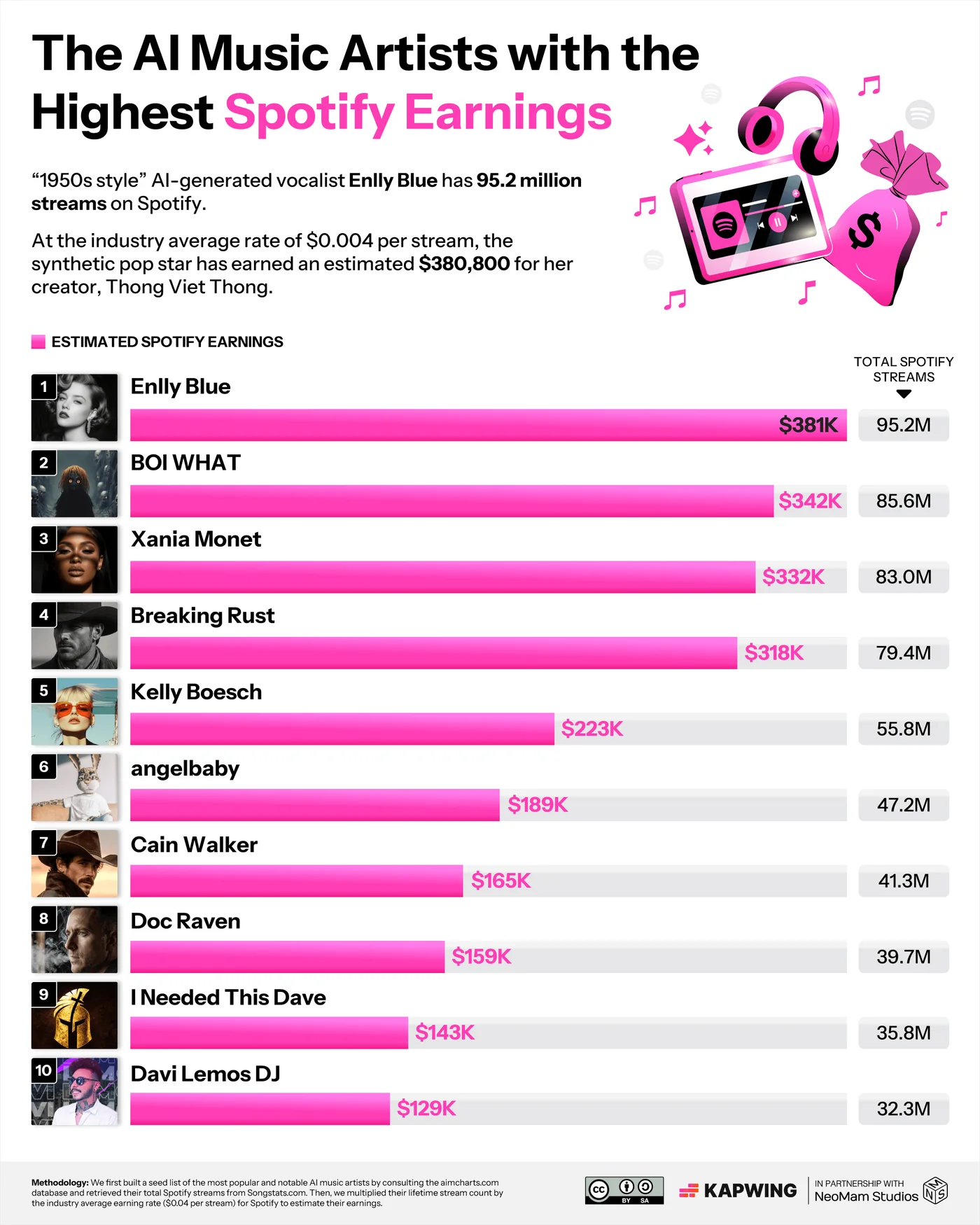
On Spotify, the top earner is Enlly Blue, a “1950s style” AI vocalist with an estimated $380,800 from 95.2 million streams. Behind her sit BOI WHAT ($342,400), Xania Monet ($332,000), and Breaking Rust ($317,600). Across the top 10, Spotify alone accounts for about $2.38 million from roughly 595 million streams.
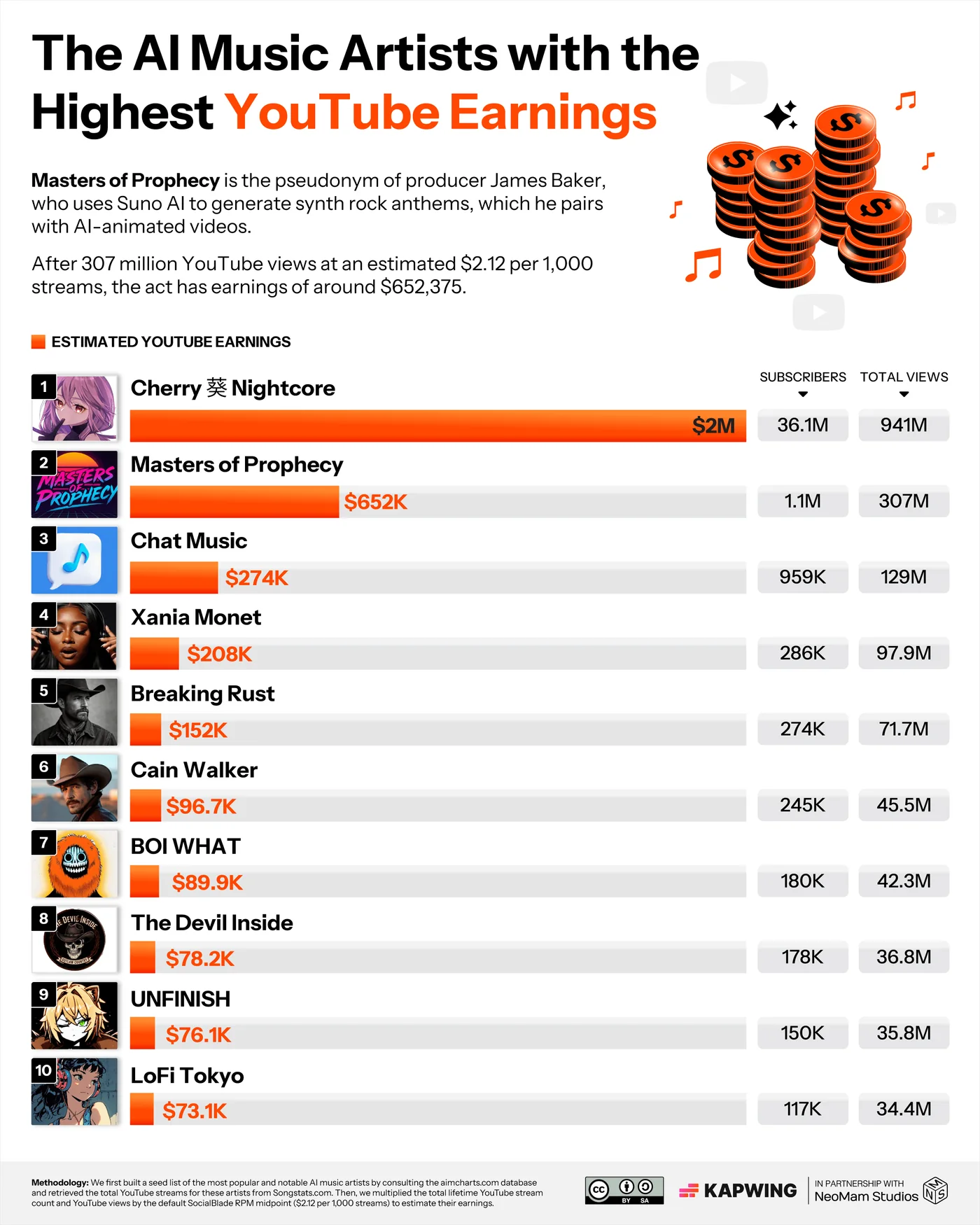
YouTube is where the biggest single number shows up. Cherry Nightcore, an anime-styled channel, sits at an estimated $2 million from 941 million views and 36.1 million subscribers. Masters of Prophecy, a synth rock act made with Suno, is second at $652,375.
The other leaderboards: followers, playlists, and chart entries
Earnings are one slice. The study also ranks reach, and the leaders change from list to list.
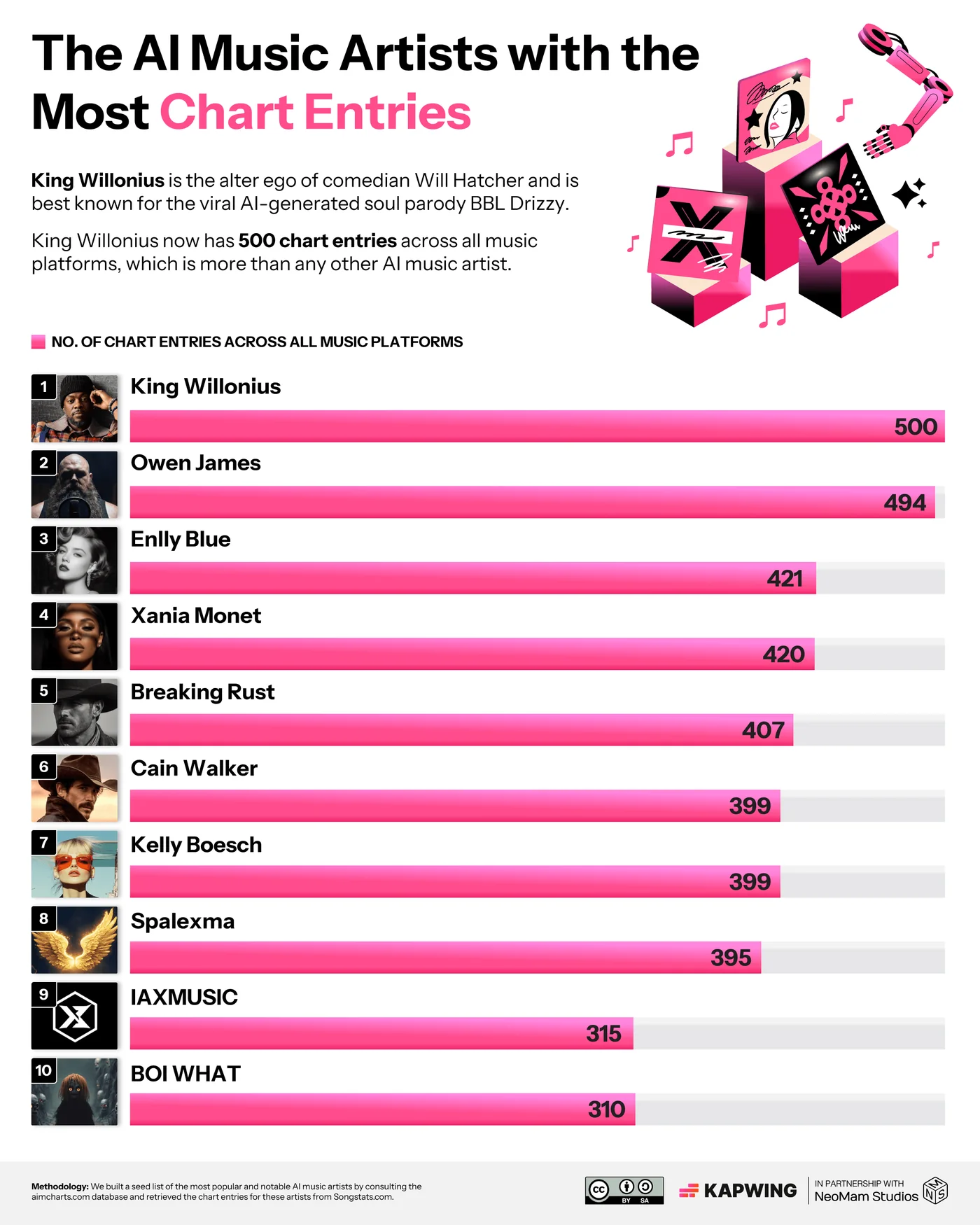
King Willonius, the AI alter ego of comedian Will Hatcher (best known for the viral parody “BBL Drizzy”), tops chart entries with 500 across all platforms.
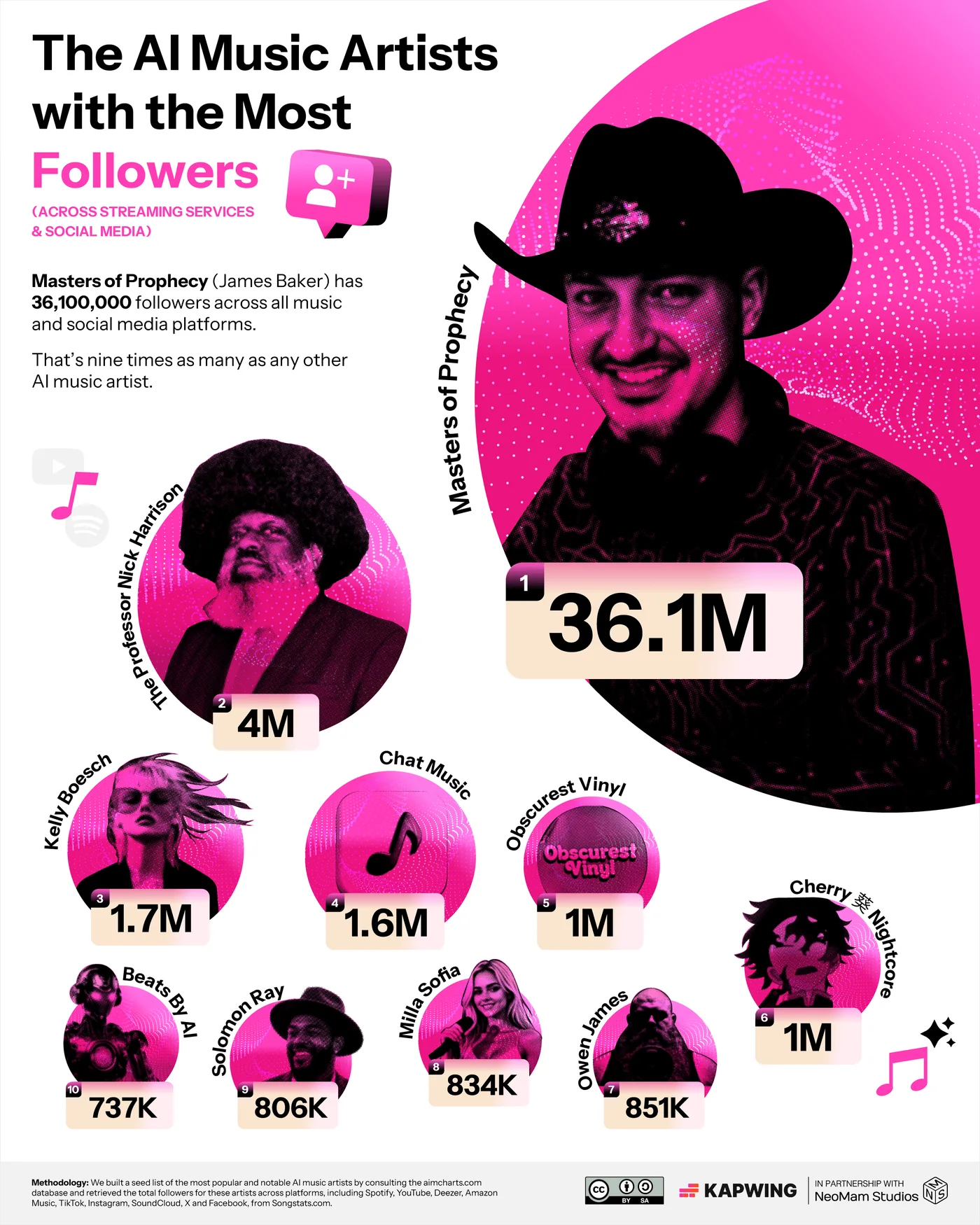
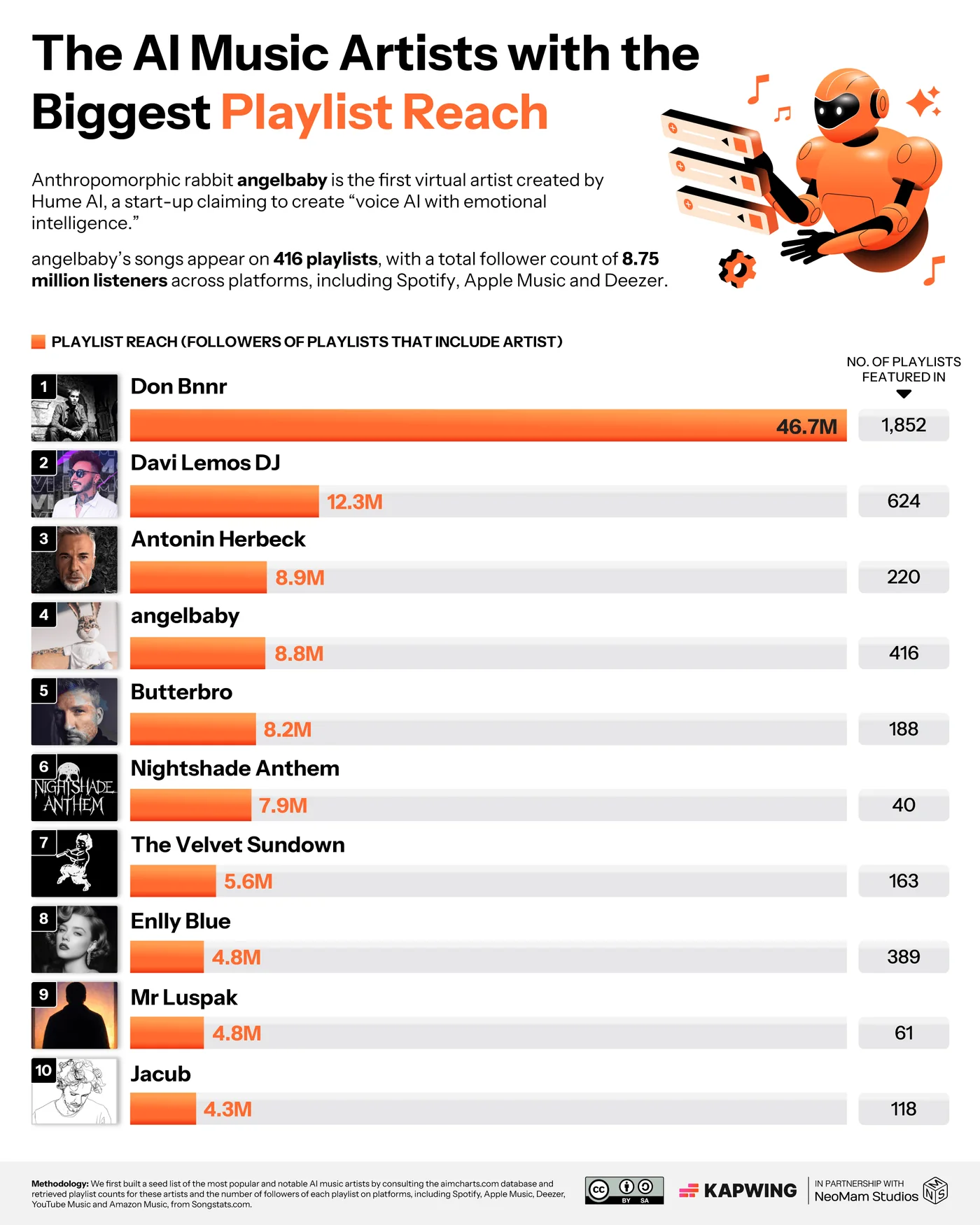
Masters of Prophecy leads followers with 36.1 million, about 9 times the next act. And producer Don Bnnr has the widest playlist reach, with tracks on 1,852 playlists that carry 46.7 million followers between them.
How Kapwing turned streams into dollars
The dollar figures are estimates, not statements from any artist or platform. Kapwing pulled stream and follower counts from Songstats, then applied flat rates: $0.004 per Spotify stream, and the SocialBlade midpoint of $2.12 per 1,000 YouTube views.
Those rates are blunt. Real Spotify payouts swing with country, plan, and rights splits, and the number you see is gross, before the distributor, the platform, and the taxman take their cut. Read $380,800 as a ceiling on the story, not a bank balance.
The context around it is solid, though. Deezer now reports that more than half of its daily uploads are AI-generated, and Suno told investors its users generate enough tracks to refill the Spotify catalog every two weeks. Money following that volume is the expected next step.
The database behind the ranking looks offline
Here’s my problem with the study. Kapwing built its seed of “notable AI acts” from a database called AiMCharts. When I went to check that source, aimcharts.com would not load for me.
I can’t say for certain what’s happening on their end. Maybe it’s a temporary outage, maybe the provider is down for good. Either way, the site the study leaned on to pick its names is not something a reader can open and verify today.
And I didn’t know much about AiMCharts to begin with. It’s not a name I hear often, and I can’t tell you who runs it, how it decides which acts count as “notable,” or how it tracks them. A study is only as strong as the source that feeds it, and this one rests on a source I can’t read and can’t open.
Why I lean on the SIQA charts instead
This is why my go-to reference is a chart whose method I can actually see. The SIQA AI music charts track thousands of AI creators every week across social platforms and the DSPs, with a submission system and a steady methodology behind them. Recurring chart acts include Olivia B. Moore, Thompsxn Therapy, and angelbaby, plus accomplished names working with AI like Imogen Heap and Eric Bellinger.
I report on the SIQA charts every week, and the picture there is fuller than any single snapshot. Its Q1 2026 intelligence report is a good place to see the method at work.
(Disclosure: I sit on SIQA’s Creative Advisory Council. I don’t run it, and no one paid me to write this.)
Frequently asked questions
How much did the top 10 AI music artists earn in the 2026 Kapwing study?
Kapwing estimates the 10 biggest AI music artists made around $6.1 million in total from more than 2.3 billion Spotify streams and YouTube views. Spotify accounted for roughly $2.38 million of that, from about 595 million streams across the top 10. All of these are estimates, not reported payouts.
How did Kapwing calculate the AI music artist earnings?
Kapwing built a seed list of notable AI acts from the AiMCharts database, then pulled stream, follower, and playlist figures from Songstats. It multiplied Spotify streams by the industry-average $0.004 per stream and YouTube views by the SocialBlade midpoint of $2.12 per 1,000. The results are gross estimates before platform cuts, distribution fees, and taxes.
What is AiMCharts, the database behind the Kapwing study?
AiMCharts is the database Kapwing used as its seed list to decide which AI artists to measure. There is little public information about who runs it or how it selects and tracks AI music, and when I went to check it, aimcharts.com would not load. Because the rankings depend on that source, they are hard to verify.
How reliable is the Kapwing AI music earnings study?
The dollar figures are reasonable estimates, but they rest on a seed list from AiMCharts, a source that is hard to learn about and currently offline. Without being able to see how the artists were chosen, treat the study as a useful floor for AI music earnings rather than a definitive ranking.
About the author

Covering AI music tools, industry shifts, and news for music creators and professionals. Twice-weekly newsletter at aimusicpreneur.com.