Your indie distributor probably isn't indie any more: 4 deals that moved the pipes in 2026
My stack My fav 6 tools for AI music after testing 70+
-
 ElevenMusic · Music generation
 -
 Moises · Stem separation
 -
 Controlla · Voice swap & cloning
 -
 Cryo Mix · Mixing + mastering
 -
 Neural Frames · Music videos
 -
 ONCE · Distribution
Some links are affiliate links — I earn a commission at no cost to you. Every tool here is one I run myself and truly believe in. This stack is proven.
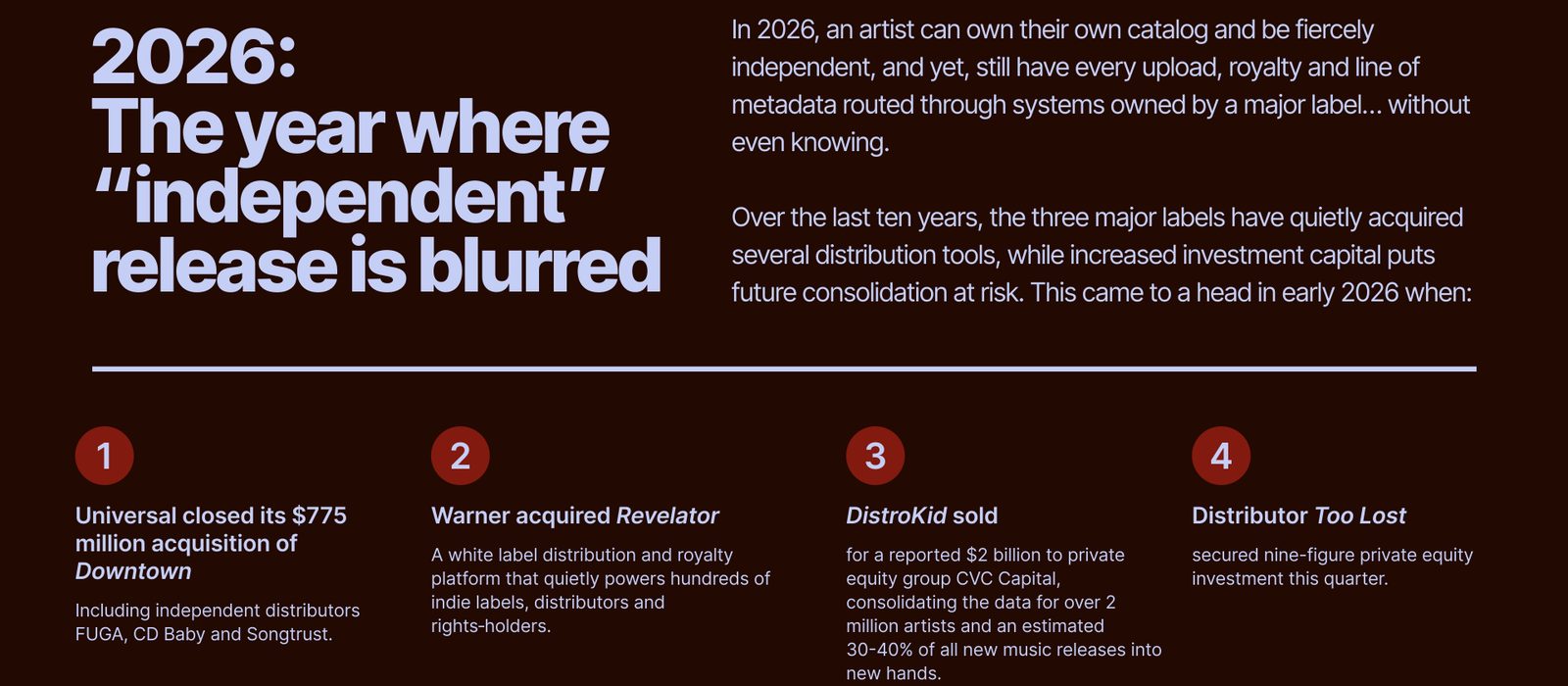
You turned down the label deal. You kept your masters. You call yourself independent, and you mean it. Then you upload through CD Baby, which Universal now owns, and your publishing admin runs on Songtrust, which Universal also owns, and every line of your royalty statement passes through a major label’s servers on the way to you.
That’s the opening argument of the Independent Music 2026 report from Stvdio and Secretly Distribution, and it names the four deals that made 2026 the year the word independent stopped describing the pipes. Here are the 4 deals, what each one actually bought, and what’s left that nobody owns yet.
The 4 deals that put independent releases on somebody else’s rails
A distributor is the company that puts your release on Spotify and Apple Music and collects the money that comes back. These four deals changed who owns that job.
1. Universal Closed Its $775 Million Acquisition of Downtown
Universal paid $775 million for Downtown, and Downtown came with FUGA, CD Baby and Songtrust.
That’s three of the most-used routes to market for independent artists moving into one major in a single transaction. CD Baby is a self-serve distributor. FUGA is the distribution and services layer under a long list of indie labels. Songtrust is publishing administration, meaning the company that collects your songwriting royalties worldwide.
The report frames it as the culmination of a 20-year pattern, and its map of that pattern is worth a minute:
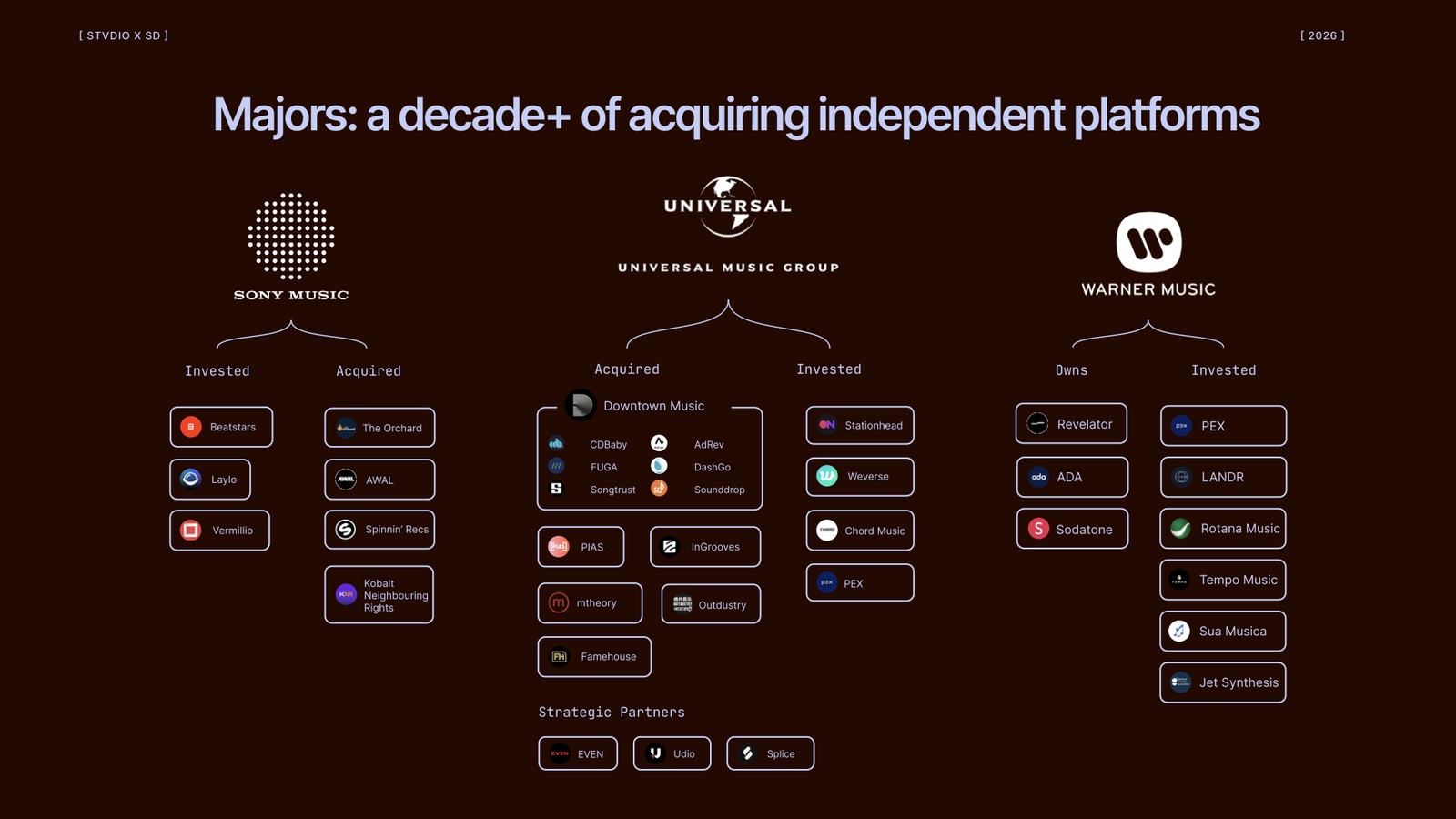
Sony took The Orchard in 2015 and paid $430 million for AWAL in 2021. Universal invested in Ingrooves in 2006, bought it outright in 2019, and took full ownership of PIAS in 2024. Downtown was the next step, not a change of direction.
2. Warner Acquired Revelator, the Platform Under Hundreds of Indie Labels
Warner bought Revelator, which most artists have never heard of, and that is the point.
Revelator is white label software. A distributor or indie label runs its uploads, rights management and royalty accounting on it, and puts its own name on the front. The report says hundreds of indie labels, distributors and rights holders sit on top of it.
Owning Revelator gives Warner the back office of a market it doesn’t otherwise control. I covered the same move in the chaos economy piece earlier this year: as AI floods the pipes, the money moves to whoever runs them.
3. DistroKid Sold to CVC Capital at a Reported $2 Billion
DistroKid, the biggest self-serve distributor on the planet, confirmed a sale to private equity firm CVC Capital Partners at a reported $2 billion valuation.
Not a major label this time, but the report treats it as the same problem from a different angle. DistroKid holds data on more than 2 million artists and, by the report’s estimate, carries 30% to 40% of every new release. Private equity buys to sell, so whoever buys it next is an open question. I wrote about what CVC’s stake means for AI uploads when it was announced.
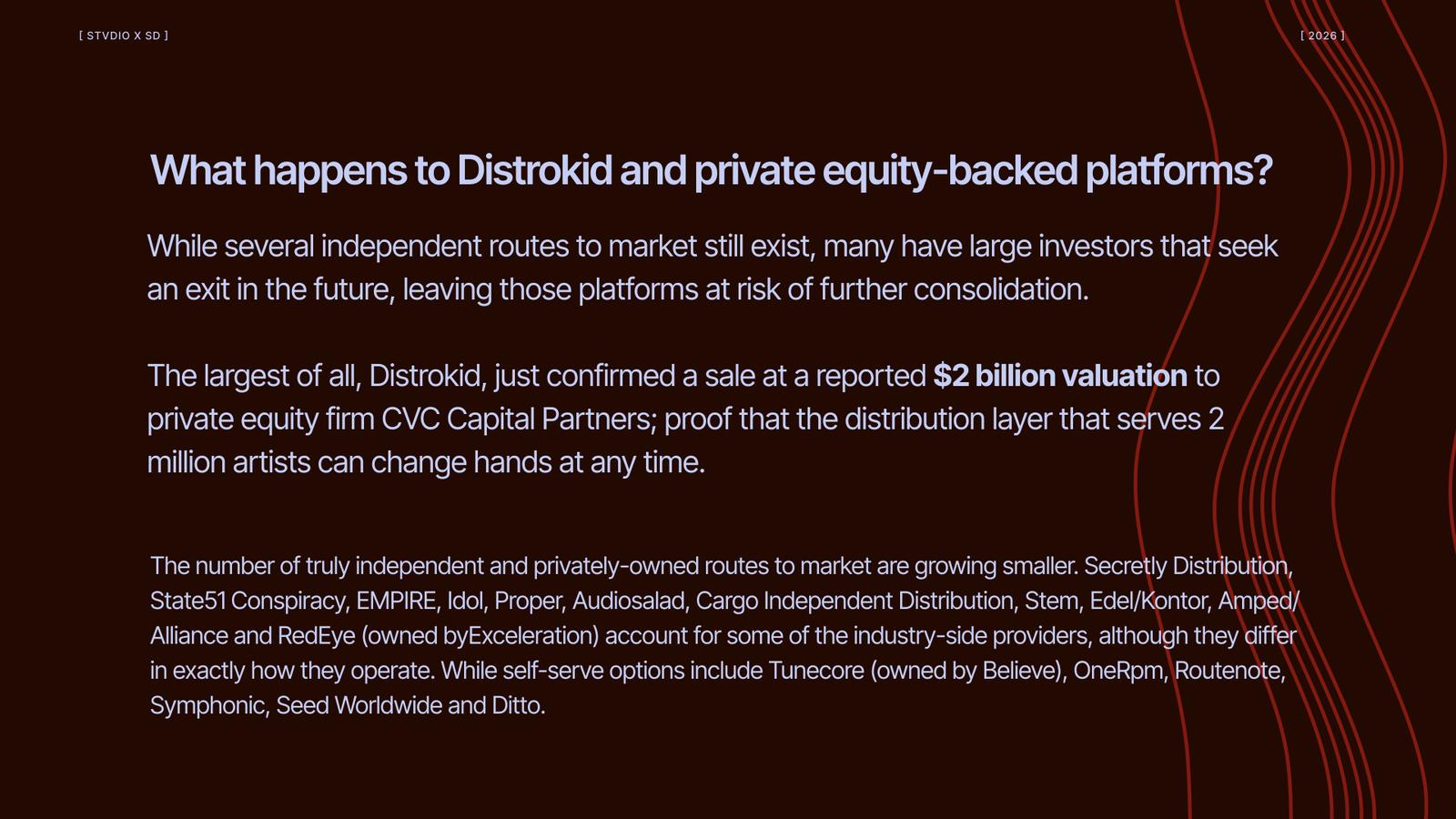
Here’s what the report says the sale proves:
- The distribution layer serving 2 million artists can change hands at any time
- Platforms with big investors are one exit away from consolidation
- The list of truly independent, privately owned routes to market keeps getting shorter
4. Too Lost Took Nine-Figure Private Equity Money
Distributor Too Lost secured a nine-figure private equity investment in the same quarter.
The report gives no further detail, and neither will I. What matters is the pattern it completes: in one quarter, one major bought the biggest indie services group, another bought the plumbing, the largest self-serve distributor went to private equity, and a fast-growing challenger took private equity money too.
The majors and other large holders of capital are deepening their power over the infrastructure that increasingly determines how music is made, circulated, and paid for.
Why the majors want the pipes and not just the catalog
The report gives four reasons, and the third is the one that should keep you up.
The first is leverage. Early streaming deals favoured the majors because Spotify needed catalog and they had it. As the streaming platforms got stronger, that leverage faded, and owning the pipes that carry 30% to 40% of independent releases gets it back.
The second is data. The back office of the independent market, meaning dashboards, royalty systems and analytics, shows the majors what’s happening across hundreds of thousands of artists they don’t sign.
The third is AI. Whoever owns the distribution rails owns the metadata standards, the attribution systems, the opt-ins and the payment rails that AI licensing runs on. The report calls these strategic chokepoints, and notes Warner’s Suno settlement already gives its distribution engine an edge over Universal, Sony and the indies represented by Merlin.
The fourth is the stock price. Platform revenue is recurring and predictable. Hit records are not.
What’s still independent, and what to check on your own release
The report lists the industry-side distributors still privately owned: Secretly Distribution, State51 Conspiracy, EMPIRE, Idol, Proper, Audiosalad, Cargo Independent Distribution, Stem, Edel/Kontor, Amped/Alliance and RedEye. On the self-serve side it names TuneCore (owned by Believe), OneRPM, RouteNote, Symphonic, Seed Worldwide and Ditto.
Three things to check this week:
- Who owns your distributor today, and who owns the company it runs on
- Whether your publishing admin and your distributor now sit inside the same major
- Where your fan data lives, because that’s the one layer none of these deals touched
Quick recap of the 4 deals:
- Universal took Downtown, and with it FUGA, CD Baby and Songtrust, for $775 million
- Warner took Revelator, the software under hundreds of indie labels
- DistroKid went to CVC Capital at a reported $2 billion
- Too Lost took nine-figure private equity money
The report’s closing line on this chapter is the one to remember. Independence in 2026 is no longer about who owns the copyright. It’s about who owns the infrastructure, the tools and the leverage. So which pipe is your next release going through?
Frequently asked questions
Which independent distributors does Universal Music Group own after the Downtown deal?
The $775 million Downtown acquisition, which closed in early 2026, brought FUGA, CD Baby and Songtrust into Universal, along with AdRev, DashGo and Soundrop. Universal already owned Ingrooves, acquired in full in 2019, and took full ownership of PIAS in 2024.
What is Revelator and why did Warner Music Group buy it?
Revelator is a white label distribution, rights management and royalty accounting platform. Hundreds of indie labels and distributors run their back office on it without their artists ever seeing the Revelator name. Owning it gives Warner the royalty data and the payment rails underneath a large slice of the independent market.
How much of all new music releases does DistroKid handle?
The Independent Music 2026 report estimates DistroKid carries 30% to 40% of all new music releases and holds data on more than 2 million artists. Its reported $2 billion sale to CVC Capital Partners moved that whole layer to a private equity owner.
Which music distributors are still independently owned in 2026?
The Independent Music 2026 report lists Secretly Distribution, State51 Conspiracy, EMPIRE, Idol, Proper, Audiosalad, Cargo Independent Distribution, Stem, Edel/Kontor, Amped/Alliance and RedEye on the industry side, and TuneCore (owned by Believe), OneRPM, RouteNote, Symphonic, Seed Worldwide and Ditto among self-serve options. The report notes they differ in how they operate and that several have investors who will eventually want an exit.
Why are the major labels buying independent distribution companies?
The Independent Music 2026 report gives four reasons: leverage over streaming platforms now that catalog alone buys less, visibility into royalty data and deal terms across the wider market, control of the metadata and payment rails that AI licensing will run on, and predictable platform revenue to show public market investors.
About the author

Covering AI music tools, industry shifts, and news for music creators and professionals. Twice-weekly newsletter at aimusicpreneur.com.