SOCAN partners with Musical AI to build opt-in AI attribution for 200,000 music creators
My stack My fav 6 tools for AI music after testing 70+
-
 ElevenMusic · Music generation
 -
 Moises · Stem separation
 -
 Controlla · Voice swap & cloning
 -
 Cryo Mix · Mixing + mastering
 -
 Neural Frames · Music videos
 -
 ONCE · Distribution
Some links are affiliate links — I earn a commission at no cost to you. Every tool here is one I run myself and truly believe in. This stack is proven.
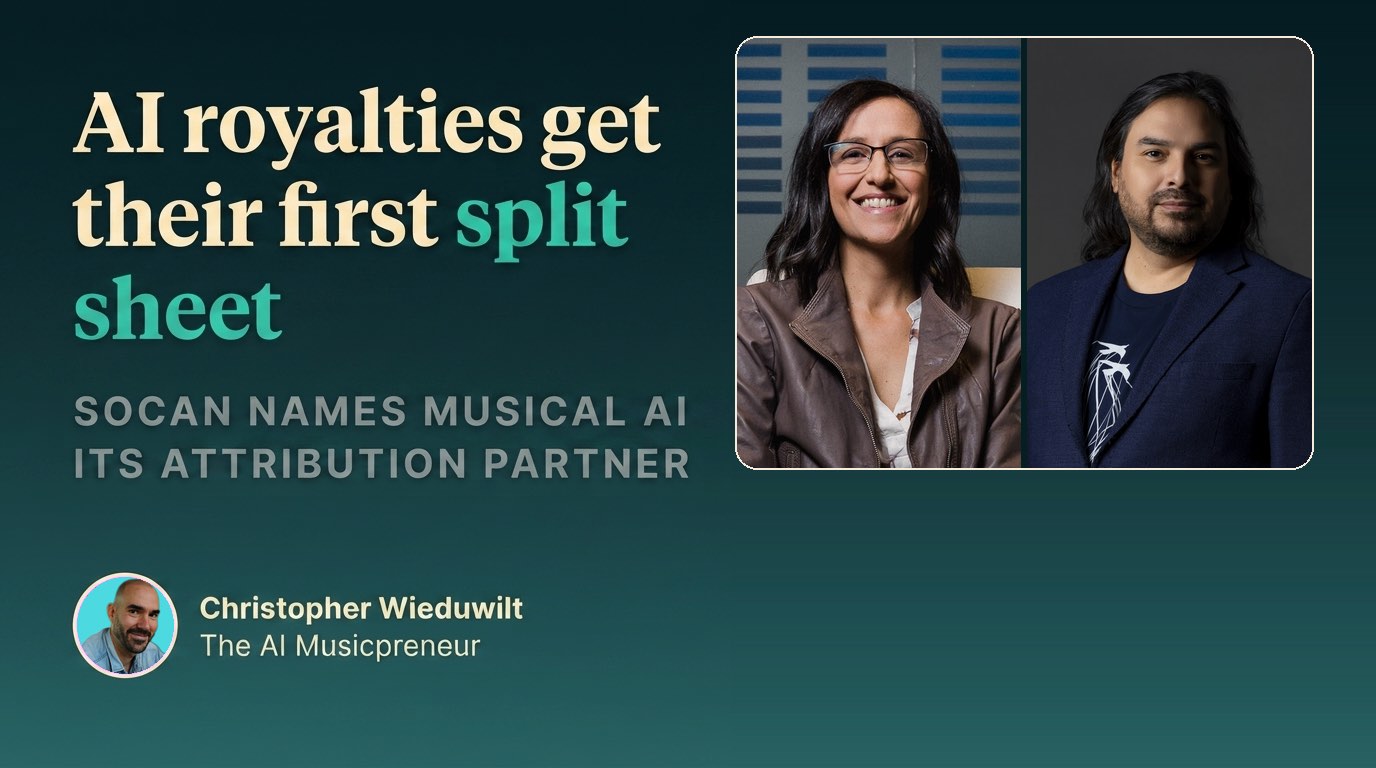
SOCAN named Musical AI an approved technology partner on July 21, 2026. Canada’s largest music rights organization and the Canadian attribution company will build consent and attribution infrastructure so songwriters get credit and payment when their music shapes an AI-generated output.
The deal rests on 2 principles. AI use of members’ work happens on an opt-in basis only. And when a member’s song influences an AI output, the member gets credited and paid.
What SOCAN’s approved-partner deal with Musical AI covers
SOCAN will work with Musical AI on guidelines for attribution technology in Canada, with Musical AI recognized as the approved partner for attribution services. The stated goal: use those capabilities to compensate members when AI outputs draw on their work.
Musical AI’s system analyzes an AI-generated track and traces which source material influenced it, down to specific percentages. It assesses sound recordings and musical compositions separately, then produces reports built like a split sheet between co-writers.
“This collaboration with Musical AI establishes a foundation for attribution and compensation, to ensure that music creators are paid when their music is used by AI,” said Jennifer Brown, CEO of SOCAN.
The first step is consent. The next step is attribution that can show how music contributes to an output and how value should flow to artists and songwriters.
Consent management comes next on the roadmap: tools designed to record each member’s opt-in choices in a structured way, at catalog scale.
Who pays songwriters when an AI-generated track plays in public?
Here’s the gap this deal starts to close. A song plays in a coffee shop where 100 people hear it, or before a band takes the stage in front of 5,000. A PRO like SOCAN collects license fees for those public performances and routes them to the songwriter. When an AI-generated track built on member catalogs plays in the same room, the industry’s answer so far has been “we don’t know yet.”
Musical AI has spent 2 years wiring itself into this problem. The company raised $4.5M in January 2026 to expand its attribution platform. Its Beatoven partnership produced a fully licensed AI song generator trained on 3M+ songs, and Pro Sound Effects runs licensed AI training through the same platform.
SOCAN has been moving too. Together with ASCAP and BMI, it started accepting AI-assisted works for registration in October 2025. The Musical AI deal goes further, because it points at the money.
Ottawa is watching with intent. Evan Solomon, Canada’s Minister of Artificial Intelligence and Digital Innovation, backed the partnership publicly and called it “responsible Canadian innovation.” Two Canadian companies defining the AI royalty pattern is now government-endorsed industrial policy.
Neither company named royalty rates, payout mechanics, or a launch date. The pieces to watch: whether attribution reports reach member statements, and which PRO signs a deal like this next.
Frequently asked questions
What did SOCAN and Musical AI announce on July 21, 2026?
SOCAN, Canada's largest music rights organization, named Musical AI an approved technology partner for attribution services. The two Canadian companies will develop consent, attribution, and reporting infrastructure so SOCAN's songwriter, composer, and publisher members control how their works are used in AI and get compensated for it.
How does Musical AI's attribution technology work?
Musical AI analyzes an AI-generated output and traces which source material influenced it, down to specific percentages. It assesses sound recordings and musical compositions separately and produces reports comparable to a split sheet between co-writers, which can support licensing and compensation.
Does the SOCAN and Musical AI partnership pay songwriters for AI music now?
No. The partnership defines the framework first, opt-in consent and attribution reporting. Neither company has announced royalty rates, payout mechanics, or a launch date for member-facing tools.
Why did the Canadian government back the SOCAN and Musical AI partnership?
Evan Solomon, Canada's Minister of Artificial Intelligence and Digital Innovation, called the deal responsible Canadian innovation. The government frames it as stewardship over Canadian music and creative economic infrastructure as AI reshapes how music gets made and monetized.
About the author

Covering AI music tools, industry shifts, and news for music creators and professionals. Twice-weekly newsletter at aimusicpreneur.com.