Suno powers 92.8% of AI tracks that reach streaming, and its share is still growing
My stack My fav 6 tools for AI music after testing 70+
-
 ElevenMusic · Music generation
 -
 Moises · Stem separation
 -
 Controlla · Voice swap & cloning
 -
 Cryo Mix · Mixing + mastering
 -
 Neural Frames · Music videos
 -
 ONCE · Distribution
Some links are affiliate links — I earn a commission at no cost to you. Every tool here is one I run myself and truly believe in. This stack is proven.
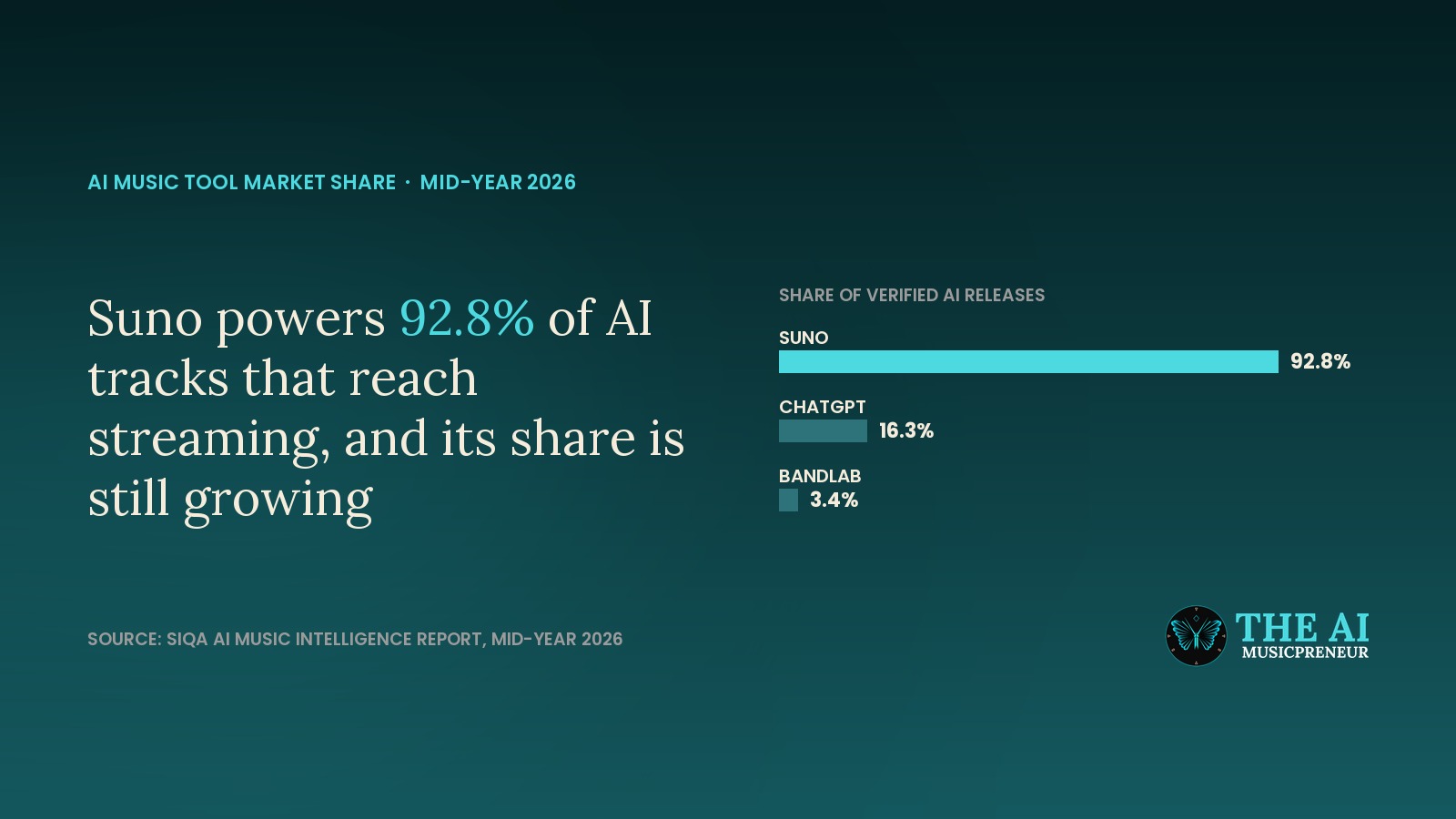
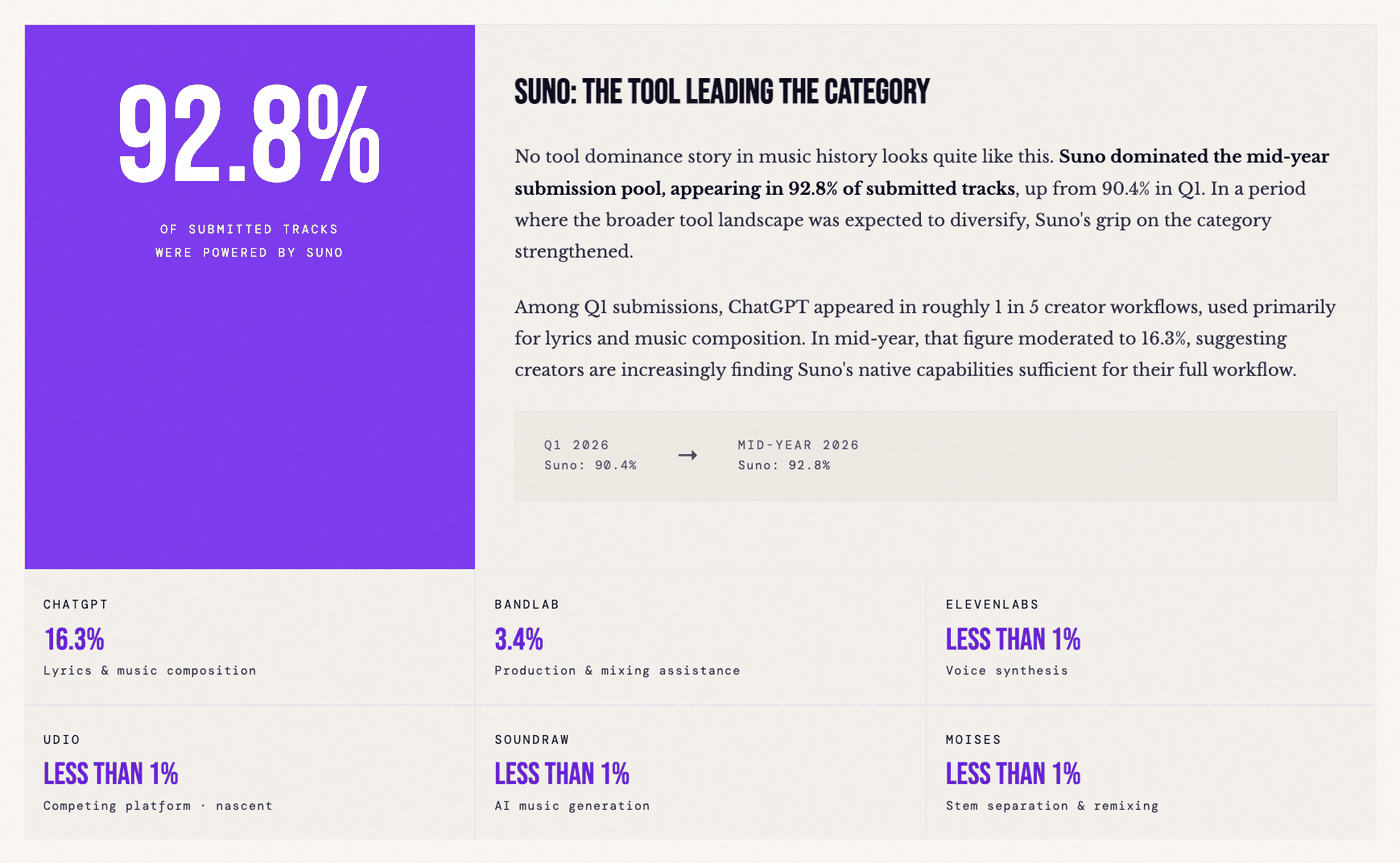
Suno made 92.8% of the AI music that reached streaming services between April and August 2026, according to the Sonic Intelligence Academy’s Mid-Year 2026 report. In the Q1 edition the figure was 90.4%. Everyone expected the tool field to spread out this year. It got tighter.
The report covers 1,743 verified releases from 886 artists in 54 countries. Every track was commercially distributed and every tool credit was disclosed by the creator who submitted it.
What Suno’s 92.8% share actually measures
SIQA’s pool is not all AI music. It is AI music that got released, went through a distributor, and was submitted to a chart. That distinction matters, and it cuts in Suno’s favour rather than against it.
My read goes one step past what SIQA prints. If 92.8% of AI music that reaches Spotify and Apple Music came from one tool, then roughly 9 in 10 AI tracks on the streaming services you release to are probably Suno output. SIQA does not make that claim and I can’t verify it against platform data. Nothing else in the report points anywhere else.
Why ChatGPT’s share of AI music workflows fell to 16.3%
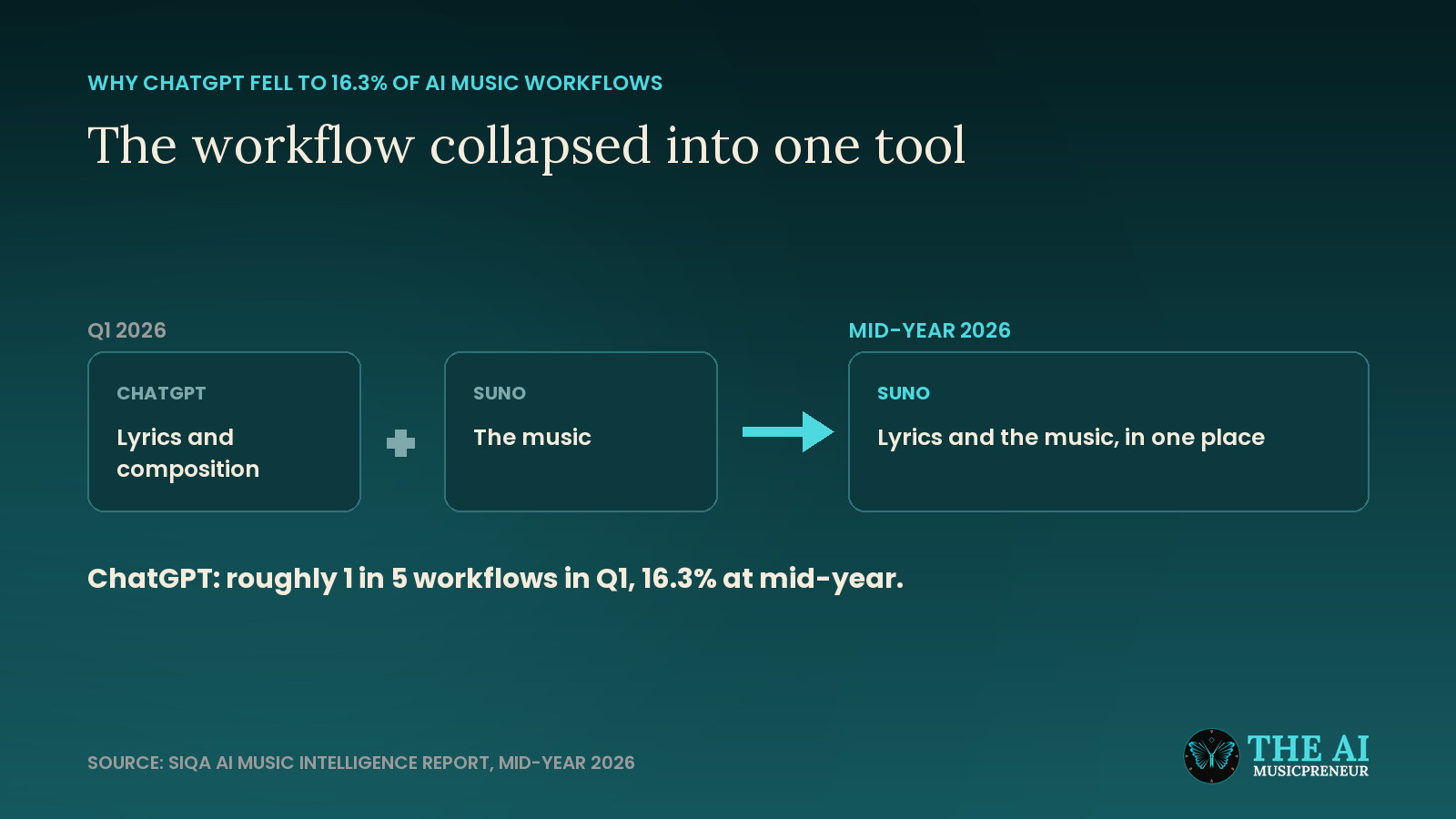
ChatGPT is the only other tool with a real presence, at 16.3% of workflows, used mostly for lyrics and composition. In Q1 it sat at roughly 1 in 5.
SIQA reads that drop as creators finding Suno’s own lyric tools good enough to stop switching apps. That tracks with what I see when I run these tools: the fewer windows a workflow needs, the more likely someone finishes a song.
Everything else is a rounding error. BandLab appears in 3.4% of tracks for production and mixing help. ElevenLabs, Udio, Soundraw and Moises each sit below 1%.
Udio at under 1% is the number I’d look at hardest. Its walled-garden policy stopped users from downloading and monetising what they made, and a dataset built on commercial releases cannot see a tool whose output never reaches a distributor. A restriction on export reads, in data like this, as absence.
What one tool at 92.8% means for the rest of the music industry
When a single company makes 9 in 10 releases in a category, its product decisions stop being product news and become supply news for everyone downstream.
Three consequences follow, and none of them are hypothetical:
- Every lawsuit against Suno is a lawsuit against most AI releases. The Munich GEMA ruling and the ongoing US cases land on the tool behind almost the whole category, not on one vendor among many.
- Suno’s licensing deals set the terms. Its agreements with Warner, BMG and Believe decide what a licensed AI track even looks like, because there is no second tool at scale to set a different standard.
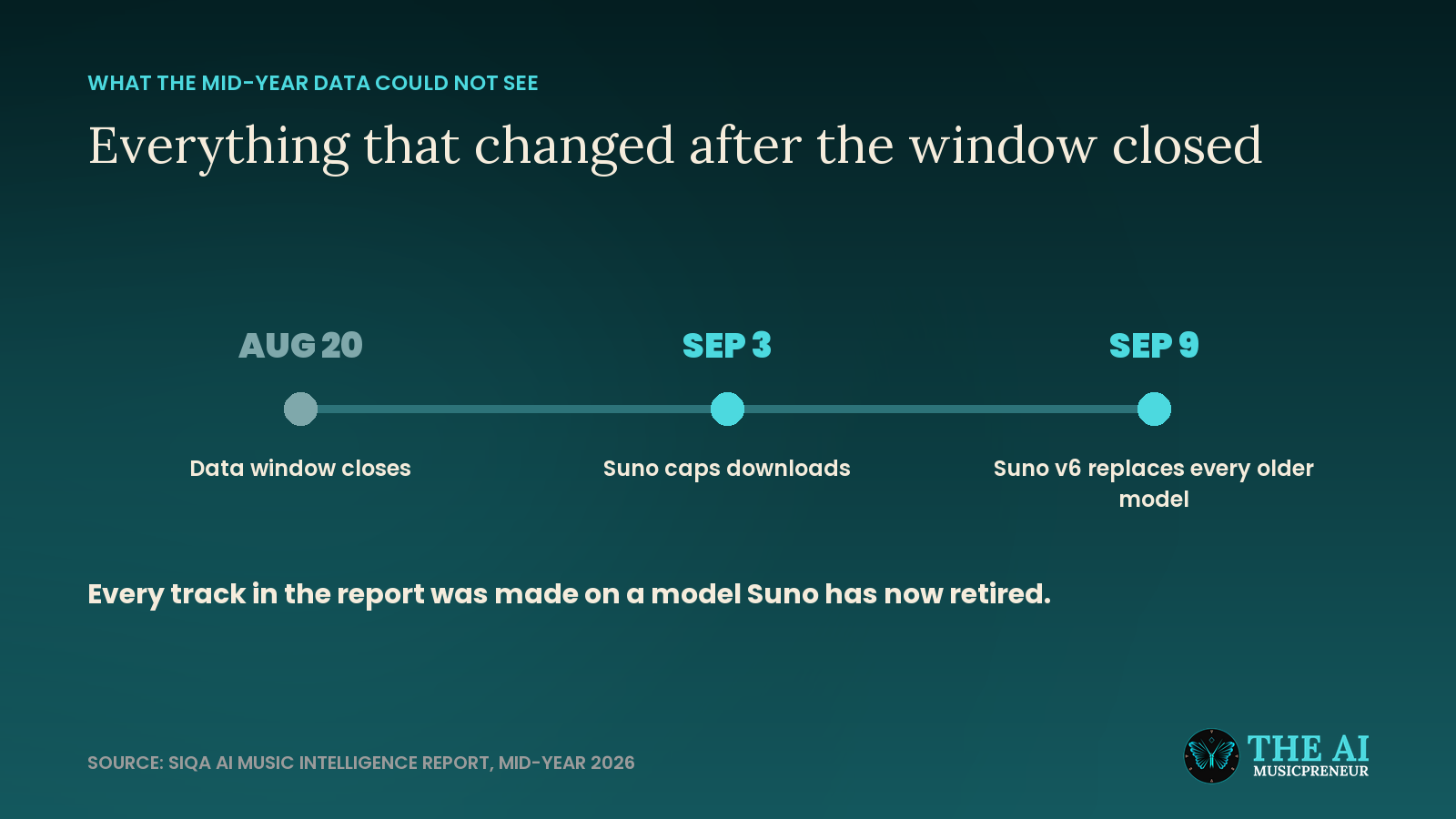
- A pricing or policy change moves the whole market. Suno capped downloads on September 3 and retired every older model on September 9. Both changes hit most AI releases at once.
What the next SIQA report will show about Suno v6
The window closed on August 20, so none of this reflects Suno v6, which went live on September 9 and retired v4.5, v5 and v5.5 on the same day. It also predates the download caps Suno introduced 6 days earlier.
Both changes give the full-year report something to measure. Download caps put a ceiling on how many finished tracks a paying user can actually release, and a release cap is the one thing that could move a submission share.
If you release music made with AI, the practical read is narrow. You are almost certainly building on one vendor, and that vendor’s policy changes reach you before any regulator does. I’d watch Suno’s terms page the way you’d watch a distributor’s, because for most people releasing AI music this year, it functions as one.
Frequently asked questions
Why did Suno's share of AI music grow between SIQA's Q1 and Mid-Year 2026 reports?
SIQA expected the tool field to spread out and it concentrated instead, moving from 90.4% to 92.8% of verified releases. The report points to creators finding Suno's own lyric and composition tools sufficient for a full workflow, which also explains ChatGPT falling from roughly 1 in 5 workflows to 16.3%. SIQA does not identify a single cause.
Which AI music tools does SIQA's Mid-Year 2026 report track besides Suno?
The report names ChatGPT at 16.3% of workflows, used mainly for lyrics and composition, and BandLab at 3.4% for production and mixing help. ElevenLabs, Udio, Soundraw and Moises each appear in less than 1% of submitted tracks. Percentages exceed 100% because one track often involves more than one tool.
Does SIQA's 92.8% Suno figure include Suno v6?
No. The data window ran from April 1 to August 20, 2026, and Suno v6, v6-wild and v6-mini launched on September 9, 2026. Every track in the pool was made on v4.5, v5 or v5.5, all of which Suno retired at the v6 launch. The full-year report will be the first to cover v6.
Why does Udio appear in less than 1% of SIQA's mid-year AI music data?
SIQA only counts commercially released tracks with distributor data. Udio's walled-garden policy restricted users from downloading, owning and monetising their output, so Udio tracks largely could not be released through a distributor during this period. A chart built on commercial releases cannot see a tool whose output does not reach streaming services.
About the author

Covering AI music tools, industry shifts, and news for music creators and professionals. Twice-weekly newsletter at aimusicpreneur.com.