Loudly launches an MCP server with 42 tools, so Claude and ChatGPT can now mix and master your tracks

Black Friday deal · ends Nov 30 My #1 AI music video tool is up to 50% off until Nov 30
Music videos made with Neural Frames
- 50% off when you go yearly
- 25% off monthly plans and credit top-ups
Back to full price after Nov 30. Affiliate link: I earn a commission at no cost to you.
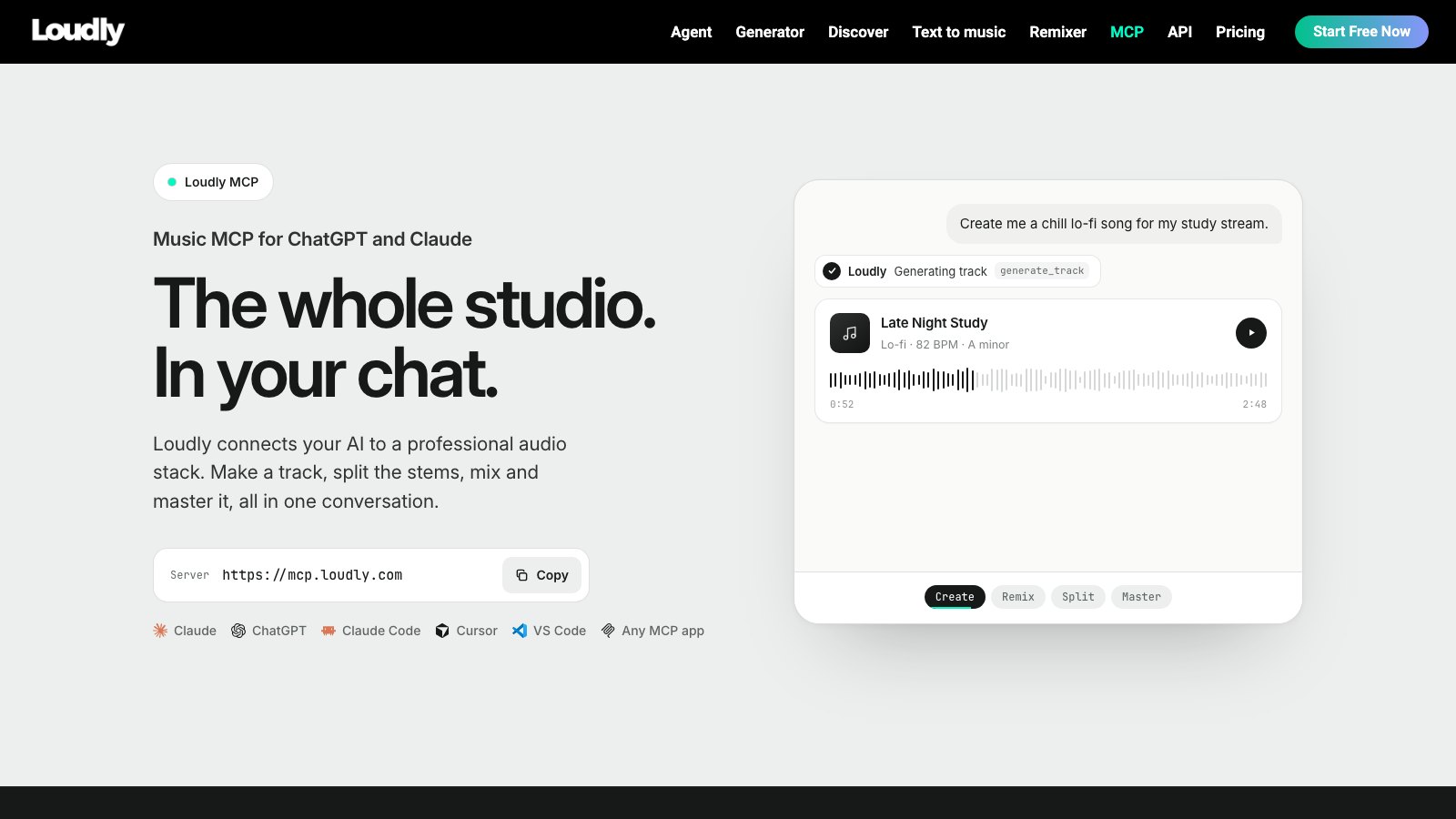
Loudly launched Loudly MCP on November 26, 2026, a music MCP server with 42 tools that plugs Loudly’s audio engine into Claude, ChatGPT, Claude Code, Cursor and VS Code. You paste one URL, sign in, and your AI can analyse a song, split it into stems, mix it, master it and hand you a WAV in the same chat. It needs a paid Loudly plan from $10 a month, and it deletes your files after 2 days unless you export them.
Co-founder and CEO Rory Kenny announced it on LinkedIn with one prompt: make 10 techno club versions of a track at 126 BPM in A minor, keep the 3 with the most dynamic energy, give each one 2 stem-mix variations and master them to your loudness and true-peak targets. That’s 6 masters back in the chat, each with a reason for the pick.
One caveat: I haven’t run Loudly MCP myself yet, so everything below comes from Loudly’s launch page, its setup docs and Kenny’s post.
That's when it hit me: the smartest AI models in the world had never really heard a song. Now they can.
He wrote that after asking ChatGPT for feedback on a track he’d spent months on, and getting an answer it made up from the title. That’s why the first tool in the chain listens.
What Loudly MCP does: 42 tools from SongDNA analysis to a mastered WAV
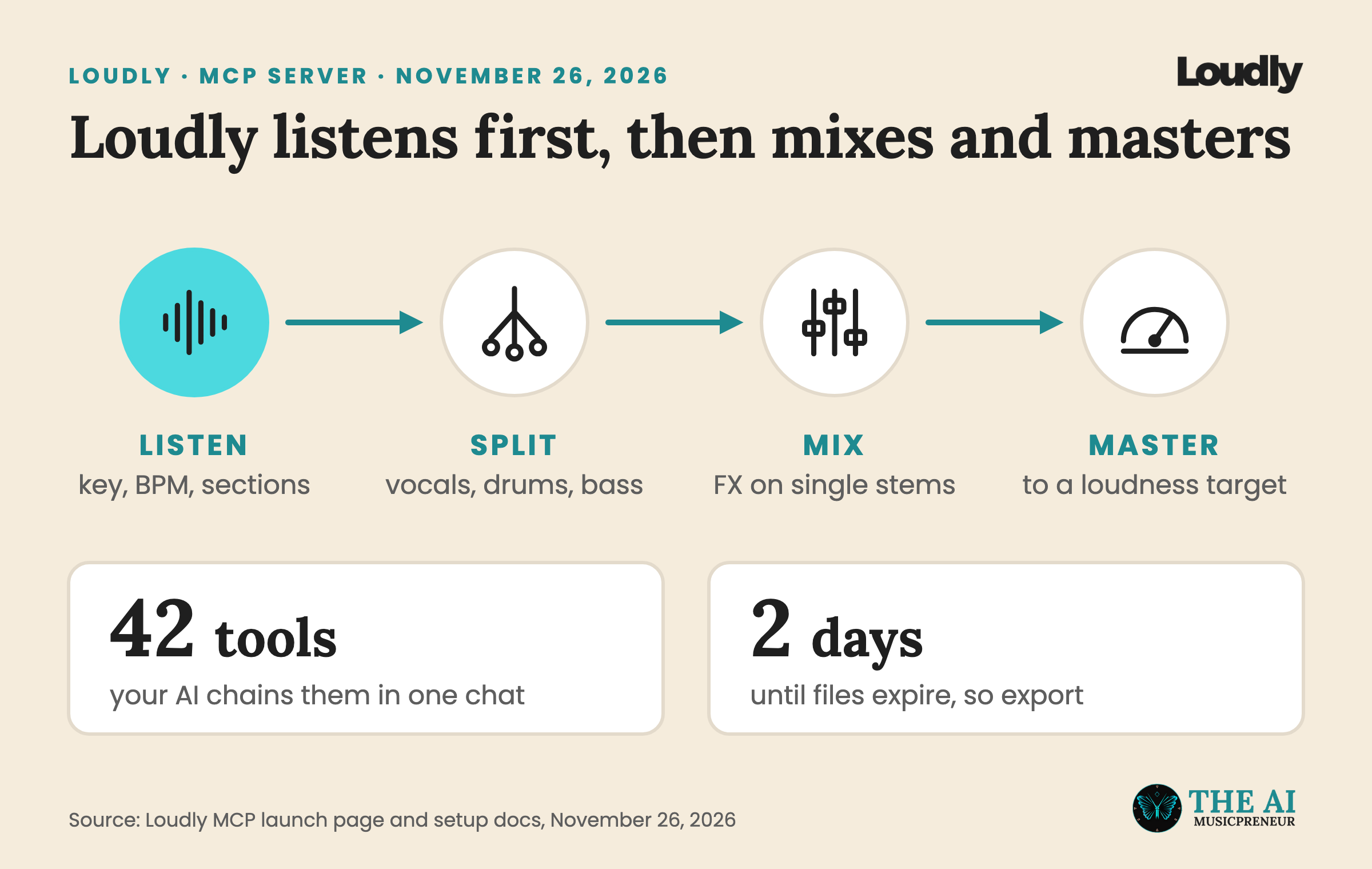
The 42 tools sort into 5 jobs, according to Loudly’s MCP docs:
- Listen. SongDNA reads mood, key, BPM, instruments, genres and loudness from the audio itself, and a second pass adds the lyrics and a section map, which takes a few minutes.
- Generate. There are 3 models: Manta writes full songs with sung vocals, Stable Audio makes instrumentals up to 360 seconds long, and VEGA builds arrangements out of Loudly’s own loop library.
- Split. The stem splitter separates any track by instrument, and a remix tool turns a song into a pack of stems and loops per section.
- Mix. An AI mixing engineer balances the stems and explains its settings, and you also get EQ, compression, limiting, time-stretch and pitch-shift on single parts.
- Master. The AI mastering tool masters to a reference track, a song from Loudly’s catalog or a genre, and a loudness meter reports LUFS and true peak.
Every edit makes a new file instead of overwriting the old one, so you can go back a step in the same chat. Exports go out as MP3, WAV, AIFF or FLAC at up to 192 kHz, per the same docs.
One gap in the docs: Kenny’s follow-up prompt asks the AI to “add more reverb”, but the tool list has no standalone reverb tool, so it isn’t clear yet which step handles that request.
Loudly MCP vs Suno MCP: stems and analysis on both, mixing and mastering only on Loudly
Loudly’s launch page puts a table next to its pitch. A “typical music MCP” generates songs, and Loudly also analyses them, splits stems and mixes per stem. Its FAQ names Suno as the example of an MCP that focuses on generating and remixing.
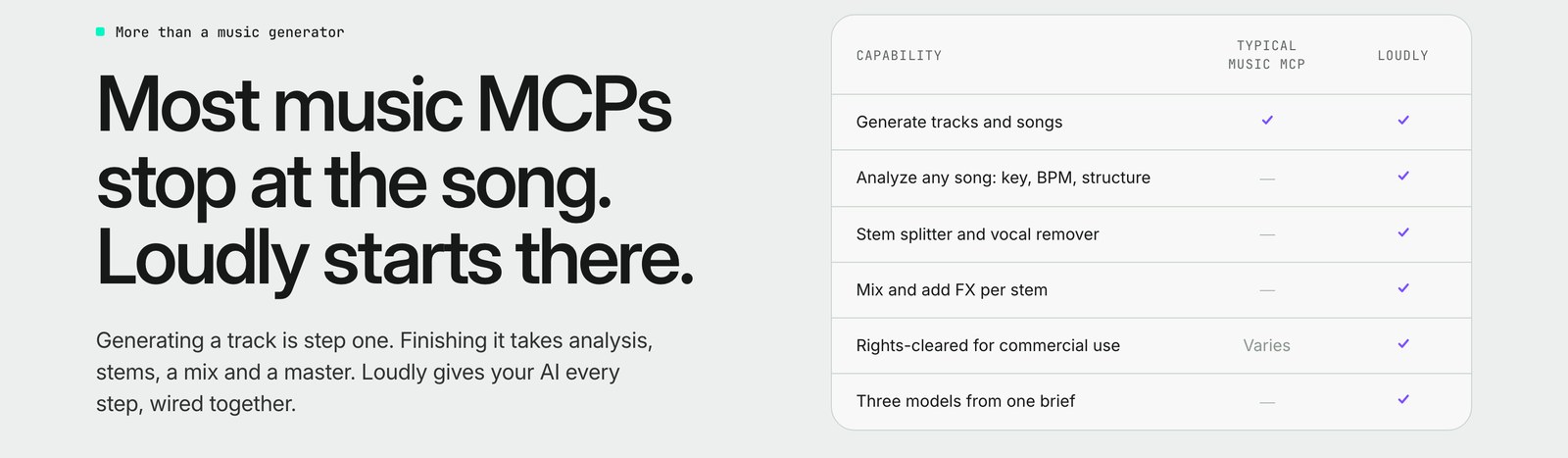
That’s out of date for Suno. Suno MCP launched on October 28, 2026, and the tool list it serves today (I have it connected in Claude Code) includes a stem splitter with 2 or 12 parts, at 10 or 50 credits a split, plus an analysis tool that returns key, BPM, beats and song sections.
What Suno’s list doesn’t have is a mixing tool, a mastering tool or a loudness meter. So the real split is this: Suno’s MCP gets you a song and its parts, and Loudly’s takes those parts to a finished master.
2 more differences matter. Suno’s stem tool only works on songs in your Suno library, while Loudly takes any audio you upload or link. And Suno MCP runs on the free Suno plan, while Loudly MCP doesn’t.
What Loudly MCP costs, and which Claude and ChatGPT plans can use it
Loudly MCP needs a paid plan, and every tool call that does real work spends credits. On Loudly’s pricing page, Personal costs $10 a month (or $96 a year) with 2,500 credits, and Pro costs $30 a month (or $288 a year) with 10,000 credits. You can buy top-ups when you run out.
Loudly hasn’t published a credit price per tool. Each priced call reports its cost and your balance afterwards, so your first few runs are how you’ll find out what a 6-master batch costs.
The license follows the plan. Personal covers your social channels, YouTube, livestreams and podcasts, and Pro adds ads, client work, apps and games. Audio you upload keeps its original rights, so the commercial clearance covers what Loudly generates, not your demo.
In Claude, you add Loudly as a custom connector under Customize, then Connectors, and on Team and Enterprise plans an owner adds it first. ChatGPT is narrower: it works on the web in Business, Enterprise and Edu workspaces, and Pro accounts get read-only access. In Claude Code it’s one line, then /mcp inside a session to sign in:
claude mcp add --transport http loudly https://mcp.loudly.comFrequently asked questions
What is the Loudly MCP server URL?
The Loudly MCP server URL is https://mcp.loudly.com. You add it as a custom connector or remote MCP server in Claude, ChatGPT, Claude Code, Cursor or VS Code, then sign in with your Loudly account. There is no API key to copy.
Do you need a paid Loudly plan to use Loudly MCP?
Yes. Loudly's MCP docs say you need a Loudly subscription, and every tool call that does real work spends credits from your monthly allowance. Personal costs $10 a month, or $8 a month billed yearly, with 2,500 credits, and Pro costs $30 a month, or $24 billed yearly, with 10,000 credits.
Does Loudly MCP work with ChatGPT Plus?
Loudly's docs list ChatGPT on the web with a Business, Enterprise or Edu workspace, where an admin may need to add it, and say Pro accounts can connect it with read-only access. ChatGPT Plus isn't mentioned. Claude, Claude Code, Cursor and VS Code all connect with a Loudly sign-in.
Can Loudly MCP master a song I made outside Loudly?
Yes. You can upload your own audio file in the chat or pass a direct link to it, then ask Loudly to analyse, split, mix or master it. Loudly says audio you upload keeps its original rights, so you need to own or license it, and you should export the master as a WAV, AIFF or FLAC file before the 2-day expiry.
About the author
Covering AI music tools, industry shifts, and news for music creators and professionals. Twice-weekly newsletter at aimusicpreneur.com.