
Best Claude connectors for musicians in 2026: 15 music apps and how to use them
My stack My fav 6 tools for AI music after testing 70+
-
 ElevenMusic · Music generation
-
 Moises · Stem separation
-
 Controlla · Voice swap & cloning
-
 Cryo Mix · Mixing + mastering
-
 Neural Frames · Music videos
-
 ONCE · Distribution
Some links are affiliate links — I earn a commission at no cost to you. Every tool here is one I run myself and truly believe in. This stack is proven.
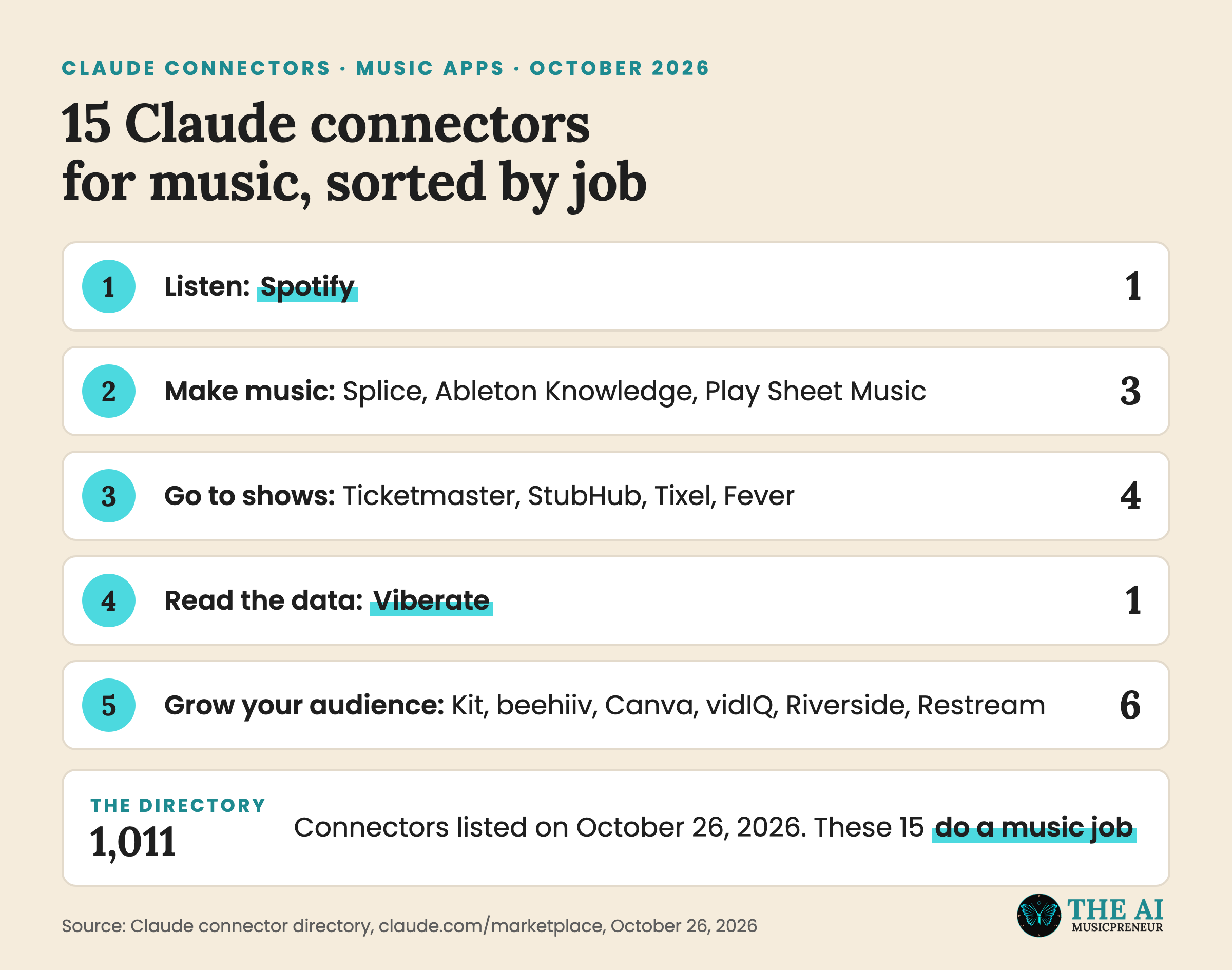
Claude connectors plug Claude into the apps you already use, so it can search, read and act inside them. On October 26, 2026, Claude’s connector directory listed 1,011 of them. I went through the list, and 15 do a real music job.
For a musician, 5 of them matter most, because they cover the jobs that eat your week: finding playlists to pitch, digging for samples, knowing where your fans are, emailing those fans and planning where to play.
One honest note before the list. The one I use myself is beehiiv, because my own newsletter runs on it. I haven’t run the others yet, so everything else below comes from each connector’s listing in the directory, the companies’ own docs and Anthropic’s help center.
Here’s where I’d start, by job:
- Spotify, for playlist scouting: find playlists in your niche and see what’s on them before you pitch.
- Splice, for producers: describe a sound in plain words and get matching samples back.
- Viberate, for career decisions: your listeners by city, the playlists artists like you are on, and how your tracks do from Spotify to Shazam.
- Kit or beehiiv, for your fan email: write the email in Claude and send it into your email tool from the same chat.
- Ticketmaster, for tour planning: see which venues artists in your genre are playing, then match them against your Viberate cities.
What are Claude connectors?
A Claude connector is a link between Claude and another app. Once you connect one, Claude can pull data out of that app and take actions inside it, like searching Splice’s catalog or drafting an email in Kit.
Under the hood, each connector is an MCP server. MCP (Model Context Protocol) is just the standard way an app tells Claude which tools it offers. Splice’s connector, for example, lists 5 tools, and Claude picks the right one for your request:
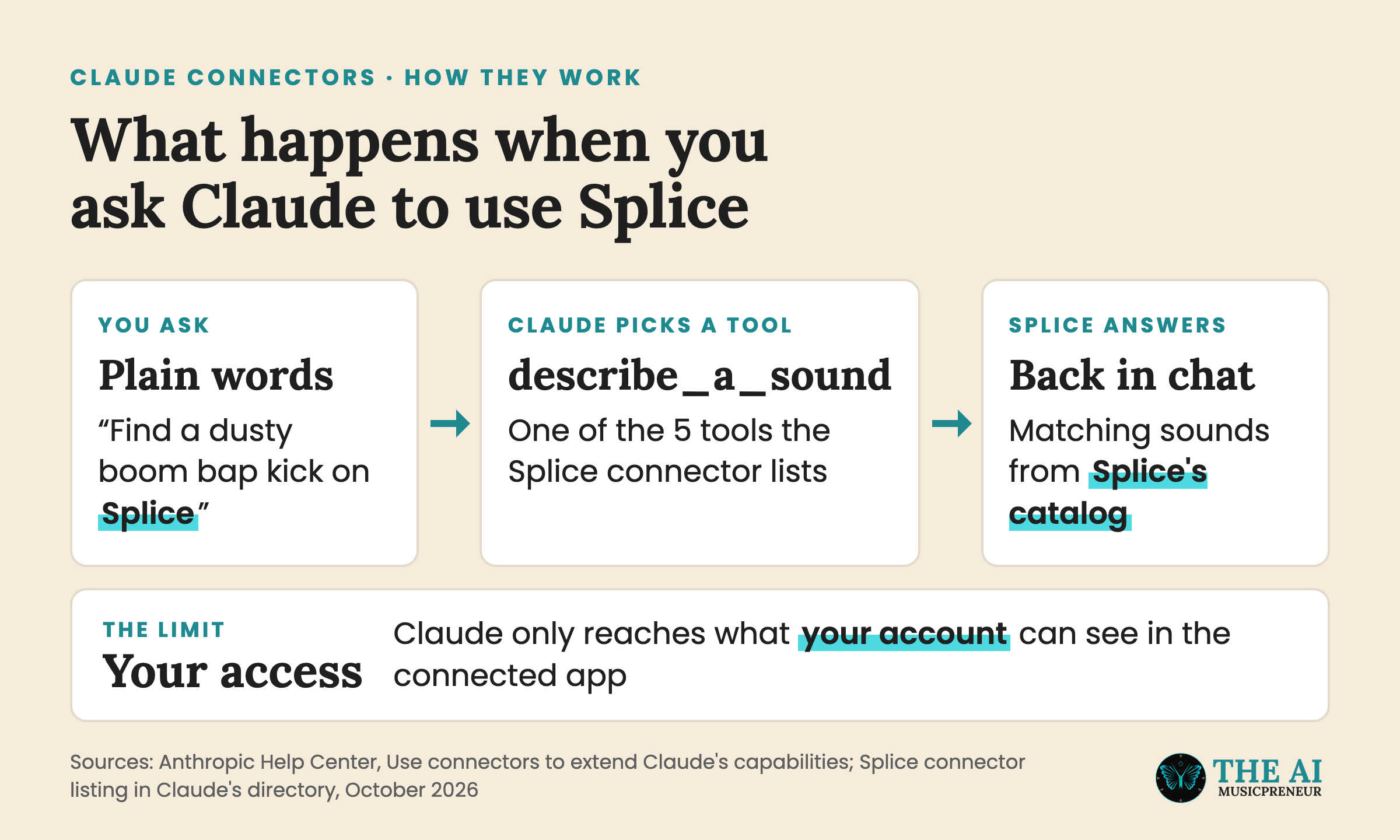
You find connectors in the Connectors Directory, under Customize and then Connectors on claude.ai, or through the “+” menu in a chat. Once connected, you switch each one on per conversation. Anthropic says connectors work in Claude, Claude Desktop, Claude Code and the API.
The part that matters most: Claude inherits your permissions. If your account can’t see something in the connected app, Claude can’t either.
Claude connectors list for music apps
These are the 15, with what each listing says, who made it and whether you need to sign in:
| Connector | What it does | Made by | Sign-in | Added |
|---|---|---|---|---|
| Spotify | Search, playlists, playback | Spotify | Not required | April 2026 |
| Splice | Sample search and stacks | Splice | Required | April 2026 |
| Ableton Knowledge | Searches Ableton manuals | Ableton (experimental) | Not listed | July 2026 |
| Play Sheet Music | Generates and plays sheet music | MCP community | Not required | January 2026 |
| Viberate | Streaming and audience data | Viberate | Required (free plan available) | July 2026 |
| Kit | Email list and broadcasts, 83 tools | Kit | Required | August 2026 |
| beehiiv | Newsletter, automations, 198 tools | beehiiv | Required | August 2026 |
| Ticketmaster | Event and ticket search | Ticketmaster | Not required | June 2026 |
| StubHub | Resale ticket listings | StubHub | Not required | April 2026 |
| Tixel | Fan-to-fan ticket resale | Tixel | Not required | Not listed |
| Fever | Live event discovery by city | Fever | Required | March 2026 |
| Canva | Create and export designs | Canva | Required | November 2025 |
| vidIQ | YouTube, Instagram, TikTok research | vidIQ | Required | August 2026 |
| Riverside | Video and podcast editing, 59 tools | Riverside | Required | August 2026 |
| Restream | Live streams to 30+ platforms | Restream | Required | June 2026 |
Claude connector for playlist scouting: Spotify
Spotify’s connector is the obvious first click, and Spotify built it itself. It lists 6 tools: search, fetch tracks, create playlist, add to library, remove from library and get what’s currently playing.
The listing says you can ask for songs, artists, albums or playlists. For a musician, that last one is the useful part. Ask Claude for playlists in your niche, pull up the tracks on them, and you’ve got a list of playlists where your song would actually fit before you pitch anyone.
Find 10 Spotify playlists for indie folk with female vocals and show me the tracks on each one.
What it doesn’t do is anything for your own releases. It’s a listener’s connector, and it lists no Spotify for Artists data, so your streams and saves stay in the Spotify for Artists app. I also haven’t checked whether search shows follower counts or curator contacts. For which playlists artists like you actually land on, Viberate is the stronger tool (more on that below).
Best for: building a pitch list of playlists in your niche, or a reference playlist before a session.
Claude connectors for making music: Splice, Ableton Knowledge and Play Sheet Music
This is the group producers will care about. Only one of the 3 touches actual audio, and it’s Splice.
Splice: sample search by description
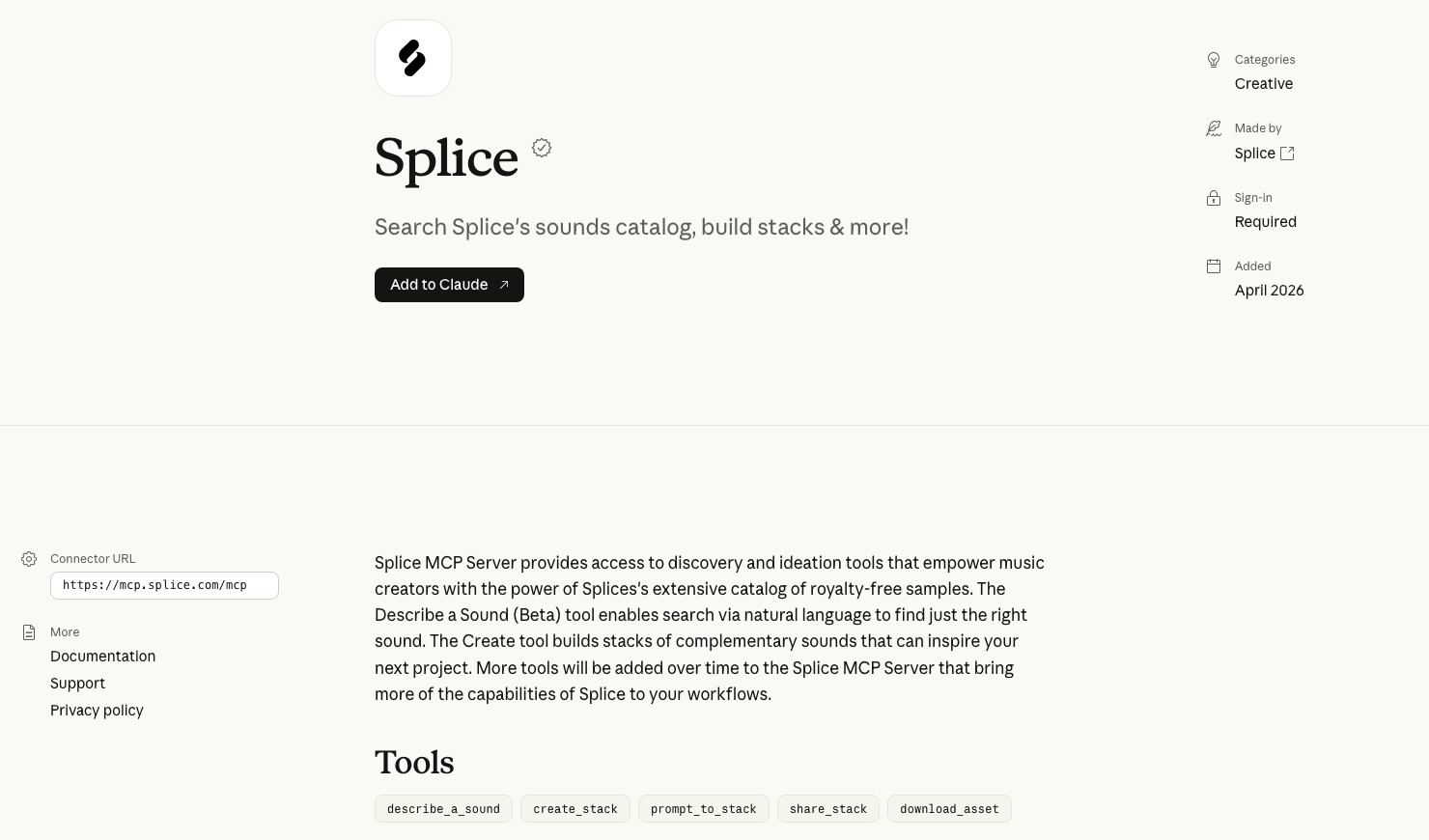
You sign in with your Splice account. The headline tool is Describe a Sound, still in beta, which searches Splice’s royalty-free catalog from a plain-language description. So instead of clicking through genre, key and BPM filters, you type what you hear in your head:
Find me airy female vocal chops in C minor, then build a stack around the best one.
Create Stack builds a set of complementary sounds around a sample, and there are tools to turn a prompt into a stack, share a stack and download an asset. Splice says more tools are coming.
If you’re weighing Splice against other sample finders, my AI sample finder roundup covers the alternatives.
Ableton Knowledge: your manual, searchable
Ableton Knowledge searches the manuals, release notes, knowledge base articles and tutorial transcripts for Live, Push, Move, Note, Cloud, Link and Max for Live. The listing calls it a prototype and “not an official Ableton product”, and says searches run locally on your machine. It answers questions about Ableton. It doesn’t touch your Live set.
Play Sheet Music: a demo that writes notation
Play Sheet Music asks Claude to generate sheet music and play it back with a visual. It comes from the Model Context Protocol community and runs on the project’s example server, so treat it as a fun demo rather than a writing tool.
Claude connector for career decisions: Viberate
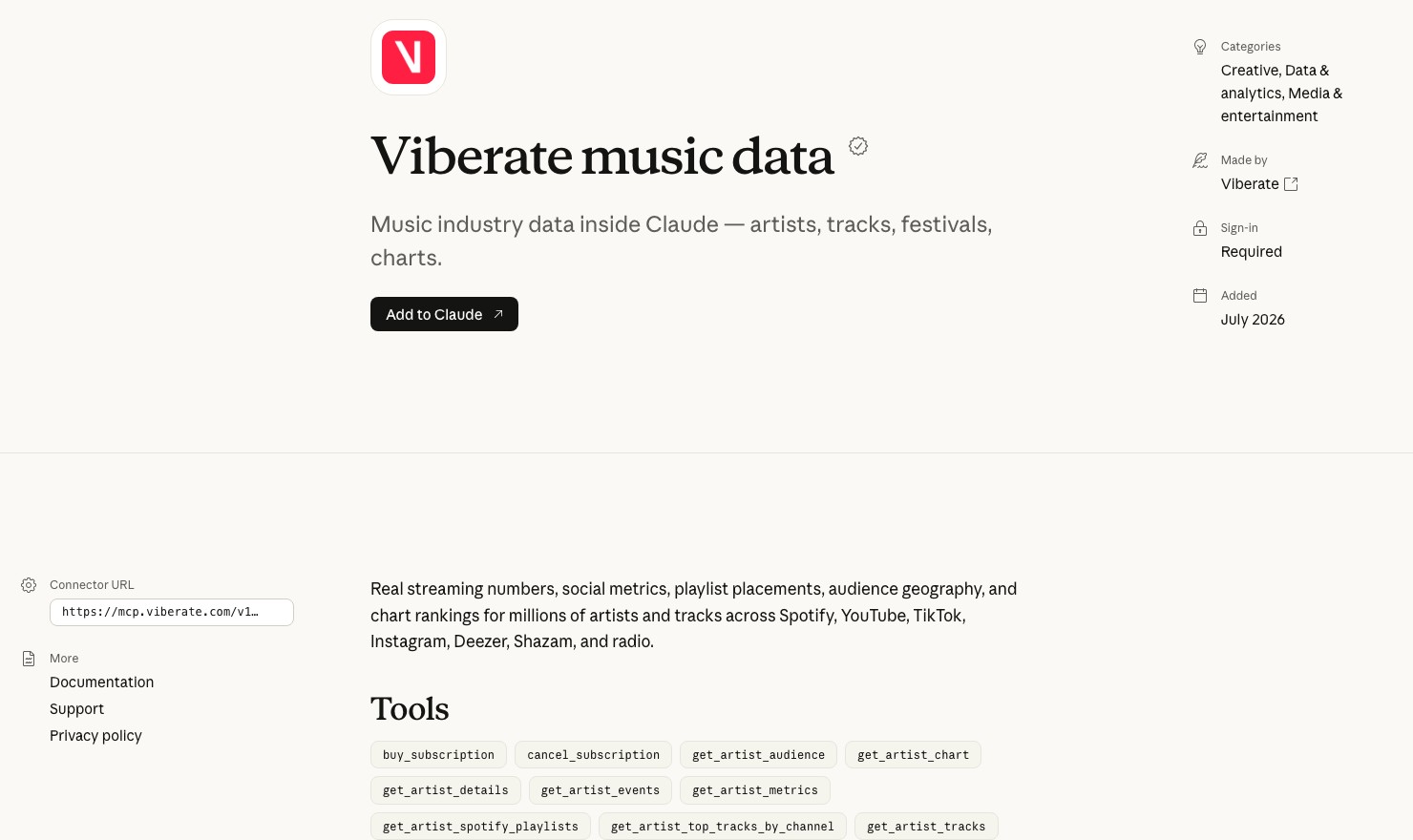
Viberate is the one connector here built for the business side of your music. Its listing promises streaming numbers, social metrics, playlist placements, audience geography and chart rankings across Spotify, YouTube, TikTok, Instagram, Deezer, Shazam and radio, in 23 tools.
Here’s what that answers, going by Viberate’s own documentation:
- Where to play: listeners and followers by city and country, so you know which cities already stream you.
- Who to pitch: the Spotify playlists an artist or a track sits on, so you can look up artists like you and see which playlists took them.
- Which song to push: streams, views, Shazams, radio spins and plays per track, across platforms.
- Which festivals to target: festival lineups, capacity, dates and genres.
- Where your peers tour: upcoming and past tour dates for any artist.
So when you ask Claude where to play next or who to pitch, the answer comes from real numbers.
You don’t need a paid plan to start. Viberate says the free plan includes all 23 tools, with limits: chart queries return 3 results, audience data covers only Spotify listeners and YouTube views by city (top 5), and metrics show totals without the change over time. The full plan lifts those caps. I covered pricing when Viberate first opened its MCP server.
Read the tool list before you connect it, though. It includes buy, cancel and manage subscription tools, which return Stripe links for your Viberate plan.
Using Viberate, show me the top cities for my Spotify listeners and which Spotify playlists [similar artist] is on.
Best for: any artist with music out, plus the managers and A&R people who make decisions for them.
Claude connectors for emailing your fans: Kit and beehiiv
Emailing your fans is one of the best ways to sell merch, memberships and music. Spotify’s numbers belong to Spotify. Your list is yours.
The slow part has always been the work around the email: writing it, pasting it into your email tool and setting everything up before it goes out. With Kit or beehiiv connected, you write the email in one Claude chat, and in that same chat Claude puts it into your email tool, ready to send. That’s how I run my own newsletter on beehiiv, and what used to take me hours now takes minutes.
- Kit (83 tools): tag subscribers, manage segments, draft and schedule broadcasts and enroll fans in sequences.
- beehiiv (198 tools): posts, automations, segments, podcasts and monetization data.
Write a fan email announcing my new merch drop from these notes, then save it as a draft in beehiiv.
Kit’s tool list includes delete tools, so read it before you connect and keep an eye on what you ask for.
Claude connectors for planning a tour: Ticketmaster, StubHub, Tixel and Fever
Four ticketing companies have official connectors. Going by their tool lists, all 4 search events and show listings, and none lists a checkout tool. Ticketmaster’s own docs confirm that purchases complete on Ticketmaster.
- Ticketmaster (June 2026): 2 tools, a unified search and a ticket finder. No Ticketmaster account is needed to search. It’s the same partner Meta picked for its Muse agent.
- StubHub (April 2026): event search, listings and a tool to highlight a listing. StubHub says it covers 50 million listings in 200+ countries.
- Tixel: fan-to-fan resale with verified tickets and prices capped near face value, mainly in the US, UK and Australia.
- Fever (March 2026, sign-in required): searches events by city, date, location or keyword, and filters by popularity, price, rating or distance.
Most people will use these to buy tickets. For an artist, the useful part is the research.
How to plan a tour route with Viberate and Ticketmaster
Ticketmaster’s docs list prompts like “Which cities is [show] coming to?” and “What comedy shows are happening in [city] this weekend?”. Swap comedy for your genre, and you can see which venues artists like you are playing, city by city. Put that next to Viberate’s data and you get a first draft of a tour:
- Ask Viberate for the cities where you have the most listeners.
- Ask Ticketmaster which venues artists in your genre are playing in those cities.
- Ask Claude to turn both into a venue list and a route for a tour or a weekender.
- Check StubHub for resale prices on those shows. If tickets resell above face value, that’s a hint fans wanted more of them than there were.
Which venues are [genre] artists playing in [city 1], [city 2] and [city 3] over the next 3 months? Then suggest a route for a 3-date weekender.
Two caveats before you book anything. Ticketmaster only sees Ticketmaster’s own listings, so shows sold through other ticketing platforms or a venue’s own box office won’t appear. And it shows what’s already booked, not how many fans would come to your show. Treat the route as a starting point for your booking emails.
Claude connectors for content and live streams: Canva, vidIQ, Riverside and Restream
None of these is a music company, but all 4 do a job every independent artist has.
- Canva: search, generate, autofill and export designs, which covers cover art and social graphics. Anthropic lists it as an interactive connector, so the design can open right in the chat.
- vidIQ: YouTube keyword research, outlier videos and channel analytics, plus Instagram and TikTok outliers. Its listing notes the Instagram data doesn’t come through Meta’s official API.
- Riverside (59 tools): find moments in recordings, cut clips, add captions and draft social posts.
- Restream (30 tools): schedule and run live streams to 30+ platforms like YouTube and Twitch, then clip the recording.
Which music apps don’t have a Claude connector yet?
On October 26, 2026, I couldn’t find a connector in the directory for SoundCloud, Bandsintown, Songkick, Chartmetric, DistroKid, TuneCore, YouTube, Apple Music, Instagram, Suno or Udio. TikTok is only there as TikTok for Business, for running ads.
You’re not stuck, though. Claude lets you add a custom connector by pasting any remote MCP server URL, and Anthropic says free accounts get 1 custom connector. The server has to be reachable over the public internet. One music example is OpenStage’s MCP, which connects your own fan data.
For Ableton, the community project AbletonMCP goes further than Ableton Knowledge. It runs locally with Claude Desktop and can create tracks, load instruments and write MIDI clips in Live. It isn’t in Anthropic’s directory, so read the code before you install it.
How Claude Duet uses your music connectors
Anthropic launched Claude Duet on October 21, 2026. It’s an agent that carries over the apps you’ve connected to Claude, checks them every few hours and sends you a morning brief. For now it’s US-only, for Pro and Max plans, by waitlist.
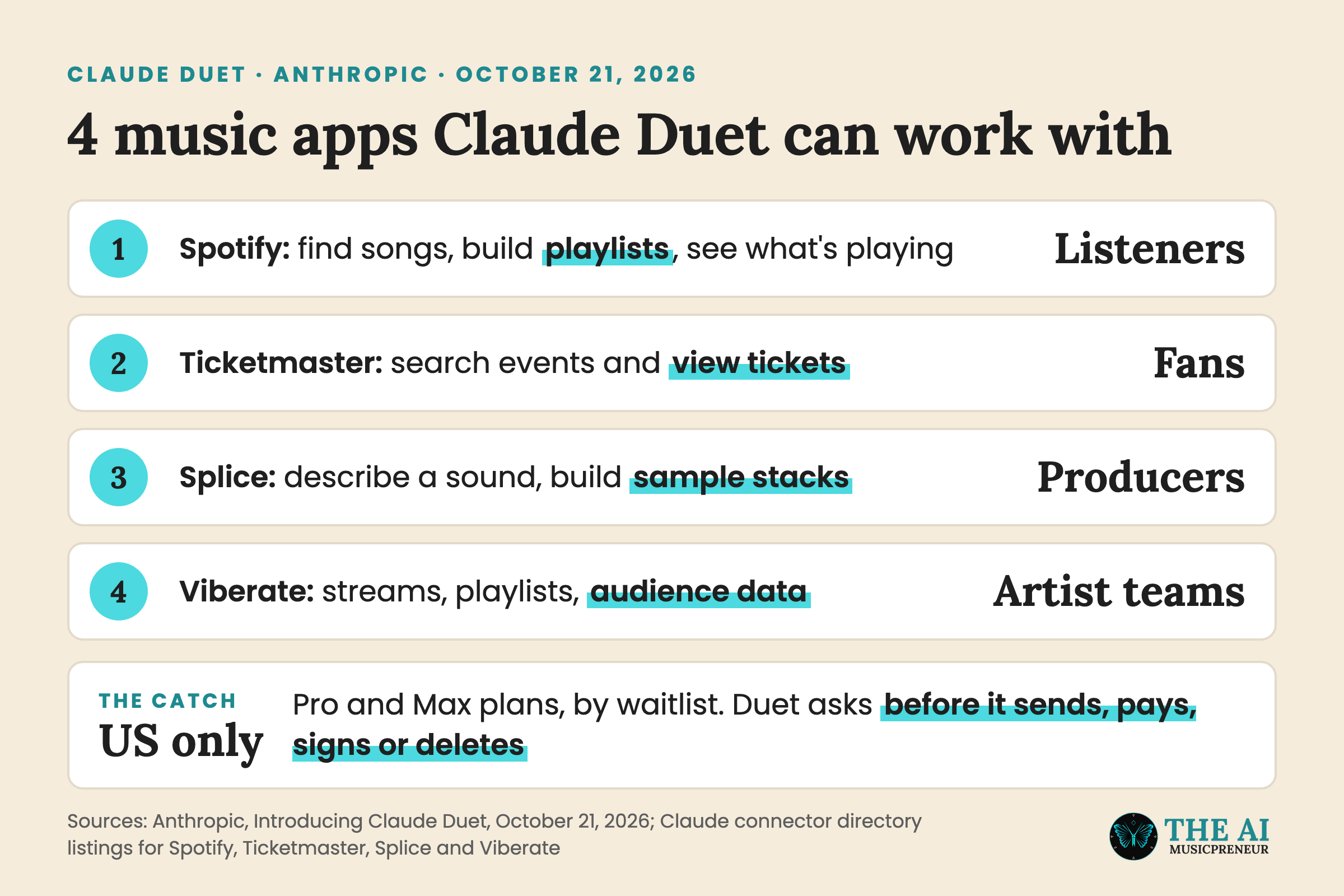
The connectors are the same. What Duet changes is who starts the conversation: it checks your apps and comes to you, instead of waiting for you to ask.
How to choose the best Claude connectors for your music
Pick by the job that eats your week, then check these 5 things on the connector’s page:
- Who made it: a connector from Spotify or Splice is backed by the company. A community or demo server, like Play Sheet Music, isn’t.
- What the tools can change: read the tool list. Kit includes delete tools, and Viberate includes subscription tools.
- Whether you need an account: Splice, Kit and beehiiv only work if you already use them. Viberate needs an account too, but its free plan is enough to start.
- Where it runs: most run in Claude on the web. Ableton Knowledge searches locally, and AbletonMCP needs Claude Desktop.
- Whether you still use it: Anthropic’s own advice is to disconnect services you no longer need.
Frequently asked questions
Can you connect Claude to Spotify?
Yes. Spotify built an official Claude connector, added to the directory in April 2026 and listed as not requiring sign-in. It lets Claude search songs, artists, albums, playlists, podcasts and audiobooks, create playlists, add or remove library items and see what's playing. Spotify Premium listeners can also describe a vibe and get a personalized playlist.
Does Spotify have an MCP server for Claude?
Yes. The Spotify connector in Claude's directory is an MCP server made by Spotify itself, so you don't need a community-built Spotify MCP server for Claude's web app. It's built for listening, with tools for search, playlists and playback, and it doesn't list any Spotify for Artists data.
Can Claude plan a tour route with the Viberate and Ticketmaster connectors?
It can draft one. Viberate's connector shows where an artist's listeners and followers are by city and country, and Ticketmaster's connector searches its live event catalog by artist, city and category. Ask Claude which venues artists in your genre are playing in your top cities, and it can turn the results into a venue list and a route. Ticketmaster only shows its own listings, so treat the route as a starting point.
Can Claude write and send a newsletter through beehiiv or Kit?
Yes. The beehiiv connector lists 198 tools, including posts and automations, and the Kit connector lists 83, including drafting and scheduling broadcasts. You write the email in a Claude chat, and in the same chat Claude puts it into beehiiv or Kit, ready to send. Both need you to sign in with your account.
What data can Claude access through connectors?
Only what your own account can see in the connected app. Anthropic's help center says Claude inherits your permissions, so if you can't open a file or record in the source system, the connector can't reach it either. Each connector page lists its tools, which shows what it can read and change.
Is there an Ableton Live connector for Claude?
There's Ableton Knowledge, an experimental connector in Claude's directory that searches the manuals, release notes and tutorial transcripts for Live, Push, Move, Note and Max for Live. It answers questions but doesn't control Live. Community projects like AbletonMCP can create tracks and MIDI clips in Live through Claude Desktop, but they aren't in the directory.
About the author

Covering AI music tools, industry shifts, and news for music creators and professionals. Twice-weekly newsletter at aimusicpreneur.com.
