OpenStage launches an MCP that connects your fan data to Claude, ChatGPT, and Gemini
My stack My fav 6 tools for AI music after testing 70+
-
 ElevenMusic · Music generation
 -
 Moises · Stem separation
 -
 Controlla · Voice swap & cloning
 -
 Cryo Mix · Mixing + mastering
 -
 Neural Frames · Music videos
 -
 ONCE · Distribution
Some links are affiliate links — I earn a commission at no cost to you. Every tool here is one I run myself and truly believe in. This stack is proven.
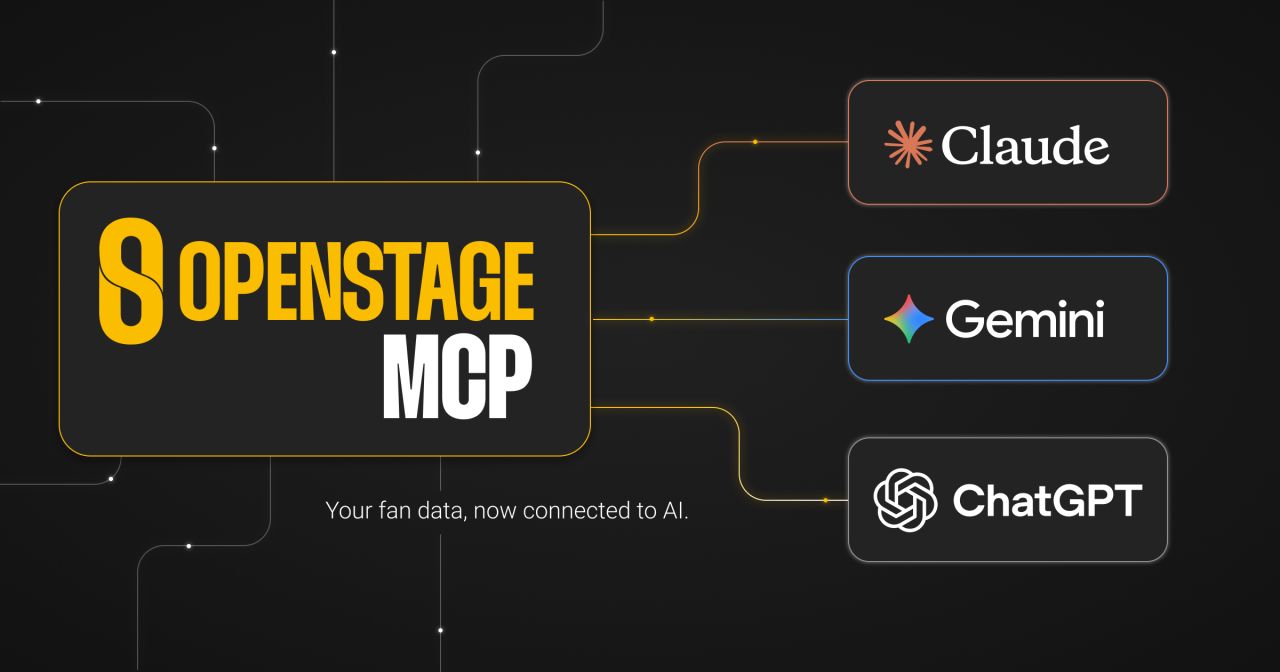
OpenStage, the fan data platform behind Paul McCartney, Lana Del Rey, and Bad Bunny, launched OpenStage MCP on June 25, 2026. It connects an artist’s live fan data straight to OpenStage inside Claude, ChatGPT, or Gemini, so the AI can read, analyze, and act on the fan graph from a normal chat window. Most artists collect fan data and then let it sit. This is the move to make it usable.
How OpenStage MCP connects fan data to Claude, ChatGPT, and Gemini
An MCP, short for Model Context Protocol, is an open standard that lets an AI assistant pull from and act on an outside data source. OpenStage built one for its fan database. Connect it once, and your AI can reason across every fan, every campaign, and every transaction you have on the platform.
The point is that the AI runs on your exact context, not generic advice. You can ask it plain questions and get back work:
- Who are my most engaged fans who have not purchased, and what do they have in common?
- Where are my top fans coming from, and where should I invest to get more?
- Act as my fan development strategist, audit my OpenStage, and build me a six-month fan growth plan.
“It’s an analyst, strategist and operator in your pocket,” wrote Rob Abelow, Chief Product Officer at OpenStage, in the launch post. Today the connector already builds audiences, updates fan profiles, and drops a recap in a team’s Slack the second a campaign ends. OpenStage says drafting and publishing campaigns is the next step.
What OpenStage’s early manager tests surfaced
The team handed the tool to artist managers before launch, and the early results read like a preview of how this changes the daily job. One manager asked a single question about an artist’s fanbase and learned that growth had tripled in one city over six months. That is a touring decision, a marketing decision, and a sponsorship pitch out of one prompt.
Another test ran ahead of a major international show. The tool mapped an artist’s entire fanbase across a continent in minutes, with fans pinned, segmented, and ready to activate. That kind of work used to take days.
The data was always there. Now it's actually usable.
Grant Tilbury Jaiswal, who runs Artist Success at OpenStage, said the speed is not even the main shift. The shift is that managers are finally asking questions they skipped before, because getting the answer used to be too painful.
Why your AI is only as smart as the fan data you own
Here is the honest part for independent artists. OpenStage’s edge is consolidated first-party data, pulled from streaming, social, ticketing, events, and merch into one profile per fan. The MCP is a window onto that. If your fan data is scattered across DSP dashboards, a Linktree, and a half-dead mailing list, an AI plugged into it has very little to reason over.
OpenStage is not only for stadium acts. Pricing runs by contactable fans, starting near 100 pounds a month for artists with 10,000 followers or fewer, per co-founder Rob Sealy in Pollstar. The platform first proved the model on Ticket Unlocks presales for Bad Bunny, Radiohead, and Oasis before opening it to more artists.
The lesson holds whether you run on OpenStage or not. Consolidate and own your fan data first: an email list you control, a fanbase you can actually see, transactions you can trace back to a person. That is the same data layer the majors are chasing with their superfan push, and it is the layer an AI agent needs before it can do anything useful for you.
My take on OpenStage MCP
The MCP itself is becoming standard plumbing. Claude, ChatGPT, and Gemini will all connect to whatever data you point them at, and soon every fan platform will ship a connector like this. The advantage sits with whoever owns the data on the other end of the pipe. OpenStage spent years getting artists to consolidate fan relationships in one place, and an AI that reasons across that is a real reason to do the unglamorous work of owning your fan relationships instead of renting them from a feed. If you are starting from zero, the tool is not the lesson. Owning the data is.
Frequently asked questions
What is OpenStage MCP?
OpenStage MCP is a connector that plugs an artist's OpenStage fan data into an AI assistant. It uses the Model Context Protocol, an open standard, so Claude, ChatGPT, or Gemini can read, analyze, and act on the artist's live fan data from inside a normal chat. OpenStage announced it on June 25, 2026.
Which AI assistants does OpenStage MCP connect to?
OpenStage MCP connects to Claude, ChatGPT, and Gemini. Once linked, the assistant can query the artist's fan graph, segment audiences, update fan profiles, and post a campaign recap to a team's Slack channel.
What can an artist ask OpenStage MCP to do?
An artist or manager can ask which engaged fans have not purchased yet and what they share, where top fans are coming from, or for a six-month fan growth plan. OpenStage describes the result as an analyst, strategist, and operator working from the artist's own data.
How much does the OpenStage fan data platform cost?
OpenStage prices by the number of contactable fans an artist has. Co-founder Rob Sealy has said it costs around 100 pounds per month for artists with 10,000 followers or fewer, about 400 pounds at 100,000, and roughly 3,000 pounds for artists with a million or more.
Which artists use the OpenStage fan data platform?
OpenStage powers fan relationships for more than 600 artists and 30 million fans. Named clients include Paul McCartney, Lana Del Rey, Bad Bunny, Oasis, Radiohead, Caroline Polachek, and Ellie Goulding.
About the author

Covering AI music tools, industry shifts, and news for music creators and professionals. Twice-weekly newsletter at aimusicpreneur.com.