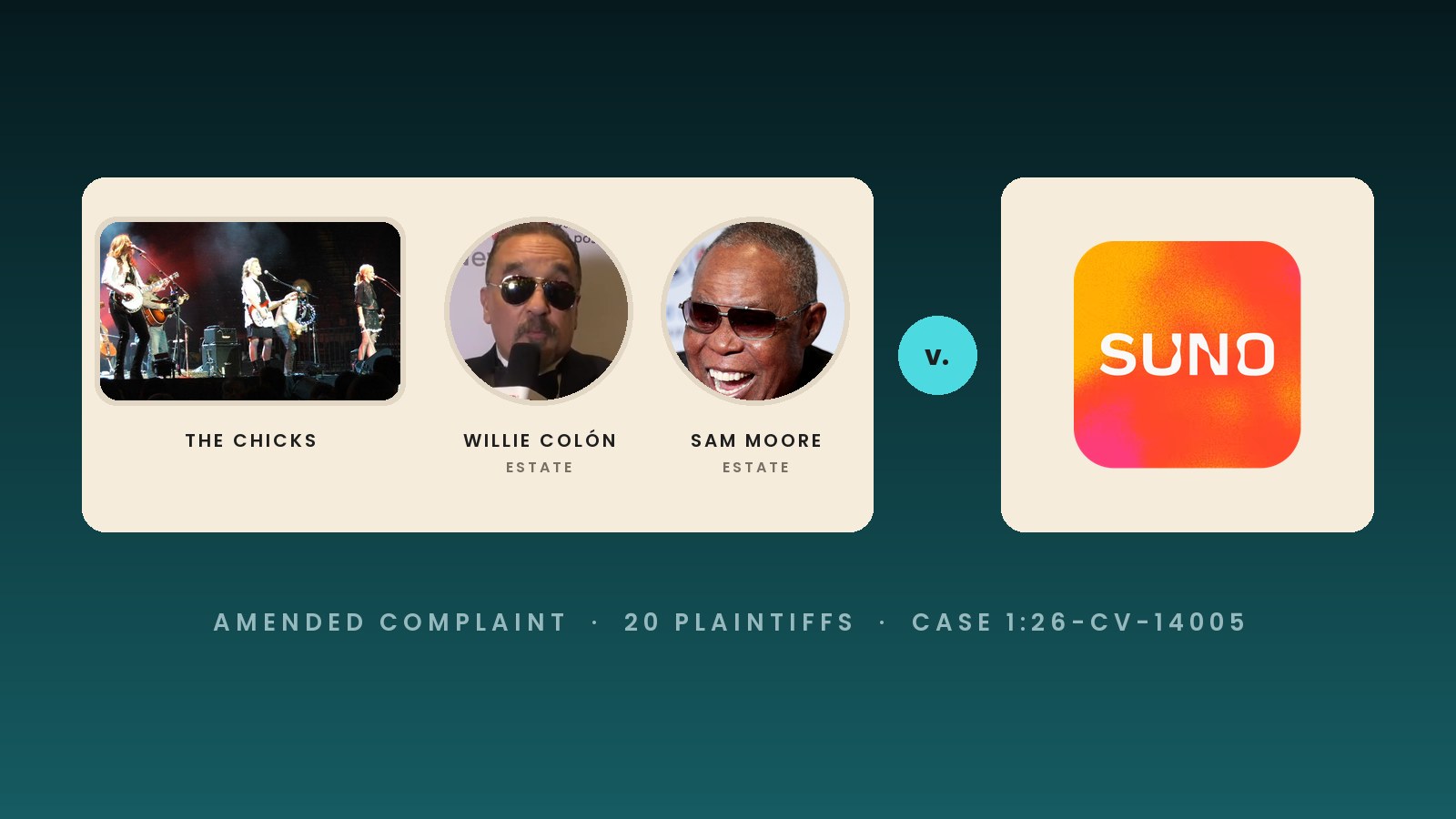
Suno's first attempt to get Jason Isbell's identity lawsuit thrown out has been denied

Black Friday deal · ends Nov 30 My #1 AI music video tool is up to 50% off until Nov 30
Music videos made with Neural Frames
- 50% off when you go yearly
- 25% off monthly plans and credit top-ups
Back to full price after Nov 30. Affiliate link: I earn a commission at no cost to you.

A federal judge in Boston has denied Suno’s motion to dismiss Lowery v. Suno, the identity class action led by Jason Isbell and David Lowery. Judge Angel Kelley’s decision came on November 25, 2026, one day after the musicians filed their amended complaint, according to Digital Music News, which was briefed on it.
DMN says the decision specifically references that new complaint. The full order wasn’t public yet, so nobody outside the court has read the reasoning. The timing points to a procedural reset, and only the published order can confirm that.
The amended complaint itself is public, and you can read all 98 pages here (PDF). It says Suno’s v6 models still accept the musicians’ names. And on page 46, it cites my own article on SIQA’s mid-year report.
If you make music in Suno, nothing changes today. The court hasn’t said whether typing an artist’s name into a prompt is legal, and Suno still works the way it did last week.
Why the amended Lowery v. Suno complaint reset Suno’s motion to dismiss
Suno’s motion to dismiss was first reported on November 3. 3 weeks later, on November 24, the musicians filed an amended complaint that added The Chicks and the estates of Willie Colón and Sam Moore, taking the case from 4 named plaintiffs to 20.
Here’s why that matters for the motion. Federal Rule of Civil Procedure 15 lets a plaintiff amend once without the court’s permission within 21 days of a motion to dismiss. An amended complaint replaces the original one completely, so a motion written against the old version usually has nothing left to attack. Courts commonly deny it for that reason and wait for the defendant to file against the new complaint.
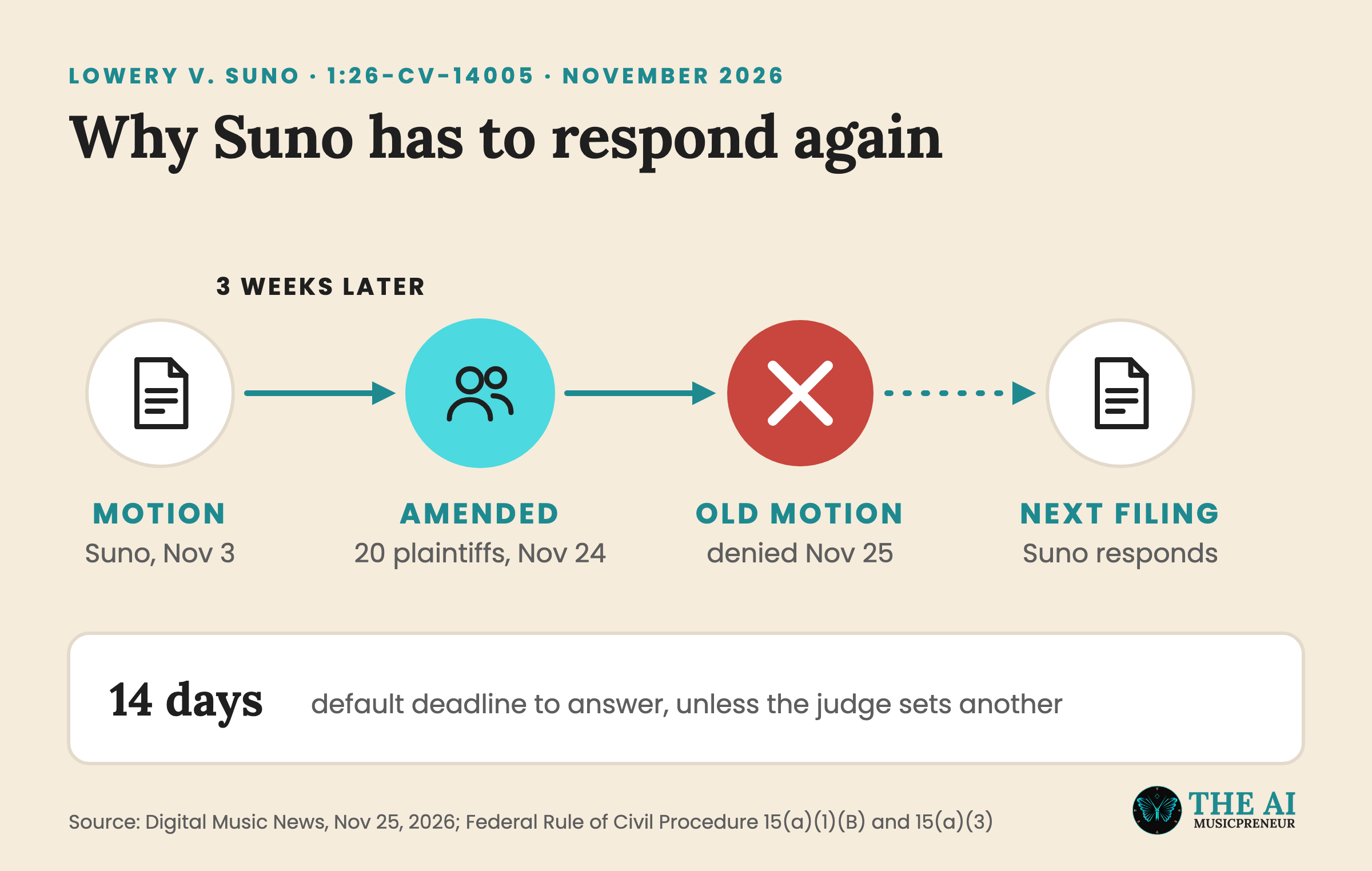
A denial one day after an amendment fits that pattern. It’s also different from the ruling in Tony Justice’s case against Suno, where a judge read the arguments and let the copyright and DMCA claims go forward.
Suno’s First Amendment and preemption arguments in Lowery v. Suno are still open
Suno’s motion made 2 arguments. First, that using an artist’s name to describe a style is speech protected by the First Amendment. Second, as a fallback, that federal copyright law preempts the state claims, because Congress chose to leave musical style unprotected.
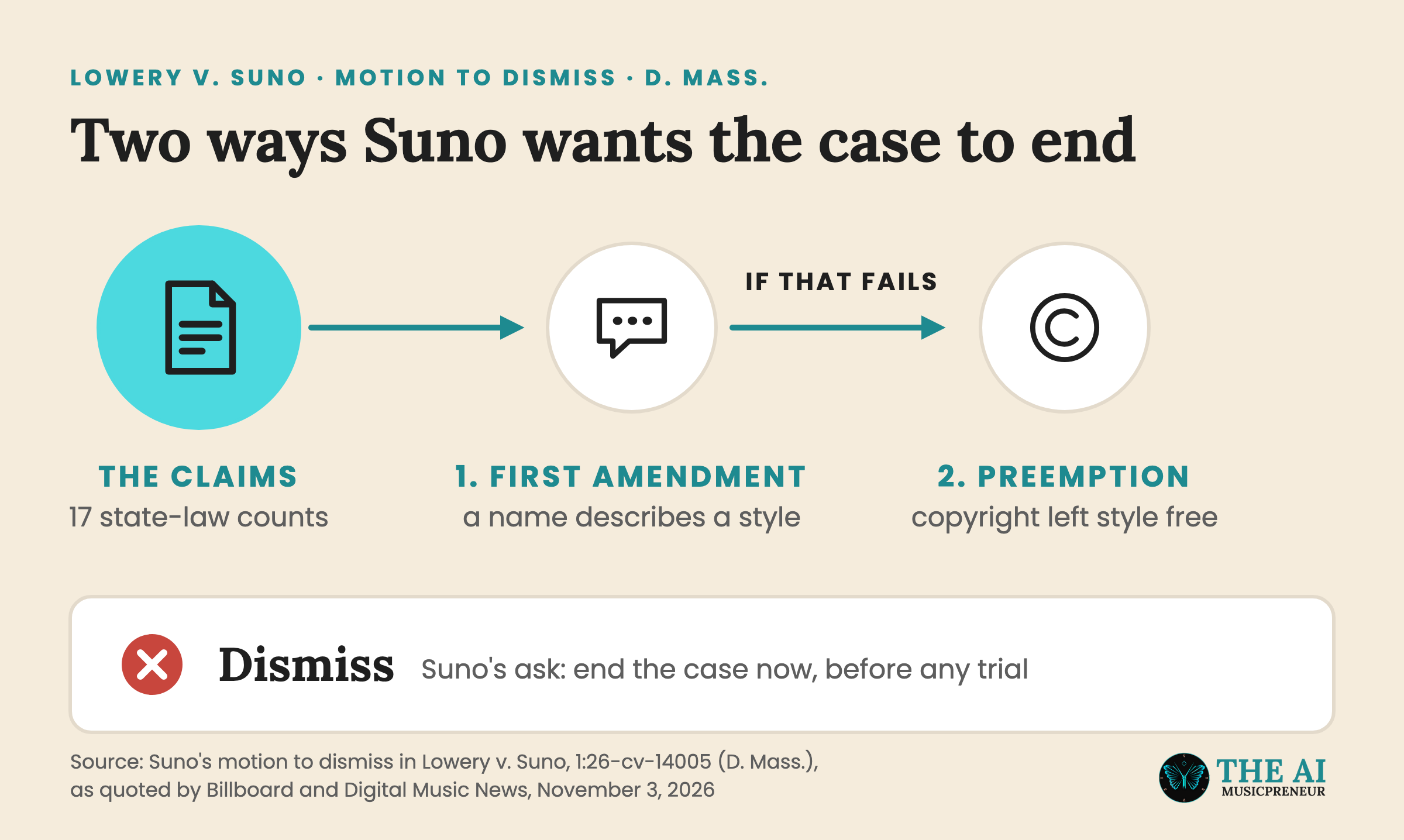
Nothing public so far says Judge Kelley ruled on either one. If Suno files a new motion, it has to deal with a different complaint: 20 plaintiffs across 14 states, demonstrations of Suno’s v6 models, and a direct challenge to Suno’s claim that v6 was trained only on licensed music.
The core of the case also hasn’t moved. The original complaint has no copyright claim at all. It relies on state publicity laws and the Illinois Biometric Information Privacy Act, which requires written consent before a company stores a voiceprint.
The amended complaint also adds a lot of detail about the names you type into Suno.
What the amended Lowery v. Suno complaint says about artist names in Suno v6
Suno says it doesn’t let you prompt with an artist’s name, and in my own test that held up. On November 5, I typed “Metallica like song” into Suno’s Styles field. Suno answered with a pop-up: “We don’t reference artists directly, so we’ve replaced your prompt with similar styles you might like.” Then it offered 4 tags: heavy metal, thrash metal, hard rock and speed metal.
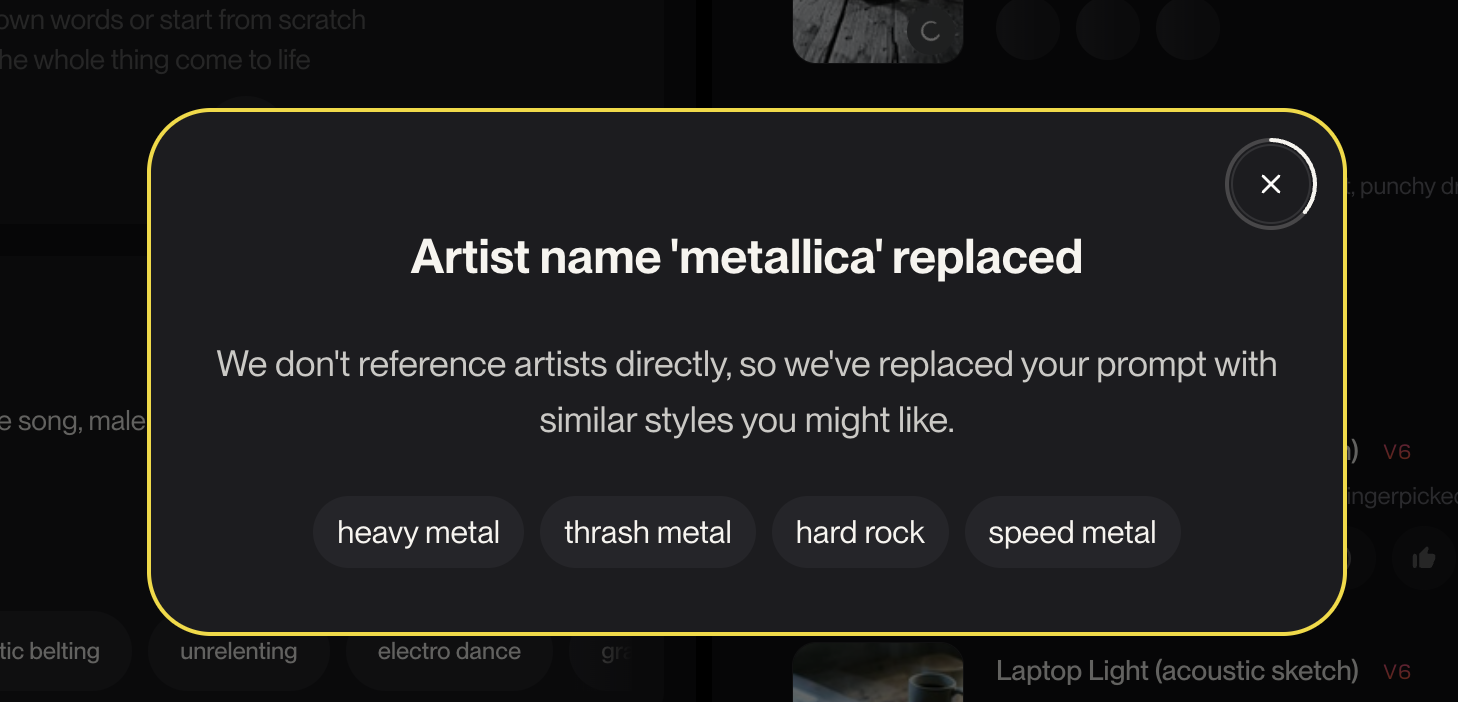
The amended complaint reads that same pop-up as evidence against Suno. Paragraph 51 says the swap shows Suno “recognizes exactly who is being invoked”. Its example is “taylor swift”, which Suno replaced with Pop, Country, Country Pop and Synth-Pop.
Then it goes further. Paragraph 67, on page 34, says the musicians ran every earlier name through Suno v6, and that “Suno’s current models again accepted those names and generated output in response to each”:
- The prompt “Martie Maguire”, a member of The Chicks, produced a “Texas country” song with a “fiddle-led…arrangement”, plus another song Suno named “Fiddle Dance”.
- The prompt “Emily Strayer”, also of The Chicks, produced songs with a “rolling banjo”.
- Suno’s own rolling suggestion text in the prompt field showed “T a y l o r s w i f t with a long verse and short chorus”.
The complaint also says spaced-out names get through. Typed as “H e c t o r L a v o e”, the salsa singer’s name produced a song that begins with a man yelling “Hector Lavoe” (footnote 63).
These are the musicians’ claims, and Suno hasn’t answered them in court yet. Suno told Billboard on November 25 that the claims are without merit.
So what does this mean if you use Suno? The complaint is aimed at how Suno built its product. Paragraph 78 puts it this way: “Whatever creative purpose a user may have in entering a musician’s name, Suno’s own conduct occurs upstream.”
No Suno user is named as a defendant. The complaint does list “Unknown Defendants”, which it describes as individuals or entities that directly misappropriated the musicians’ identities, or “knowingly induced or materially contributed to Suno’s violations”. The musicians say they’ll name them once they’re identified (paragraph 25).
Page 46 has one more detail, and this one is about my own reporting.
Why the Lowery v. Suno complaint cites SIQA’s 92.8% Suno figure
Honestly, I never thought I’d be cited in a US lawsuit, but it happened. Paragraph 90 of the amended complaint argues that Suno threatens the musicians with harm that is “imminent, substantial, and specific to the musicians whose names Suno accepts”. To show the scale, it says: “Suno was identified as the generation tool for 92.8 percent of the verified AI-generated tracks submitted to one AI-music chart service from April through August 2026.”
Footnote 132 gives 2 sources for that sentence. The first is SIQA’s own AI Music Intelligence Report for Q1 2026, with Suno in 90.4% of 1,551 verified submissions. The second is my article on SIQA’s Mid-Year 2026 report from September 15, where Suno powered 92.8% of 1,743 verified submissions between April 1 and August 20, 2026.
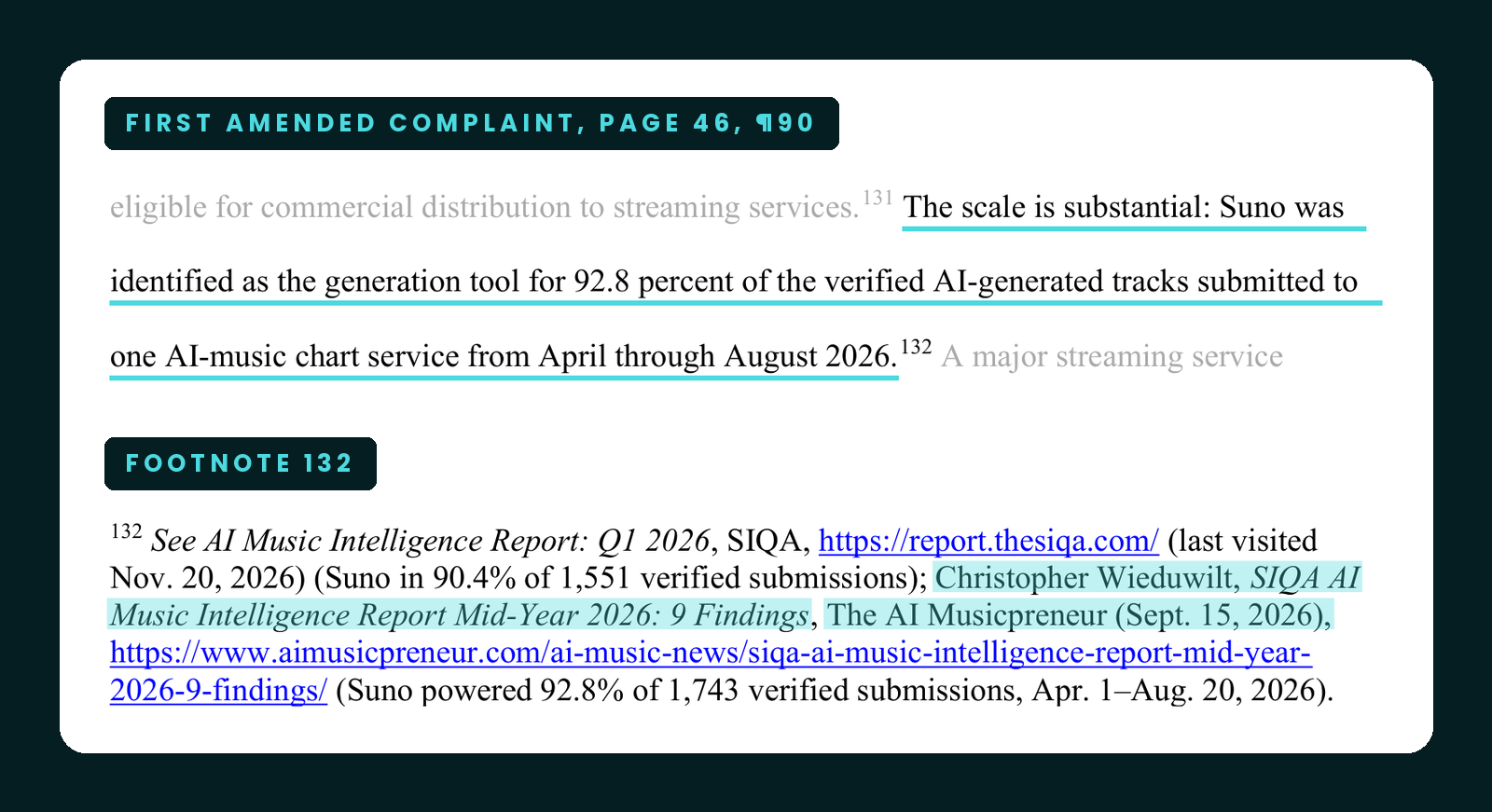
The “one AI-music chart service” is SIQA, which runs a weekly AI music chart. Every creator discloses how their track was made when they submit it, and SIQA verifies it. So the 92.8% describes the AI tracks sent to one chart, not all AI music on streaming services.
The complaint puts that number in the same paragraph as Suno’s partnership with Believe and TuneCore, which makes tracks from Suno’s new models eligible for streaming services, and a major streaming service, cited as Deezer, receiving about 90,000 fully AI-generated tracks a day. The musicians use all 3 to argue that Suno’s scale makes the harm substantial.
What happens next in Lowery v. Suno
Rule 15(a)(3) gives a defendant 14 days after service of an amended complaint to respond, unless the court orders otherwise. Counted from November 24, that points to around December 8, 2026. Judge Kelley can set a different schedule, so that date can move.
Suno has 2 basic options:
- Answer the amended complaint, which moves the case toward evidence.
- File a new motion to dismiss aimed at the amended complaint, most likely reusing its First Amendment and preemption arguments.
Suno told Billboard on November 25 that the claims are without merit and that it will defend itself in court. Digital Music News says it will publish the details of Judge Kelley’s decision later this week.
The next date to watch is Suno’s response to the amended complaint, due around December 8 by default. The Lowery v. Suno tracker has the full timeline.
Frequently asked questions
Did a judge dismiss the Lowery v. Suno identity lawsuit?
No. Judge Angel Kelley of the US District Court for the District of Massachusetts denied Suno's motion to dismiss on November 25, 2026, according to Digital Music News. The case continues on the amended complaint filed on November 24, which has 20 named plaintiffs.
Why did the judge deny Suno's motion to dismiss Lowery v. Suno?
The full order was not public when Digital Music News reported the denial, but DMN says the decision references the amended complaint. An amended complaint replaces the original one, which usually leaves a motion aimed at the old version with nothing to attack.
When does Suno have to respond to the amended Lowery v. Suno complaint?
Federal Rule of Civil Procedure 15(a)(3) gives a defendant 14 days after service of an amended complaint by default. Counted from November 24, 2026, that points to around December 8, unless Judge Kelley sets a different schedule.
Is anyone suing Suno users in Lowery v. Suno?
No Suno user is named. The first amended complaint, filed November 24, 2026, names Suno, Inc. and Unknown Defendants, which it describes as individuals or entities that directly misappropriated the musicians' identities, or knowingly induced or materially contributed to Suno's violations, to be named once identified. Paragraph 78 says Suno's own conduct occurs upstream of whatever a user types.
Where can I read the full amended complaint in Lowery v. Suno?
The first amended class action complaint in Lowery v. Suno, case 1:26-cv-14005 in the District of Massachusetts, was filed on November 24, 2026 as document 33 and runs 98 pages. The AI Musicpreneur hosts a copy at aimusicpreneur.com/documents/lowery-v-suno-first-amended-complaint-2026-11-24.pdf.
About the author
Covering AI music tools, industry shifts, and news for music creators and professionals. Twice-weekly newsletter at aimusicpreneur.com.