Judge lets indie artist Tony Justice's copyright and DMCA claims against Suno go forward
My stack My fav 6 tools for AI music after testing 70+
-
 ElevenMusic · Music generation
 -
 Moises · Stem separation
 -
 Controlla · Voice swap & cloning
 -
 Cryo Mix · Mixing + mastering
 -
 Neural Frames · Music videos
 -
 ONCE · Distribution
Some links are affiliate links — I earn a commission at no cost to you. Every tool here is one I run myself and truly believe in. This stack is proven.
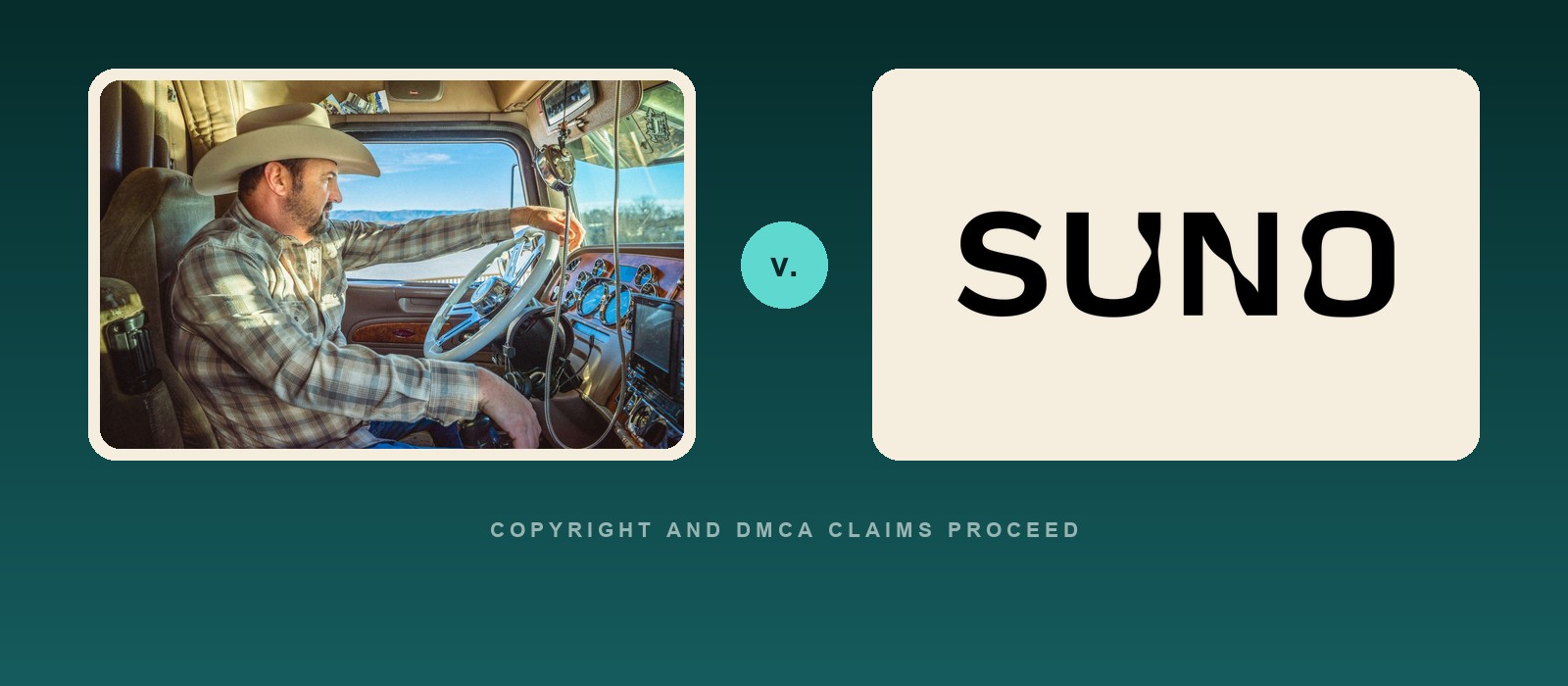
Judge F. Dennis Saylor IV refused to throw out country artist Tony Justice’s lawsuit against Suno. The US District Court for the District of Massachusetts denied Suno’s motion on the copyright and DMCA counts and dismissed a single claim, brought under the Tennessee Consumer Protection Act. An independent musician’s case against a company with major-label money on the other side of the table is heading into discovery.
The case is the proposed class action Justice filed in June 2025 with his label 5th Wheel Records and My Heartland Publishing, led by Krystle Delgado of Delgado Entertainment Law and joined last summer by Hagens Berman as co-counsel. Justice drives a truck full time. He has sold more than 100,000 albums doing it.
What Suno was trying to strip out of the case
Suno has been working to narrow this complaint since November 2025. Its position was procedural: the court should train its attention on whether using copyrighted music to build an AI model counts as fair use, and several allegations should come out of the case before anyone gets there.
Saylor took the counts one at a time and left almost all of them standing. The Copyright Act claims survive. So do the DMCA claims, which cover the removal or alteration of copyright management information, the credit and ownership data attached to a file. One count went: the Tennessee Consumer Protection Act claim, a state consumer-protection statute.
Why Suno’s “show me the infringing song” argument failed
The most useful part of the order for independent artists is a single sentence about proof.
Suno argued the complaint had to point at specific derivative works, meaning AI-generated songs built on top of the plaintiffs’ recordings, before the case could proceed. A derivative work is a new work made from an existing one, the way a remix or a translation is.
There is no categorical requirement that a plaintiff must produce the derivative work at the motion to dismiss stage.
Think about what the opposite rule would mean for an artist with 5,000 monthly listeners. Suno users have generated millions of songs. No one outside the company can search output at those numbers, and the training set is not public either. A rule demanding the smoking-gun output first would kill most training claims before discovery ever opened the door to the evidence.
Two courts, two defendants, the same group of independent artists
Justice and his co-plaintiffs are running parallel cases against Suno in Massachusetts and Udio in New York, and the two rulings this month went in opposite directions.
The New York order was a loss on paper with a route out written into it. The Massachusetts order is a plain win on the counts carrying the money. Between them sits the Woulard case, which cleared its own dismissal motion on August 5 and moved to New York.
Saylor is the same judge running Universal and Sony’s case against Suno down the hall. Eight days before this order he let the labels’ DMCA stream-ripping claim proceed while refusing to expand their case from 560 recordings to more than 61,000. One judge is now shaping how both the label fight and the indie fight get tried.
What Tony Justice said after the ruling
Justice framed the case the same way he framed it on day one, in terms of who is on each side rather than which statute applies.
We have tech and corporate America coming in and trampling on the little guy. Anytime I'm in a position to use my voice to fight for the little guy, I feel like I need to do that.
He also put a number on the stakes without using one. “This is how we live. This is how we support our families,” he told Digital Music News, describing musicians whose streaming income has thinned out as AI-generated tracks flood the same platforms. Bloomberg Law reported the ruling the same day, and the full docket sits on CourtListener.
Suno lost two other artist suits to the exit door this month, including The American Dollar’s case, dismissed with prejudice. This one did not follow.
Frequently asked questions
What did Judge Saylor decide in Justice v. Suno in August 2026?
He denied Suno's motion to dismiss on most counts, including the Copyright Act and DMCA claims brought by Tony Justice and 5th Wheel Records. The single count he dismissed was a claim under the Tennessee Consumer Protection Act. The case now moves past the pleading stage.
Does Tony Justice have to show a specific AI song that copied his music?
Not at this stage. Suno argued the complaint had to identify specific derivative works, and Saylor rejected the framing: there is no categorical requirement for a plaintiff to produce the derivative work on a motion to dismiss. Whether the outputs infringe is a question for later in the case.
Who is Tony Justice and why is he suing Suno?
Tony Justice is an independent country artist from Dandridge, Tennessee, and a full-time truck driver who has sold over 100,000 albums. He sued Suno in June 2025 with his label 5th Wheel Records and My Heartland Publishing, alleging Suno trained on his recordings and other independent artists' catalogs without permission or payment.
Is the Tony Justice ruling against Suno separate from the record labels' cases?
Yes. The major labels brought their own actions through the RIAA over recordings they own. Justice's proposed class action covers independent artists suing over their own catalogs, with different plaintiffs and different counsel, though both Suno cases sit in the District of Massachusetts before Judge Saylor.
About the author

Covering AI music tools, industry shifts, and news for music creators and professionals. Twice-weekly newsletter at aimusicpreneur.com.