
US Copyright Office fees rise in November, and registering an album's sound recordings doubles to $130
My stack My fav 6 tools for AI music after testing 70+
-
 ElevenMusic · Music generation
 -
 Moises · Stem separation
 -
 Controlla · Voice swap & cloning
 -
 Cryo Mix · Mixing + mastering
 -
 Neural Frames · Music videos
 -
 ONCE · Distribution
Some links are affiliate links — I earn a commission at no cost to you. Every tool here is one I run myself and truly believe in. This stack is proven.
Open your distributor dashboard and count how many of your releases you have registered with the US Copyright Office. For most independent artists the answer is zero. That number is about to get more expensive to fix.
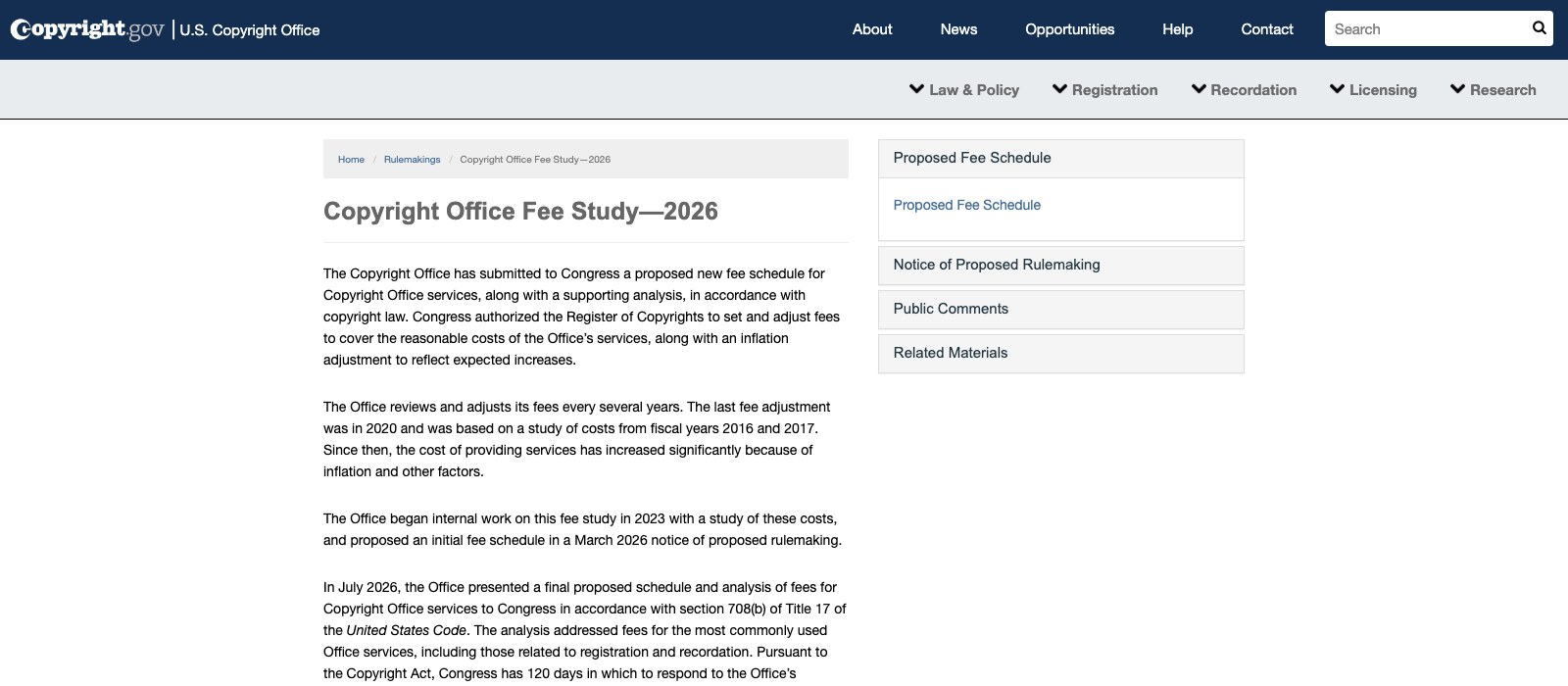
The Office sent its final proposed fee schedule to Congress in July 2026. Congress gets 120 days to object. If it doesn’t, the new fees start around November 12, and they are the first adjustment since 2020.
What the 2026 US Copyright Office fee schedule charges musicians
These are the lines that touch music catalogs, straight from the Office’s own table.
| Service | Current | New |
|---|---|---|
| Standard Application, filed electronically | $65 | $85 |
| Single Application (one author, one work, not for hire) | $45 | $55 |
| Group of musical works on an album, up to 20 works | $65 | $85 |
| Group of sound recordings on an album, up to 20 recordings | $65 | $130 |
| Group of unpublished works | $85 | $130 |
| Recordation of a document, electronic base fee | $95 | $215 |
| Expedited handling of a claim | $800 | $1,100 |
Registering a full album properly means two filings. The recordings are one claim, the songs underneath them are another. That pair goes from $130 today to $215 in November.
Why sound recordings got hit harder than compositions
Music organizations spent most of 2026 arguing the increases would land hardest on independent labels and songwriters. It worked, partly.
The March notice put group registration of musical works on an album at $130. After reading the comments, the Office cut that to $85. It also dropped its plan to kill off the Single Application, keeping the cheap $45 option and nudging it to $55 instead.
Sound recordings got none of that relief. The same $130 the Office backed away from on compositions is exactly what it kept on recordings, artwork and liner notes.
I can’t tell you why the split fell that way, and the Office’s analysis doesn’t spell it out beyond cost recovery. Registration fees currently cover about 47% of what the service costs to run. The new schedule takes that to roughly 59%.
Copyright registration is the gate to every AI lawsuit
Here’s the part that connects a fee table to the AI cases filling up federal courts.
A US work has to be registered before its owner can file a federal infringement suit. No certificate, no case. Registration is also required to bring a claim to the Copyright Claims Board, the Office’s small claims tribunal, and to join most class actions.
Timing decides what you can recover. Register before the infringement starts, or within three months of first publication, and statutory damages plus attorney’s fees stay on the table. Register after the fact and the recovery narrows sharply.
That matters right now because artists are being pulled into these fights whether they planned for it or not. More than 1,800 artists are backing the class actions against Suno and Udio in the US. Round Hill Music sued Suno and Anthropic over an initial 500 compositions and has said it may expand to 10,000 or more. Every one of those works needs a registration behind it.
What $130 buys against what a lawsuit costs
$130 to register an album’s recordings is the cheapest legal fee anywhere in this entire dispute. A copyright lawyer’s first hour costs more than that.
The expedited option shows what waiting costs. Special handling for a claim goes to $1,100 on top of the application fee, and special handling for a recordation goes from $550 to $1,100. Those are the prices you pay when a deal or a lawsuit is already moving and the paperwork isn’t done.
Back to the table for one more line. Electronic recordation, which is how a transfer of ownership gets on the public record, more than doubles from $95 to $215. If you’re buying or selling a catalog, or moving rights between entities, that’s the fee for making the change public.
Whether Congress will stop the copyright fee increase
Technically it can. Under section 708(b) of Title 17, the Register of Copyrights institutes the new fees 120 days after submission unless Congress enacts a law saying it doesn’t approve the schedule.
Nobody I’ve read expects that to happen, and the Office is already publishing the schedule as settled. But the clock hasn’t run out yet, and until it does the November date is an expectation rather than a fact. The Office’s own Proposed Fee Schedule and Analysis is the document to read if you want the full list, including services this piece skipped.
If you’re tracking how US copyright policy is shifting around AI training, my coverage of the H.R. 6028 bill and the Copyright Office covers the legislative side, and the RIAA v. Suno case tracker follows the litigation. Digital Music News covered the increase from the catalog owner’s side.
Frequently asked questions
When do the new US Copyright Office fees take effect?
The Office submitted its final proposed schedule to Congress in July 2026. Under section 708(b) of Title 17, the Register of Copyrights can institute the fees 120 days later unless Congress passes a law disapproving them. That puts the effective date around November 12, 2026.
How much will it cost to register an album's sound recordings after the 2026 fee increase?
The group registration covering up to 20 sound recordings on an album, along with the artwork and liner notes, goes from $65 to $130. Registering the underlying musical works on the same album is a separate filing that goes from $65 to $85. An artist who registers both pays $215 instead of $130.
Did the US Copyright Office lower any of its proposed 2026 fees for music?
Yes. The March 2026 proposal put the group registration of musical works on an album at $130. After public comments the Office cut that to $85. It also kept the $45 Single Application, which it had proposed eliminating, raising it to $55 instead.
Do I need a copyright registration before suing an AI company over my music?
For a US work, yes. A copyright owner generally must hold a registration before filing a federal infringement suit, and registration is also required to bring a claim to the Copyright Claims Board. Registering before the infringement starts, or within three months of first publication, is what preserves eligibility for statutory damages and attorney's fees.
About the author

Covering AI music tools, industry shifts, and news for music creators and professionals. Twice-weekly newsletter at aimusicpreneur.com.