Labelcamp launches an AI Connector, so labels can change hundreds of releases from one Claude or ChatGPT prompt

My stack My fav 6 tools for AI music after testing 70+
-
 ElevenMusic · Music generation
-
 Moises · Stem separation
-
 Controlla · Voice swap & cloning
-
 Cryo Mix · Mixing + mastering
-
 Neural Frames · Music videos
-
 ONCE · Distribution
Some links are affiliate links — I earn a commission at no cost to you. Every tool here is one I run myself and truly believe in. This stack is proven.
Labelcamp, the distribution platform owned by Paris-based distributor IDOL, launched an AI Connector on November 11, 2026 that lets labels and distributors run their catalog from Claude or ChatGPT. You type a request in plain words, and the connector turns it into actions inside Labelcamp: pulling streaming data, changing territories, moving release dates, fixing metadata.
One instruction can chain several API calls and run them across hundreds of releases at once, according to Labelcamp’s announcement, reported by Music Business Worldwide. The AI Connector is built on MCP, and it’s available now to every Labelcamp client, including IDOL, the labels it distributes and their artists.
For scale, Labelcamp says it manages more than 10 million tracks and delivers them to 180 DSPs.
What Labelcamp’s AI Connector can do in Claude and ChatGPT
The AI Connector reads and writes. On the reading side, Labelcamp’s own example question is “Which of my releases spiked in streams this week, and which playlists drove it?” From there you can dig into questions like “Do Instagram Reels bring more plays than Story stickers on this single?”, or ask what share of your streams are played in Dolby Atmos.
On the writing side, Labelcamp says a single prompt can:
- Change territorial rights on several releases at once.
- Move an album’s release date together with the dates of its supporting singles.
- Correct metadata across a full import.
- Fill in missing DSP artist IDs across a catalog.
- Explain why a platform rejected a delivery.
Because MCP is an open standard, the assistant can also mix Labelcamp’s numbers with other tools you’ve connected, for example ad results from Meta, Spotify and TikTok, or project notes in Notion. The AI Connector works alongside the normal Labelcamp dashboard.
The AI Connector gives labels and distributors tools that remove the administrative strain of global distribution, so teams can invest their energy where it genuinely counts, building long-term audiences and supporting their artists.
So how does a sentence typed into Claude end up as a change in Labelcamp?
What is an MCP connector, and how does Labelcamp’s AI Connector use one?
MCP, short for Model Context Protocol, is an open standard Anthropic introduced in November 2024 for connecting AI assistants to other software. Think of it as a universal plug: an app publishes a list of actions, and any assistant that speaks MCP can call them. OpenAI’s ChatGPT supports it too.
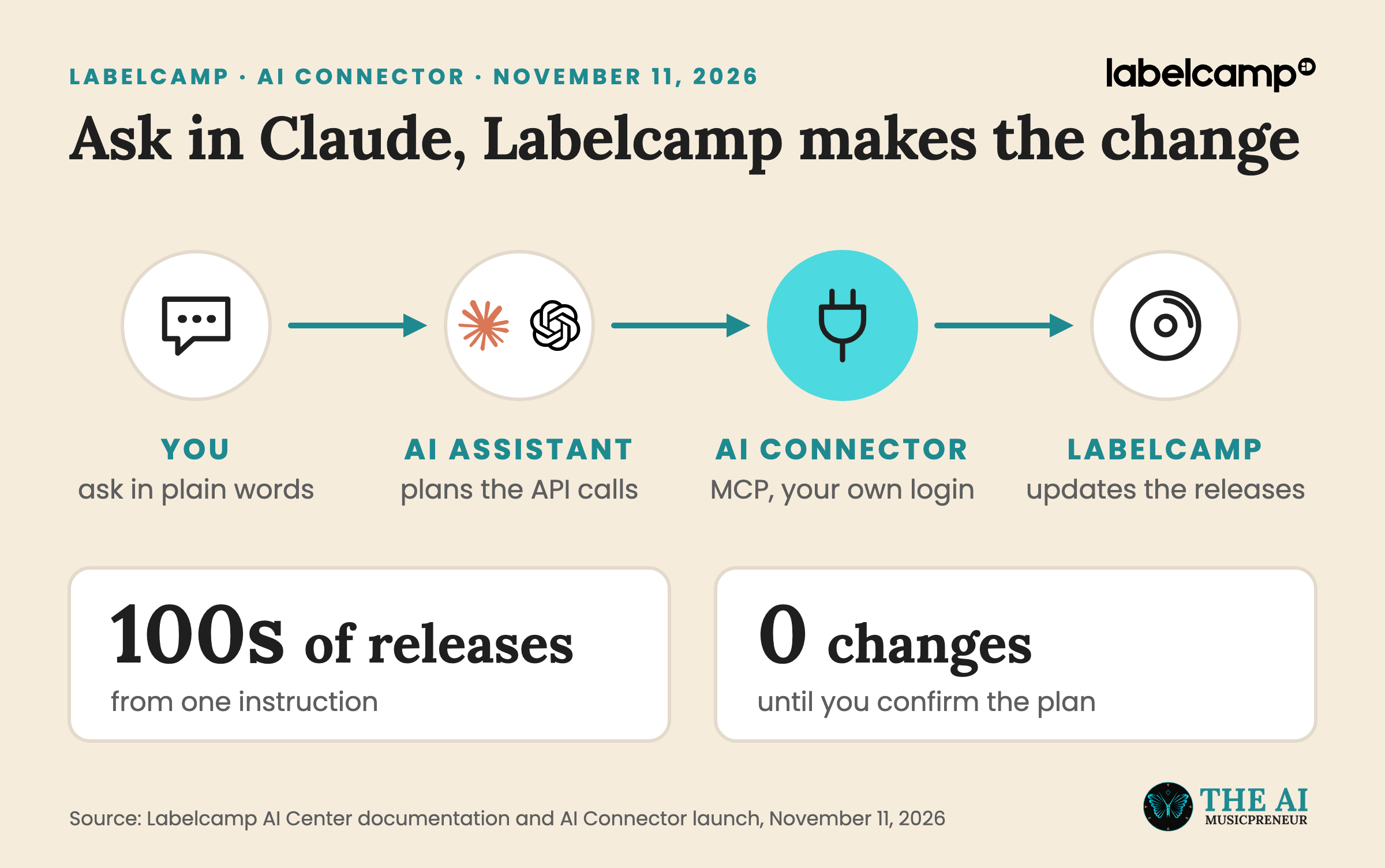
Labelcamp says it has been “API-first since its earliest days”, so the connector sits on top of the same REST API distributors already use to automate catalog management and delivery. You ask, the assistant plans the API calls, the connector runs them under your own Labelcamp login, and Labelcamp applies the change with the same checks as the app.
Labelcamp isn’t the first music company to plug into AI assistants this way. LabelGrid released an MCP server for its distribution platform on July 15, 2026, and OpenStage and Viberate opened their fan and analytics data to Claude and ChatGPT in late June and early July 2026.
Setting Labelcamp’s version up takes a couple of minutes, according to its docs.
How to connect Labelcamp’s AI Connector to Claude or ChatGPT
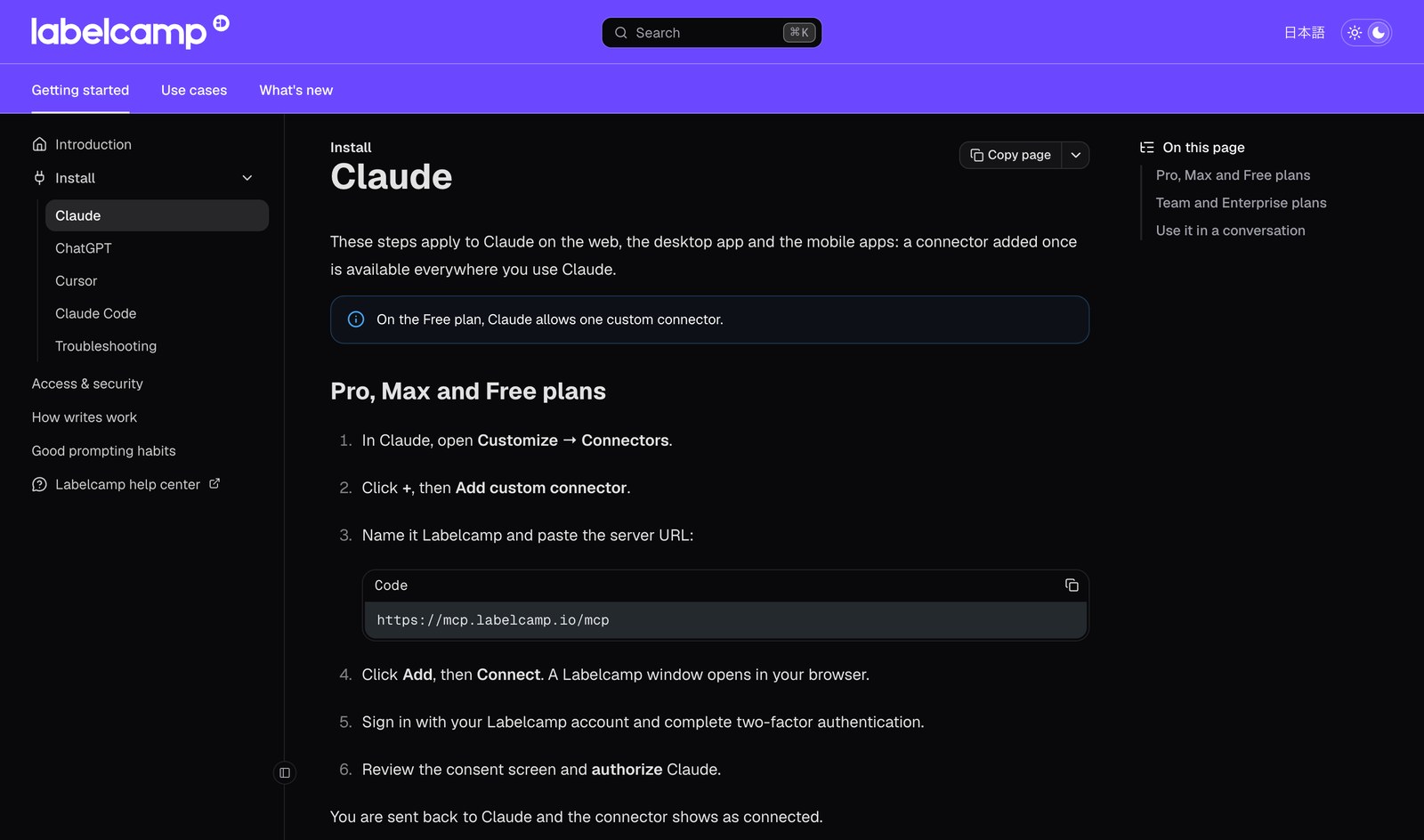
First, the connector has to be switched on for your Labelcamp account. Labelcamp enables it account by account, so ask your administrator. Then you add it to your assistant with this server URL: https://mcp.labelcamp.io/mcp.
In Claude (web, desktop and mobile), Labelcamp’s install guide lists these steps for the Pro, Max and Free plans:
- Open Customize, then Connectors.
- Click +, then Add custom connector.
- Name it Labelcamp and paste the server URL.
- Click Add, then Connect, and sign in with your Labelcamp account and two-factor code.
- Review the consent screen and authorize Claude.
The Free plan allows only one custom connector. On Team and Enterprise plans, an organization Owner adds the connector under Organization settings, and each member then connects with their own Labelcamp login.
In ChatGPT, custom connectors run through developer mode on the web, for Plus, Pro, Business, Enterprise and Education accounts. Turn on Developer mode under Settings, then Security and login, create an app under Plugins, name it Labelcamp, paste the same URL and sign in. Labelcamp also has install guides for Cursor and Claude Code.
Once you’re connected, Labelcamp suggests a first test prompt: “What can I do with Labelcamp?” The assistant should list what your account is allowed to do. The same custom-connector route works for other music apps that plug into Claude.
An assistant that can rewrite hundreds of releases raises one obvious question, though.
Does Labelcamp’s AI Connector change releases without asking?
No. Labelcamp’s documentation on writes says the connector never writes on the first call. The assistant first gets a plan of what would change, product by product, and nothing is written until you say go.
A few more guardrails from the same docs:
- Tracks that carry their own price or genre count as deliberate overrides, so they’re left alone and named in the plan by title and ISRC.
- Ambiguous input gets refused. Give it 03/04/2026 and it asks for 2026-04-03 instead of guessing between March and April.
- Each bulk change is capped at a limited number of items, and Labelcamp doesn’t publish the exact cap.
- Request limits are shared across your whole group, so one busy colleague can use them up for everyone.
The assistant also never gets more access than your Labelcamp account has. IDOL’s operations staff used the connector day to day in a beta before launch, according to Labelcamp.
“Teams can turn a plain-language request into real actions, like importing complex sets of metadata or breaking down how listeners discover a release, in as much detail as each platform allows, while keeping their catalogue and financial data private and protected,” Nicolas Safieh, General Manager of Labelcamp, said in the launch announcement.
Labelcamp’s AI transparency tags and AI training rules for rightsholders
Alongside the connector, Labelcamp added a feature it says lets rightsholders “retain control over how AI companies use their music”. According to Labelcamp, the platform “can communicate AI transparency tags to DSPs if AI was involved in a release and set rules on whether their recordings can be used for AI training and generation”.
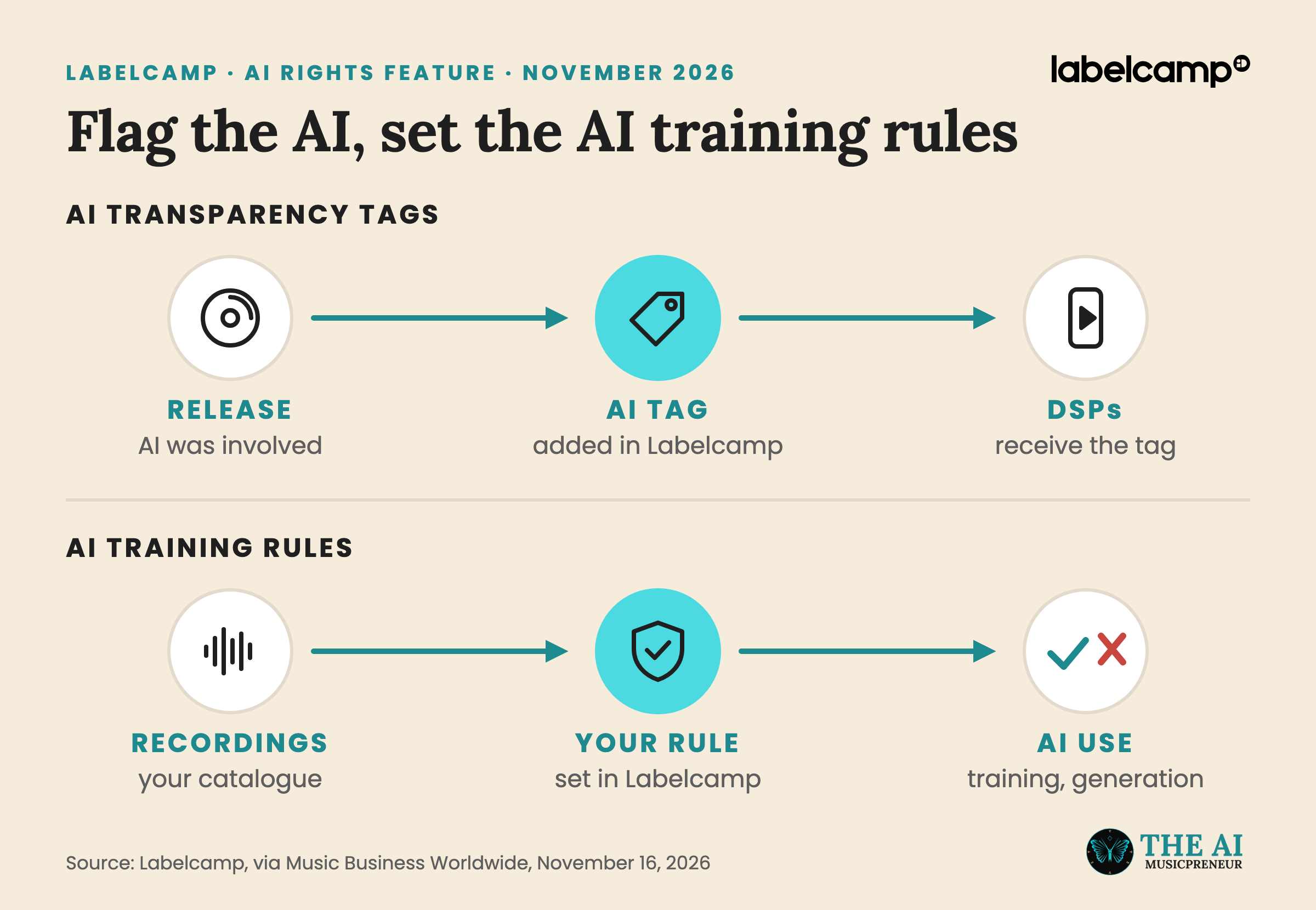
An AI transparency tag is a flag in the release data that tells a store AI was used. Some stores already ask for one, like Apple Music’s AI tagging rule and Qobuz’s AI tag on albums. Labelcamp didn’t say which of its 180 DSPs act on the tag.
The feature is rolling out across Labelcamp now. It lands as the platform grows: Labelcamp says revenue rose 23% in the 12 months to the end of June 2026, and it works with more than 40 B2B clients outside IDOL, including Because Music, Ditto Music, Kompakt, [PIAS], WMMusicDistribution, ERIK in India, Euphoria Media Group in Hong Kong and FaroLatino in Argentina.
IDOL, which Bittard founded in 2006, is also one of the distributors backing the IFPI’s Streaming Integrity Initiative. If your label or distributor already runs on Labelcamp, the connector is live today: ask your administrator to switch it on, then start with a small batch.
Frequently asked questions
Who owns Labelcamp, the platform behind the AI Connector?
Labelcamp is owned by IDOL, an independent distributor headquartered in Paris that Pascal Bittard founded in 2006. Labelcamp has handled IDOL's own distribution for more than 15 years and also works with more than 40 B2B clients, including Because Music, Ditto Music and [PIAS].
How much does Labelcamp's AI Connector cost?
Labelcamp hasn't published a separate price for the AI Connector, and it is available to all existing Labelcamp clients. You do need an AI assistant plan that accepts custom connectors: Claude's Free plan allows one, and ChatGPT needs a Plus, Pro, Business, Enterprise or Education account with developer mode turned on.
Can independent artists use Labelcamp's AI Connector?
Only through a label or distributor that runs on Labelcamp. Labelcamp sells to labels and distributors, and the connector is open to its clients, to IDOL, to the labels IDOL distributes and to their artists, once an administrator switches it on for the account.
Does Labelcamp's AI Connector share catalog data with Claude or ChatGPT?
Yes, the answers to your questions pass through your AI assistant like anything else you type into it, so Anthropic's or OpenAI's data policy for your plan applies. Labelcamp's documentation says the assistant never sees your Labelcamp password, only an access token, and it can only reach what your own account can.
About the author
Covering AI music tools, industry shifts, and news for music creators and professionals. Twice-weekly newsletter at aimusicpreneur.com.