Suno ranks #7 on a16z's first AI consumer spending list, and it's the only music app on all 3 of its Top 100 rankings
My stack My fav 6 tools for AI music after testing 70+
-
 ElevenMusic · Music generation
 -
 Moises · Stem separation
 -
 Controlla · Voice swap & cloning
 -
 Cryo Mix · Mixing + mastering
 -
 Neural Frames · Music videos
 -
 ONCE · Distribution
Some links are affiliate links — I earn a commission at no cost to you. Every tool here is one I run myself and truly believe in. This stack is proven.

#7. That’s where Suno lands on the first ranking of what US consumers actually pay for in AI.
Andreessen Horowitz published the 7th edition of its Top 100 Gen AI Consumer Apps on October 5, 2026. Next to the usual web and mobile lists, it added a spending ranking built from YipitData’s panels of US consumer card payments.
Only 7 companies make all 3 lists: ChatGPT, Claude, Suno, Perplexity, Photoroom, Canva and Notion. Suno is the only music app in that group.
Where Suno and ElevenLabs rank in a16z’s Top 100 Gen AI Consumer Apps
The 3 lists measure different things:
- Web traffic ranks the top 50 products by monthly visits in July 2026, from Similarweb.
- Mobile ranks the top 50 apps by monthly active users, from Sensor Tower.
- Spending ranks the top 50 vendors by observed US consumer card spend from June to August 2026, from YipitData. a16z says it should not be read as total company revenue.
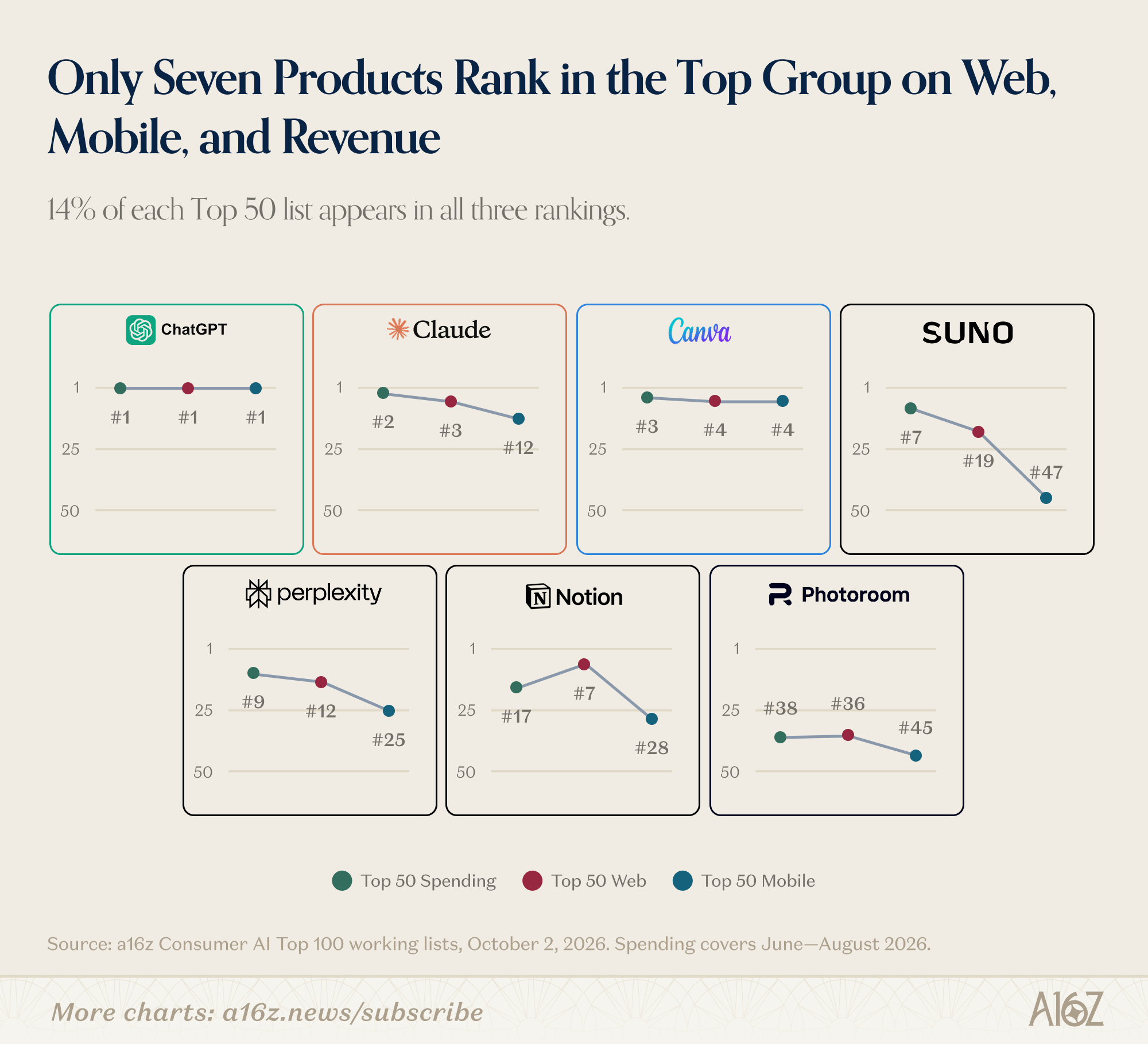
Suno’s spread is the widest of the 7: #7 on spending, #19 on web and #47 on mobile.
ElevenLabs ranks #10 on spending and #25 on web traffic, but doesn’t make the mobile list. Moises, the stem separation and practice app, makes the spending list too.
Suno’s web rank slipped. It was #15 in the 6th edition in March 2026, and it held that spot from the edition before. Now it’s #19.
It’s Suno’s second traffic drop on this list since 2025. In the 5th edition, Suno fell from #8 to #15, and the question then was whether its position was slipping. The spending list answers a different question: who pays.
Why a16z says Suno earns more than its web traffic suggests
a16z’s main finding is that AI spending is concentrated. In August 2026, only 4.5% of US consumers paid for ChatGPT, Gemini or Claude, and the top 10% of spenders made up roughly half of all observed spend.
Those heavy spenders buy coding, productivity and creative tools. a16z groups Suno and ElevenLabs under creative products built on their own models, alongside Midjourney, HeyGen, Kling and Topaz Labs.
A distinctive sound, visual style, or training dataset can matter more for a particular creative task than which lab has the strongest general-purpose model.
That’s the case for Suno and ElevenLabs holding their spot while Google pushes its own music models. a16z lists Lyria among Google’s creative launches of the past 6 months, and people are still paying for the specialist tools.
The numbers line up with what Suno says about itself. CEO Mikey Shulman said on October 1 that Suno is “far beyond” the 2 million subscribers and $300 million in revenue it reported in February. ElevenLabs, for its part, reached a $22 billion valuation in its employee tender last week.
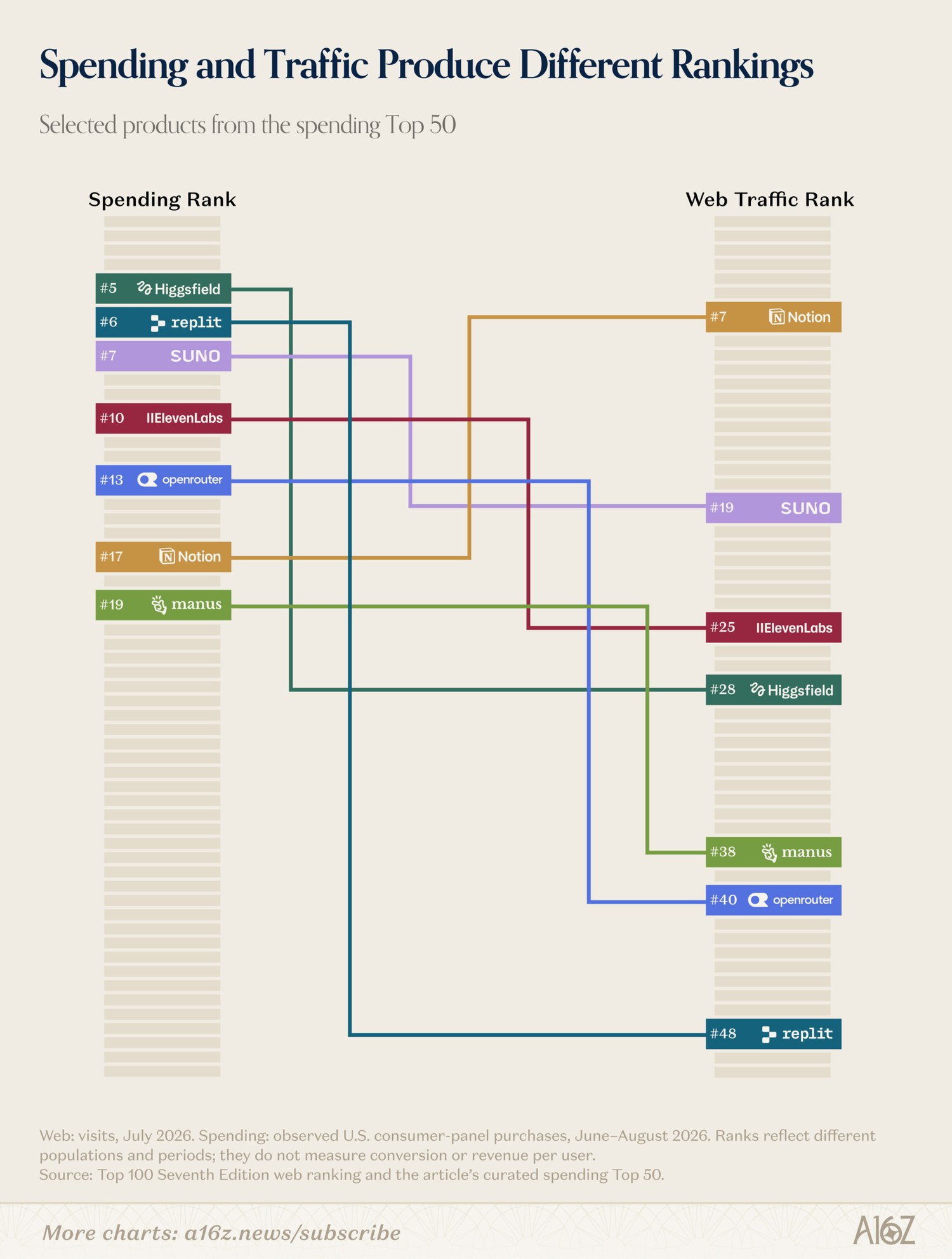
So the music generator with the 19th-biggest website is the 7th-biggest place US consumers spend money on AI. The next edition will show whether that gap holds.
Frequently asked questions
Where does Suno rank in a16z's Top 100 Gen AI Consumer Apps 7th edition?
Suno ranks #7 on a16z's new US consumer spending list, #19 on its web traffic list and #47 on its mobile list. It is one of 7 companies on all 3 lists, alongside ChatGPT, Claude, Perplexity, Photoroom, Canva and Notion.
Which music apps made a16z's first consumer AI spending ranking in October 2026?
Suno ranks #7 and ElevenLabs ranks #10 on a16z's first spending list, and the stem separation app Moises also makes the top 50. The ranking is based on observed spending on US consumer cards from YipitData.
How does a16z measure consumer AI spending in its Top 100 Gen AI Consumer Apps report?
a16z uses YipitData's panels of US consumer card spending, so the ranking shows what consumers pay rather than total company revenue. The web list uses Similarweb monthly visits and the mobile list uses Sensor Tower monthly active users.
About the author

Covering AI music tools, industry shifts, and news for music creators and professionals. Twice-weekly newsletter at aimusicpreneur.com.