
Secretly Distribution offered 100+ labels an AI licence. 3 said yes.
My stack My fav 6 tools for AI music after testing 70+
-
 ElevenMusic · Music generation
 -
 Moises · Stem separation
 -
 Controlla · Voice swap & cloning
 -
 Cryo Mix · Mixing + mastering
 -
 Neural Frames · Music videos
 -
 ONCE · Distribution
Some links are affiliate links — I earn a commission at no cost to you. Every tool here is one I run myself and truly believe in. This stack is proven.
For two years the independent sector’s position on AI has been consistent: consent, compensation, and a seat at the table. ElevenLabs gave it all three. It licensed training rights from Merlin and Kobalt on opt-in terms with a revenue share, and Secretly Distribution put that licence in front of every one of its 100-plus label partners.
Three labels said yes. Seven artists said yes. That number is buried on page 26 of the Independent Music 2026 report, and I think it’s the most important number in it.
What ElevenLabs actually put on the table
The facts first, because the deal is better than most people assume.
ElevenLabs launched its latest music model with training licences from Merlin, which represents thousands of independent labels, and from Kobalt, the biggest independent publisher. The licences are opt-in. An artist or songwriter chooses whether their work goes into the model, and if it does, they participate in the revenue.
Kobalt got a most favored nation clause on top. If ElevenLabs ever hands a major label better terms, Kobalt’s terms rise to match. The report calls that proof that favourable structures can be cut at this layer, and it’s right.
Merlin did the first-mover part twice. Its deal with Spotify for AI covers and remixes landed ahead of two of the majors, and its ElevenLabs deal closed at the end of 2025 before any major had signed anything comparable.
Why 3 out of 100 decides more than any lawsuit does
Here’s the thing about a licence between an AI company and a collective. It only covers what the members underneath it clear. The paper exists, and the model still trains on a fraction of the repertoire.
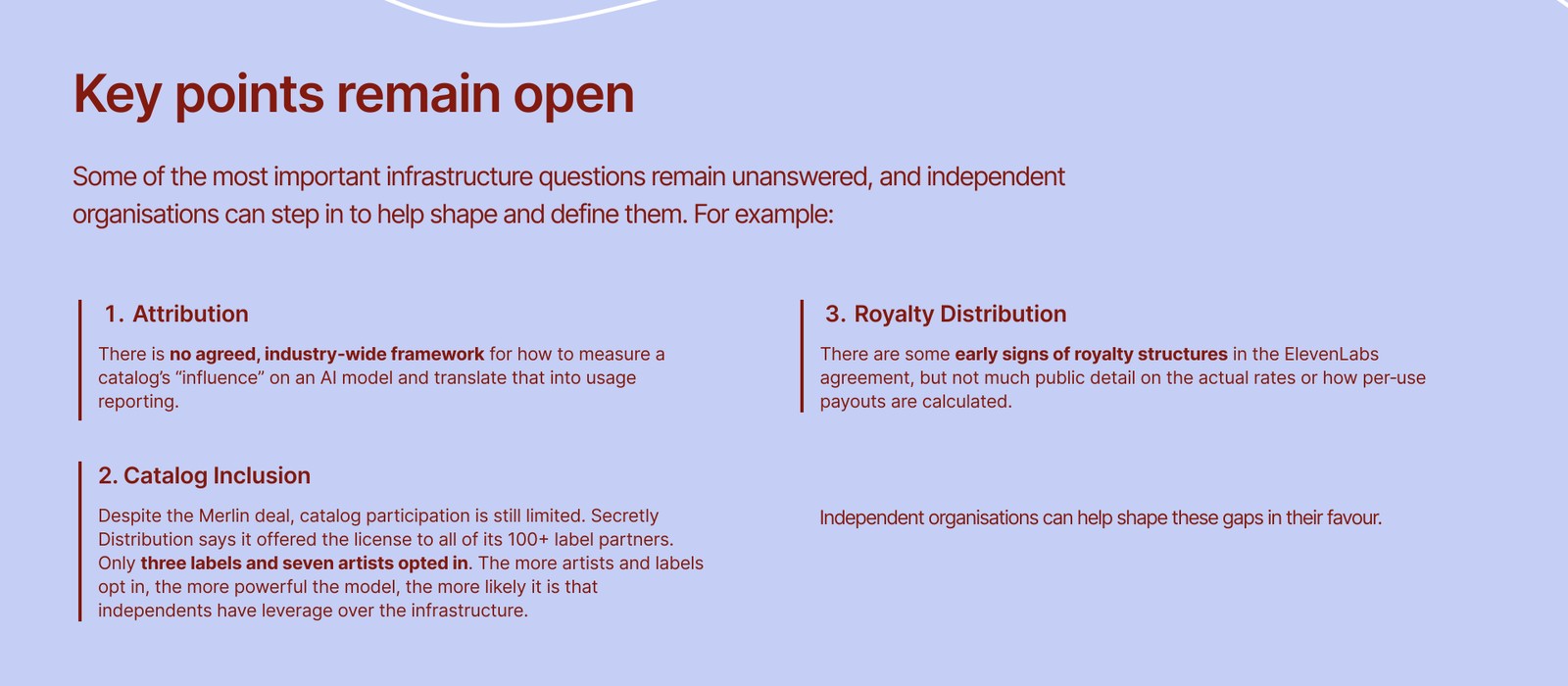
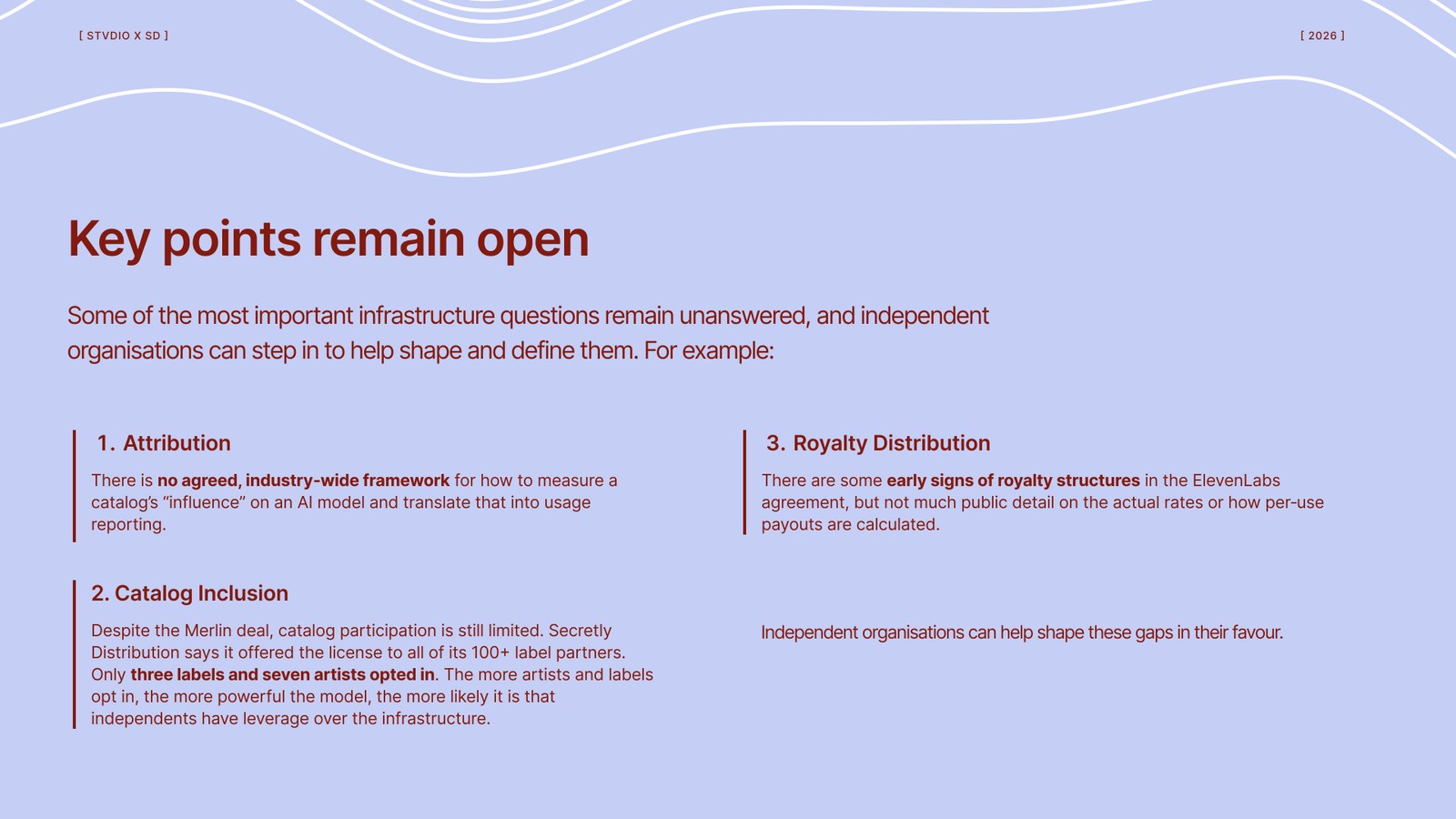
The report says it plainly: the more artists and labels opt in, the more powerful the model, and the more likely independents get leverage over the infrastructure. Run that backwards. Three labels and seven artists means the licensed model is competing against Suno’s everything with almost nothing, and the indie sector’s proof of concept for a middle path is sitting on 3% participation.
I’ve spent a year arguing that indies build their own leverage instead of waiting for the labels to win the fight for them. Tony Justice putting a tobacco-settlement firm on Suno was that. Merlin and Kobalt cutting the ElevenLabs terms was that. The opt-in rate is where the argument goes to die, because leverage you don’t use is a press release.
The strongest case for staying out, and why it only half holds
The honest counterargument is that opting out is a decision, not apathy.
Plenty of independent labels oppose AI training on any terms, and the report is candid about how unfinished the terms are. There is no agreed way to measure a catalog’s influence on a model. There’s no public detail on actual rates or per-use payouts. A label with no legal team looking at that is not being lazy when it declines; it’s being careful with the only asset it has.
I made the same point about the 300 AI deals stat in June. A big number at the top hides a narrow access base, and the structural reason indies stay out is that they lack catalog scale and lawyers, not that they lack interest.
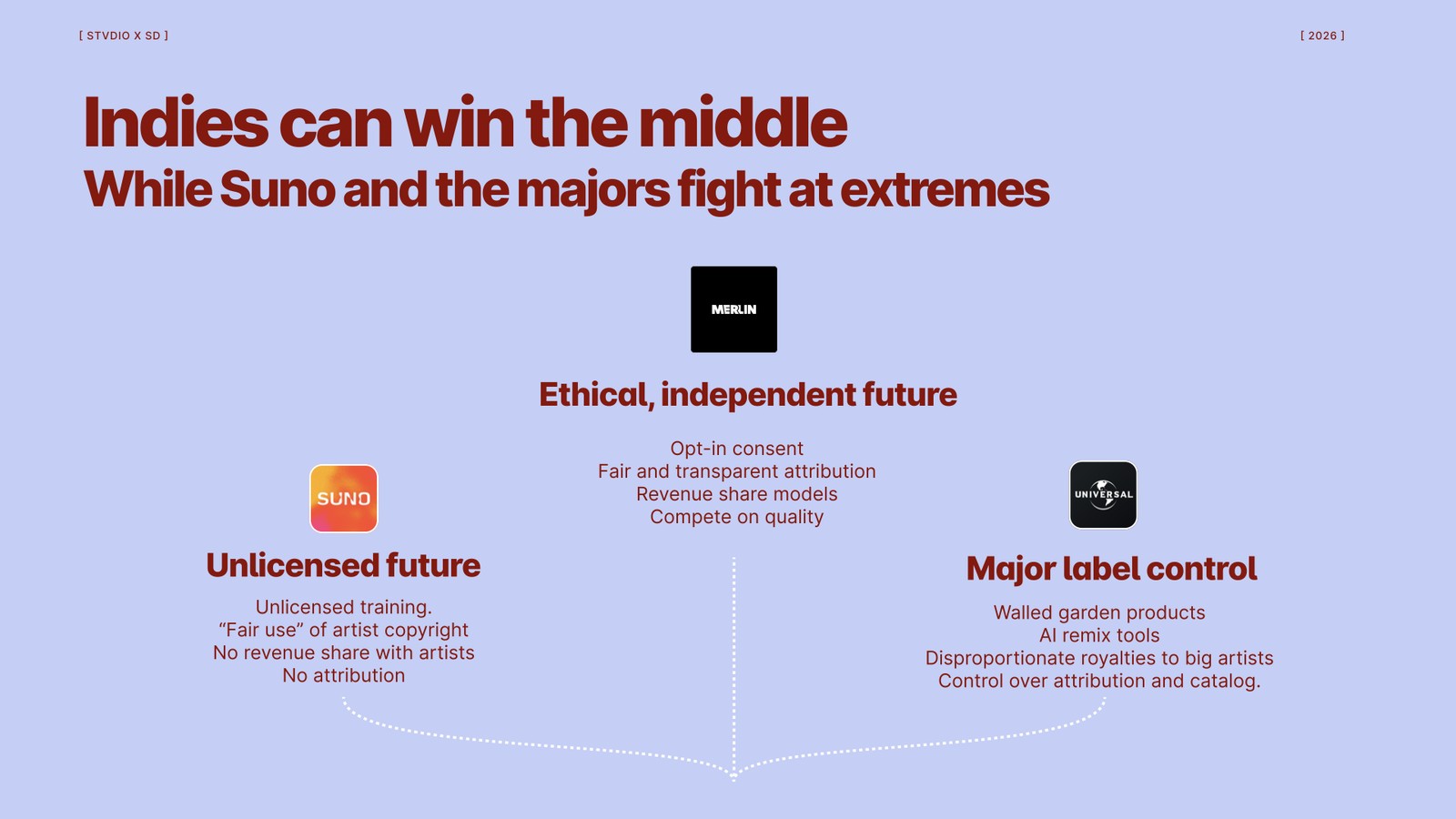
Where it stops holding is here. The ElevenLabs licence was built to remove exactly those barriers. Merlin did the negotiating. Kobalt did the lawyering. The most favored nation clause did the protecting. The remaining risk is the one every licence carries, and at some point declining every deal on principle becomes the thing the report warns about: sitting on the sidelines while big tech and the majors set the rules again.
Either: engage and accelerate a technology that many are philosophically opposed to, but at least shape it in their favour. Or do nothing, leaving this crucial infrastructure layer yet again in the hands of big tech and major label decision-makers.
Where this goes if the number doesn’t move
The report says the door won’t stay open long, and I’d put a shape on that.
Suno has a BMG deal and a Warner settlement and no deal with any independent organisation. Udio has Universal and Warner and a walled garden. If the licensed independent model stays at 3% participation, ElevenLabs has every commercial reason to go sign a major, the most favored nation clause kicks in, and the independent middle path becomes a footnote in a market the majors wrote.
I don’t know whether opting in is the right call for your catalog. I do know the question is no longer whether the industry will offer consent and a revenue share. It offered them. The question is what independents do with the offer, and right now the answer is 3 out of 100.
If you run a label on Secretly, or on Merlin’s network through any distributor, the licence is there. Read it, price it against what you’d get from silence, and decide on the terms rather than the tribe. Watch the opt-in number in next year’s report. It will tell you who’s actually building the middle and who was only asking for it.
Frequently asked questions
What are the terms of the ElevenLabs licensing deal with Merlin and Kobalt?
According to the Independent Music 2026 report, the licences are opt-in, so each artist and songwriter chooses whether their work trains the model, and those who opt in share in the revenue. Kobalt also negotiated a most favored nation clause, which upgrades its terms automatically if ElevenLabs later gives a major label a better deal.
Why did so few Secretly Distribution labels opt into the ElevenLabs AI licence?
The report doesn't say, and Secretly Distribution hasn't published reasons. The likeliest explanations are principle, meaning labels that oppose AI training on any terms, and uncertainty, because the report itself notes there is no agreed way to measure a catalog's influence on a model and little public detail on the actual rates.
What does catalog inclusion mean in AI licensing?
It's the share of a rights holder's catalog that is actually cleared for a model to train on. A licence can exist on paper between an AI company and a collective like Merlin, but if the labels underneath it don't opt in, the model trains on a fraction of the repertoire and the licence carries little weight.
What is a most favored nation clause in a music licensing deal?
A most favored nation clause guarantees that if the licensor later gives another party better terms, the clause holder's terms improve to match. In the ElevenLabs deal it means Kobalt cannot be left behind if a major label negotiates a higher rate later.
About the author

Covering AI music tools, industry shifts, and news for music creators and professionals. Twice-weekly newsletter at aimusicpreneur.com.