Suno's 4 principles for AI music, and the download limit that comes with them
My stack My fav 6 tools for AI music after testing 70+
-
 ElevenMusic · Music generation
 -
 Moises · Stem separation
 -
 Controlla · Voice swap & cloning
 -
 Cryo Mix · Mixing + mastering
 -
 Neural Frames · Music videos
 -
 ONCE · Distribution
Some links are affiliate links — I earn a commission at no cost to you. Every tool here is one I run myself and truly believe in. This stack is proven.
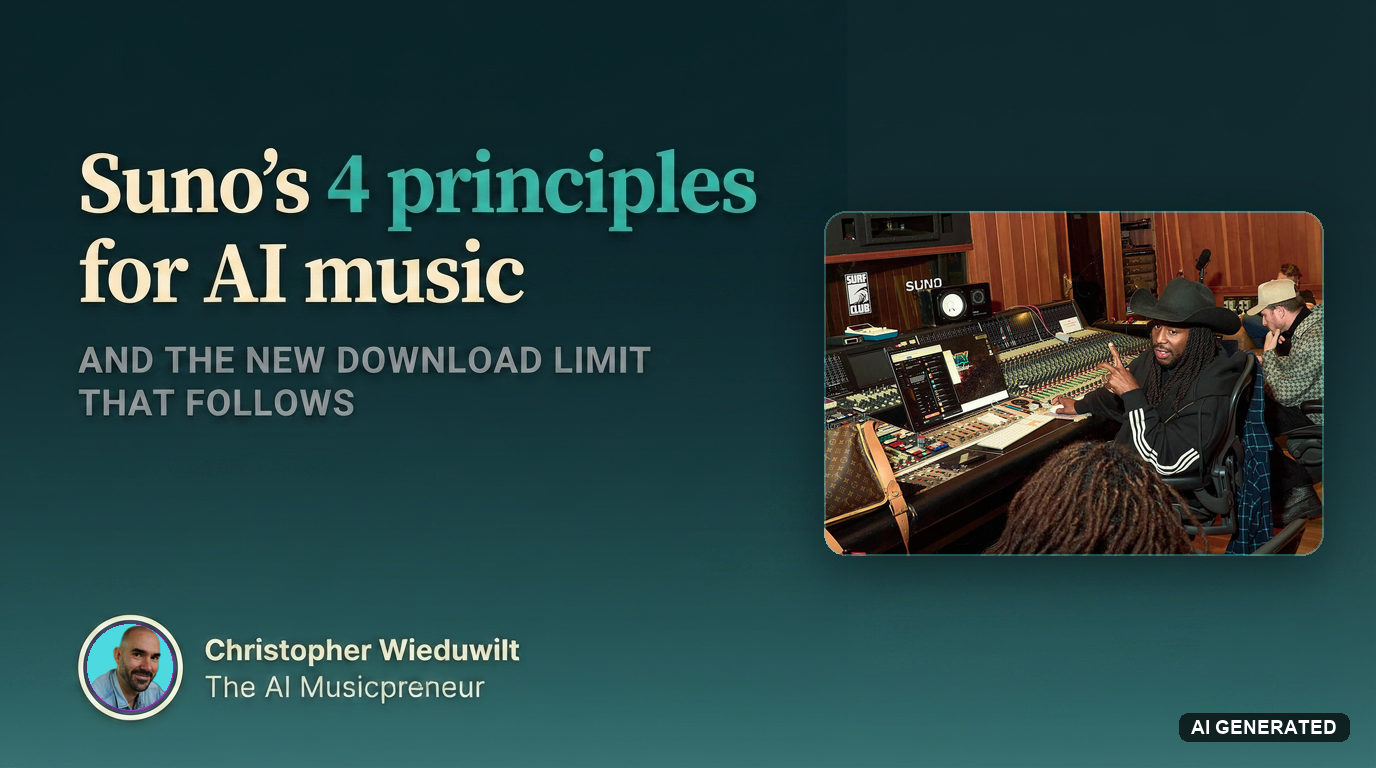
Suno published the 4 principles it builds by on August 6, 2026, in a post from co-founder and CEO Mikey Shulman. The same post confirmed a downloads policy built to stop people pushing Suno songs onto streaming platforms at scale.
Shulman framed the principles as decision rules the company already runs on, not a new mission statement. Each one arrives attached to a programme or a product change, and the fourth one carries the part with teeth.
We've always believed that how we build matters just as much as what we build.
Here are the 4 principles, what Suno already does under each one, and the changes landing next.
Principle 1: Suno says great music is made by people
Suno’s first principle puts humans at the centre of the output. Technology opens new ways to create, the post argues, and it cannot replace the experiences, emotions, and imperfections behind a song people care about.
The proof Suno offers is process. The company says it runs weekly writing camps with artists at every career stage, building models and products next to songwriters, musicians, and producers rather than shipping to them.
The goal Shulman states is to sit inside the creative process with artists who work in different ways, then build tools around how they actually want to create.
Principle 2: Spark grants and education back the second principle
The second principle says Suno’s tools should open new ways for artists to create, reach fans, and build careers. Shulman ties it directly to the next generation of models Suno is developing with the music industry.
Two existing programmes carry it today. Suno funds educational work for creators, and runs Spark, its incubator for unsigned artists, which hands out grants, mentorship, and marketing support.
Shulman also says Suno is exploring mechanisms for artists to capture benefits the technology did not previously make possible. He gave no detail on what those look like.
Principle 3: How Suno blocks artist-name prompts
The third principle is the one Suno has argued in court and in public for over a year. AI should help people make something new rather than copy someone else’s work.
Suno calls its training approach Original Creation, By Design. The company says it deliberately left artist names out of its training metadata so the model is not taught to sound like named acts. Suno’s product chief made the same argument in June.
Here is what Suno says it does at the prompt layer:
- Prompts naming a specific artist or a copyrighted song have never been allowed
- A prompt referencing an artist gets the name stripped and redirected to descriptive musical traits
- Uploaded audio and lyrics are screened with Audible Magic, Musixmatch, and other third-party providers
The claim sits against an unresolved legal record. A Munich court ruled for GEMA earlier this year, and the major-label cases are still running.
Principle 4: Why Suno is limiting mass downloads to streaming platforms
The fourth principle says more people making music should strengthen the wider music economy, or in Suno’s own wording, “strengthen the ecosystem.”
Shulman’s argument is that most Suno output is personal. A lullaby for a child, a song for a partner, something made to hold a memory. Music like that may never get released publicly and still matters to the person who made it.
Suno separates personal creation from using the tool to mass export content. The company says it will not decide what has artistic value, and it does accept a responsibility to make the tool harder to abuse in ways that damage how music gets paid for.
Suno flagged a more intentional approach to downloads last year. Billboard reported the plan traces back to the terms of Suno’s Warner Music settlement.
What Suno has not published: the actual caps, which plans they apply to, or a start date. If your release plan depends on high-volume Suno exports, it is running on an unconfirmed policy right now. Suno accounts for most commercially released AI music, so the caps will reshape a lot of catalogues.
Suno’s watermarking and fingerprinting rollout
Suno is starting to ship transparency tools built to “align with emerging industry standards,” so a song generated on Suno can be identified after it travels to another platform. Audio watermarking and fingerprinting follow in the coming weeks, aimed at helping distribution platforms catch fraud.
Suno says the marks are durable and resistant to tampering, and do not change the listening experience. The company is explicit that they carry no verdict on whether a song is good, meaningful, or sufficiently human.
Who discloses stays with artists and platforms, in Suno’s framing. Its role is supplying the option. Suno took a similar line when it responded to the RIAA labelling proposal.
What Suno’s updated Community Guidelines now ban
Suno rewrote its Community Guidelines the same day, mostly for clarity. The prohibitions cover recreating existing songs, uploading material a user has no rights to, and using someone’s voice or likeness without permission.
The list also names scams, spam, fake engagement, bots used to evade detection, and deceptive audio presented as authentic. Music Week noted the Musixmatch adoption alongside the guidelines update.
Suno’s Trust and Safety team reviews content and works through in-app reports. Enforcement scales from warnings and temporary suspensions up to permanent bans and referrals to authorities.
The 4 principles, recapped
Quick recap before you plan your next release:
- Great music is made by people, evidenced by weekly artist writing camps
- Technology opens new possibilities, funded through Spark grants and education
- AI should enable originality, enforced by stripped artist names and upload screening
- More people creating music should strengthen the wider music economy, enforced by the coming download limit
The download limit is the only item on the list changing what you can do this year. Watch for the caps.
Frequently asked questions
What is Suno's new downloads policy?
Suno said it will soon introduce a downloads policy designed to limit the ability to mass distribute songs on streaming platforms. The company says the change preserves professional, creative, and personal uses of the tool. Suno first signalled the shift last year and repeated it in its August 6, 2026 principles post.
Will Suno's download limit stop you from distributing your songs?
Suno says the change will not affect the vast majority of its users, and the stated target is large-scale abuse rather than individual releases. The company has not yet published the download caps, the tiers they apply to, or a start date. Until those details land, treat any high-volume release plan built on Suno exports as unconfirmed.
What are the 4 principles in Suno's August 2026 announcement?
The 4 are that great music is made by people, technology opens new possibilities for creatives, AI should enable originality rather than imitation, and more people making music should strengthen the wider music economy. Mikey Shulman framed them as decision rules the company already uses. Each one is tied to a programme or product change in the post.
What audio watermarking is Suno adding to its songs?
Suno is rolling out transparency tools so songs generated on Suno can be identified when shared on other platforms, followed by audio watermarking and fingerprinting in the coming weeks. Suno says the marks are built to be durable and resistant to tampering without changing how a track sounds. The company describes them as identification tools rather than a quality judgement.
What does Suno's updated Community Guidelines policy ban?
The updated guidelines prohibit recreating existing songs, uploading material a user has no rights to, and using someone's voice or likeness without permission. They also ban scams, spam, fake engagement, bot-based evasion, and deceptive audio presented as authentic. Enforcement runs from warnings and temporary suspensions to permanent bans and referrals to authorities.
About the author

Covering AI music tools, industry shifts, and news for music creators and professionals. Twice-weekly newsletter at aimusicpreneur.com.