Mozart AI adds Treblo, the model linked to Fenix Flexin's 'Rubberz', next to its licensed ElevenLabs option

Black Friday deal · ends Nov 30 My #1 AI music video tool is up to 50% off until Nov 30
Music videos made with Neural Frames
- 50% off when you go yearly
- 25% off monthly plans and credit top-ups
Back to full price after Nov 30. Affiliate link: I earn a commission at no cost to you.
Mozart AI is adding Treblo as a music model. Mozart’s Black Friday email to subscribers on November 25 ended with one line: “One more thing: Treblo, our new model, goes live tomorrow.” Mozart’s terms of service, last revised on November 26, name Treblo’s company, Sonauto, Inc., next to ElevenLabs.
Treblo is the 4-person platform that detection tools, its own included, linked to Fenix Flexin’s Hot 100 hit “Rubberz”, and it hasn’t said what its model was trained on. When Mozart raised $6 million in February, it said its model providers train on licensed material.
I emailed Mozart’s support team on November 25 with 4 questions: how the integration works, what Treblo was trained on and whether rightsholders get paid, whether artist names work in prompts, and which commercial rights apply. No statement had come back when this article went live. I’ll add Mozart’s answers here when they arrive.
What Mozart AI announced about Treblo on November 25
The email led with 40% off annual plans and Hans 2.0, which Mozart calls “our best-sounding music model yet.” Treblo got the last line. The email didn’t say who builds Treblo or what it learned from.
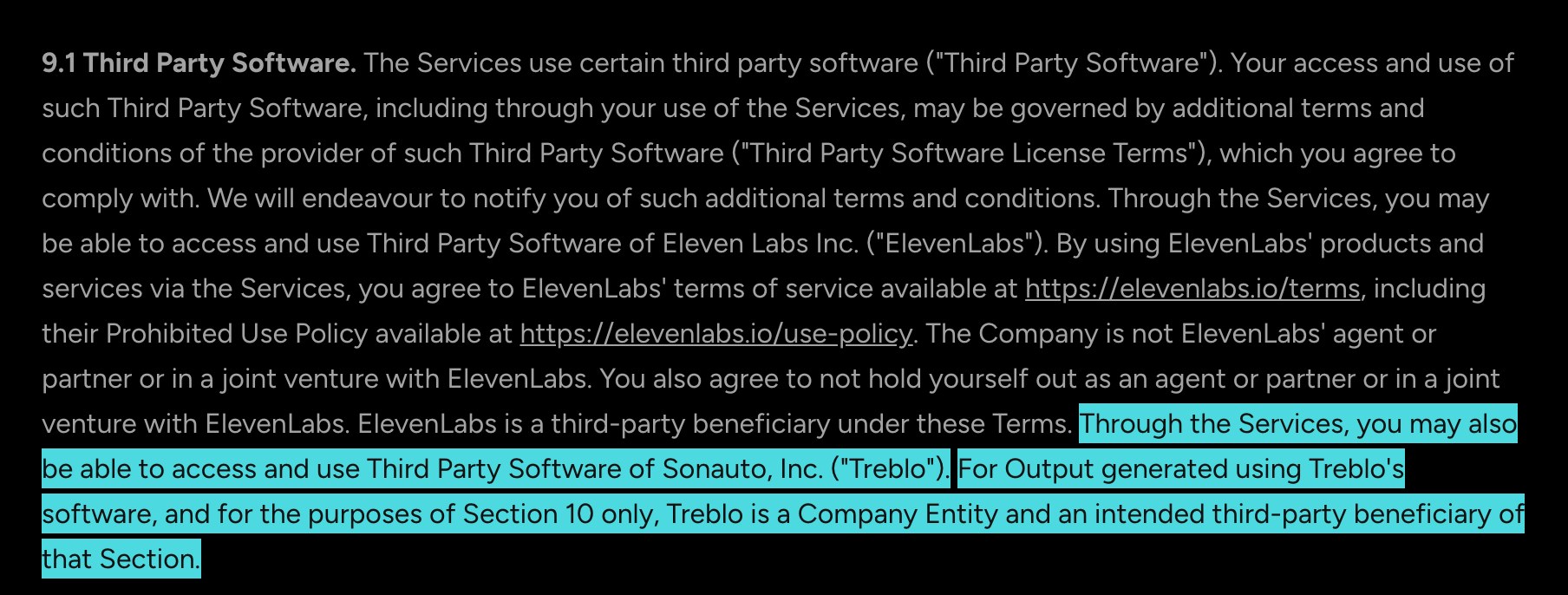
On the morning of November 26, Mozart’s models page still listed Hans 2.0, Hans 1.0 and ElevenLabs. The terms of service, revised the same day, already name Treblo. Section 9.1 says users “may also be able to access and use Third Party Software of Sonauto, Inc. (“Treblo”).”
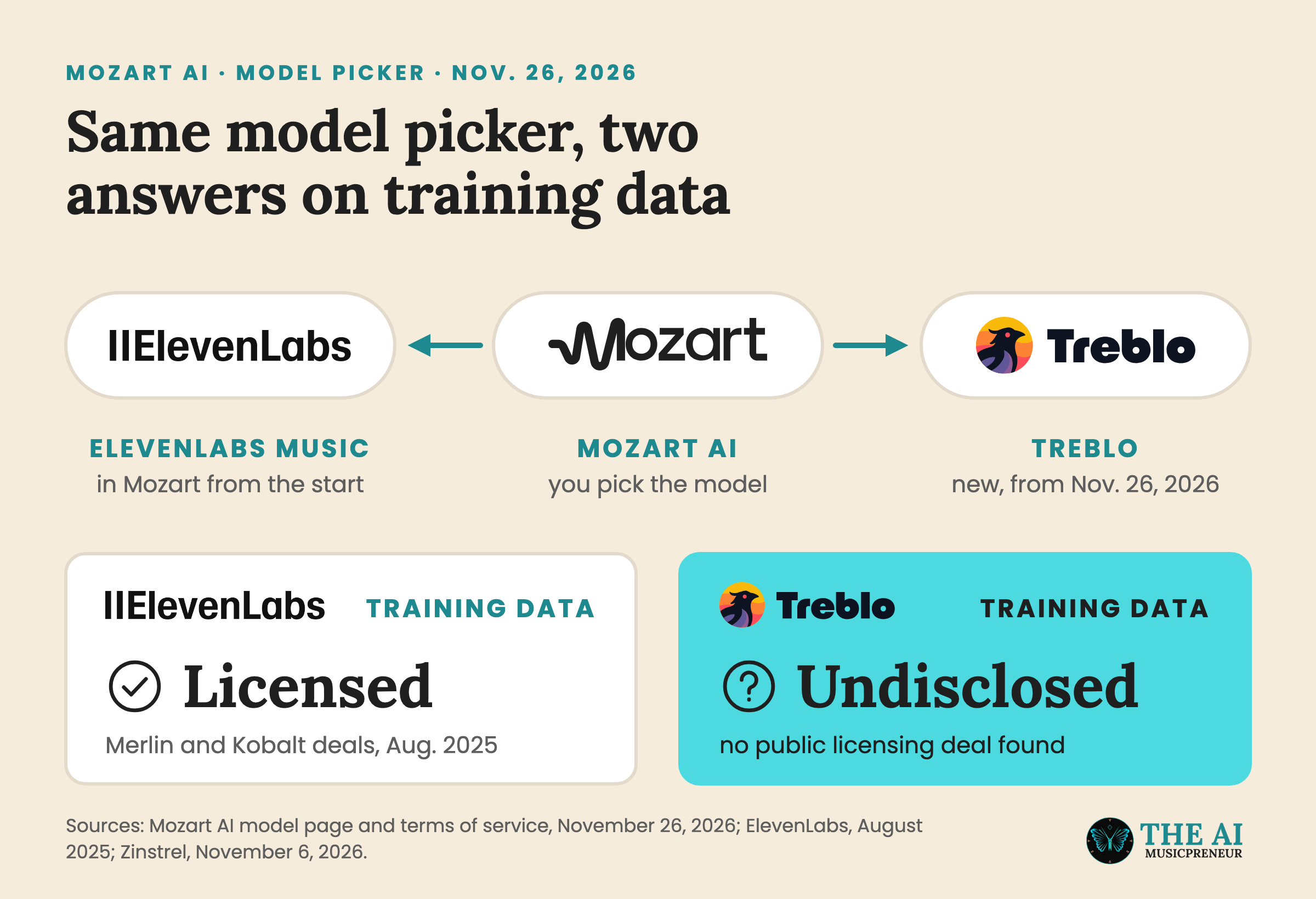
On Mozart, you choose the model for each song in a picker next to the prompt, and Hans 2.0 is the default for text to song. Treblo joins that list next to Hans and ElevenLabs.
How Mozart AI described its models’ training data before Treblo
Licensed training data has been part of Mozart’s pitch. When it raised $6 million in a seed round led by Balderton Capital, Tech.eu reported that “Mozart AI is built on commercially cleared third-party generative models, and the company notes that its model providers are trained on licensed material, allowing music created on the platform to be used for commercial purposes.”
ElevenLabs is where that claim is easiest to check. ElevenLabs calls itself “a core partner since Mozart AI’s inception” in a January 2026 case study, and Eleven Music launched in August 2025 with licensing deals with Merlin and Kobalt. On Mozart, ElevenLabs runs Layers, Studio, Personas and section edits by default.
What is known about Treblo’s training data
Treblo started as Sonauto in August 2023, went through Y Combinator, and renamed itself Treblo on June 3, 2026, according to a November 6 Zinstrel investigation by Marcus Lawrence. Songs are free and unlimited, and Treblo launched a paid Pro tier on November 4 at $9.99 a month. Reviewers like its section editing, and Kompozy called it “the most generous free AI music generator on the market,” per Zinstrel.
Zinstrel asked co-founder Ryan Tremblay in January what the model was trained on. His answer: “Probably the same songs everyone else is.” Zinstrel found no publicly announced music-training licensing deal involving Treblo.
In March 2025, Tremblay argued that training on all available music was “no more theft than Taylor Swift listening to the radio growing up.”
Unfortunately for the time being I think we benefit most from a certain strategic ambiguity.
Zinstrel also tested famous voices. On September 29, a prompt for “a Taylor Swift Midnights-era song” on Treblo’s default settings returned a convincing sound-alike, and a test on November 5 got the same result.
Suno blocks prompts that name artists. Treblo’s own terms, updated November 3, bar users from uploading someone else’s voice without consent and from using an artist’s name to promote a song without that artist’s consent.
Rasha Rahman, founder of the detection firm HumanStandard, told Zinstrel that “it’s clear they’ve trained on individual artist styles,” and that “there are real concerns, because no consent was given for these artists to be trained on that way.” Zinstrel found no lawsuit, cease-and-desist letter or public label statement aimed at Treblo so far. Entertainment lawyer John Strohm of Meitus Strohm doesn’t expect that to last: “I assume they’ll get sued.”
Treblo and Fenix Flexin’s ‘Rubberz’
“Rubberz” came out on June 5 and reached number 58 on the Billboard Hot 100. Zinstrel raised the AI question first: on June 26 it asked whether “Rubberz” was the world’s first mainstream AI music hit, and reported that HumanStandard had retrained its detector on Treblo tracks and then classified the song as fully AI-generated. Producer Medasin followed on July 30 with a viral breakdown that also pointed to Treblo.
Treblo then released its own detector, which rated the song “very likely Treblo.” Stereogum wrote on August 4 that Treblo appeared to confirm “Rubberz” as the first AI-generated Hot 100 hit.
Fenix Flexin denied using AI for weeks. Then he wrote “Never said I didn’t use AI,” adding that it “had nun to do w recording process,” Rolling Stone reported. Rolling Stone also noted that nobody has independently verified Treblo’s detector.
The full story, from the first accusations to the admission, is on Fenix Flexin’s artist profile.
What Mozart AI’s terms say about Treblo songs and claims
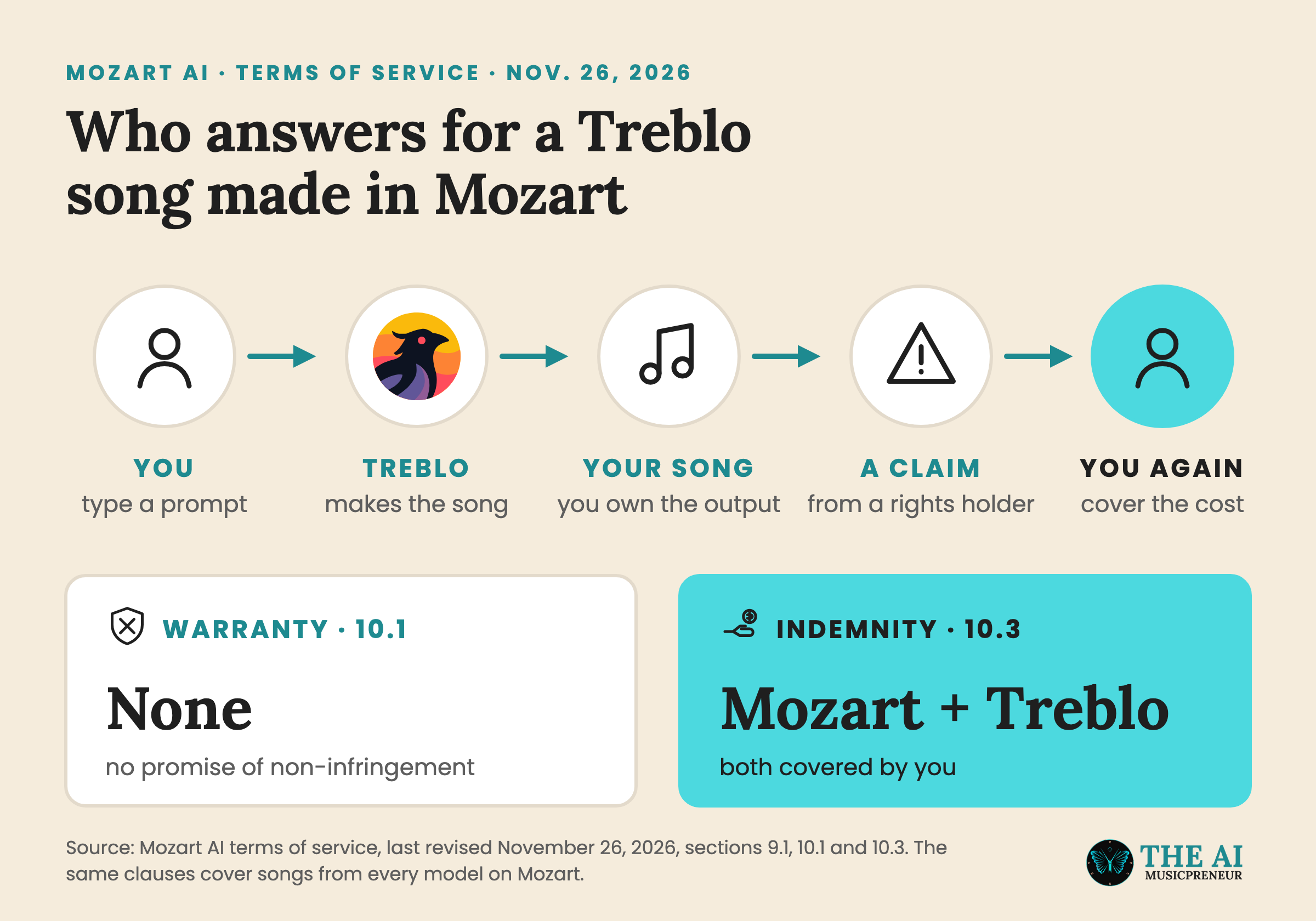
Section 9.1 also brings Treblo into Mozart’s liability rules: “For Output generated using Treblo’s software, and for the purposes of Section 10 only, Treblo is a Company Entity and an intended third-party beneficiary of that Section.” Section 10 is the liability section, and it does 2 things:
- No warranty (10.1): outputs come on an “AS IS” basis, and the Company Entities take no responsibility for “the infringement of the rights of any third party in your use of any Output.”
- Indemnity (10.3): you agree to “defend, indemnify and hold the Company Entities harmless” against claims arising from “your violation of any rights of any third party, including through your generation or use of any Output.”
So for a Treblo song, the protection Mozart’s terms give Mozart now covers Treblo too, and the user carries the claim. To be fair to Mozart, these clauses cover every song on the platform, whichever model made it.
Section 5.2(n) also bans any output that “replicates any real-world likeness, person, brand or location” unless you hold the rights, and Section 6.1 gives commercial use to songs made on the Creator, Pro or Premium plans with no separate rule for Treblo.
What Mozart AI users can check before releasing a Treblo song
- Check the model: the picker shows which model makes each song. ElevenLabs Music is the option on Mozart with named licensing deals behind it.
- Keep artist names out of prompts: Mozart’s terms ban outputs that replicate a real person, and Treblo’s terms bar using an artist’s name to promote a song without consent.
- Expect detection: Vobile’s AI song detector, hosted by Pex, added Treblo’s newest model in August, and HumanStandard says platforms, distributors, publishers and labels now notice “when Treblo comes into the stack,” per Zinstrel.
- Write down the model: keep a note of which model made each song you release, so you can answer a distributor or a claim quickly.
Mozart has my 4 questions. When the team answers, I’ll add the statement to this article.
Frequently asked questions
When does Treblo go live on Mozart AI?
Mozart's Black Friday email on November 25, 2026 said Treblo goes live the next day, November 26. On the morning of November 26, Mozart's public models page still listed Hans 2.0, Hans 1.0 and ElevenLabs, but its terms of service, revised that day, already named Treblo.
What has Treblo said about the music its model was trained on?
Co-founder Ryan Tremblay told Zinstrel the model learned from 'probably the same songs everyone else is.' He later declined further questions, saying Treblo benefits from 'a certain strategic ambiguity.' Zinstrel found no publicly announced music-training licensing deal involving Treblo.
Who is responsible if a Treblo song made on Mozart AI gets a copyright claim?
Under Mozart's terms of service, the user. Section 10.3 makes users defend and indemnify the 'Company Entities' against claims over what they generate, and Section 9.1 adds Treblo to that group for Treblo output. Section 10.1 gives no warranty that any output is free of infringement.
Do Mozart AI's terms allow songs that imitate a real artist?
Not without permission. Section 5.2(n) of Mozart's terms bars generating or using any output that 'replicates any real-world likeness, person, brand or location' unless you have obtained the necessary rights and clearances. This applies to every model on Mozart, Treblo included.
About the author
Covering AI music tools, industry shifts, and news for music creators and professionals. Twice-weekly newsletter at aimusicpreneur.com.