




HumanStandard
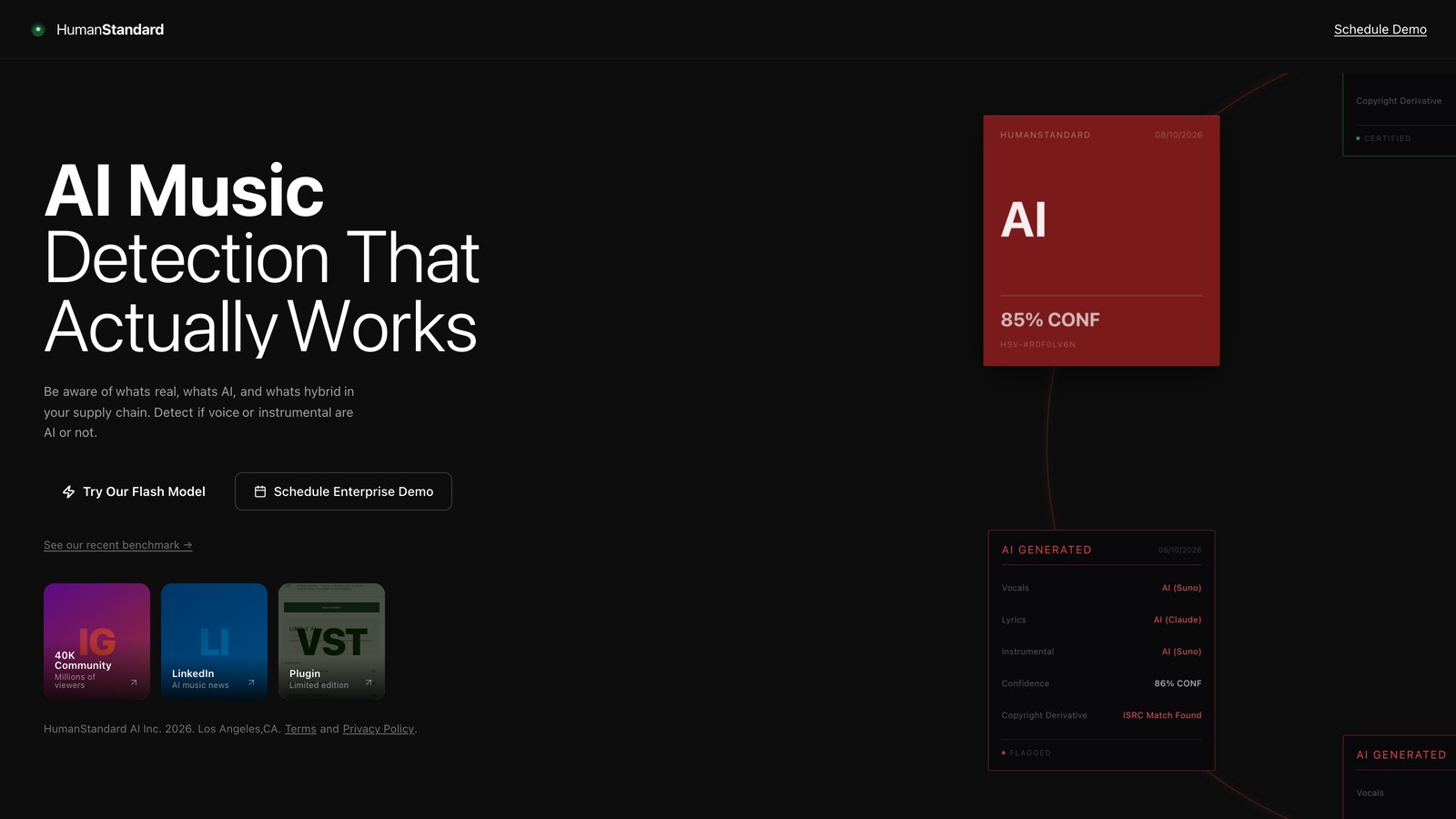
HumanStandard scores vocals, lyrics and instrumental separately, returns an AI, human or hybrid verdict, and flags copyright derivatives by ISRC match.
What is HumanStandard and how does it work?
HumanStandard is an AI music detection platform built by musician and software engineer Rasha Rahman, incorporated as HumanStandard AI Inc. in Los Angeles. It analyses a finished recording and returns one of three verdicts rather than two: AI, human, or hybrid.
That third category is the reason it sits apart from most of the AI music detection tools in this directory. Its own framing is direct: know “whats real, whats AI, and whats hybrid in your supply chain”, and detect whether the voice or the instrumental are AI independently of each other.
How it works:
- Submit a track through the self-serve Flash model or an enterprise integration
- The system analyses the recording as separate components rather than one file
- It returns a per-component verdict covering vocals, lyrics, and instrumental
- A confidence percentage accompanies the verdict
- A separate check reports whether the track matches an existing copyright as a derivative, identified by ISRC
The platform is aimed at two groups at once: platforms screening volume who need uncertain cases routed to human review, and creators who want to evidence provenance for their own work.
How much does HumanStandard cost?
HumanStandard does not publish pricing for either access route.
| Plan | Price | What you get |
|---|---|---|
| Flash model | Not published | Self-serve detection, positioned as the entry point |
| Enterprise | Not published, demo required | Catalogue-scale screening and integration |
Pricing changes frequently, and in this case is not public at all. Verify current terms directly at HumanStandard. Two access routes existing at all is worth noting: most catalogue-grade detectors in this category are enterprise-only with no route for an individual artist.
What does a HumanStandard detection card actually show?
It shows a component breakdown, not a single score. A flagged result on the company’s own site reports the vocals, the lyrics, and the instrumental as separate lines, each with its own attribution, alongside an overall confidence figure and a copyright derivative check.
- Vocals, lyrics and instrumental are scored separately, so a track can return AI on one component and human on another
- Attribution names a suspected source where one is identified, rather than reporting only that the track is generated
- A confidence percentage sits alongside the verdict rather than replacing it
- A copyright derivative field reports an ISRC match when the track appears derived from an existing recording
- Uncertain cases route to human review rather than resolving to a forced yes or no
That last point connects to Rahman’s stated position on derivatives. Writing about an unauthorised AI remix of Stick Figure’s “Angel Above Me” that reached number 1 on iTunes in several countries, he argued that because a fully AI-generated track cannot hold copyright, revenue from an AI derivative of a copyrighted song should go to the original rights holder. Conventional fingerprinting matches identical audio, so a derivative in a new style passes through it.
What HumanStandard does not tell you
Detection reads the finished file. That sets a hard boundary on what any verdict here can mean, and it applies to HumanStandard the same as everything else in the category.
- It does not know how long a track took to make, or who made which decision
- It cannot distinguish your own voice from a clone of your own voice on your own lyrics
- Coverage depends on training samples per generator, so a new model is invisible until the detector has learned it
- The company reports roughly 90% accuracy on Treblo output after 1,000 training samples, against 10,000 samples needed for comparable Suno detection
The clearest illustration is HumanStandard’s own record. It initially cleared Fenix Flexin’s charting single “Rubberz” as human-made, then reversed after a tip pointed Rahman toward Treblo, the platform formerly called Sonauto. My coverage of the Treblo detector confirmation sets out that sequence. A public reversal is unusual for a detection vendor, and it is the most concrete evidence available that per-generator coverage is the variable that matters.
What are some use cases for HumanStandard?
- Screening a catalogue before distribution: platforms and distributors checking volume with uncertain cases sent to human review rather than auto-rejected.
- Checking a collaborator’s stems: separate vocal and instrumental verdicts tell you which part of a delivered track is in question.
- Evidencing your own provenance: creators who want a record supporting that their work is human-made.
- Tracing an unauthorised derivative: the ISRC match check targets AI remixes of an existing recording, the case that defeats conventional fingerprinting.
- Reporting on a disputed release: the detector behind the Tyga $TARFACE allegations, where producer Medasin ran a single through it and published the result.
- Preparing for disclosure obligations: a component-level record is closer to what EU AI Act transparency rules ask for than a single binary flag.
For anyone dealing with part-AI tracks rather than fully generated ones, the three-way output is the distinguishing capability.
Is HumanStandard free to use?
The company offers a self-serve Flash model and a scheduled enterprise demo, but publishes no pricing for either. Contact them directly for current terms.
Can HumanStandard detect a track that is only partly AI?
That is its stated purpose. It reports vocals, lyrics, and instrumental separately, and treats hybrid as a distinct verdict rather than forcing a track into AI or human.
Who built HumanStandard?
Rasha Rahman, a software engineer and longtime musician, founded the company. It is incorporated as HumanStandard AI Inc. in Los Angeles.
Can HumanStandard tell which AI platform made a track?
It attributes a suspected source where it has learned that generator. Coverage is per-model and built from training samples, so accuracy varies by platform and a newly released generator is not covered until the detector is trained on it.
Does HumanStandard detect AI remixes of existing songs?
It includes a copyright derivative check that reports an ISRC match. This targets tracks derived from an existing recording, which conventional audio fingerprinting misses when the derivative lands in a different style.