Google lets you switch off the visible AI watermark on Gemini songs, and SynthID stays regardless
My stack My fav 6 tools for AI music after testing 70+
-
 ElevenMusic · Music generation
 -
 Moises · Stem separation
 -
 Controlla · Voice swap & cloning
 -
 Cryo Mix · Mixing + mastering
 -
 Neural Frames · Music videos
 -
 ONCE · Distribution
Some links are affiliate links — I earn a commission at no cost to you. Every tool here is one I run myself and truly believe in. This stack is proven.
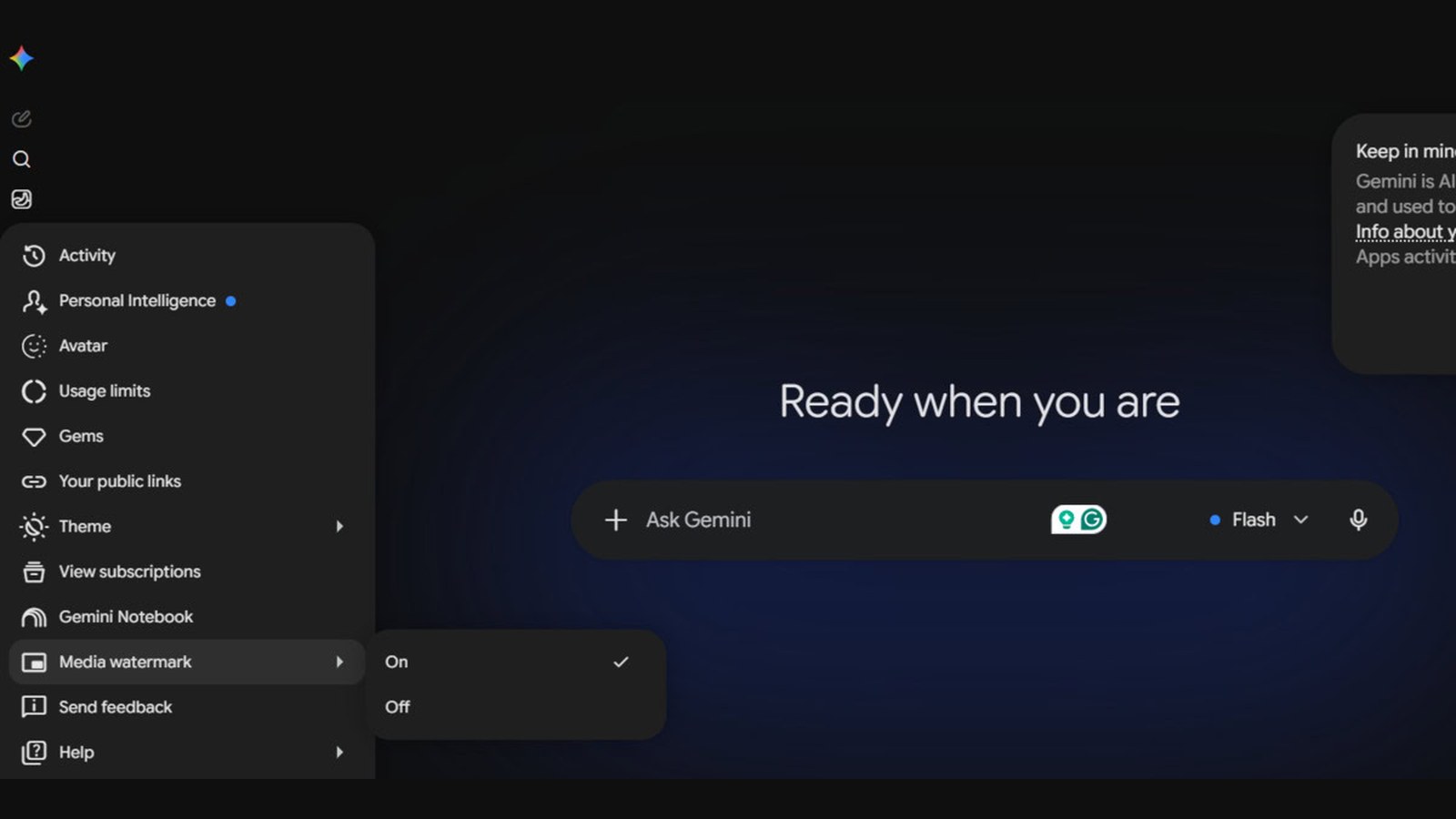
Google made the visible AI watermark optional on everything Gemini generates, songs included. The Media Watermark setting landed on August 14, 2026, and TechCrunch reported it covers the Nano Banana, Omni and Lyria models. Lyria is the one that writes music, so a track made in the Gemini app can now leave without a mark anyone can see.
The invisible layer does not move. Google says SynthID and C2PA metadata stay embedded either way, and SynthID survives screenshots, crops and format conversions.
What Gemini’s Media Watermark toggle changes for AI songs
The setting sits in Gemini’s Settings menu in the left bar, near the bottom, with two states: On and Off. Android Authority found it as the third-to-last item in the menu. It also works in Flow, Google’s video editor, and Google says Search support is coming.
Josh Woodward, the Google VP running Gemini, AI Studio and Google Labs, had asked users for their biggest complaints about the product. Stripping the visible watermark came back in the top 10. So this shipped as a feature request, not as a policy shift.
We're striking a balance here between creative control and safety: while the visible watermarks are now optional, invisible SynthID watermarks and C2PA metadata are still being used for transparency.
Google is also open-sourcing a library called Credentio for working with content credentials, which lines up with the C2PA half of the claim.
Why platforms labelling AI music now depend on a mark you cannot see
Follow the timing. EU AI Act transparency rules took effect this month and put the marking duty on the companies building the models. Suno added audio watermarking to its own output in early August. Anthropic started marking Claude text on August 13. Google made its human-readable mark optional the next day.
Nothing here is a violation. The EU duty leans on machine-readable marking, and SynthID is exactly that. What changes is who can perform the check. A DJ, an A&R, or a playlist curator could read a visible watermark in a second. Reading SynthID takes a query to Gemini or Google Search, which means the verification step now belongs to whoever bothers to run it.
That lands awkwardly on the platforms writing AI policy right now. Spotify’s AI Persona badge depends on artists self-declaring, and Beatport withholds AI uploads at ingestion using Beatdapp detection. Neither reads a visible sparkle. Both are built for a world where the label travels invisibly or not at all.
For your own releases the practical answer has not changed. Your distributor’s upload form still has a disclosure field, and that field, not Google’s toggle, is what platforms read when they decide how to treat your track.
Frequently asked questions
What is the Media Watermark setting in the Gemini app?
It is a setting Google added on August 14, 2026 that controls whether Gemini stamps a visible AI watermark on what you generate. It sits in Gemini's Settings menu in the left bar, near the bottom, with two options, On and Off. Turning it off removes the visible mark from images, video and music.
Does turning off Gemini's Media Watermark remove SynthID from AI songs?
No. Google says the invisible SynthID watermark and C2PA metadata stay embedded either way. SynthID survives screenshots, crops and format conversions, and anyone can run a file through Gemini or Google Search to check whether it was AI-generated.
Which Gemini models does the Media Watermark toggle cover?
Google's VP for Gemini, Josh Woodward, said the toggle applies to Nano Banana, Omni and Lyria. Lyria is the music model, so the setting governs the visible mark on songs generated in the Gemini app as well as images and video.
Where does Gemini's Media Watermark setting work besides the Gemini app?
The setting is available in Gemini and in Flow, Google's video editor, with support in Search described as coming soon. Google said the change would roll out over the following few days rather than switching on for everyone at once.
Why did Google make Gemini's visible watermark optional?
Josh Woodward asked Gemini users for their biggest complaints, and removing the visible watermark ranked in the top 10 requests. Google frames the change as balancing creative control against safety, since visible marks make output harder to use in professional work.
About the author

Covering AI music tools, industry shifts, and news for music creators and professionals. Twice-weekly newsletter at aimusicpreneur.com.