Universal and Sony's amended Suno complaint puts stream ripping at the center of the case
My stack My fav 6 tools for AI music after testing 70+
-
 ElevenMusic · Music generation
 -
 Moises · Stem separation
 -
 Controlla · Voice swap & cloning
 -
 Cryo Mix · Mixing + mastering
 -
 Neural Frames · Music videos
 -
 ONCE · Distribution
Some links are affiliate links — I earn a commission at no cost to you. Every tool here is one I run myself and truly believe in. This stack is proven.
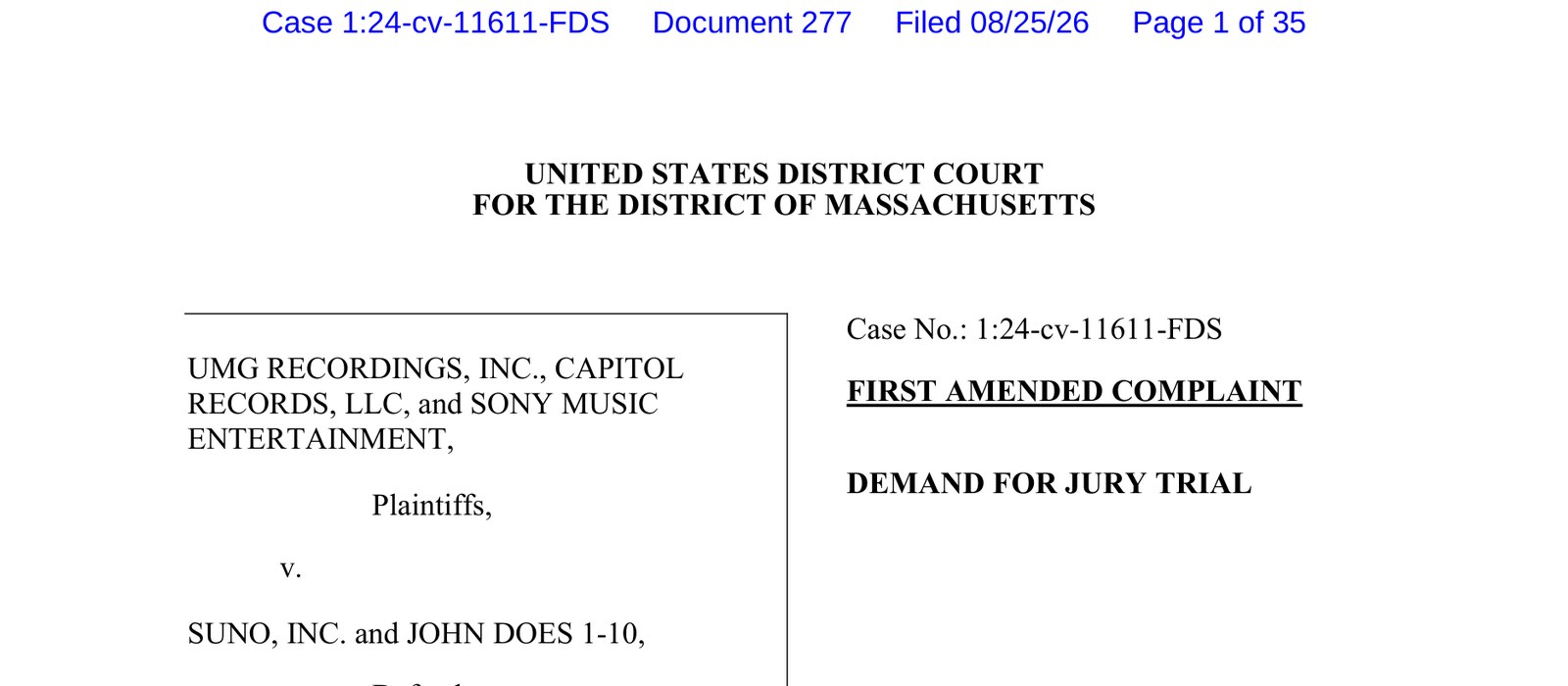
Universal Music Group, Capitol Records and Sony Music filed their First Amended Complaint against Suno on August 25, 2026. It runs 35 pages, it carries the case number 1:24-cv-11611-FDS in Boston federal court, and it does one big new thing: it accuses Suno of ripping the training audio off YouTube.
This is the filing that follows Judge Saylor’s two August 18 orders. One let the labels bring the stream-ripping claim. The other refused to grow the case from 560 recordings to 61,026.
What the amended Suno complaint says about YouTube
The complaint’s core allegation sits in paragraph 7. Suno “obtained those copies in the first instance by unlawfully ‘stream ripping’ them from the popular streaming platform YouTube, and circumventing the technological measures designed specifically to prevent such unauthorized copying.”
Stream ripping is downloading a permanent audio file from a service that only meant to stream it to you. YouTube tries to stop this with what the filing calls a rolling cipher: the page URL you can see, and a hidden file URL scrambled with an algorithm that keeps changing.
Paragraph 49 names the tools. YT-DL and YT-DLP, two open-source command-line downloaders, which the labels say Suno used “to circumvent YouTube’s encryption and scrape copyrighted recordings from YouTube.” The footnote for that sentence cites Suno’s own supplemental answers to the labels’ interrogatories.
That footnote is the part I’d watch. According to Saylor’s order, Suno told the labels back in May 2025 that it had downloaded audio files from YouTube, and that it used open-source tools including YT-DL and YT-DLP to do it.
Why Section 1201 is a smaller question than fair use
Fair use asks whether copying millions of recordings to train a model was lawful. Section 1201 of the Digital Millennium Copyright Act asks something narrower and earlier: was a technological lock bypassed to get at the work in the first place.
That gap is where the Anthropic settlement lives. A judge accepted that training on books was fair use, but only for books the company had bought. Anthropic had used millions of pirated ebooks instead, and it paid authors $1.5 billion to settle.
So Universal and Sony have a reason to spend 35 pages on how the files arrived. Even a fair-use win on training doesn’t clean up a source that was taken through a broken lock.
Plaintiffs are not presently alleging that these outputs themselves infringe the Copyrighted Recordings unless discovery reveals that they directly or indirectly recapture portions of the Copyrighted Recordings.
The labels are holding back the output-infringement claim
Paragraph 53 is worth reading twice. The labels say the songs Suno generates mimic identifiable features of their recordings, then say they are not presently alleging those outputs infringe.
The outputs serve as evidence here. Paragraph 54 explains the method: certain prompt patterns can make Suno produce files that reveal which recordings went into the training data.
The door stays open. If discovery shows outputs recapture parts of the recordings, the labels can come back for that.
What Universal and Sony are asking Suno to pay
Two separate damages requests sit in the prayer for relief.
- Up to $150,000 per work infringed under 17 U.S.C. 504(c), across the 560 recordings listed in Exhibit A. That caps out around $84 million.
- Statutory damages under 17 U.S.C. 1203(c)(3)(A) for willful circumvention, which the statute sets between $200 and $2,500 for each act.
Nobody has said how many acts of circumvention there were. If the number tracks the number of files pulled off YouTube, the second request could dwarf the first, and that is probably the point of adding it.
A detail in the filing that dates it
Paragraph 32 of the complaint describes Suno’s pricing with odd care. Free users get 50 credits a day, enough for 10 music files, and can’t use them commercially. Pro costs $8 a month for 2,500 credits a day, or 500 files. Premier costs $24 a month for 10,000 credits a day, or 2,000 files.
The filing also describes Suno as having raised $125 million at roughly a $500 million valuation. That was true once. Suno raised more than $400 million in June 2026 at a $5.4 billion post-money valuation, so parts of this complaint are describing a company about ten times smaller than the one being sued.
What happens next in UMG Recordings v. Suno
Fact discovery closes September 30, 2026. Both sides are expected to move for summary judgment on fair use after that, which Saylor has already said will likely resolve the main question in the case.
Two days after granting leave here, Saylor used the same reasoning to keep an equivalent stream-ripping claim alive in country artist Tony Justice’s proposed class action against Suno. One ruling, two live cases.
The thing still unsettled is the lock itself. Saylor wrote that deciding whether Suno circumvented a measure that effectively controls access “will require a developed factual record on how the technological measure and circumvention tools work.” Whether YouTube’s rolling cipher controls access to a recording or only controls copying it is a question nobody has answered yet, and the whole circumvention count rides on it.
For the full case history, including Warner’s November 2025 settlement and the $9 billion expansion attempt, see my RIAA v. Suno case tracker. Suno also lost a separate ruling in Germany this year, where GEMA won its Munich case. The amended complaint itself is public on CourtListener, and Music Business Worldwide reported the filing first.
Frequently asked questions
What does Universal and Sony's First Amended Complaint against Suno add to the case?
The August 25, 2026 filing adds a Digital Millennium Copyright Act anti-circumvention count over how Suno obtained its training audio. It alleges Suno pulled recordings off YouTube by bypassing the platform's encryption. The list of named recordings stays at the original 560 in Exhibit A.
Are Universal and Sony still claiming Suno's generated songs infringe their recordings?
Not right now. Paragraph 53 of the amended complaint says the labels are not presently alleging the outputs themselves infringe, unless discovery reveals they directly or indirectly recapture portions of the copyrighted recordings. The labels use the output similarities as evidence that Suno copied the recordings into training data.
How much can Suno be ordered to pay for each act of circumvention?
The amended complaint asks for statutory damages under 17 U.S.C. 1203(c)(3)(A), which runs from $200 to $2,500 for each act of circumvention. That sits on top of the copyright claim, where the labels seek up to $150,000 per work across the 560 recordings named in the case.
Why does the amended Suno complaint describe Suno as a $500 million company?
The filing repeats funding figures from an earlier round, describing a $125 million raise at roughly a $500 million valuation. Suno raised more than $400 million in June 2026 at a $5.4 billion post-money valuation, so the complaint's numbers are already out of date.
About the author

Covering AI music tools, industry shifts, and news for music creators and professionals. Twice-weekly newsletter at aimusicpreneur.com.