2 in 3 AI tracks are made in the United States, but the UK is growing faster than any other market
My stack My fav 6 tools for AI music after testing 70+
-
 ElevenMusic · Music generation
 -
 Moises · Stem separation
 -
 Controlla · Voice swap & cloning
 -
 Cryo Mix · Mixing + mastering
 -
 Neural Frames · Music videos
 -
 ONCE · Distribution
Some links are affiliate links — I earn a commission at no cost to you. Every tool here is one I run myself and truly believe in. This stack is proven.
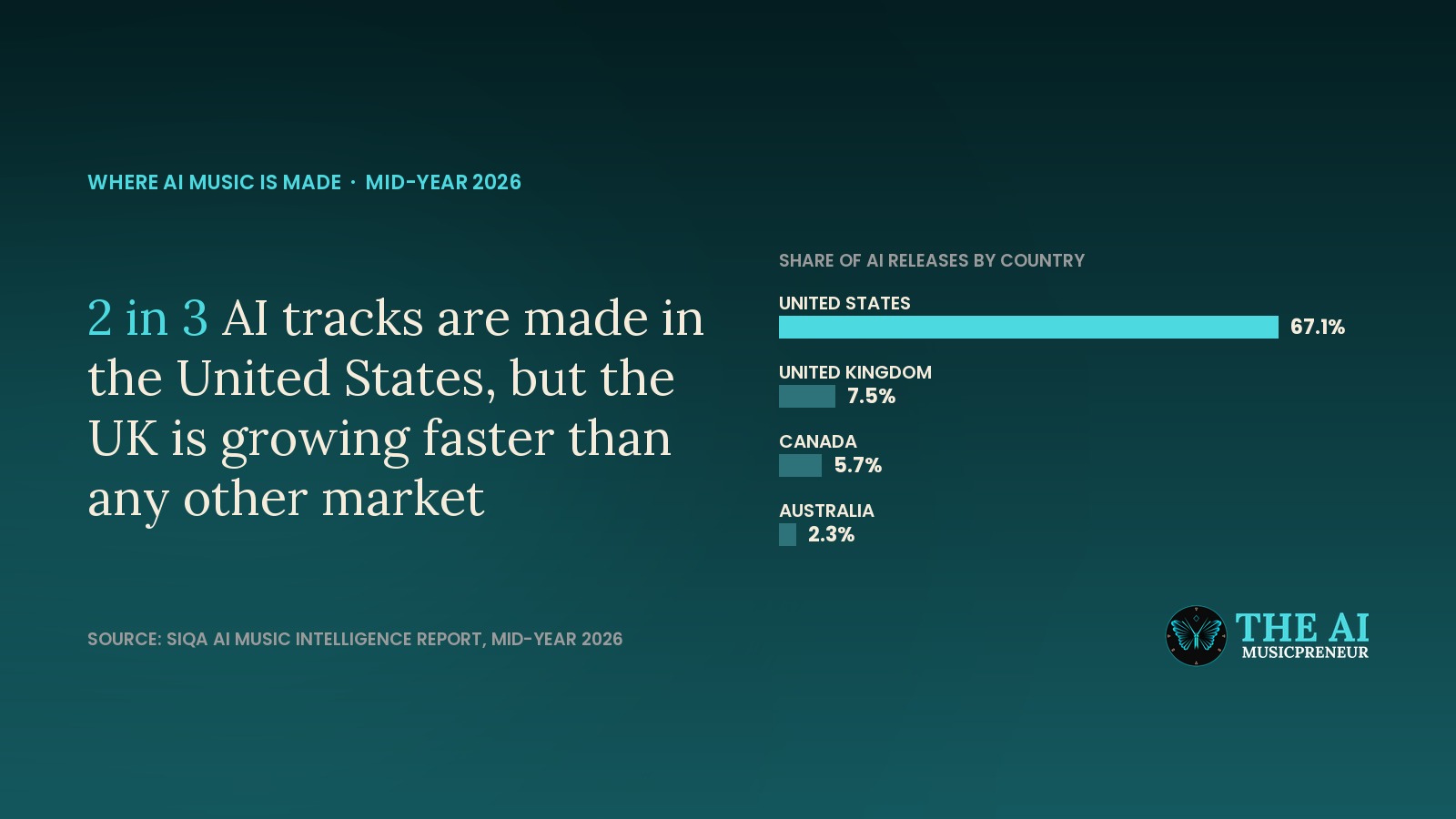
The United States made 67.1% of the AI music that reached streaming services between April and August 2026. The rest came from 53 other countries. Those figures come from the Sonic Intelligence Academy’s Mid-Year 2026 report, covering 1,743 verified releases from 886 artists.
AI music is an American product with an accelerating export market. The US share is shrinking, slowly, while several smaller markets grow.
The United Kingdom is now a clear second at 7.5%
The UK climbed from 5.4% of releases in Q1 to 7.5% at mid-year, the largest international gain in the dataset. Canada sits third at 5.7%.
The rest of the movement is worth reading in order:
- Australia entered the top 5 for the first time at 2.3%, replacing Nepal
- South Africa and Germany hold 1.3% each
- Nigeria doubled from 0.5% to 1.1%, the fastest-growing African market
- Spain appeared in the top 10 at 0.9%, and the Netherlands holds 0.8%
- The remaining 45 countries share 12% between them
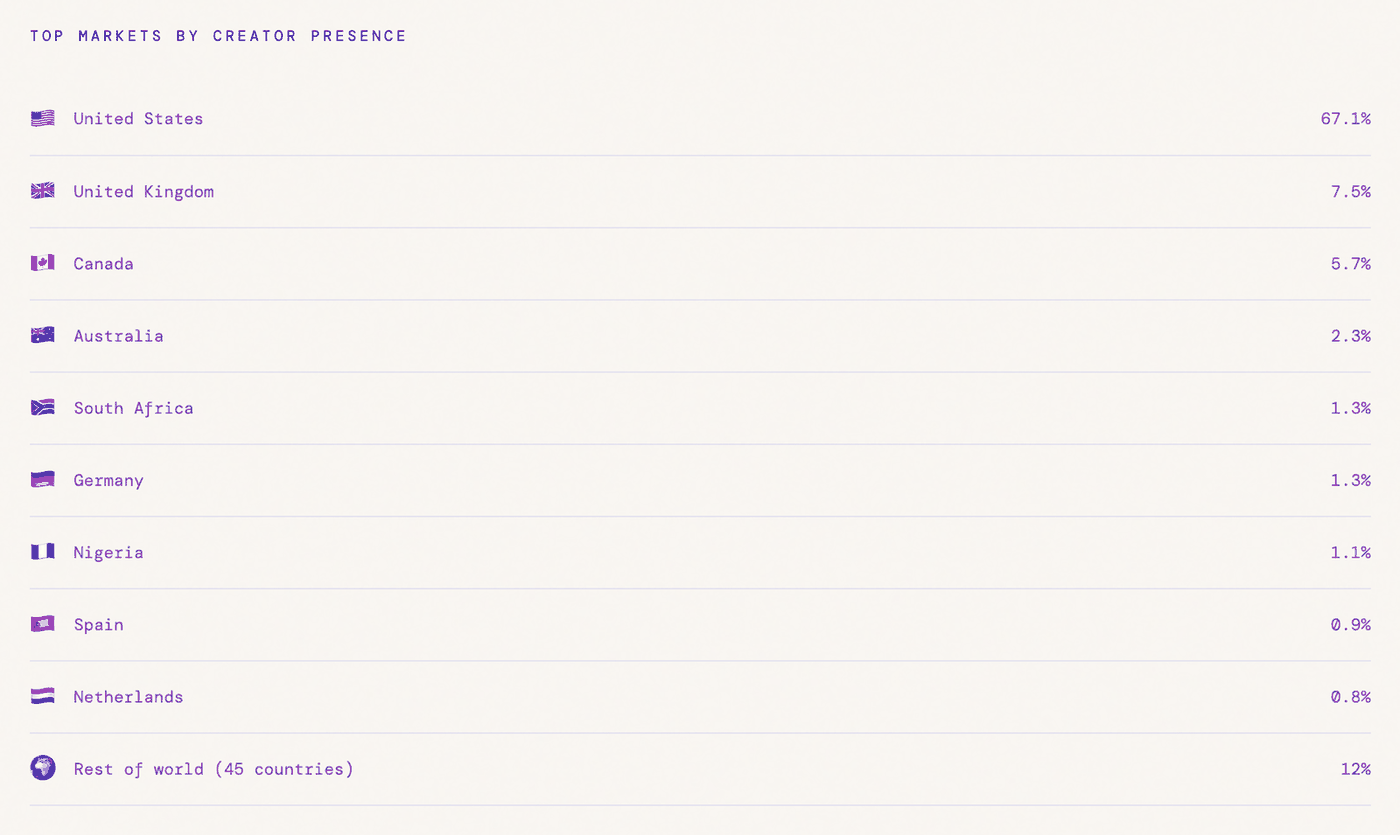
The total country count fell from 57 to 54, which SIQA does not explain. A smaller country count alongside stronger growth in the leading international markets suggests consolidation rather than retreat.
Why one market making 2 in 3 releases matters for everyone else
American policy, American distributors and American platform rules currently set the terms for a category where two thirds of the supply is American.
That has been a convenient simplification for anyone drafting AI rules. It is getting less true each reporting period, and the next 12 months of AI music regulation will be written in more than one jurisdiction at once.
For a UK label signing an AI-assisted act, or a Nigerian distributor building AI policy, the practical problem is that the rules arriving from Washington, Brussels and London do not agree with each other, and the supply chain runs through American tools either way.
Germany fell by more than half while the GEMA case ran
The line SIQA does not touch is Germany. It went from 3.2% of releases in Q1 to 1.3% at mid-year, a fall of more than half.
Those are the same months GEMA’s copyright case against Suno moved through the Munich court, which ruled in GEMA’s favour on July 31.
I want to be careful here. The German sample is small, SIQA draws no connection, and a correlation across 2 reporting periods is not a cause. I have asked SIQA for the underlying submission counts. What I can say is that if a legal climate does change creator behaviour, it shows up in release data before it shows up in law, and this is where I would look for it.
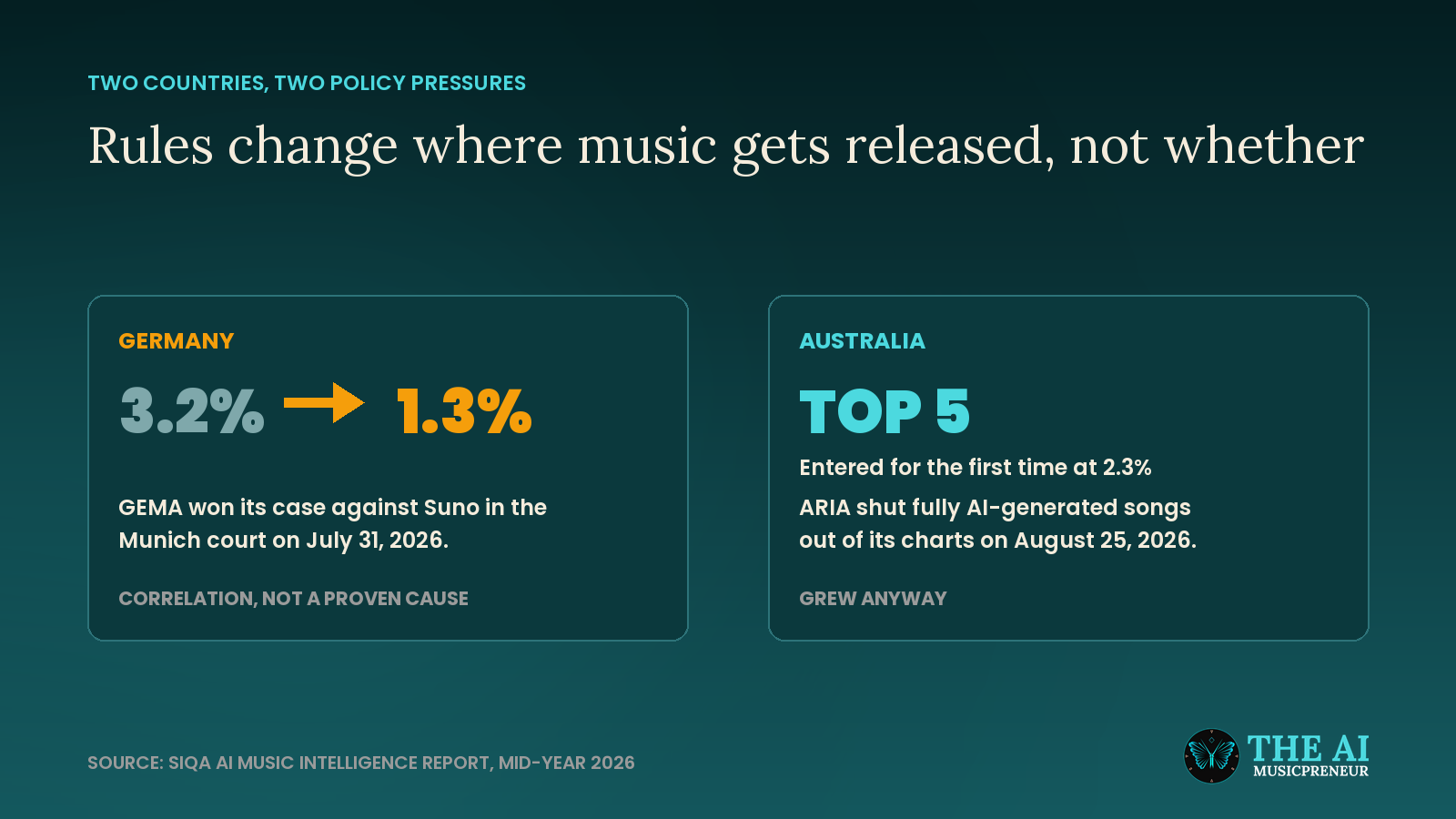
Australia points the other way and is worth the comparison. Its share grew to 2.3% across the same months ARIA was publicly warning it would shut fully AI-generated songs out of the official charts, which it did on August 25. A chart ban appears to move creators toward a chart that will have them, rather than stopping them releasing.
Two countries, two policy pressures, two opposite movements. That is the most useful thing in this table for anyone setting AI policy: the rules you write change where music gets released, not whether it does.
Frequently asked questions
How much AI music comes from the United States in 2026?
The United States accounted for 67.1% of the 1,743 verified AI releases in SIQA's Mid-Year 2026 report, covering April 1 to August 20, 2026. That is down slightly from 68.3% in the Q1 report. The remaining 32.9% came from 53 other countries across 6 continents.
Which country grew fastest in AI music during mid-year 2026?
The United Kingdom recorded the largest international gain, climbing from 5.4% of releases in Q1 to 7.5% at mid-year, which puts it clearly second behind the United States. Nigeria doubled its share from 0.5% to 1.1%, the fastest-growing African market. Australia entered the top 5 for the first time at 2.3%, replacing Nepal.
How many countries release AI music according to SIQA's mid-year data?
54 countries appear in the mid-year dataset, down from 57 in Q1 2026. After the United States at 67.1%, the ranking runs United Kingdom 7.5%, Canada 5.7%, Australia 2.3%, South Africa and Germany 1.3% each, Nigeria 1.1%, Spain 0.9% and Netherlands 0.8%. The remaining 45 countries share 12% between them.
Did AI music releases from Germany fall during 2026?
Germany fell from 3.2% of releases in Q1 2026 to 1.3% at mid-year. The decline happened over the same months GEMA's copyright case against Suno moved through the Munich court, which ruled in GEMA's favour on July 31, 2026. SIQA does not connect the two and the sample is small, so the timing is a correlation rather than an established cause.
About the author

Covering AI music tools, industry shifts, and news for music creators and professionals. Twice-weekly newsletter at aimusicpreneur.com.